

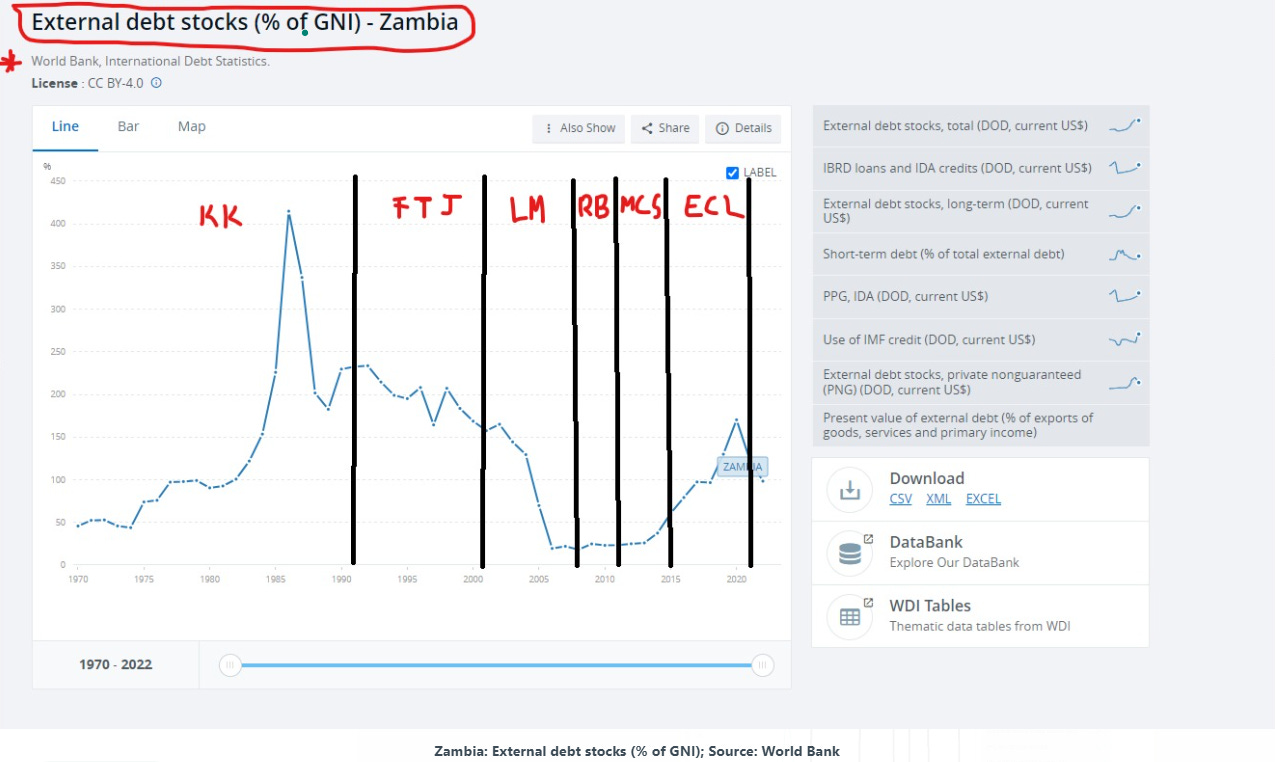
This chart traces Zambia’s external debt as a percentage of Gross National Income (GNI) from 1970 to 2022. The analysis explores how successive administrations contributed to Zambia’s escalating debt levels, culminating in the significant event of a default in 2020, focusing on the scale and timing of debt increases.
Critical Historical Periods and Economic Analysis:
1. Kenneth Kaunda (1964-1991): Debt levels rose sharply in the 1970s and 1980s due to flawed state-led economic policies, such as import substitution and nationalization, amidst falling copper prices. An unsustainable debt burden reached over 400% of GNI, driven by external borrowing to plug fiscal gaps.
2. Frederick Chiluba (1991-2001): Although structural adjustment programs (SAPs) helped reduce debt, the social costs of privatization and market liberalization left the economy vulnerable, with unemployment and inequality rising.
3. Levy Mwanawasa (2002-2008): Debt relief through the Heavily Indebted Poor Countries (HIPC) initiative brought substantial debt reductions, giving Zambia a fresh start and offering a glimmer of hope. However, challenges like reliance on copper exports persisted.
4. Rupiah Banda (2008-2011): The government kept debt levels stable while contracting new loans for infrastructure projects during Banda's tenure. The increase remained moderate compared to later administrations because Sata’s government executed most of the drawdowns. The chart reflects this stability, showing that debt only rose modestly during Banda’s term as most borrowing focused on preparatory measures.
5. Michael Sata (2011-2014): Sata’s government aggressively drew down on the loans contracted earlier and pursued new large-scale borrowing to fund infrastructure, leading to a visible and significant rise in debt. The debt increase under Sata was sharper than Banda’s, reflecting the combined impact of both previous contracts and new borrowing initiatives, with a focus on road and energy projects.
6. Edgar Lungu (2015-2021): Lungu’s administration saw the sharpest rise in debt, dwarfing the increases seen under both Sata and Banda. The scale of borrowing escalated dramatically, driven by fiscal mismanagement and reckless accumulation of unsustainable loans, resulting in Zambia’s debt default in 2020. The chart clearly shows the steep incline, underscoring the significant fiscal misconduct during this period and the urgent need for corrective action.
Dean N Onyambu is the Founder and Chief Editor of Canary Compass, a co-author of Unlocking African Prosperity, and the Executive Head of Trading at Opportunik Global Fund (OGF), a CIMA-licensed fund for Africans and diasporans (Opportunik). Passion and mentorship have fueled his 15-year journey in financial markets. He is a proud former VP of ACI Zambia FMA (@ACIZambiaFMA) and founder of mentorship programs that have shaped and continue to shape 63 financial pros and counting! When he is not knee-deep in charts, he is all about rugby. His motto is exceeding limits, abounding in opportunities, and achieving greatness. #ExceedAboundAchieve
The Canary Compass Channel is available on @CanaryCompassWhatsApp for economic and financial market updates on the go.
Canary Compass is also available on Facebook: @CanaryCompassFacebook.
For more insights from Dean, you can follow him on LinkedIn @DeanNOnyambu, X @InfinitelyDean, or Facebook @DeanNathanielOnyambu.