

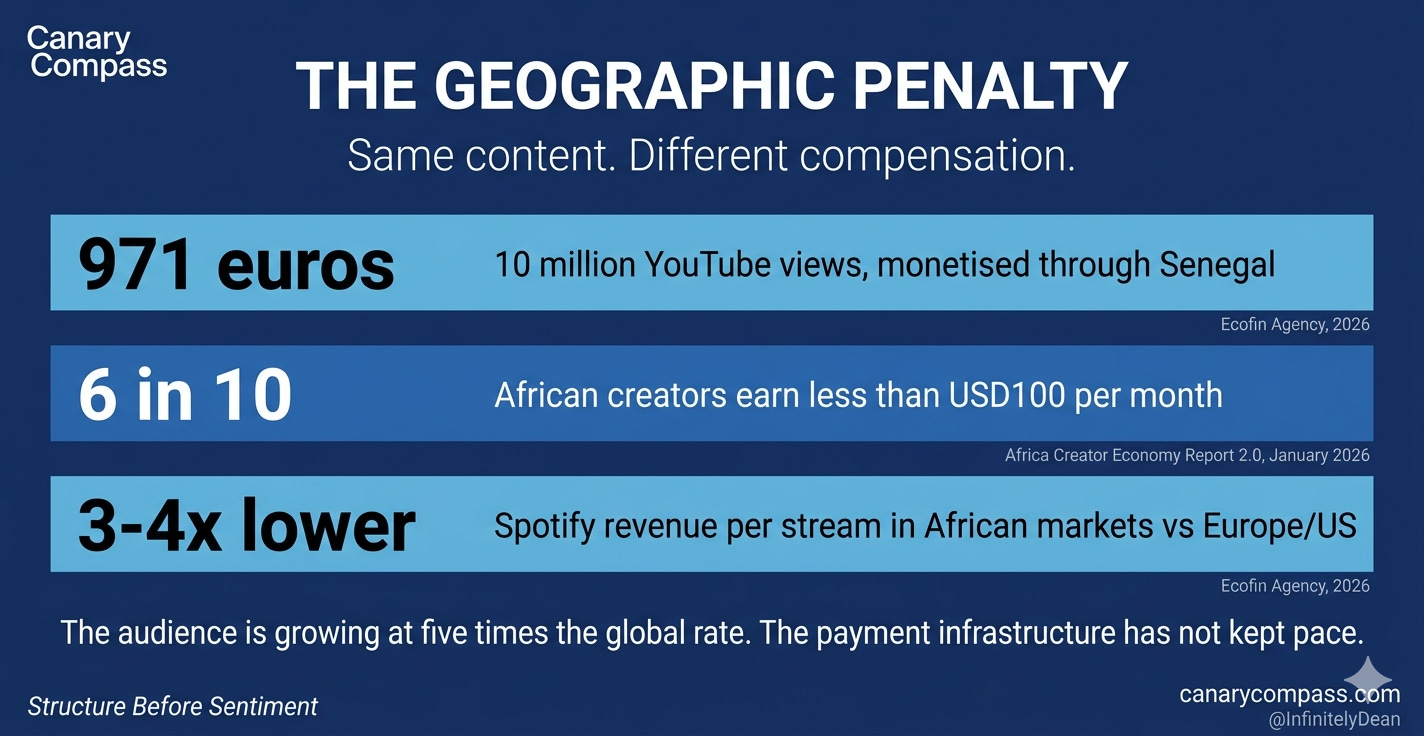
AI-generated image of the geographic penalty.
There is a product being sold to hundreds of millions of people every day, and most of them do not know they are buying it. It arrives on their phones disguised as information. It sounds like news. It carries enough verifiable fact to feel credible. But its purpose is not to inform. Its purpose is to hold attention long enough to monetise it.
The business model is straightforward. Take a real event. Thread a narrative through it that is partly true and partly constructed, selectively framed to maximise emotional response rather than to clarify. Deliver it with high production quality and emotional conviction. The consumer receives something that feels like analysis but functions like entertainment. The old version of this product was the Hollywood movie. It came with one or two trailers, a release date, and a screen you chose to sit in front of. The new version is the video podcast, cut into short-form clips and fed into every platform simultaneously. It is a daily trailer that never stops releasing, hitting the consumer from every angle, every scroll, every feed. The movie never pretended to be real. And it never followed you home.
The creators who command the most attention in this economy are not the most informed. They are the most watchable. Dysfunction turned into product, sold at scale, consumed as insight.
I have written before that discomfort is not violence, and that free speech requires harder ground than most societies are currently willing to maintain. That argument still holds. But it was incomplete. It addressed the listener’s fragility. It did not address the supplier’s incentive. When the business model of the content economy is optimised to blur the boundary between truth and narrative, the problem is no longer that people cannot tolerate hard speech. The problem is that they can no longer distinguish it from performance.
The Perception Distortion
The data tells a different story from the one most people carry in their heads. Across the major US podcast charts, fewer than twenty of the top-ranking programmes are built primarily on political controversy. On the right: Tucker Carlson, Candace Owens, Ben Shapiro, Patrick Bet-David, Megyn Kelly, Matt Walsh, Dan Bongino. On the left: Pod Save America, MeidasTouch, The Young Turks, Rachel Maddow, The Bulwark, Ezra Klein. That is roughly ten per cent of the most listened-to programmes. The categorisation is mine, and the boundary is not clean. Many of these programmes do substantive work alongside their partisan framing: policy analysis, long-form interviews, investigative reporting. The label “controversy-driven” does not mean every episode is noise. The phenomenon is not uniform, and it spans the political spectrum. A decade ago, the most commercially successful form of ideological rigidity in the content economy came from the cultural left: policing language, enforcing orthodoxies around identity and appropriation. Today, the most commercially dominant version comes from the right: institutional distrust, anti-establishment certainty, and alternative knowledge communities built around suspicion of official narratives. At their core, neither version rewards sustained engagement with counter-evidence, even when individual episodes do substantive work. Both monetise conviction. The mechanism is the same. The direction has rotated. The distinction I am drawing is about a business model, not an ideology: programmes whose commercial engine runs on partisan emotional activation, where the audience’s political convictions are the product being monetised. This is not to say that other genres avoid emotion. All media activates emotion. True crime manufactures suspense. News selects for resonance. The distinction is between content that uses emotion to illustrate reported events and content that uses emotion to advance political claims presented as factual analysis. The rest of the chart includes programmes that are sensational, trivial, or shallow. But they are not built to blur the line between fact and narrative for political effect.
What dominates the chart is comedy, true crime, news, storytelling, and long-form interview. Crime Junkie is audio-first. The Daily is audio-first. NPR is audio-first. The BBC is audio-first. Many of these shows now distribute clips or full episodes on YouTube, but their primary product is designed for audio consumption. These programmes chart consistently, attract loyal audiences, and generate revenue without manufacturing outrage. They are the quiet majority of a market that most people assume is dominated by provocation.
The analysis uses the US market deliberately, not because the content economy is exclusively American, but because the controversy-driven content that shapes global perception is predominantly American in origin. These are American products consumed globally through short-form clips on X, TikTok, and Instagram. The platforms through which African creators operate, Spotify, YouTube, Apple Podcasts, are US-headquartered with US-benchmarked CPM structures. The perception distortion this essay describes is driven by American content that travels through global feeds and shapes how creators in other markets, including Africa, assess the landscape. Chinese platforms operate under state censorship, which is a different dynamic entirely. Indian and other regional markets have their own ecosystems. This essay is not claiming to describe every content economy on earth. It is describing the content economy as experienced by African creators, which is predominantly mediated through US-origin platforms and US-produced controversy content.
The split between audio and video reinforces the point. In the top ten, the balance is roughly even. But further down the chart, the formats diverge. True crime remains overwhelmingly audio. News is almost entirely audio. The video shift is concentrated in personality-driven, controversy-adjacent content. The loudest room is not the biggest room. It is simply the one with the best acoustics.
This matters because perception shapes behaviour. A content creator entering the market today surveys the landscape and sees controversy rewarded, substance ignored, and volume valued over rigour. That perception is measurably wrong. But it is powerful enough to make serious builders question whether their work has a market. I know, because I questioned it myself.
The Geographic Penalty
If the perception distortion is the first problem, the payment architecture is the second. And for African creators, the second problem is far more damaging than the first.
The Africa Creator Economy Report, published in Lagos in January 2026, found that six in ten African creators earn less than USD100 per month from their digital work. More than half earn less than USD62. Even adjusted for purchasing power, the gap remains substantial, though the raw dollar comparison overstates the disparity in real consumption terms. Ad revenue accounts for just 5.8 per cent of creators’ income. The TikTok Creator Fund is not available in most African markets. Spotify’s revenue per stream in many African countries runs three to four times lower than in Europe or the United States, a function of cheaper subscriptions, ad-supported listening, and lower CPM rates. The Afrobeats hit “Coup du marteau,” produced by Tam Sir and the unofficial anthem of the 2023 Africa Cup of Nations, has surpassed 100 million YouTube views. The song earned substantially across global streaming, licensing, and performances. But the platform revenue from its African audience tells a different story. The roughly 10 million views routed through Senegal, the only francophone Sub-Saharan market where YouTube payouts are available, generated approximately 971 euros in ad revenue. The remaining views, overwhelmingly from Ivory Coast, Cameroon, Mali, and the broader francophone continent, generated zero platform revenue for the creators. Tam Sir earned despite the African payment layer, not because of it. Most African creators do not have a continental hit that crosses into global markets. For them, the platform payment layer is the primary income source, and it is the layer that pays the least.
An economist would argue that lower CPMs are not a penalty but a price signal: advertisers pay less to reach consumers with lower purchasing power, and the platform applies the same revenue-share algorithm to every market. That is technically correct. But when the platform’s pro rata distribution model locks that differential into every stream, every view, and every click, the price signal becomes a ceiling that individual creators have no mechanism to negotiate. The market is also growing: Sub-Saharan Africa’s recorded music revenue rose 22.6 per cent in 2024, roughly five times the global average. But the growth rate makes the infrastructure gap more urgent, not less. A rapidly expanding audience generating rapidly expanding revenue that does not yet flow to African creators at scale is a widening gap, not a closing one.
A minority of African creators have built viable businesses through direct brand relationships, sponsorship negotiations, and audience-funded models that bypass the platform payment layer entirely. These creators are not waiting for platforms to fix the plumbing. They are building around it, pioneering revenue models, from live podcast events to direct brand incubation, that global platforms have not imagined. Their success does not weaken the broader argument. It sharpens it. When the only path to sustainability requires exceptional individual effort and constant improvisation around underdeveloped infrastructure, the infrastructure is the gap.
The CEO of Afripods, a pan-African podcast hosting platform headquartered in Nairobi, stated the gap plainly: no major platform has built an Africa-specific creator payment programme at parity with Western markets. African and non-Western platforms are beginning to fill the space. Boomplay, headquartered in Beijing with major operations in Lagos, pays creators in local currencies and has tens of millions of active users. Audiomack has significant and growing African market penetration. But the scale remains disproportionate. A Zimbabwean podcaster with 30,000 subscribers described his audience as “huge for us and Zimbabwe” but, on a global scale, “a drop in the ocean.” Even BBC Africa has struggled to find regular advertising on its podcasts, according to industry participants interviewed by Jamlab. Meanwhile, Showmax, widely regarded as Africa’s largest homegrown streaming service and one of the continent’s most significant commissioners of original content, ceased operations on 30 April 2026, after losses surged to R4.9 billion. This came two years after Amazon pulled out of African originals entirely.
The monetisation infrastructure that sustains creators in New York, London, and Los Angeles does not exist at equivalent scale for creators in Nairobi, Lagos, or Lusaka. This is not a quality gap. It is a plumbing gap. The pipes that carry revenue from audience to creator were designed for markets with high CPM rates, card-based payment systems, and premium subscription bases. African markets operate on mobile money, prepaid data, and ad-supported tiers that generate a fraction of the revenue per listener. The result is a geographic penalty: African content travels globally, African payment does not.
The BBC asked the question this week: why are African creatives earning less on YouTube? The answer lies in the payment architecture. The platform’s royalty model distributes revenue based on total streams weighted by the economic value of the listener’s market. Within that model, an American listener generates more advertiser revenue than a Kenyan listener, because the advertiser’s expected return is higher in wealthier markets. The content is identical. The compensation is not.
The Regulatory Inversion
If the global market will not pay African creators fairly, the logical response would be for African governments to build the infrastructure that closes the gap: invest in payment systems, negotiate platform terms collectively, fund measurement tools that give African audience data commercial weight. Too little of that is happening at the scale required. Some governments and development institutions are investing in digital infrastructure. The Pan-African Payment and Settlement System (PAPSS) is already operational and processing cross-border transactions. Kenya has a Creative Economy Support Bill in its legislative pipeline. Rwanda’s digital economy push is among the most advanced on the continent. But the gap between policy ambition and creator monetisation remains wide. And in too many jurisdictions, what is growing faster than infrastructure investment is regulatory control over speech.
Cybercrime across African markets is real and damaging: SIM-swap fraud syndicates, mobile money theft, coordinated disinformation campaigns, AI-generated child exploitation material, and foreign-backed election interference. These are documented threats that cost African consumers and businesses billions. Legislation designed to address them serves a legitimate purpose, and some prosecutions under these laws, targeting financial fraud, identity theft, and exploitation, have delivered proportionate outcomes. The problem lies in the absence of safeguards that prevent legitimate instruments from being repurposed for political control.
In April 2025, Zambia enacted the Cyber Security Act and the Cyber Crimes Act. The laws were debated in parliament, amended during committee stage, and subject to civil society consultation, however imperfect that process was. Some provisions address genuine cybercrime. But international observers and civil society groups warned that other provisions, broadly worded, granted sweeping powers to criminalise dissent and enable intrusive surveillance. Those warnings have been borne out. Munir Zulu, a sitting member of parliament at the time of the post and a controversial, combative political figure with a documented history of inflammatory public statements, was convicted of seditious practices and sentenced to 18 months with hard labour. His offence was claiming, on Facebook, during a period of genuine political tension, that the president planned to dissolve parliament and hold early elections. The claim was wrong. Even some opposition figures criticised it. The punishment was eighteen months of hard labour. Three citizens were arrested for statements about the president’s health. The Zambian government did not respond to requests for comment from Human Rights Watch. And on 29 April 2026, the Zambian government withdrew venue access for RightsCon, a leading global summit on human rights and technology, prompting the organisers to cancel the event days before it was scheduled to open in Lusaka. The decision was reportedly driven by a combination of domestic political calculations, security concerns about certain participants, and Chinese government displeasure about invited delegates from Taiwan. The conference venue, the Mulungushi Centre, had been refurbished with USD60 million in Chinese funding, described at the time as “a gift with no strings attached.”
Zambia is not an outlier. It is a pattern, and the pattern extends well beyond any single administration. The essay uses Zambia as a detailed case precisely because the reform mandate that brought Hichilema to power makes the trajectory more instructive. Leaders who arrive on reform tickets and then build control architectures are not unique to Lusaka. The pattern recurs across the continent.
Tanzania imposed a full internet shutdown on election day in October 2025. The African Union’s own Election Observation Mission acknowledged the blackout’s impact on election monitoring, with observers and rights groups questioning the elections’ democratic credibility. Uganda imposed a near-total blackout during its 2026 elections. Togo restricted access to key social media and messaging platforms for 43 days in 2025 amid political unrest. Gabon’s social media restrictions cost nearly CFA30 billion per month, according to NetBlocks estimates. Kenya’s government ordered all television and radio stations to stop live coverage of the June 2025 demonstrations and physically cut broadcasting signals. Kenya’s High Court suspended the ban within hours on the same day and permanently struck it down five months later as unconstitutional, but the damage, a live blackout during active protests, had already been done. The government also passed legislation in 2025 expanding its powers over online content. Ethiopia has recorded at least 30 internet shutdowns since 2016. Sudan’s military government imposed a cybercrime law with severe penalties for social media users and reporters, with watchdogs warning that vaguely drafted provisions expose online speech to years of imprisonment. Nigeria’s proposed Digital Economy Bill would grant a single agency authority over virtually every pillar of the digital economy, from AI and cloud services to cybersecurity and platform governance, centralising control in a manner that its critics argue has less to do with modernisation than with capture. In 2024 alone, 21 shutdowns were recorded across 15 African countries. The estimated cost to sub-Saharan economies in 2025 was USD1.11 billion.
These interventions are usually defended through the language of consumer protection, national security, or cybersecurity. Some of those concerns are real. But in case after case, broad digital powers have also been used to restrict dissent, limit protest coverage, pressure civil society, or control information flows around elections. For young African creators, that produces a double constraint: global platforms monetise their audiences weakly, while domestic states increasingly regulate the terms on which they can operate.
The Missing Sunset Clause
There is a parallel in trade that clarifies the underlying problem.
Free markets work until a subsidised actor distorts them at scale. China’s state-backed industrial subsidies made open competition untenable for domestic manufacturers in dozens of countries. The response, tariffs and trade barriers, was not inherently wrong. But the difference between a defensible tariff and destructive protectionism is a single mechanism: the sunset clause. A time-bound intervention that protects domestic capacity while it builds, with a mandatory review and an expiry date. Without the sunset, protectionism becomes permanent rent-seeking. The state captures the benefit. The consumer bears the cost. The domestic industry never matures because it never has to.
The same logic applies to the speech and information-control provisions of digital regulation, not to the criminal provisions addressing fraud, identity theft, or exploitation, which should be permanent. If the problem is misinformation degrading the information commons, a time-bound, independently reviewed intervention directed at building the public’s evaluative capacity is defensible. Media literacy programmes with measurable outcomes. Transparency requirements for algorithmic recommendation systems. Disclosure rules for sponsored content. All of these can carry sunset clauses. All can be reviewed against evidence. All can expire.
I write this as someone who argued, less than a year ago, that no regulation can substitute for personal courage in public dialogue. That conviction has not changed. What has changed is my recognition that the information environment in which that courage operates is itself being engineered, from one side by the market and from the other by the state. The case for intervention is not abstract. In Kenya’s 2007 post-election crisis, unregulated vernacular radio, not the state, incited ethnic violence with a documented body count. That was not discomfort from hard debate. It was direct incitement to mass killing, the category of speech that even the most committed defender of open dialogue acknowledges as a legitimate limit. The question is whether the regulatory response to that real danger can be trusted not to become the greater danger: permanent state control over speech that is merely uncomfortable, inconvenient, or politically embarrassing. The sunset clause is the minimum condition under which any intervention remains distinguishable from control.
This essay identifies the design principle that any credible institution would need to embody. The principle is time-bound intervention with independent review. The institution does not yet exist. The legislative calendars of most African parliaments are already overwhelmed, and the review mechanism would need to sit outside the parliamentary cycle, which raises its own governance questions.
Among the major digital laws enacted across the continent in the past three years, none that I have reviewed contains a meaningful sunset clause on its speech-related provisions. Some include parliamentary reporting obligations or are subject to judicial review, as South Africa’s Cybercrimes Act and Kenya’s Computer Misuse Act have demonstrated. Kenya’s High Court nullification of the broadcast ban is the closest example on the continent of binding judicial review working in real time, but even there, the ban was imposed and enforced before the court intervened. These are real, if unevenly distributed, oversight structures. But they are not the same as a mandatory expiry that forces re-justification. The Zambian case is instructive precisely because Hichilema came to power on a reform mandate. Civil society groups, including CIPESA and the Paradigm Initiative, have documented how digital laws across the continent are increasingly drafted with broad provisions that serve suppression alongside their legitimate functions. The African Declaration on Internet Rights and Freedoms provides a normative framework, but it lacks enforcement teeth. The cyber laws were enacted under the banner of modernisation. In too many jurisdictions, their architecture serves control.
The enforcement gap is real and must be named honestly. The African Commission on Human and Peoples’ Rights condemned Tanzania’s election shutdown. Nothing followed. The ECOWAS Court found Senegal’s 2023 shutdown unlawful. The ruling took two years. Kenya’s permanent constitutional ruling against the broadcast ban is a genuine precedent, the kind of institutional development the continent needs more of. Whether the next government respects it is a different question. African governments have a documented tendency to abrogate constitutional provisions and ignore judicial orders when they become inconvenient. Many of the continent’s leaders aspire to the Singapore model of rapid state-led development, but Singapore’s authoritarianism was embedded in predictable, consistently applied rule of law. The authority came with discipline. The control came with predictability. That combination remains rare on the continent. The institutional architecture for digital rights exists on paper across Africa. It lacks binding authority in practice. Domestic judiciaries are slow, compromised, or both. Civil society organisations that might challenge these laws are themselves being criminalised.
The sovereignty objection will be raised against any proposal for external enforcement. It is always raised. And it is sometimes legitimate. But sovereignty is not a shield for suppression. A government that arrests citizens for social media posts about the president’s health is defending presidential fragility, not sovereignty. The distinction matters. And the leaders who would need to sign a binding digital rights treaty are, in too many cases, the same leaders currently building the infrastructure those treaties would constrain. The circularity is the problem.
Any enforcement mechanism that emerges must be African-designed and African-governed. External imposition would replicate the colonial structure this essay critiques. But African-led cannot mean government-led when the governments are the ones exercising the powers in question. The design challenge is institutional independence within a sovereignty framework. It has not been solved.
The Content Resource Curse
The pattern of peripheral value extraction that dependency scholars, from Samir Amin to contemporary analysts, have documented in commodity markets is reproducing itself in the content economy. The prescription here is not Amin’s delinking but a demand for equitable integration: the same platforms, with payment infrastructure that works for all markets. Africa exports its raw minerals for processing elsewhere, capturing a fraction of the value. The analogy is imperfect: content is not a finite resource, and creators retain ownership in ways that miners do not. But the geography of value capture is parallel in form. African creators generate attention, audiences, and cultural product. The value is captured disproportionately by platforms headquartered in San Francisco, Stockholm, and Beijing. The revenue flows through payment infrastructure built for other markets. The creator receives the equivalent of a royalty on unprocessed ore.
The objection that African governments face competing fiscal priorities, health, education, physical infrastructure, is real. But it misreads what the content economy requires. This is not a demand for state-built platforms or publicly funded ad exchanges. It is a recognition that the digital creative economy is one of the few sectors where a young person with a phone and a data connection can create a livelihood without waiting for formal employment to absorb them. On a continent where over 60 per cent of the population is under 25 and youth unemployment is structural, treating the conditions for digital participation as a luxury amounts to a misallocation of a different kind.
Part of the challenge is generational. Many of the continent’s economic planners still operate within an industrial development paradigm where value creation means manufacturing, mining, and formal employment. The content economy does not look like productive work to policymakers who came of age before smartphones. But it is a livelihood bridge that requires less capital, less time, and less state permission than any industrial programme, and it is available now.
If African governments will not build the monetisation infrastructure and will not permit the speech that makes content creation viable, the market will impose its own verdict. Talent will migrate, digitally if not physically, to platforms and jurisdictions that both pay and permit. The continent will continue to produce creative output whose commercial value is captured disproportionately outside its borders.
The loud ten per cent of the global content economy will continue to command disproportionate attention. But they are not the market. They are the distortion. The broader market is quieter, more diverse, and still significantly audio-led outside the most visible personality-driven segment. It rewards consistency, trust, and depth over provocation. African creators belong in that market. They do not yet have access to its payment layer at equivalent terms, and their own regulatory environment is tightening the space in which they can operate.
The question is not whether to regulate. It is whether the regulation has an expiry date, an independent reviewer, and a purpose beyond the next election cycle. Until African governments can answer that question credibly, the content economy on the continent will remain trapped between a global market that will not pay and a domestic state that will not permit. The loudest voices will keep commanding the room. The ones with something to say will keep being told to be quiet.
In September 2025, I argued in “Discomfort Is Not Violence” that free speech requires harder ground than most societies are willing to maintain. That argument addressed the listener. This essay addresses the supplier and the regulator. The two pieces are companions. The ground has not become harder. It has become contested from both sides.
Sources
Africa Creator Economy Report 2.0, Communique and TM Global, January 2026. African Declaration on Internet Rights and Freedoms. Broadcast Media Africa, “Monetising Podcasts and On-Demand Audio in Africa,” April 2025. Broadcast Media Africa, “Africa’s Media Industry Confronts Revenue Shift,” April 2026. CIPESA, “Africa’s Digital Dilemma: Platform Regulation vs Internet Freedom,” May 2025. Ecofin Agency, “African Artists Face a ‘Geographic Penalty’ in Streaming Payouts,” February 2026. Freedom House, “Zambia: Freedom on the Net 2025.” Human Rights Watch, “Zambia: Summit on Human Rights, Technology Effectively Canceled,” 1 May 2026. ISS Africa, “Internet Shutdowns Won’t Solve Central Africa’s Political Crises,” April 2026. Journal of Democracy, “How Zambia’s Cyber Laws Rebrand Repression,” August 2025. Netzpolitik, “Internet Shutdowns in Africa: A Human Rights and Democratic Crisis,” February 2026. Paradigm Initiative. Reuters Institute, “African Podcasters Are Now Recognised Globally. Can They Transform This Success into a Viable Business?” Spotify Charts; Podtrac Multi-Channel Podcast Rankings, March 2026. TechCabal, “Podcasting in Africa Is on the Rise. Why Is It Not Profitable Yet?” August 2022. TechCabal, “These African Countries Passed Major Tech Laws in 2025,” December 2025. TechPoint Africa, “Six in Ten African Creators Earn Less Than $100 Monthly,” January 2026. UN News, “UN Warns of Rising Internet Shutdowns,” January 2026. Variety, “After Canal+ Shutters Showmax, Is the Dream for Cutting-Edge African Content Over?” March 2026.
Disclaimer
This article does not constitute legal, financial, or investment advice. The author shares views for perspective and discussion only. Do not rely on them as a substitute for professional advice tailored to your specific circumstances. Always consult a qualified legal, financial, investment, or other professional adviser before making decisions based on this content. The analysis reflects proprietary research undertaken by Canary Compass and the author.
Canary Compass and the author accept no liability for actions taken or not taken based on the information in this article.
The views expressed in this article represent the author’s independent professional analysis and do not constitute an endorsement of any individual, institution, or position. Canary Compass and the author accept no responsibility for how this content is interpreted, excerpted, or recontextualised by third parties not involved in its production and publication. Reproducing any portion of this work in isolation, or in combination with other material, in a manner that misrepresents the author’s original meaning constitutes a distortion of the published record.
The author may hold positions in financial instruments, currencies, or assets discussed or referenced in this publication. Such positions do not constitute a recommendation to buy or sell.
All views, projections, and forecasts reflect the author’s assessment at the time of writing. Data sourced from third parties is believed to be reliable but has not been independently verified. Past performance does not indicate future results.
All content published by Canary Compass is the intellectual property of the author. Reproduction, adaptation, or redistribution, in whole or in part, requires written permission.
About the Author
Dean N. Onyambu is the Founder and Chief Editor of Canary Compass, a financial research publication focused on African monetary architecture and financial sovereignty. He brings 18 years of experience across trading, fund leadership, and economic policy, with senior roles at Standard Bank, First Capital Bank, and Opportunik Global Fund.
Read and subscribe at www.canarycompass.com.
The Canary Compass Channel is available on @CanaryCompassWhatsApp for economic and financial market updates on the go.
For more insights from Dean, you can follow him on LinkedIn @DeanNOnyambu or X @InfinitelyDean.