

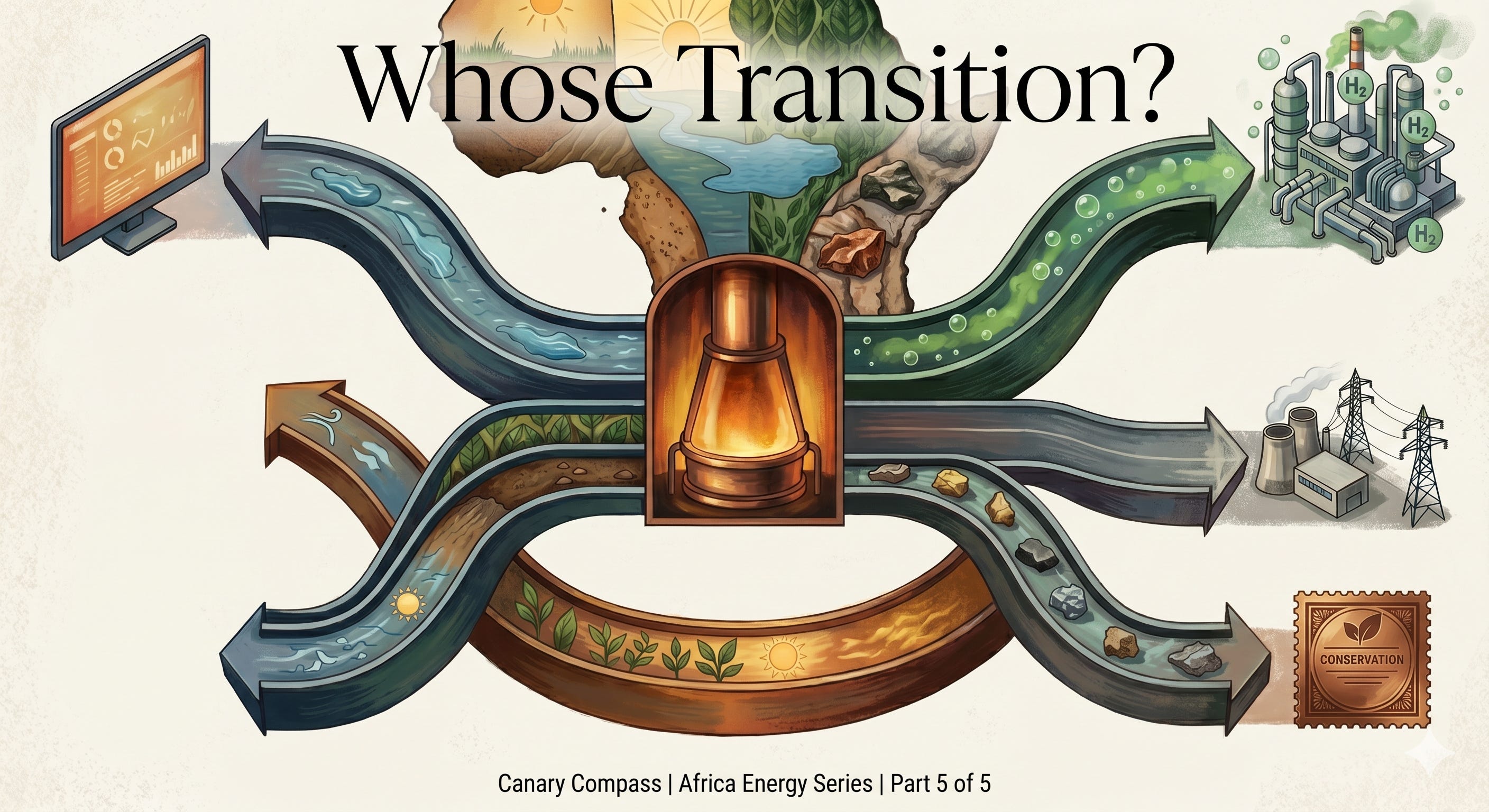
AI-illustration: Whose Transition?
Misaligned Transition is a five-part series. Part 1: The Taxonomy Problem (18 May). Part 2: The China Ceiling (22 May). Part 3: Two Lanes (26 May). Part 4: Misaligned Capital (28 May).
Parts 1 through 4 diagnosed how the climate finance system restricts the firm power capital Africa needs and specified the corrective across four fronts. Label reform opens climate pools to firm power. DFI anchors and capacity payments close the financing gap. Cost-reflective tariffs and utility restructuring make the off-taker bankable. Cross-border settlement through PAPSS removes dollar exposure from intra-African fuel trade. This final essay asks what the corrective does not reach. Capital flows into Africa under green labels. The question is which of Part 1’s four functions it finances, who captures the value, and whether it builds African productive capacity or serves external demand. Each instrument addresses an immediate need. Each commits long-term resources to priorities that may not align with industrialisation. The instruments measure carbon saved, hectares conserved, and gigawatts announced. They do not measure industrial optionality foreclosed.
The essay does not ask whether carbon credits, hydrogen, or land concessions can ever benefit Africa. They can. It asks whether the dominant transaction architecture places ownership, offtake, pricing, and verification inside African productive systems or outside them.
Three instruments are tested. Carbon credits. Green hydrogen export corridors. External concessions in land, energy, and debt. Each is marketed as climate finance flowing into Africa. Each must pass the taxonomy test.
1. Carbon Credits
Carbon markets can work. The question is who aggregates, and where they sit.
In Zimbabwe, Verra’s carbon accounting review confirmed that the Kariba REDD+ project had issued 15,220,520 excess credits out of 26,822,953 total, approximately 57 per cent. Investigative reporting has placed project revenue above EUR100m, but the distribution between developer, intermediary, buyers, and communities remains opaque. Verra’s separate quality control review referred unresolved questions on fund traceability, revenue allocation, and benefit sharing to validation and verification bodies. The project has withdrawn from the Verra registry. The developer, Carbon Green Investments, is contesting the findings.
In Kenya, 165 community members from Isiolo won a ruling from the Environment and Land Court. The court found that two of the largest conservancies participating in the Northern Rangelands Trust carbon project were established unconstitutionally, without proper community consent under the Community Land Act. One of the two, Biliqo Bulesa, contributes about one fifth of the project’s credits. Verra suspended the project for a second time. NRT had sold 6.2 million credits to Netflix, Meta, Salesforce, and others across 2 million hectares. NRT discloses that 60 per cent of total sales revenue flows to conservancies. An independent 2024 scoping study found 25 per cent reaching the Community Carbon Fund. The two figures use different accounting bases.
The intermediary layer is where value concentrates. A 2023 Carbon Market Watch study found 90 per cent of intermediaries did not disclose the fees they charged or the profits made on voluntary market sales. Akinwumi Adesina, then president of the AfDB, compared African credits selling for as little as USD3 per tonne to EU Emissions Trading System permits trading in the EUR60 to EUR95 range. The instruments are different markets with different structures, so the comparison is political rather than technical. But the intermediary opacity is the finding: the aggregation, pricing, and retirement happen in Zurich, Singapore, and Dubai. Some revenue reaches local actors. The price formation architecture does not sit in the host country.
The Africa Carbon Markets Initiative targets 300 million credits annually by 2030. Cumulative issuance remains a fraction of what the annual target requires with under four years to run. The UNFCCC’s Article 6.4 mechanism issued its first credit in February 2026: a Myanmar clean cooking project, with credits transferred to the Republic of Korea for compliance use. No African project had issued credits under Article 6.4 as of writing.
The critique targets externally controlled offset substitution, not carbon finance as such. Kariba and NRT do not prove that all African carbon projects fail. Community-led projects such as Kenya’s Mikoko Pamoja demonstrate that the model works where governance is designed from the ground up. What the flagship failures prove is that where aggregation, pricing, verification, and retirement sit outside the host economy, the default rewards opacity unless national law forces benefit sharing and registry control.
Kenya is building the corrective. The Climate Change (Carbon Markets) Regulations 2024 mandate that land-based projects on public or community land contribute at least 40 per cent of aggregate earnings to communities, and non-land-based projects at least 25 per cent. The National Carbon Registry launched in February 2026, administered by the National Environment Management Authority. Kenya framed carbon credits as “sovereign assets protected by law.” At the African Union’s second Africa Climate Summit in Addis Ababa in September 2025, the AU endorsed the Africa Sovereign Carbon Registry Foundation. The corrective has four moves: benefit-sharing renegotiation, domestic registry build-out, African-owned aggregation institutions, and coordinated demand-side discipline through regional blocs. Kenya has advanced the first two. The third requires an aggregation platform through institutions such as Afreximbank or AFC that does not yet exist. The fourth requires AU-level coordination that the Addis Ababa endorsement signals but does not deliver.
2. Green Hydrogen Export Corridors
Part 1 classified hydrogen by destination. Produced in Africa and consumed in African industry: Firm Power Finance. Produced in Africa and exported to Europe: resource extraction under a green label. Exported green ammonia may deliver genuine climate benefit by displacing fossil ammonia in buyer markets. The taxonomy test asks whether it also serves African industrial demand.
The announced investment pipeline is staggering. Namibia’s Hyphen project: USD10bn, 7 gigawatts of renewables, 3 gigawatts of electrolyser capacity, 2 million tonnes of green ammonia annually, on 4,000 square kilometres of the Tsau Khaeb National Park under a 40-year lease. Mauritania’s AMAN project: USD40bn, 30 gigawatts of renewables, 8,500 square kilometres of Saharan and coastal land. Egypt’s Suez Canal Economic Zone: USD40bn in framework agreements signed in February 2024 across announced projects. Morocco’s “Morocco Offer”: approximately USD33bn to USD35bn across five consortia, with land reservation agreements signed in February 2026.
Combined: approximately USD125bn in announced green hydrogen investment across four African countries, covering more than 12,500 square kilometres of African land across the two largest projects alone. Both Hyphen and AMAN require large-scale seawater desalination in water-scarce regions. AMAN’s design promises over 50 million cubic metres of desalinated water annually.
Though not itself green-labelled, Senegal’s Greater Tortue Ahmeyim gas project illustrates the allocation pattern. GTA is producing and exporting LNG while SENELEC, the national utility, sources 25 per cent of its electricity from floating power vessels. Export-oriented energy infrastructure operates alongside domestic energy poverty.
The offtake tells the story. Hyphen’s ammonia is planned for export to Europe, Japan, and South Korea. Hyphen also identifies local use cases, potential excess electricity to the Namibian grid, and water supply to Lüderitz. Those features matter. The taxonomy test, however, asks where the bankable offtake sits. On Hyphen’s own description, the target demand centres are external. In 2025, RWE withdrew from its non-binding offtake memorandum, citing slower European market growth. AMAN’s developer paused the project in June 2025, citing a lack of committed offtake. Development-stage negotiations resumed later that year, but no final investment decision had been reached as of writing. CWP Global’s founder attributed the failure entirely to offtake, telling Quantum Commodity Intelligence: “The EU ETS trades at too low of a number for this to work.” Egypt’s most advanced project, Scatec’s 100 megawatt electrolyser at Ain Sokhna, won a German H2Global auction to supply renewable ammonia to the European Union from 2027.
The binding variable sits in the buyer jurisdiction, not the host. Mauritania passed a Green Hydrogen Code in October 2024. Namibia leased the land, structured the equity (24 per cent government stake), and secured AfDB support. The African side delivered the institutional framework. The European side did not deliver the demand. When the buyer’s carbon price falls or the buyer’s domestic alternatives improve, the African asset stalls. The land remains committed. The water remains allocated.
Namibia’s negotiated equity and profit share in Hyphen represents a stronger host-country position than most export concessions. The distinction this essay draws is between resource rent and productive capacity. Resource rent accrues from exporting a commodity. Productive capacity accrues from processing it.
Namibia’s HyIron Oshivela project is presented as the domestic-use counter-example: green hydrogen producing direct reduced iron. Benteler, the German steel group, is the offtake partner, with production starting at 15,000 tonnes annually and expansion planned. Production on African soil, value captured by German steel. OCP Morocco is the one large-scale exception: green ammonia tied to domestic fertiliser production.
The export-led industrialisation argument has historical force. South Korea and Taiwan exported before they consumed domestically. The distinction is that Korean and Taiwanese export industries were governed by industrial policies that mandated domestic technology transfer and eventual import substitution. None of the African hydrogen projects reviewed in public disclosures contains a binding domestic redirection clause, a local content manufacturing requirement for electrolysers, or a timeline for transitioning production to domestic industrial offtake. The corrective requires that a defined share of production serves domestic industrial offtake before full export rights vest.
Domestic demand would not eliminate risk. It would relocate the governance of the project from European carbon pricing to African industrial policy, credit support, grid reliability, and demand aggregation. Building the creditworthy domestic offtaker is the firm power programme’s actual task: cost-reflective tariffs, DFI anchors, and payment chain discipline as Parts 1 through 4 specified. The vulnerability is architectural, not accidental.
3. External Concessions: Land, Energy, and Debt
The pattern extends beyond hydrogen. Blue Carbon, a UAE company owned by a member of Dubai’s royal family, was founded in 2022. Within its first year, it negotiated control over millions of hectares of African forest across agreements with the governments of Liberia, Zimbabwe, Tanzania, Zambia, Kenya, and Nigeria. Twenty per cent of Zimbabwe’s landmass. Ten per cent of Liberia’s. By late 2025, an AFP and Code for Africa investigation found the deals had stalled and the company had gone silent. Community consultation was absent or inadequate across the reported deals. The credits were never generated. The land commitments remain in various states of legal limbo. The deals stalled because African courts, civil society, and investigative journalism resisted. The international system did not prevent the attempt.
The Land Matrix Initiative’s 2025 analytical report formally categorised carbon offsets and green hydrogen land requirements as a new primary driver of large-scale land acquisitions. The database’s term is “green grabs.”
The Xlinks Morocco-UK project proposed 11.5 gigawatts of solar and wind generation on 1,500 square kilometres of Moroccan land, transmitting 3.6 gigawatts through 3,800 kilometres of subsea cable to the UK grid. One hundred per cent of the electricity was allocated for UK consumption. Zero allocation to the Moroccan grid. In June 2025, the UK government declined to support the project, concluding that domestic alternatives better serve UK interests. Morocco committed the land, the planning, and the institutional effort. The UK preferred to build at home.
The GREGY interconnector proposes 3,000 megawatts of subsea cable from Egypt to Greece, powered by Egyptian renewables, designed to transmit “100 per cent clean energy” to Greek industry and EU markets. The EU approved EUR9.6m for preparatory studies in January 2026.
Debt-for-nature swaps extend the pattern to fiscal space. Gabon’s 2023 deal refinanced USD500m of sovereign debt through a blue bond insured by the US International Development Finance Corporation and facilitated by The Nature Conservancy. The savings are earmarked for marine conservation under externally monitored KPIs. Three more African deals worth a combined USD500m are in negotiation as of March 2026. Part 4 established that the fiscal space is there and the label determines where it goes. In debt-for-nature swaps, the label is conservation. The conservation may be genuine. The misalignment with industrial priorities is also genuine.
Part 1’s taxonomy applies. Hydrogen produced for European ammonia markets is Energy Volume Finance for the European buyer. Solar generation transmitted to the UK grid is Energy Volume Finance for the UK grid. Carbon credits retired in Korean compliance markets are offset substitution for Korean emitters. None of these is Firm Power Finance for African industry.
4. Whose Transition?
Parts 1 through 4 diagnosed one restriction: climate-labelled capital excludes firm power. Part 4 diagnosed a second: bilateral channels fill the gap on terms that serve bilateral interests. This essay diagnoses a third: green-labelled instruments either route value outside when they transact or strand African land, water, and institutional effort when they do not. In both branches the binding variable sits in the buyer jurisdiction.
The three patterns are not separate phenomena. Multilateral channels restrict the capital that would build firm power for African industry. Bilateral channels provide firm power but on terms that serve the provider’s value chain. Green-labelled instruments serve external demand under labels that count as climate finance. Three structurally different instruments, each responding to different incentives, produce one consistent outcome: project viability is governed from outside the African jurisdiction.
Each instrument finances a transition. Carbon credits finance Northern emitters’ compliance transition. Hydrogen exports finance Europe’s energy transition. Land concessions finance the buyer’s grid transition. Debt-for-nature swaps finance the global conservation transition. Each is legitimate. None is Africa’s industrial transition.
The claim is not conspiracy. Each institution acts rationally within its mandate. The MDB that excludes gas follows its shareholders’ climate commitments. The bilateral lender that ties energy to mineral access follows its national interest. The hydrogen developer that targets European offtake follows the highest-margin buyer. The carbon aggregator that captures the price spread follows market incentives. No single actor is irrational. The system that makes these the rational choices is the problem.
Consistent outcomes from structurally different instruments suggest structural incentive rather than institutional drift. The distinction from ordinary commodity trade is governance displacement. Commodity export generates sovereign revenue the host deploys freely. Green-labelled instruments carry conditions that route verification, aggregation, pricing, and compliance outside the host country’s institutional control. OCP Morocco’s green ammonia programme, serving domestic fertiliser production with domestic offtake, is the one case where bankable demand sits in the host jurisdiction. Its exceptionality is the test: if it were the norm, this thesis would fail.
This essay tests three instruments, not the full universe of green-labelled capital entering Africa. The pattern requires testing at scale.
5. The Sovereign Response
Reform of the international system is necessary. The corrective this essay opened with can improve the terms when international capital flows into African firm power. It cannot build the domestic demand that anchors projects inside the African jurisdiction.
Only domestic architecture can do that. Kenya demonstrates the first layer: sovereign registry, statutory benefit sharing, carbon credits framed as sovereign assets. The AU’s endorsement of the Africa Sovereign Carbon Registry Foundation at Addis Ababa in September 2025 signals the continental direction. The AfDB validated a continent-wide Sustainable Finance Taxonomy in July 2025. These are real institutional steps. They are also sustainability classifications, not a sovereign transition taxonomy built on the firm-power logic this series proposes.
The deeper corrective requires building the creditworthy domestic offtaker that does not yet exist at scale. Cost-reflective tariffs that make the utility bankable. DFI anchors that reduce the cost of capital. Payment chain discipline that makes the PPA enforceable. Domestic industrial demand for firm power that does not depend on the EU ETS price or UK energy policy or Gulf investment cycles. Parts 1 through 4 specified the tools. The Canary Codex, developed across the 2026 Inflection series, proposes the deployment framework: domestic credit channelled into absorption industries, institutional capital redeployed through African institutions, diaspora capital directed into majority-African-owned enterprise. Whether the framework is the Codex or another architecture, the necessity is what this series establishes.
The Forced Choice identified a five to seven year window before battery chemistry substitution erodes Africa’s mineral bargaining power. The minerals window determines the timeline. The domestic architecture determines everything after it. Firm power that enables mineral processing today enables agricultural value addition, manufacturing, and the services economy a continent of two billion people will require. The domestic architecture is needed not only for the minerals window but for every stage of industrialisation that follows.
This essay asked whose transition the current system serves. The evidence across three instruments and four continents of buyer jurisdictions answers it. The sovereign response is not to accept the answer. It is to build the architecture that keeps Chambishi’s furnace hot.
Sources
African Development Bank, African Sustainable Finance Taxonomy (Nairobi, validated 16-17 July 2025, via AFAC).
African Development Bank, Sustainable Energy Fund for Africa: USD10m Loan to Hyphen Hydrogen Energy (Abidjan, December 2025).
African Union, Second Africa Climate Summit, Addis Ababa Declaration and endorsement of Africa Sovereign Carbon Registry Foundation (Addis Ababa, 8-10 September 2025).
AFP and Code for Africa, “The Case of Africa’s ‘Vanishing’ Carbon Deals” (November 2025).
African Climate Wire, “Trapped in Green Debt: Debt for Climate Swaps Are Not Enough” (May 2025, AU/UNECA Debt Conference, Lomé).
Carbon Market Watch, “Secretive Intermediaries” report (2023).
CWP Global, founder Mark Crandall statement to Quantum Commodity Intelligence on AMAN project (June 2025).
Environment and Land Court at Isiolo, Osman v Northern Rangelands Trust, judgment delivered January 2025.
Fertiglobe, Q4 2025 Results Filing (H2Global award, European offtake).
Kenya Gazette Supplement, The Climate Change (Carbon Markets) Regulations, 2024, Legal Notice No. 84 (17 May 2024).
Land Matrix Initiative, “Large-Scale Land Acquisitions for Carbon Offsetting: Green Grabbing or Just Transition?” (October 2025).
Mongabay, “Kenyan Soil Carbon Project Suspended for a Second Time” (May 2025).
Onyambu, Dean N., “The Forced Choice,” Canary Compass (February 2026).
Reuters, “Trio of African Countries Eyeing Debt-for-Nature Swaps, Nature Conservancy Says” (23 March 2026).
Onyambu, Dean N., “The 2026 Inflection: Parts I-II,” Canary Compass (January and April 2026).
Rainforest Foundation UK, “Blue Carbon and the New Scramble for Africa’s Forests” (November 2023).
Scatec, Egypt Green Hydrogen Project Disclosures (2023-2026).
SourceMaterial, “Scramble for Africa: Inside Dubai’s Carbon Offsetting Mega-Deal” (September 2024).
UNFCCC, “UN Carbon Market Approves First-Ever Issuance of Credits Under the Paris Agreement” (26 February 2026).
Verra, “Verra Acts on Kariba Project: Cancels Excess Credits, Advances Independent Review” (23 September 2025).
Xlinks, UK Department for Energy Security and Net Zero decision and Xlinks corporate statements (June 2025).
Disclaimer
This article does not constitute legal, financial, or investment advice. The author shares views for perspective and discussion only. Do not rely on them as a substitute for professional advice tailored to your specific circumstances. Always consult a qualified legal, financial, investment, or other professional adviser before making decisions based on this content. The analysis reflects proprietary research undertaken by Canary Compass and the author.
Canary Compass and the author accept no liability for actions taken or not taken based on the information in this article.
The views expressed in this article represent the author’s independent professional analysis and do not constitute an endorsement of any individual, institution, or position. Canary Compass and the author accept no responsibility for how this content is interpreted, excerpted, or recontextualised by third parties not involved in its production and publication. Reproducing any portion of this work in isolation, or in combination with other material, in a manner that misrepresents the author’s original meaning constitutes a distortion of the published record.
The author may hold positions in financial instruments, currencies, or assets discussed or referenced in this publication. Such positions do not constitute a recommendation to buy or sell.
All views, projections, and forecasts reflect the author’s assessment at the time of writing. Data sourced from third parties is believed to be reliable but has not been independently verified. Past performance does not indicate future results.
All content published by Canary Compass is the intellectual property of the author. Reproduction, adaptation, or redistribution, in whole or in part, requires written permission.
About the Author
Dean N. Onyambu is the Founder and Chief Strategist of Canary Compass, a financial research publication focused on African monetary architecture and financial sovereignty. He brings 18 years of experience across trading, fund leadership, and economic policy, with senior roles at Standard Bank, First Capital Bank, and Opportunik Global Fund.
Read and subscribe at www.canarycompass.com.
The Canary Compass Channel is available on @CanaryCompassWhatsApp for economic and financial market updates on the go.
For more insights from Dean, you can follow him on LinkedIn @DeanNOnyambu or X @InfinitelyDean.