

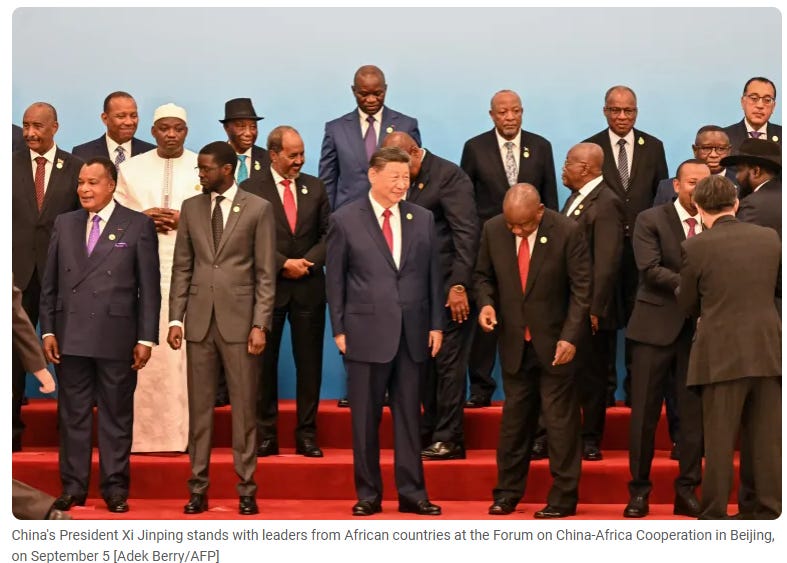
Photo from Aljazeera
I value how Ray Dalio simplifies complexity. His insights on China open up essential questions about growth, governance, institutional design, and ideological influence in a multipolar world.
China’s pivot from investment-led to consumption-driven growth is not new but is increasingly urgent. China faces severe constraints with diminishing returns from infrastructure and property sectors and an ageing population. Centralized governance has delivered stability and scale but was not the engine of its rise. Market reforms, WTO integration, demographic dividends, and strategic industrial policy were all critical. Governance alone does not build prosperity — strategy does.
Singapore is cited as a model of efficient state-led development in many African policy circles. It is often invoked as a shorthand for what success might look like under tight control. But let’s be clear: Singapore succeeded not simply because it centralized authority, but because it coupled that authority with world-class institutions, the rule of law, and an unrelenting investment in state capacity. Technocratic efficiency is not the same as institutional accountability, and both matter.
Here’s the problem: Across many African capitals, we treat Singapore like a slogan, not a system. Everyone wants the Marina Bay skyline, but no one wants to do the decades of state reform, bureaucratic pruning, or policy discipline it took to get there. You cannot benchmark ambition on aesthetics. And yet, “Singapore of Africa” has become a mantra, recited by politicians who want authoritarian speed without institutional cost.
Singapore may inspire admiration, but China increasingly commands emulation. And while both are held up as examples of order and rapid development, their models are not interchangeable, and neither are their risks. We admire the outcomes without examining the foundations. This brings us to the question that cuts deeper: What kind of power does a rising China represent? And what happens to the world, particularly to Africa, if that power becomes normative?
This is where I stop being analytical and start being honest.
Africa cannot afford to flirt with authoritarian mimicry again. Not because we’re incapable, but because we’ve tried it. We’ve seen what happens when power consolidates without accountability. We’ve watched liberation movements turn into dynasties, parliaments into rubber stamps, and dissent into exile. These aren’t theoretical risks, they are historical facts.
Yes, African states have agency. Many are leveraging partnerships across the West, the East, and the Global South. However, we must acknowledge a dangerous trend: authoritarian aesthetics can look like strength where institutions are weak. And that illusion has cost us decades.
We must stop idolizing outcomes we didn’t build. Power that is not earned institutionally becomes violence or vanity - and often both.
So what is the alternative?
We don’t need imported ideologies, we need indigenous blueprints. We need governance models born from our own history of precolonial consensus-building, postcolonial resilience, and the lived knowledge that power without restraint is a curse, not a solution. We need institutions that reflect our complexity, not paper copies of someone else’s efficiency.
Let’s be clear: institutional power is not about who rules but what survives when no one does. Any model that depends on a single man, moment, or myth is not a model, it’s a memory waiting to collapse.
We don’t need more borrowed models. We need to ask harder questions. What does a public service reform look like when you have neither elite cohesion nor a culture of civic trust? What does the rule of law mean when courts are funded by the executive they must judge? These are not academic hypotheticals, they are the real work of nation-building.
Here’s the paradox: The only way to follow global power… is to stop following anyone. The only way to catch up… is to stop copying. And the only way to build sovereign governance… is to stop outsourcing our imagination.
This is not an indictment of China or Singapore. Both nations followed paths suited to their histories, challenges, and social contracts. It is a call to African leadership. We must critically assess which parts of any model are transferable and which are not. Governance is not a plug-and-play affair. Without trusted institutions, independent judiciaries, and an engaged citizenry, any model — Western, Eastern, or indigenous — will falter.
So no, we don’t need to mimic power. We need to build it.
Deliberately. Intelligently. And unapologetically on our own terms.
Because if we fail to do so, we won’t just be borrowing someone else’s model, we’ll be re-entering our own past.
And this time, we’ll have no one else to blame.
Africa’s crisis is not imitation — it’s imagination. The future won’t be built by those who follow best, but by those who dare to create differently.
Dean N Onyambu is the Founder and Chief Editor of Canary Compass, a co-author of Unlocking African Prosperity, and the Executive Head of Treasury and Trading at Opportunik Global Fund (OGF), a CIMA-licensed fund for Africans and diasporans (Opportunik). Passion and mentorship have fueled his 15-year journey in financial markets. He is a proud former VP of ACI Zambia FMA (@ACIZambiaFMA) and founder of mentorship programs that have shaped and continue to shape 63 financial pros and counting! When he is not knee-deep in charts, he is all about rugby. His motto is exceeding limits, abounding in opportunities, and achieving greatness. #ExceedAboundAchieve
The Canary Compass Channel is available on @CanaryCompassWhatsApp for economic and financial market updates on the go.
Canary Compass is also available on Facebook: @CanaryCompassFacebook.
For more insights from Dean, you can follow him on LinkedIn @DeanNOnyambu, X @InfinitelyDean, or Facebook @DeanNathanielOnyambu.
The authoritarian convergence is not happening in isolation. This is not just about leaders repressing dissent. It is about global incentives that made authoritarian shortcuts easier.
China’s Belt and Road Initiative (BRI) poured billions into Africa with fewer governance conditions attached. Between 2000 and 2022, China issued $170.08 billion in loans to African governments, much of it outside Paris Club oversight, according to the China’s Overseas Development Finance (CLA) Database. That suited political elites who preferred opacity, padded contracts, and freedom from institutional constraints. Projects like Kenya’s Standard Gauge Railway (SGR) show both the promise of infrastructure delivery and the problems of cost inflation, debt opacity, and political capture. At the same time, the IMF and World Bank’s conditional lending often imposed stringent transparency requirements that overlooked deeper global financial inequities, creating challenges for African nations. This context helps explain why many leaders turned to China’s less restrictive BRI, though it too came with its own complexities.
Now the United States, never a saint in its own right, but once the loudest in demanding democratic standards, is shifting toward more transactional diplomacy. What we are seeing is a retreat from value-based diplomacy to counter China, with deals mattering more than principles. What that clearly means is that the era of Western powers proclaiming democratic guardrails is reduced, as repression now carries a diminished external cost. Western sanctions still exist in certain cases, but the broad deterrent effect of U.S. and European diplomacy has waned.
That leaves Africa more on its own. And if external accountability is diminished, internal accountability becomes the frontier. Citizen activism is no longer an accessory, it becomes the backbone of liberty through bottom-up agency. This requires not only sustained engagement on questions of economic governance and transparency but also political acceptance, meaning acceptance by governments to tolerate civic participation and acceptance by society at large that dissent is legitimate. Movements such as Nigeria’s hashtag#EndSARS protests and Kenya’s youth-led fiscal resistance demonstrate both the risks and the potential of citizen agency.
There is both risk and opportunity. If citizens do not claim the space, authoritarian shortcuts and opaque contracts will harden. If they do, then accountability will be built from the ground up. The real path forward is not to wait for external lectures or imported models, but for citizens themselves to RESPONSIBLY insist that freedom and accountability belong to them, through LAWFUL, CONSTRUCTIVE, and sustained civic engagement.
Original post: https://x.com/InfinitelyDean/status/1959912038865436979