

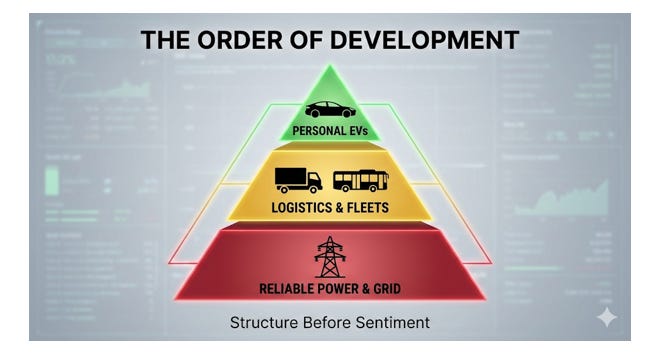
Image Caption: AI-generated image visualising the correct sequencing of development priorities.
This week, I had a long WhatsApp exchange with a friend about electric vehicles. He made the usual case: the technology works, you stop buying fuel, servicing gets cheaper. I did not argue against the technology. I argued against the sequencing.
A state does not get rewarded for picking every working technology. A state gets rewarded for closing binding constraints first. In most of Africa, the binding constraint is not propulsion. It is power reliability, household cash flow, logistics cost, and basic public services. Until those move, EVs remain a last-mile outcome dressed up as a first-mile priority. This argument speaks to the median African state and the typical household, not the best-electrified pockets or the highest-income corridors.
Start with the part that gets skipped in almost every EV debate: electricity access. The World Bank and partners estimate that roughly 600 million people in sub-Saharan Africa still live without access to electricity, and progress has struggled to keep pace with population growth. That is why initiatives like Mission 300 exist in the first place. That initiative aims to connect 300 million people by 2030: an acknowledgement that the access gap remains the region’s defining infrastructure challenge. If you cannot guarantee power for homes, clinics, and small businesses, you cannot credibly position mass consumer EV adoption as a first-order national priority.
Europe provides a valuable reality check. In 2023, the European Union set a 100% emission-reduction target for new cars and vans from 2035, effectively a ban on internal combustion engines. On December 16, 2025, the European Commission proposed a 90% target and added compliance flexibility. Under the proposal, EU-based carmakers would compensate for the remaining 10% of emissions rather than eliminate them entirely. That is not a moral commentary on EVs. It is a fiscal and industrial reality signal: even wealthy regions move timelines and redesign mandates when costs, voters, and supply chains push back.
Now zoom out to China, because that is where many Africa conversations get emotionally stuck. People see falling prices and assume falling costs. Those are not the same thing. Overcapacity means output exceeds economically healthy demand, and the system sustains it through policy, credit, and industrial strategy. The EU did not launch its anti-subsidy investigation for entertainment. In July 2024, the European Commission imposed provisional countervailing duties on battery electric vehicles from China, explicitly linking the action to concerns about unfair subsidisation. By late October 2024, the EU finalised additional duties as high as 35.3%, on top of the standard 10% car import tariff, taking the total tariff burden as high as 45.3% on some Chinese-built EVs. When advanced markets treat the price signal as policy-distorted, Africa should not treat that same price as a clean development shortcut.
Ethiopia often comes up as the proof case for Africa. It is an important case, but not for the reason people think. Ethiopia announced a ban on the importation of gasoline and diesel vehicles in January 2024, with the stated aim of cutting fuel import costs and air pollution, enforced through duties that discourage internal combustion imports and preferential treatment for electric and hybrid vehicles. That is not organic consumer adoption. That is a hard state lever, pulled under foreign exchange stress. Recent reporting puts the annual fuel import in the mid-single-digit billions of dollars, roughly $4 to $5 billion, with higher figures cited by some officials. Either way, the policy emerged as a balance-of-payments response, not a green transport ambition. Ethiopia inaugurated the Grand Ethiopian Renaissance Dam in September 2025, with planned capacity of just over 5 gigawatts of hydropower: Africa’s largest. Yet even with GERD online, electricity access remains only a little above half of the population. The dam’s output should close that gap before it powers vehicles for the urban minority already connected. Even sympathetic reporting notes the practical barriers: public chargers remain scarce, reported anywhere from the low teens to roughly 100 nationwide depending on the source, alongside limited specialist maintenance capacity, spare parts constraints, frequent power outages, and a transition burden that falls on households and informal markets. Ethiopia’s example proves that EV adoption at scale is not a simple, cost-free switch. It is a policy imposition that comes with severe implementation challenges.
Look closer at Ethiopia’s tax structure, because the fiscal transfer is hiding in plain sight. Internal combustion vehicles attract cumulative taxes that can exceed 100% once VAT, excise, surtaxes, and withholding layers stack on top of customs duty, while EVs face lower import charges and broader waivers. When a government exempts EVs from taxes it would otherwise collect, the savings do not appear on the sticker price. They appear on the fiscal balance sheet. Multiply the foregone revenue across the tens of thousands of EVs now in Ethiopia (government figures cite over 100,000, though independent estimates vary), and you have a large implicit fiscal transfer from the public purse. That is not EVs paying for themselves. That is the state paying for EVs through the back door.
The standard defence is that incentives are temporary: stimulate adoption, then withdraw support once the market matures. That logic assumes the market matures. In the United States, the $7,500 federal EV tax credit ended on September 30, 2025. Buyers rushed purchases into September. October then showed the cliff: battery electric vehicle sales fell sharply, roughly halving from September levels. If subsidised demand can swing that violently in a market with near-universal electricity access and high household incomes, it will swing even harder in markets where access, incomes, and grid reliability remain binding constraints. Incentives do not automatically create self-sustaining demand. Sometimes they simply mask the true cost until the mask comes off.
Now ask who benefits. Households buying EVs in Africa today are not the bottom 60%. They are households with garages, stable incomes, and capital for a $20,000 purchase. In Ethiopia, only 55% of the population has electricity access, and formal credit penetration remains low (approximately 4-5% of adults are borrowers from a formal financial institution). The buyers are concentrated in Addis Ababa, where incomes and electricity access rates are far above the national average. Duty exemptions on EVs are a transfer from the public purse to households wealthy enough to afford them. When a state that subsidises vehicles for the urban affluent has half the population without electricity, it has misordered its priorities.
The total cost of ownership argument deserves scrutiny. The EV pitch assumes lower running costs, but that assumption was built in Oslo, not Nairobi. Battery degradation can accelerate with heat, dust, irregular voltage, and inconsistent charging patterns: conditions that describe most African operating environments. Manufacturer warranties assume controlled conditions; African roads, climates, and grid quality often do not. Battery pack replacement can cost several thousand dollars, and sometimes far more, depending on model and market, and no local supply chain exists in most African markets. Resale value becomes harder to price once battery health becomes the dominant variable, with no functioning secondary market to absorb older units. Charging requires grid power that is itself often subsidised. Specialist maintenance is unavailable outside capital cities; spare parts must be imported with lead times measured in weeks. Until someone publishes a credible lifecycle cost comparison for African operating conditions, the savings claim remains an assertion, not a fact.
The foreign exchange argument cuts both ways. Ethiopia’s case rests on saving hard currency by reducing fuel imports. But EVs are imported. Batteries are imported. Chargers are imported. Spare parts are imported. The counterargument is that internal combustion vehicles are also imported and contain more components. That is true but incomplete. The policy question is not ICE versus EV. It is whether shifting from recurring fuel purchases to upfront vehicle, battery, and infrastructure imports improves or worsens the foreign exchange position over a decade. Internal combustion vehicles, whatever their faults, plug into an existing repair ecosystem with local mechanics, recycled parts, and regional supply chains built over fifty years. Electric vehicles do not. The FX cost of an EV fleet, plus battery replacements, plus charging infrastructure over ten years, may approach or exceed the FX cost of fuel for an equivalent internal combustion fleet. Until someone runs the full lifecycle FX comparison for African import structures and the realities of maintenance, the savings claim is incomplete.
None of this denies externalities. Cleaner urban air matters. Lower noise matters. Reduced diesel exposure matters. The question is sequencing and targeting. Externality gains do not substitute for electricity access, reliable supply, and household purchasing power. They complement them once the base constraints move.
Without standards, Africa risks becoming a destination for end-of-life and unsupported units. Africa has been a dumping ground for used internal combustion vehicles that cannot pass inspection in Europe or Japan. The pattern will repeat with EVs unless standards are set now. Degraded batteries, end-of-life vehicles, and units with no spare parts pipeline will flow to markets without certification requirements. This is not technology transfer. It is waste transfer with a green label.
This is the core distinction I want us to hold. Private enterprise can experiment. Corporates can pilot fleets. Mines can electrify closed-loop operations. Logistics firms can build depot charging and prove the economics route-by-route. Electric two-wheelers and three-wheelers serving last-mile connectivity can find their footing where duty cycles are short, and home charging is feasible. Electric buses on fixed routes with depot charging can demonstrate economics before anyone asks for subsidies. When these experiments fail, investors absorb the loss. When they succeed, they scale without asking taxpayers to underwrite the learning curve. The critique here is not of electric mobility in all forms. It is of mass consumer adoption of personal electric vehicles before the underlying conditions justify the priority. The state’s role is not to import solutions wholesale but to create conditions where local entrepreneurs can adapt technologies to African realities: duty cycles, climate, income levels, and repair cultures.
Policy does not travel well. What works in Stuttgart does not automatically work in Addis Ababa. The European Union built its EV targets on a foundation of universal electricity access, dense charging networks, high household incomes, deep capital markets, and automotive industries that could pivot domestically. None of those conditions exist at scale in sub-Saharan Africa. Borrowing the target without replicating the foundation is not ambition. It is cargo cult policymaking: building the runway and waiting for the planes to land.
The state has a different job. State budgets must prioritise food systems, power, health, education, water, roads, and productivity plumbing. The state must reduce transmission losses, raise reliability, and expand access. The state must lower the cost of moving goods, because that cost hits every poor household through food prices and jobs. Kenya just demonstrated what sequencing looks like. On December 15, 2025, the Kenya Electricity Transmission Company signed a $311 million public-private partnership with Africa50 and Power Grid Corporation of India to finance, build, and operate two high-voltage transmission lines across Western and Northern Kenya. The project will extend a 220-kilovolt grid into Western Kenya for the first time, reduce voltage instability, integrate renewable energy from the Baringo-Silali geothermal fields and Lake Turkana wind project, and cut technical losses. The private partner finances and builds the infrastructure under a 30-year concession, recovering costs through availability payments from KETRACO. This is not free money—availability payments are a fiscal commitment that sits on the public balance sheet over time—but the investment targets the right constraint: grid reliability before consumer vehicles. That project does not mention EVs. It focuses on grid stability, renewable integration, and reliable supply: the foundation without which mass electrification of transport remains a fantasy.
So yes, let EVs grow in Africa. Just put them in the right lane.
EVs are welcome in Africa the moment they meet these conditions: total cost of ownership at parity with internal combustion without any tax preference; charging infrastructure financed and operated by private capital, not public budgets; battery recycling economics that do not require state subsidy; reliable grid supply in target markets before mass consumer rollout; and a functioning secondary market for used EVs with transparent battery health disclosure. Until those conditions are met, EVs belong in the private-sector lane, where investors, not taxpayers, absorb failure.
My EV lane for Africa is last-mile. First, set standards and safety rules now, so the market does not become a dumping ground for degraded batteries and uncertified vehicles. Second, establish battery recycling and disposal policy now, before scale creates a waste crisis that poorer municipalities cannot manage. Third, target pilots for fleets, buses, and closed-loop industrial use where duty cycles are predictable and charging infrastructure can be purpose-built. Fourth, reserve consumer mass adoption for after reliability and incomes can carry the shift without subsidies pretending to be development.
EVs are not an ideology. They are a tool. Sequencing is not delay. It is ensuring that when Africa adopts at scale, it adopts on terms that build capacity rather than dependency. Africa does not lose by waiting for the right conditions. Africa loses by misordering priorities while poverty arithmetic remains unresolved.
If we want a serious conversation on EVs, we should start where the constraint actually sits: power, incomes, and logistics. Everything else is commentary.
Disclaimer
This article does not constitute legal, financial, or investment advice. The author shares views for perspective and discussion only. Do not rely on them as a substitute for professional advice tailored to your specific circumstances. Always consult a qualified legal, financial, investment, or other professional adviser before making decisions based on this content. The analysis reflects proprietary research undertaken by Canary Compass and the author.
Canary Compass and the author accept no liability for actions taken or not taken based on the information in this article.
About the author
Dean N. Onyambu is the Founder and Chief Editor of Canary Compass. His insights draw on experience across trading, fund leadership, governance, and economic policy.
The Canary Compass Channel is available on @CanaryCompassWhatsApp for economic and financial market updates on the go.
Canary Compass is also available on Facebook: @CanaryCompassFacebook.
For more insights from Dean, you can follow him on LinkedIn @DeanNOnyambu, X @InfinitelyDean, or Facebook @DeanNathanielOnyambu.