

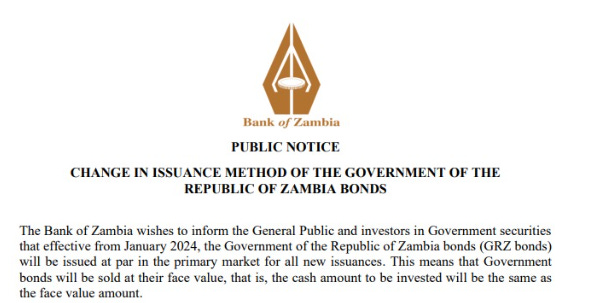
The original article was published on the Canary Compass LinkedIn page on December 6, 2023, and is available here: Flash Commentary on Change in Issuance Method of GRZ Bonds
The Canary Compass Channel is available on @CanaryCompassWhatsApp for economic and financial market updates on the go.
Canary Compass is also available on Facebook: @CanaryCompassFacebook.
Introduction
A subtle but significant shift can have far-reaching implications for the issuing state and investors. Presently, Zambian bonds sell at a discount (where GRZ sells or issues them for less than their face value), where the coupon rates are much lower than the market yields. This practice creates a market dynamic that balances capital gains (where investors profit by buying low and selling high) against lower interim coupon payments.
The pivot towards issuing bonds at par (where GRZ sells or issues bonds at the same price as their face value) – equating the coupon rate with the yield at issuance – marks a critical turn. The move mirrors trends in other African markets like South Africa and Nigeria and reflects a broader regional adaptation to more up-to-date financial practices.
This column considers the current environment where market yields at issuance are significantly higher than coupon rates. It aims to dissect this shift, scrutinizing its ramifications for investors and the Zambian government. Furthermore, it considers future-oriented bond types like green or infrastructure bonds and the role of tax policies in shaping market dynamics.
Historical Context and Shift in Issuance Practice
Zambia's bond market has a consistent pattern of issuing bonds at a discount. In simple terms, this means bonds sell for less than their face value, with the promise to pay back the total amount at maturity. This approach often appeals to investors seeking capital gains – profit earned when a bond is sold or redeemed for more than its purchase price. For example, a bond bought for ZMW 800 and sold or redeemed for ZMW 1000 results in a capital gain of ZMW 200.
However, this method often delivers lower returns in the form of periodic interest (coupon payments) for investors, which is especially problematic for those risk-averse investors dependent on these payments for income, like retirees, pensions, or institutional investors managing fixed-income portfolios. In this model, since bonds sell below their face value, the coupon rate – the periodic interest payment to the bondholder – is often set lower than the prevailing market yield at issuance. That said, investors seeking capital gains prefer this approach as the bond's value appreciates over time. In addition, the lack of capital gains taxation on Zambian bonds accentuates this preference with the trade-off being lower interim income from coupon payments.
By aligning the coupon rate with the market yield at issuance, the Zambian government signals a move towards a more investor-friendly, balanced bond market. This change simplifies the bond structure, making it more attractive to a broader range of investors, particularly those prioritizing steady income over capital gains.
Benefits for Investors
The transition to issuing bonds at par materially boosts cash flow income as the alignment of coupon rates with the prevailing market yield at issuance guarantees that bondholders receive a higher rate of periodic interest. This shift is particularly advantageous for investors who depend on bonds as a reliable source of regular income. The increased coupon rate translates into a more robust income stream, a stark improvement over the relatively lower coupon payments characteristic of bonds issued at a discount.
This enhancement in the coupon rate, now in sync with market yields, ensures that the net interest income from these bonds remains considerably higher for investors, even when accounting for deductions due to the 15% withholding tax and the 1% handling fees. These deductions, while applied to a more considerable coupon amount, do not negate the overall increase in income. As such, the added benefit for investors in the context of bonds issued at par is their shorter durations (amount of time it takes to get back your investment; this is shortened since, as per current market conditions, receivable coupons are higher as compared to the discount model).
For instance, consider a retail investor purchasing a 2-y bond with a face value of ZMW1,000 at a 9% coupon rate. Under the discount model, the coupon would amount to ZMW 90.00 annually. With par issuance, the same bond, based on the last bond auction accepted 2-y yield of 17%, would now pay coupons at an annual rate of 17%. After consideration of 15% withholding tax and 1% handling fees, the investor would now receive ZMW 142.80 annually, a substantial increase even after accounting for withholding taxes and handling fees.
Note: Here, we have used this example for simplicity. For more accurate calculations, please see the following links:
https://x.com/InfinitelyDean/status/1732427246365749563?s=20
https://x.com/InfinitelyDean/status/1732419952664076592?s=20
Furthermore, the augmented coupon receipts bolster the reinvestment benefits significantly. While deploying the same initial capital, investors can now receive more significant cash flows. This increase in liquid capital presents a golden opportunity for reinvestment, potentially leading to enhanced compounded growth of their investment portfolio. The immediate access to increased cash flows allows investors to promptly capitalize on other investment opportunities, enhancing their overall financial returns. (Sidebar: Remember the debt-restructuring terms reached with private creditors that were rejected by the OCC?)
Institutional investors, such as pension funds or insurance companies, also stand to benefit significantly from the enhanced cash flow inherent in the par issuance model. These entities typically manage large portfolios and are particularly sensitive to income. The transition to higher coupon payments enhances the management of their long-term liabilities. Moreover, the increased interim cash flows provide more leeway for these institutions to reinvest or rebalance their portfolios according to market conditions.
By shifting to par issuance, the government not only incentivizes investment in bonds through higher direct returns but also indirectly fosters a more dynamic investment environment. Investors are empowered with greater financial flexibility, making it possible to diversify and strengthen their investment strategies with the additional capital generated from these higher coupon payments.
Challenges for Investors
The challenge for investors in bonds issued at par, especially in a rising interest rate environment, lies in the opportunity cost. When market interest rates increase after the bonds have been issued, new bonds come to market with higher yields. While the existing par-issued bonds retain their stability and continue to pay the agreed-upon coupon rate, they may become less attractive compared to new bonds with higher yields. This doesn't necessarily mean that par-issued bonds become a bad investment; rather, their relative attractiveness may decrease compared to newly issued bonds in such market conditions.
Benefits for the Government
The Zambian government stands to gain considerably from issuing bonds at par. The most immediate benefit is a reduction in long-term debt obligations. When bonds sell at a discount, the government eventually needs to pay back more than the amount initially received due to the bond's face value being higher than its initial selling price. By issuing at par, the government aligns its cash inflow with repayment obligations, potentially easing its debt burden.
An added advantage for the Zambian government in issuing bonds at par is managing future liabilities. Bonds issued at a discount require large rollovers at maturity due to their significant face value compared to the lower amount initially raised. This practice often leads to substantial refinancing needs at the bond's maturity. Now, the government can gradually chip away at this liability by issuing at par and paying higher coupon rates throughout the bond's life. This approach not only eases the burden of large lump-sum payments at maturity but also contributes to a more balanced fiscal management strategy over time.
Moreover, the transition to par issuance simplifies the bond structure and enhances the market's attractiveness, potentially increasing demand. A more straightforward bond structure could attract a broader range of domestic and international investors, enhancing market liquidity. Increased demand for bonds, driven by their appealing structure and enhanced interim returns, can lead to lower overall borrowing costs for the government.
Challenges for the Government
However, the transition is challenging for the government. The most significant is the potential increase in immediate fiscal pressure. Issuing bonds at a discount gives the government a form of 'deferred financing,' as the full repayment is only due at the bond's maturity. Switching to par issuance means the government has to deal with higher interest payments right from the start, which could strain its short-term budgetary resources through an increase in annual interest expenses in the national budget.
That said, while this implies an increased outlay in interest payments, it also leads to higher tax receipts from the withholding tax and handling fees on these increased coupon payments. Although the overall immediate fiscal burden is significantly higher due to increased coupon payments, the enhanced tax receipts partially offset this. (Sidebar: While withholding taxes go to GRZ, handling fees go to the Bank of Zambia, which facilitates bond issuance for GRZ; as such the BOZ is a material beneficiary of this change as, under current market conditions where prevailing market yields are significantly higher than current coupon rates, the alignment of coupon rates to market yields at issuance will materially increase the BOZ’s income from handling fees)
As such, while the immediate increase in fiscal pressure due to higher interest payments is a notable challenge, a more stable and attractive bond market has long-term benefits. The initial fiscal strain can be offset by the benefits of having a robust and liquid bond market, attracting long-term investment, and reducing future borrowing costs.
Policy Considerations and Recommendations
A crucial policy consideration for Zambia in refining its bond market lies in the treatment of taxation on bond coupons. One compelling argument for reducing or removing the tax on bond interest is the potential for lowering the overall cost of borrowing for the Zambian government. When investors consider the net return on their investments, the presence of taxation on coupons means they often demand a higher yield to compensate for this tax burden. Consequently, this drives up the cost of borrowing for the issuer – in this case, the government.
If the tax on bond coupons is reduced or eliminated, the immediate benefit would be an increase in the attractiveness of these bonds to investors. They would be more inclined to accept a lower yield since taxes would not reduce their net income. This scenario leads to a decrease in the interest rates that the government needs to offer, effectively reducing its cost of borrowing.
Kenya's approach to infrastructure bonds, where the interest earned is exempt from withholding tax, exemplifies the benefits of such a policy. This tax advantage has significantly affected the high demand for and oversubscription of these bonds. The higher net income they receive draws investors and the Kenyan government benefits from lower borrowing costs. Zambia could draw lessons from this approach, potentially replicating these benefits in its bond market.
Moreover, a lower interest rate environment can have broader positive economic implications. It can stimulate investment in other areas, as lower borrowing costs make various projects and investments more financially viable. The latter could lead to enhanced economic growth and development, creating a virtuous investment cycle and improvement in the national economy.
Combining the tax benefits above with exploring innovative bond types such as infrastructure, social impact, and green bonds could open new financing avenues. These bonds often attract diverse investors, including those focused on ethical and sustainable investments, and can provide funding for critical national projects. Countries like Egypt have successfully issued green bonds, aligning with global environmental goals while diversifying their investor base.
Beyond the shift to par issuance, the Zambian government could consider a comprehensive reorganization of its bond market. Although the government introduced 3-y, 5-y, and 10-y benchmark bonds, the current landscape is still primarily characterized by many bonds with varying maturities and needs more optimal liquidity and clarity. A strategic approach could involve a process akin to bond market consolidation or standardization. The latter would involve repurchasing existing bonds and reissuing them into specific, standardized maturities, such as 2-y, 3-y, 5-y, 10-y, and 15-y, and potentially introducing longer terms like 20-y or 30-y bonds. Such a reorganization would enhance market liquidity and investor appeal by providing clear, distinct options for investment horizons.
This consolidation process, often referred to in financial terms as a 'bond market reorganization' or 'refunding operation,' would create more distinct liquidity buckets and streamline the bond offerings. It would represent another step towards a more mature, organized bond market, aligning Zambia with global best practices.
Conclusion
The Zambian government's decision to issue bonds at par is a strategic move in line with evolving trends in African financial markets. For investors, it offers a more straightforward investment with improved cash flow. For the government, it promises long-term fiscal stability but poses short-term budgetary challenges. The experiences of countries like Kenya with infrastructure bonds and the global rise in green bonds provide valuable lessons for Zambia in crafting its bond market policies. Coupled with the potential consolidation of the bond market and introduction of innovative bond types, Zambia can signal a forward-thinking approach, aligning the nation's financial practices with global trends and addressing long-standing market fragmentation issues.
#zambia #kwacha #zmw #boz #mof #mofnp #bonds #coupons #yields #investments #taxpayments #witholdingtax #handlingfees #capitalgains
Dean N Onyambu is the Executive Head of Trading at Opportunik Global Fund (OGF), a CIMA-licensed fund for Africans and diasporans (Opportunik), and is a co-author of Unlocking African Prosperity. Passion and mentorship have fueled his 15-year journey in financial markets. He is a proud former VP of ACI Zambia FMA (@ACIZambiaFMA) and founder of mentorship programs that have shaped and continue to shape 63 financial pros and counting! When he is not knee-deep in charts, he is all about rugby. His motto is exceeding limits, abounding in opportunities, and achieving greatness. #ExceedAboundAchieve
For more insights from Dean, you can follow him on LinkedIn @DeanNOnyambu, X @InfinitelyDean, or Facebook @DeanNathanielOnyambu.