

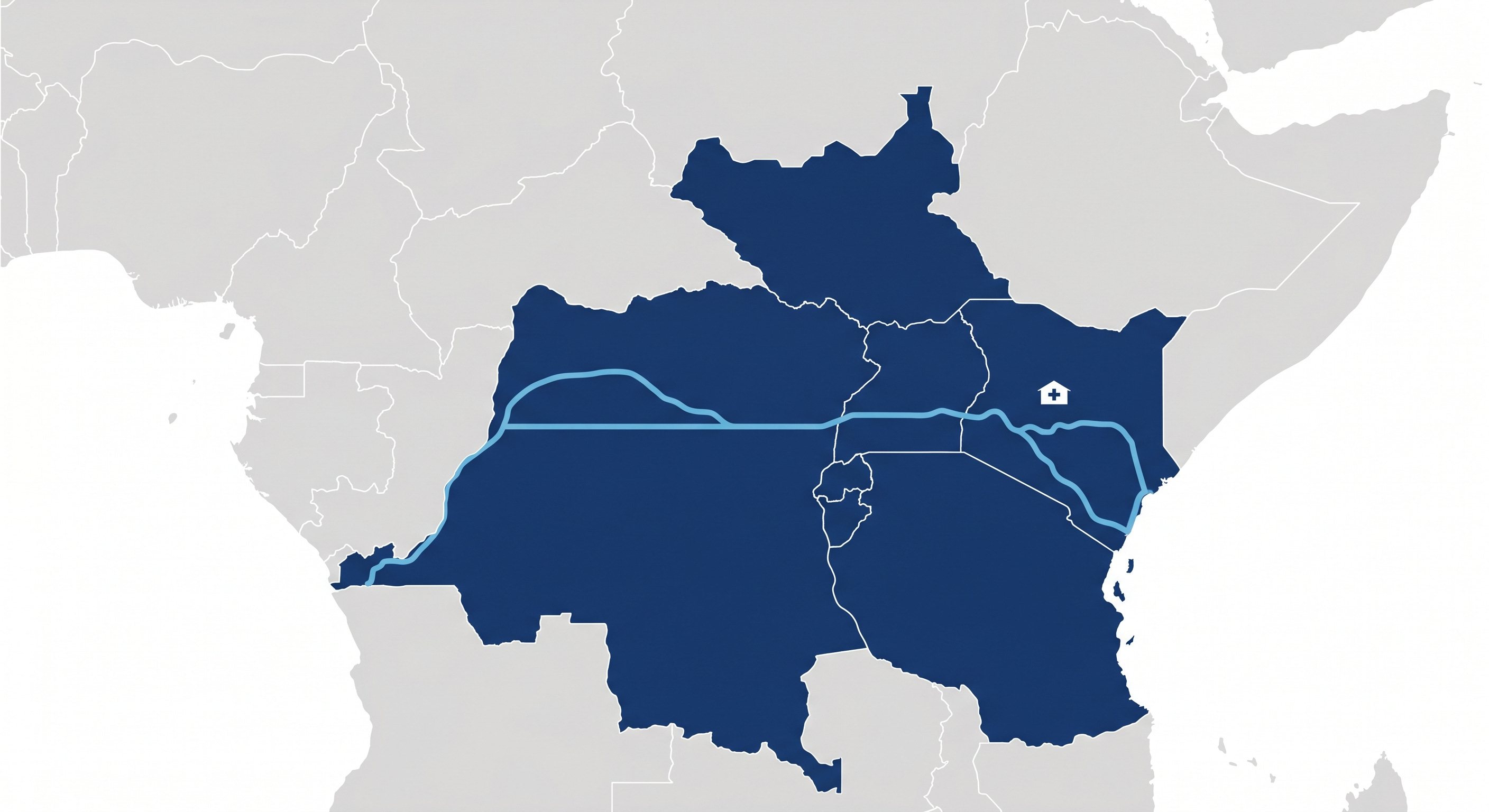
AI-illustration: Pick a struggle.
Someone close to the response sent me a message last week. Suspected cases near Eldoret. None confirmed. But surveillance was not keeping pace. The words stayed with me. Kenya is chasing this outbreak, not ahead of it. The trucking corridors are the weakest link.
The Bundibugyo strain has no vaccine. No approved treatment. It presents as fever, muscle aches, fatigue: indistinguishable from malaria or typhoid without diagnostic testing. If it reaches a clinic in western Kenya, the first case will be treated for malaria. By the time the haemorrhaging starts, the contacts are already scattered. It spreads through direct contact with body fluids: touch, care of the sick, burial of the dead. It does not travel through the air. Previous outbreaks have killed between a quarter and half of confirmed cases. Fewer people catch Ebola than caught COVID. Far more of them do not survive it.
The United States requested to build a fifty-bed facility at Laikipia Air Base to quarantine Americans exposed to Ebola in the DRC and Uganda. A Kenya Air Force installation, not an American base. Not patients flown in from Washington. People already in the region.
The public response was sovereignty. Neo-colonialism. Build it in the DRC. Kenya should build its own facility.
Build it in the DRC. In Ituri Province, where the outbreak is centred, where armed groups control territory, where power and water supply are unreliable, where health workers have already been attacked. You do not build a monitoring facility in a conflict zone when a stable allied base exists three hours away by air.
Kenya should build its own. The health insurance scheme we cannot get to work. The surveillance network the EAC established in 2000 that is still without guaranteed funding twenty-six years later. If we could build this, we would have built it already.
The agreement itself tells the story. 24 July 2015. Signed under Uhuru Kenyatta during the Obama visit. Cabinet approved it in April 2016. Parliament ratified it after public participation. The public participation that people now claim never happened. It entered into force on 6 April 2017 with a five-year term. The same legal instrument was activated during COVID to build a quarantine centre at Nairobi Hospital. A different operational setting, but the same agreement. No court intervened. No one took to the streets over it. In April 2022, still under Uhuru in his second term, the agreement was renewed for seven years to 2029. Ruto was inaugurated five months later. He inherited the framework. One president signed it, activated it for COVID, and renewed it. Another activated it for Ebola. A separate health cooperation agreement was signed in December 2025.
That same month the agreement was renewed (April 2022), the DRC signed its treaty of accession to the East African Community. Kenya expanded its open border exposure and renewed its containment partnership in the same breath.
The precedent runs the same way everywhere except here.
In 2014, the United States built ten Ebola treatment units across Liberia. Up to four thousand troops. Five hundred beds. Most were never used. A study later found they still reduced mortality for those who were treated. Liberia accepted it without a court order or a street protest. That same year, South Africa’s National Institute for Communicable Diseases built a diagnostic laboratory near Freetown in Sierra Leone. It was the only diagnostic capacity in the capital for weeks. The NICD trained Sierra Leonean nationals, then formally handed the facility to the Ministry of Health with full documentation: training certifications, equipment inventory, reagent supply, and a capacitation agreement for ongoing support. The lab tested over eleven thousand specimens across two years. Sierra Leonean staff trained by the NICD went on to train ten more nationals. China sent a mobile laboratory to the same country weeks later. Three foreign nations operating containment infrastructure on African soil during an active outbreak. No sovereignty crisis.
Yes, the Laikipia facility is designed around exposed Americans. That is what the agreement provides for. It may never receive a single patient. The outbreak may be contained before anyone is evacuated to Kenya. But the infrastructure will remain on Kenyan soil regardless. The Sierra Leone precedent tells you what can follow: equipment, diagnostic capability, a facility that did not exist before. That precedent worked because the NICD built local capacity from the outset. The umbrella agreement itself contemplates the same. Article IX requires the parties to agree on transfer and sustainability of goods and services. Article II names technology transfer, Kenyan capacity building, and human resource development as stated purposes. These provisions survive the agreement’s termination. The framework provides for Kenyan benefit. The question is whether Laikipia’s implementing terms honour that commitment. The progressive conversation is not whether this facility should exist, but what safeguards ensure the agreement’s promises are kept and what safety protocols protect surrounding communities. None of this is new to the continent.
A CDC study last year found that fifty-six per cent of Kenya’s mpox cases were linked to the Mombasa-to-Malaba trucking corridor: the same corridor that connects through Uganda to the DRC. The DRC is now inside the EAC. The corridor is not theoretical. A different pathogen has already used it. And who actually dies from Ebola? The historical record is clear. Local populations without containment infrastructure bear the highest cost.
The agreement was signed and renewed under one president across two terms. The opposition arrived under another. The question is whether the outrage is about the facility or the man. The virus does not read the politics. The corridor is open either way.
Ebola is the trigger. The pattern is the point. A continent signs integration frameworks at summits and refuses the infrastructure they demand, even at no cost. We celebrate the DRC joining the EAC for its minerals, its markets, its hundred million consumers. A bloc that stretches from the Indian Ocean to the Atlantic. And then pretend the disease corridor does not come with it.
Pick a struggle.