

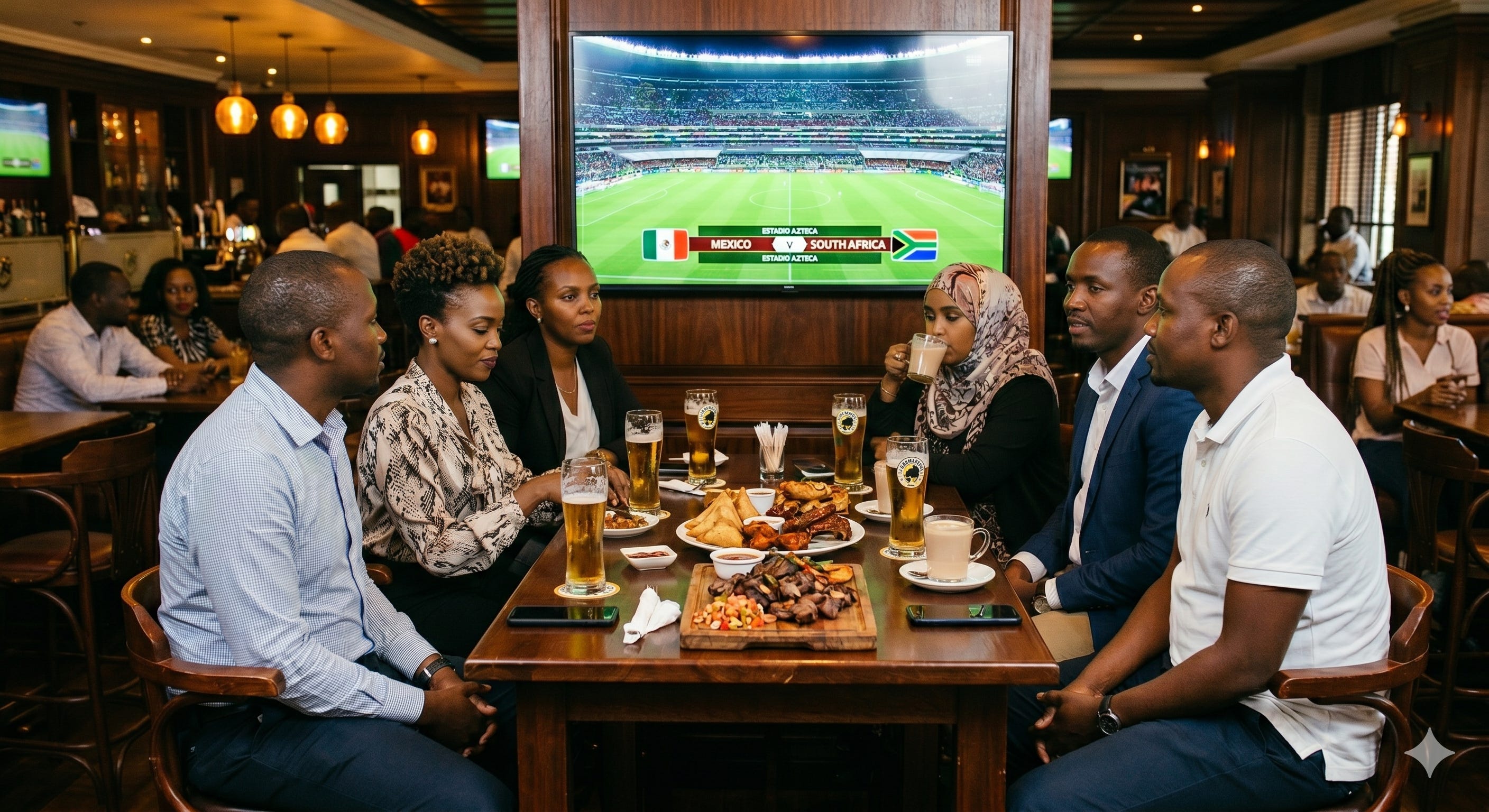
AI-illustration: The Table That Did Not Hesitate
I watched Mexico play South Africa at a spot in Nairobi on 11 June 2026, old high school friends around the table, the Estadio Azteca filling the screen. It was the same fixture that opened the 2010 World Cup at Soccer City, sixteen years earlier, when Siphiwe Tshabalala struck that goal and the continent rose because it was Africa’s tournament. No one needed to be told who to support. The continent had a team, and the team wore yellow.
Mexico won this one 2-0. The table I was at did not hesitate. And in group chats and living rooms and bars across the continent, Africans cheered for Mexico. They chose the other side, loudly and without apology. Two-nil was a receipt.
The solidarity South Africa once held as continental inheritance has been spent. Not by South Africans broadly. Most South Africans are watching this with the same discomfort the rest of the continent feels. The people who spent it have names. Herman Mashaba and ActionSA. Floyd Shivambu and the Afrika Mayibuye Movement, who on 15 June sat down with March and March to coordinate an anti-immigration campaign running through to election day. Operation Dudula. March and March itself, the group that set the deadlines and organised the street marches. A nativist flank that learned from the EFF’s unravelling that owning the immigration grievance wins seats, and that local elections in November are close enough to harvest. They handed the world footage of burning shops and vigilante deadlines and a vocabulary that stopped distinguishing between undocumented and foreign somewhere around April. The targets are black African foreigners. Nigerian, Malawian, Zimbabwean, Mozambican, Congolese, Somali. Sit anywhere else on the continent and that sentence reads one way. It reads like apartheid with a different author. Dig underneath and the selection is more specific. Black African migrants are the ones physically present in the informal economy, the township shopfront, the construction site, the space where the tension lives. White foreign investors buying rental properties in Cape Town are not in those spaces and not in the country for long enough to be a target. The violence follows geography and economic niche. But the vocabulary does not, and that is where the danger lives. “Illegal immigrant” became “foreigner,” and “foreigner” became a word that means every black person who speaks the wrong language in the wrong township. At that point a Shangaan or Venda South African citizen can become a target in his own country. That is where the conflation crosses from immigration enforcement into something South Africa should recognise from its own history. Anti-immigrant groups have now set 30 June as the date by which undocumented foreigners must leave. That deadline is ten days away. This story is not behind us. It is arriving.
And the numbers underneath it are smaller than the noise suggests. Census 2022 counted 2.4 million foreign-born people in South Africa, 3.9 per cent of the population. Mid-year estimates have put it nearer four million, roughly 6.5 per cent. The UN said 4.2 million in 2019, around 7 per cent. So foreigners are somewhere between 4 and 7 per cent of the population, depending on the count. The legal-illegal split nobody credibly knows. The 15 million figure Mashaba put into circulation was a World Bank count of people in South Africa lacking any proof of legal identity, South Africans included. It was never a count of foreigners. Africa Check debunked it. Mashaba backtracked. But the number had already done its work, and one of the named actors leading this wave built his platform on a misappropriated denominator.
South Africa's sports minister, the man who told the continent's migrants abahambe, go home, and who faced a criminal complaint for incitement over it, recently stood in front of cameras and drew the one line his own movement would not: don't fight crime by committing a crime. That is the whole of it. Every citizen on this continent has the right to press their government to enforce its own laws. No citizen has the right to enforce those laws with their own hands. Immigration must be lawful and controlled. A state that cannot determine who enters or stays has surrendered a function no citizen should have to reclaim. But the migrant who entered lawfully, and the citizen whose ethnicity makes them look foreign, are owed the full protection of that same law. Dignity and order are not opponents. They are the same system. The lawful enforcement grievance underneath the violence is not imaginary. The position is shared across the continent and written into statute nearly everywhere. The instruments differ, capital thresholds in some countries, reserved-sector lists in others, blanket prohibitions in a few, but the destination is the same: citizens trade first. That principle is sound. Protected space for local enterprise is how economies develop. Capital must serve sovereignty, not hollow out the citizens it is supposed to lift. The question has never been the principle. It is enforcement. Zimbabwe’s Statutory Instrument 215, passed in December 2025, reserves more than a dozen sectors for citizens and prices foreign entry into retail at twenty million US dollars. Ghana bans foreigners from market stalls outright, prices trading-company entry at a million dollars, and its own traders’ association still estimates foreigners control sixty per cent of local commerce through fronting. The statute exists. The enforcement does not. Ethiopia barred foreign retail entirely for over fifty years and only cracked its doors in 2024. Kenya prices its investor permit at a hundred thousand dollars. The same principle runs from the township shopfront to the copper mine, where local-content rules force procurement quotas on foreign operators for the same reason. The scale ranges too. A township spaza turning over a few thousand rand is not an Eastleigh wholesale floor moving containers from Dubai, and neither is a formal supermarket chain. But the citizen’s grievance at each level is the same: someone else is standing where I should be. South Africa is closer to the liberal end of this spectrum than the strict end. That is the irony.
The most-targeted nationalities in this wave come from the strictest regimes. A Zimbabwean running a spaza shop in Soweto is exercising a freedom Zimbabwe denies foreigners at home behind a wall South Africa never built. An Ethiopian trader in Durban spent his working life under a state that would never have let a South African do the same in Addis Ababa. The grievance about who owns the township shopfront has a statutory foundation in nearly every African country. South Africa’s distinction is not having the rule. It is having no lawful, visible channel to enforce it. The state criminalised the workaround, fronting, where a citizen name sits on a foreign-operated shop, and still could not hold the line. So the enforcement migrated to the mob. The mob’s own justification is simple: the law requires five million rand to operate a foreign-owned business. The spaza owner does not have it. The state will not act. So they do.
That failure is self-inflicted, and it runs from top to bottom. The state built the continent’s most extensive race-based economic redress architecture at the corporate summit. Legislated, scored against a points card, gatekept through procurement codes that reach deep into the formal economy. Broad-based by name. Concentrated around a connected elite by outcome. And while that machinery consumed political capital and institutional energy at the top, the survival floor was left exposed from two directions. The laws that existed, the business visa threshold, the fronting prohibition, the trading licence requirement, sat unenforced since they were written. And the laws that other African states built to protect their own citizens at the survival level, reserved-sector lists and citizen-first trading frameworks, were never created in South Africa at all. Some of that was neglect. Some of it may have been deliberate, a post-apartheid government repaying the countries that sheltered its exiles by looking the other way when their nationals filled the township shopfronts. Either way the space was open, and the people who filled it did what anyone would do. A migrant who sees demand and no barrier enters. That is not a crime. That is an economy working as economies do. But the frustration built year after year while foreign-owned spaza shops undercut local traders who could not match the supply chains. The redress went where the poor were not. The violence broke out where they were. The enterprise gap at the survival floor is the same firm density problem that confronts the continent at every level: an economy that cannot create enough firms for its own citizens cannot absorb anyone else’s.
Perhaps there is a structural patience owed here. One after another, post-colonial African states went through a commercial nationalism phase within a decade or two of independence. Ghana expelled 200,000 immigrants in 1969, twelve years after independence, driven by the same forces burning through South Africa today: youth unemployment, foreign dominance of informal retail, a state that had not yet built the enforcement architecture. Kenya passed its Trade Licensing Act four years after independence. Nigeria its Indigenisation Decree twelve years after. Uganda expelled 80,000 Asians ten years after. Each country legislated or expelled its way through the transition, sometimes brutally, sometimes lawfully, always driven by the same pressure. South Africa’s democracy is thirty-two years old. It never went through that phase. Apartheid destroyed Black commercial networks more recently and more completely than colonialism did elsewhere, and the post-apartheid state rebuilt upward through BEE rather than downward at the market stall. What the continent is watching may not be an aberration. It may be a delayed post-colonial transition arriving without the legislative architecture the others built in theirs.
What do you do when citizens are tired? When the law exists and the state will not enforce it and the courts move slowly and the shops keep opening under someone else’s name? That is the question South Africa cannot answer and the rest of us pretend does not apply to us. The enforcement gap is not South African. It is continental. Our own reserved-sector statutes sit in our own gazette archives, unenforced, while our own citizens absorb the same pressures. South Africa cracked first because South Africa’s formal unemployment rate is among the worst on the continent. It will not be the last. Sixty-five per cent of Africa is under twenty-five. Uhuru Kenyatta warned years ago that Kenya’s youth bulge, if not properly handled, is a time bomb that can blow the country to pieces. At Makerere last year he told the continent’s youth the same: no one is coming to save you. In Kenya, those numbers filled the streets in June 2024 over a tax bill and again in June 2025 over a police killing. Both times the anger was aimed at the government. It has not yet been aimed at the shopkeeper. But the distance between a finance bill protest and an Eastleigh shopfront is one political entrepreneur harvesting the frustration, and if South Africa has shown us anything, it is that the entrepreneur always arrives. Whether that entrepreneur is homegrown or whether external actors exploit conditions already ripe is a question the continent has not settled, but the harvest comes either way. In Zambia I have seen the same friction building quietly against Rwandese shopowners in middle and lower-income neighbourhoods, visible online if not yet in the newspapers.
On 16 June, Youth Day, the anniversary of the children shot in Soweto in 1976, President Ramaphosa stood and drew the line the state should have drawn a decade ago. The enforcement concern is legitimate. The scapegoating is not. Do not blame migrants for failures that are South Africa’s own. He said it on the right day, in front of the right memory, after a decade of enforcement silence. Ramaphosa is also not speaking only from conviction. The ANC watched the nativist parties eat into its base and knows November is coming. That speech is governance and it is flank defence, and everyone in the room understood both. The vocabulary had already slipped past the line he was trying to hold. And the world stopped hearing the legal argument underneath and started seeing only the field in Durban and the deaths the WHO chief was publicly citing while Pretoria disputed the causes.
The damage runs outward now. South African artists are losing bookings across the continent. South African companies are facing consumer backlash in markets they spent decades building. The continent that once gave South Africa shelter, that hosted its exiles and armed its liberation fighters and turned its stadiums into fundraising grounds, is recalculating. Not with the same violence. With something quieter and harder to reverse. A withdrawal of goodwill that no trade agreement can legislate back into place. Open borders cannot outrun broken enforcement. A continent whose member states cannot enforce their own trading laws at the survival floor is not ready to dissolve the borders between them. The integration that works will come through coalitions of the willing, not continental declarations that run ahead of domestic capacity.
I watched that match in Nairobi, and the table did not hesitate. The choice was instant and unanimous and carried no guilt. That tells you how far the account has been drawn down. Sixteen years ago the continent lent South Africa its full voice. The loan has been called in, and the balance is not there.
And if we are honest about what we felt at that table when Mexico scored, not all of it was outrage on behalf of the people in that Durban field. Some of it was relief that the footage, this time, was not ours.
But it is ours. In Nairobi’s Eastleigh, the same stresses are building under a different flag, and the same collapse of categories is already running. The KRA is cracking down on Somali-owned businesses for cash trading and tax non-compliance. That is a legitimate enforcement concern. Separately, federal prosecutors in Minnesota convicted individuals in a fraud scheme and traced proceeds to Kenyan real estate. That is a specific criminal matter. And in January Rigathi Gachagua, the former deputy president, stood in a Kiambu church and took a real case, federal convictions and a money trail that did reach Kenya, and collapsed it into a specific accusation: that BBS Mall was built on stolen money, that its owner is tied to the president, and that Trump should bypass extradition and come collect. The fraud was real. The leap from convicted defendants in Minnesota to a named mall in Eastleigh has not been established. The mall's owners filed a hate speech complaint with the National Cohesion and Integration Commission. Months later Duale, himself Somali, named the prejudice underneath it all: Gachagua's message was clear, he said. Somali wealth is criminal wealth. That was the accusation the former deputy president had planted, and it had already taken root. In South Africa they call the workaround fronting: a citizen registers the business, a foreigner runs it. In Kenya the risk runs deeper: the front can become citizenship itself. The Standard newspaper just exposed a cartel inside the Immigration Department selling Kenyan identity documents for a hundred dollars. The vocabulary is doing in Kenya what it did in South Africa. Fraud became tax evasion became Somali immigration became Somali. And Kenyan Somalis born in Garissa and Wajir are not immigrants at all. They are citizens whose ethnicity is being collapsed into a foreign threat. In South Africa the conflation ran from illegal immigrant to foreigner. In Kenya it has already reached past immigration into the citizenship of our own people. No one has been burned out of a shop yet.
Our own laws are just as unenforced. Our own citizens are just as tired. Our own streets are held together by the same fraying patience. We are not watching South Africa from a distance. If we are not careful, we are watching an early print of our own footage.
May we be better than what we cheered for.