

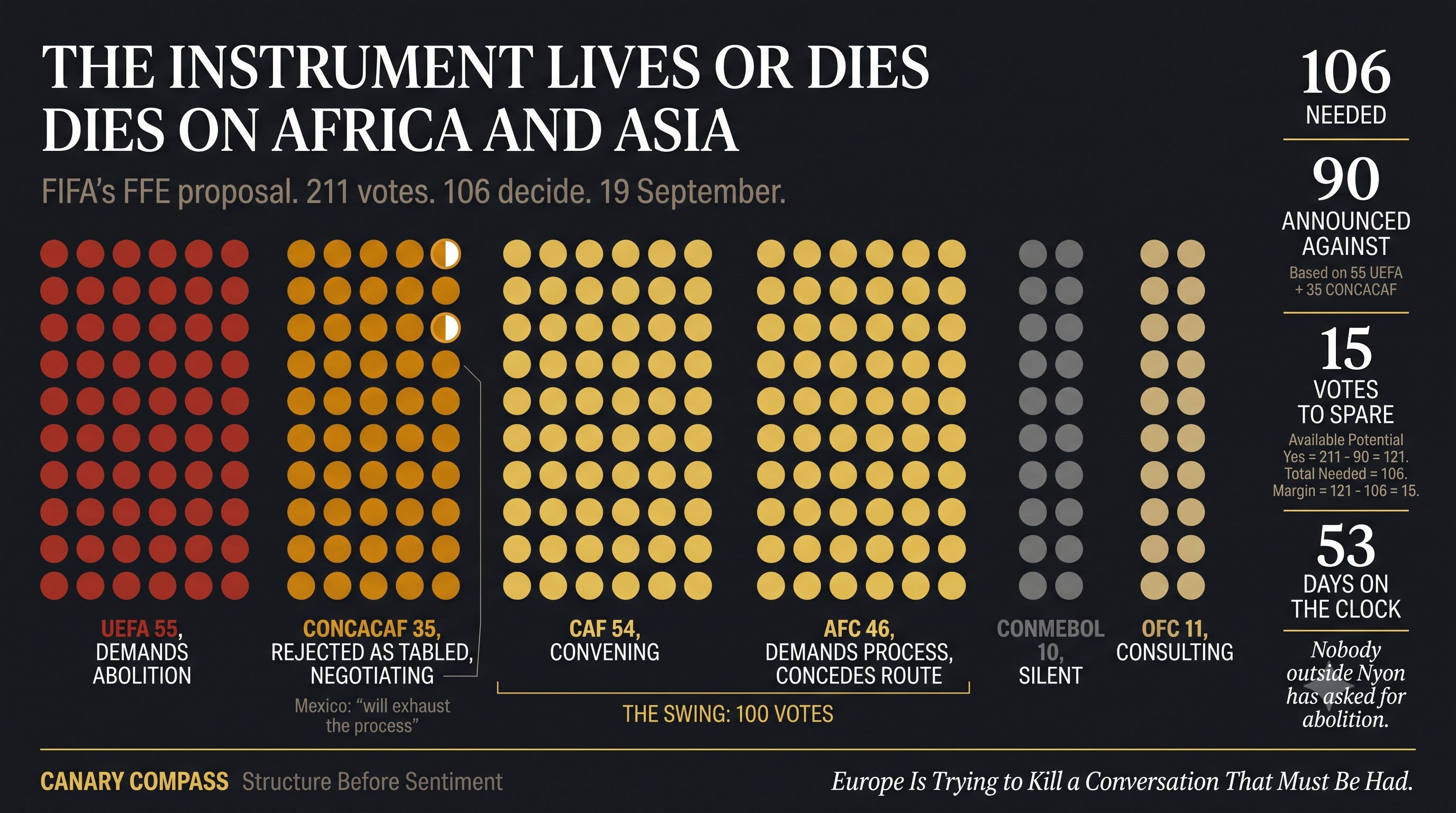
AI-illustration: 106 decide. 90 announced against. 100 votes, Africa and Asia's, still on the table. Nobody outside Nyon has asked for abolition.
It is defending control of the game's future. FIFA priced the periphery's consent at USD20m per association; Europe moved to kill the market rather than argue the price. On the absorber, the surplus confederation, and the levers the 156 already hold. The instruction to the 156: not yet, at a price.
When more than five outlets run the same equation on the same morning, and the reporters adjacent to European football run it louder still, I go fishing.
The equation was the World Cup, for sale. Yahoo had a stake in the World Cup sold to investors. CBS had FIFA wanting to sell a World Cup stake. The Hollywood Reporter had a World Cup sell-off plan. Sky had part of FIFA sold off. CNBC opened by declaring the World Cup officially for sale, at least a portion of it. Those five are the exhibits rather than the census; the chorus ran wider, and the commentary layer cried murder before the document was read. The document those headlines described says something narrower: a minority stake in a commercial subsidiary, reported at 20 per cent, with FIFA holding board control and every sporting power reserved.
The CBS piece printed FIFA’s clarification in its own body copy. Investors would hold a minority position, take no operational role, and buy into a subsidiary rather than into FIFA. Then it headlined the sale anyway. The headline is what travelled; that is what headlines are built to do.
Three weeks ago I wrote about an institution that had made its questions unanswerable, and what the silence was worth to it. Last week I wrote about a sovereign that found a counterparty unable to refuse, and priced it accordingly, and I asked you to keep that sentence. Bring it back out. This week FIFA found 211 counterparties and priced their consent at USD20m each. Then it moved a second time, by circular rather than release, putting 53 days on the clock and attaching USD40m to a signature. And Europe, which has spent the past decade selling versions of what it now calls unsellable, moved to kill the market rather than argue the price.
This essay argues that the proposal is structurally right for the 156 associations outside Europe, right in its route rather than in its unpublished instrument. It argues that it is right only on conditions FIFA has not yet granted. And it argues that the loudest objection in world football this week came from the one confederation whose business model the proposal threatens. That last claim is the aggressive one, so the evidence carries it stage by stage. None of it requires a theory of anyone’s heart.
And the game tree of a kill is the stake under everything here, so state it from the start. If Europe’s demand succeeds and the instrument is killed, the periphery’s consent goes unpriced and the question is barred from being asked again. The funding reverts to the grant path, roughly USD10m a cycle on FIFA’s own letter. And the veto that killed it stands ratified without ever being voted on. The full case for that tree is argued at the close of the Case Against FIFA, and it is priced again where the conditions are set.
The essay is long because the record is, so here is the route for a reader with ten minutes. The veto finding, a demand written to be refused backed by 55 votes of 211, sits in Other Confederations Negotiate, One Vetoes. UEFA’s own test failing at home sits in UC3. The vote board and the ten conditions, with the core and the redlines marked, sit in The Conditions. The boycott’s geography, which points at Europe’s own hosts, sits in the Close. CONCACAF’s homework, the envelope arithmetic run on FIFA’s documents, sits with the confederations. Everything between is the evidence, and the evidence is the point.
The Document and Its Description
The record first, because the reaction has mostly been to the headline rather than the structure.
The Times and the Financial Times both carried it on the morning of Tuesday 28 July. The FT reported, from two sources familiar with the matter, that FIFA planned to sell a stake in its commercial operations. The Times carried an unnamed senior football figure calling the plan potentially worse than the European Super League. At 15:00 Zurich time that same day, FIFA published. The frame was set before the institution spoke, and who set it is unknown. What the chronology establishes is that FIFA published mid-stream rather than by choice. Friday’s clarification confirms it from FIFA’s side: a planned consultation, disrupted by what it calls incorrect reports, now to proceed. Grant that defence its full weight, because parts of this essay depend on granting it: an interrupted timetable excuses missing documents, and what it cannot excuse is prosecuted where the deadline is.
What the release says. FIFA Forward Enterprise, a FIFA-owned subsidiary, would consolidate FIFA’s commercial rights across broadcast, sponsorship, ticketing and licensing with the operational delivery of its tournaments. FFE would raise up to USD 4.2 billion this year against an initial equity valuation of USD 20 billion, selling minority, non-controlling interests. FIFA retains sole control through majority board representation and exclusive authority over governance, competitions, the match calendar and all regulatory and sporting decisions. Thrive Eternal, Joshua Kushner’s permanent capital vehicle, is expected to lead the investor group. J.P. Morgan is engaged alongside FIFA. Greg Maffei, who ran Liberty Media through its ownership of Formula One, has been the key commercial adviser. Reporting adds two sizing facts the release does not state: the FT puts the stake at 20 per cent, and the USD 20 billion is reported as J.P. Morgan’s estimate.
Before the new money, the old machine, because Fast Forward only makes sense against what Forward is. Forward is FIFA’s development programme, and it is criteria-gated rather than a cheque. A base allocation rises through increments earned by employing a general secretary and a technical director, running men’s and women’s youth leagues, and maintaining governance, grassroots and refereeing programmes. All of it sits under contracts of agreed objectives and the audit machinery this essay returns to. Alongside it runs the Talent Development Scheme: USD 200 million of implementation funding, academies written into the permitted uses, and an initial target of 75 associations operating a high-performance academy by 2027. The machinery already funds formation specifically, not administration alone.
Its trajectory is the part the week’s coverage never mentions. Forward grew from under USD2m per association to USD8m over about a decade, funded from operating revenue. That trajectory is not a growth ceiling; it is a pass-through choice. Across the same stretch cycle revenue grew by nearly three quarters on the FT’s floor, to more than USD60m per association per cycle across 211 members, and the amount passed through reached USD8m.
Keep the rails distinct from here. USD8m is the current pass-through and, on FIFA’s release, the budgeted next cycle. Roughly USD10m is where the no-deal path was already rising on FIFA’s own letter, and USD20m is the offer. The first two figures come from two FIFA documents that do not quite agree, the release budgeting 8 and the letter projecting 10 for the same cycle. And when this essay says the uplift, it means one thing only: the recurring rise in Forward from USD8m toward USD20m and beyond, never the one-off the raise funds.
And meet the hardest objection to the uplift where it lives, because it will be asked in exactly these words. If this money already touches African federations, why do players still chase unpaid bonuses through the press? Separate the rails again before answering, because the question conflates two economies. Forward is not a federation’s payroll. It is criteria-gated project money, released against contracts of agreed objectives, with procurement thresholds and forensic audit powers. Its criteria, the ones listed above, are themselves institutionalisation paid for: the secretary employed, the director employed, the leagues run. The bonus scandals live in the other economy, the unaudited cash of gate receipts, subventions and prize money, where weak federations run weak treasuries.
That failure is real and this column has never excused it. Kenya’s government dissolved its own federation in 2021 over misappropriation allegations, FIFA suspended Kenya for the interference, and the tap stayed frozen until reforms passed audit in December 2025. Read what the episode certifies: the machinery catches, freezes and conditions. So the answer to weak federations is not less contracted money; it is more of the federation’s economy moved inside the audited perimeter. Deployment-gated scale does that, and discretionary trickles never did.
And read the moment as the opportunity it is, because the same consent that prices Europe’s conduct can price the periphery’s own reform. A federation that takes the uplift takes the audit perimeter with it: published accounts, contracted deployment, treasuries built to hold real money. The 156 should not endure that discipline as the cost of the cheque; they should demand it as part of the instrument, because the wastage is their own players’ money first. The sixth condition below exists to write exactly that.
The proceeds of FFE fund two things against that baseline. An optional one-off of up to USD20m per member association through a new Fast Forward Programme, whose allocation rules are unpublished. And a repositioning of Forward itself from USD8m per association to USD20m for 2027 to 2030, USD22m the cycle after, USD24m the cycle after that.
Set the two clocks side by side. A decade of discretionary pass-through added more than USD6m per association. The capital route writes USD12m per cycle above the current budget, plus the one-off, into an offer that requires the periphery’s signature. The difference between the clocks is not that money appeared; it is that a mechanism did. No member has ever been able to oblige FIFA to distribute one dollar more than it chose, and a proposal that needs the members’ votes is the first tabled mechanism that can carry an obligation. And be precise about the new number, because the offer is not a budget FIFA holds. On FIFA’s own Friday words, the 20m rides on additional revenues FFE has yet to generate, which is why it comes to the floor for approval instead of appearing in a budget line. The 156 can write their price into the instrument as the condition of their yes, which no budget line, however generous, has ever let them do.
What stopped FIFA across that decade was never the balance sheet; the pass-through crawled while the surpluses banked. A discretionary allocation is leverage, and no institution converts its own leverage into an obligation unprompted. And answer the question that follows before anyone asks it: if the 156 hold 74 per cent of the votes, why did they never simply vote themselves more? Not because they could not table it; the statutes let any member put a motion to Congress. Because a money motion needs the budget machinery behind it: Congress approves the budget the administration prepares, and a member’s motion arrives without the machinery. Because a majority that Europe’s market power can nullify is a petition, which is the Ladder’s whole subject below. Because money given at discretion disciplines its recipients; nobody outvotes the hand that allocates. And because a discretionary system has clients as well as a patron. For a federation president, proximity to the allocator can pay better than a rule that pays every federation the same, so the demand for rules kept losing to the market for favour. That is not a slur on anyone; it is what discretion does to an electorate, and it is one more reason to prefer a contract that makes proximity worthless.
FFE breaks every one of those locks at once. The administration has, for once, tabled the obligation itself, with the financing architecture only an administration can build. The cost of nullifying it now sits on Europe’s side of the ledger; and the conditions below convert the discretion into a contract. That mechanism, not the money, is the entire reason the equity conversation exists, and it is what every alternative has to beat. An alternative without a consent moment is a return to the grant, money that arrives at the giver’s pleasure and can leave the same way. Approval requires a majority of the 211 member associations, which is 106, plus the FIFA Council, and that requirement is where the price gets written.
Now the arithmetic, run from numbers FIFA itself published. The release says the raise finances the new programme; multiply it out. Two hundred and eleven associations multiplied by USD20m is USD 4.22 billion, against a raise of up to USD 4.2 billion. The FT’s 20 per cent of USD 20 billion implies USD 4.0 billion; to within roughly five per cent, the raise and the one-off are the same object. The equity sale funds the one-off consent payment, and on the release itself that is the raise’s one specified use. The recurring uplift, USD 2.53 billion every four years, is funded by nothing in the raise. It is a claim on operating cash flow FFE has yet to generate above what FIFA’s current operations already fund. The Friday statement says so in FIFA’s own words: the increased funding would come from additional revenues generated by FFE. That sentence is why seniority stands first among the conditions.
Then the valuation. FIFA’s current four-year cycle carries at least USD 13 billion in revenue by the FT’s count, against USD 7.6 billion the cycle before. Its approved 2027 to 2030 budget foresees USD 14 billion, and its own projections, which this publication has already carried, run past USD 15 billion. Annualised, that is USD 3.25 to 3.75 billion, and a USD 20 billion valuation on that base runs five to six times annual revenue. Formula One earned roughly USD 3.4 billion in 2024, a commercial base of the same order. Liberty Media acquired F1 at USD 8 billion of enterprise value in 2017 and the business now carries an enterprise value above USD 26 billion. The man who executed that trajectory is advising this raise. The route ran through more races, destination events, sprint formats and direct-to-consumer distribution. The USD 20 billion reads as a Formula One comparable, and the architect of that trajectory is in the room. The valuation is therefore a wager on expansion, inferred from the documents rather than disclosed in them, and the fourth condition exists to force the wager into the open. Ask which lever pays it back, and note what sits inside FFE’s perimeter alongside the World Cup: the Club World Cup, Europe’s direct competitor in FIFA colours. Most of what follows follows.
And the comparable’s full record cuts both ways. F1’s fanbase grew 63 per cent and its attendance rose from 4.2 million in 2019 to 6.7 million in 2025. Prices rose fastest at the top, general admission up 2 per cent in 2025 against 8.2 per cent for the main grandstands. Growth and premiumisation arrived together in the precedent FIFA’s adviser built, which is why the free-to-air floor sits among the conditions rather than the hopes.
Maffei gave the FT an interview this week defending the plan, and one sentence in it deserves more attention than the rest of the coverage combined. He was appointed, the FT reports, partly for his F1 experience, a sport that manages commercial rights while being regulated by an external body. Read that twice. Formula One’s structure is defensible precisely because Liberty runs the commerce while the FIA, a separate institution, regulates the sport. The FIA’s president does not chair the commercial company, and F1’s rulebook cannot change on the commercial owner’s vote alone.
Now place FFE’s allocation beside it: FFE runs the commerce, FIFA controls FFE through a majority board, and FIFA reserves every regulatory and sporting decision to itself. FIFA will call that reservation the separation, and the release words it as one. It is a departmental line, not an institutional boundary. The reserved authority sits with the commercial vehicle’s majority owner and, on the FT’s reporting, its chairman, so investor pressure on the calendar lands on the body that writes the calendar. The hydration record below shows what the fused authority already does to its own rulings with no shareholder present. The fusion is older than the proposal, and what FFE changes is that the fused body acquires shareholders.
And football cannot mint an FIA, because FIFA is its 211 members, which is the deepest structural problem stated in full below. So the regulator this essay proposes is the only one available: the members themselves, contracted. The golden share, the ratchet and the consent rules among the conditions make the electorate the calendar’s regulator, so the calendar cannot change on the commercial side’s vote alone. The defence’s own chosen precedent contains the safeguard the structure lacks, and the conditions exist to write its football equivalent. The FT adds, from a person familiar with the proposed governance, that the FIFA president would chair the FFE board. Reported, single-sourced, undenied in the same article where FIFA’s adviser speaks on the record. It stays as reported, and the eighth condition converts it into a demand.
What Europe Already Sold
That gap between the document and its description is what sent me fishing, and what I found is that most of what Europe now calls unthinkable is already European practice.
LaLiga sold 8.2 per cent of a new commercial vehicle to CVC for just under EUR 2 billion, on a fifty-year term. Ligue 1 sold 13 per cent of LFP Media to the same firm for EUR 1.5 billion. The Bundesliga attempted the same and abandoned it in February 2024 after supporter protests, with CVC the last bidder standing. Serie A is sounding out private capital again this year. Market research by PitchBook puts private equity, venture capital or private debt behind more than 36 per cent of clubs in the big five leagues. Clearlake holds 60 per cent of Chelsea. RedBird owns Milan. Oaktree took Inter when Suning defaulted. Ares holds a third of Atlético. Qatar owns PSG, Abu Dhabi owns City, and the Saudi state owns Newcastle. Three Serie A clubs are majority owned by private equity firms.
So the structure is unremarkable and the counterparty is familiar. Two of Europe’s largest leagues have executed longer-dated versions of the FFE trade, and no emergency meeting sits on any public record for any of it. Neither transaction is UEFA’s, which is the point rather than a defence: both ran inside the jurisdiction whose custodian now declares such structures unsellable, and custodianship is judged by what it moves for.
The objection I have now heard several times runs that a national league is one thing and a competition between countries another. It would carry weight if UEFA’s own position rested on it, and it does not. UEFA’s statement objects to ownership interests in competitions as a category, and it could not draw the club-country line anyway, because of what sits inside its own accounts.
UC3
In May 2017 UEFA created UEFA Club Competitions SA as a subsidiary with a board composed of UEFA and club representatives, initially an advisory vehicle. The relationship deepened by stages until UC3, as it is now branded, fully manages the sale and delivery of all media, sponsorship and licensing rights. That covers the Champions League, the Europa League, the Conference League and the women’s club competitions. Its offices opened for business in January 2025 and it has appointed Relevent to sell the men’s rights through 2033.
UC3’s own website describes UEFA and European Football Clubs, the body representing more than 800 clubs, as its two shareholders, and states that the two are equally represented on its Board of Administration. Whatever the equity split, and it is unpublished, the clubs hold board parity in the vehicle that manages the competitions they play in. Miguel Poiares Maduro, formerly Advocate General at the European Court of Justice and chair of FIFA’s own governance committee, puts EFC at 49 per cent. I cite the figure as his because UC3’s terms are not in the public domain, and a former chair of FIFA’s governance committee had to say so publicly. FIFA is proposing majority board control over FFE. UEFA already granted board parity inside UC3.
Now apply UEFA’s own test to its own vehicle, clause by clause, because the statement supplies the standard and the record supplies the verdict.
The statement says that once external parties hold ownership interests in competitions, every decision on the calendar and on formats answers to shareholders rather than the game. Apply it. EFC co-owns the commercial vehicle of the competitions its members play in, and it holds two seats on UEFA’s Executive Committee. That committee gave final approval to the 36-team format, its access list and its calendar, with 64 additional matches, on 10 May 2022, with the ECA’s chairman sitting on it as the clubs’ representative. UEFA’s own release records the decision as unanimous and notes the reform’s backing by the ECA Board and by a Club Competitions Committee composed of a majority of club representatives. The shareholder was in the room for the calendar decision, and the room was unanimous. And this counterparty is worse than the one UEFA is warning about, since a passive fund holds no view on who wins, while EFC’s members compete in the competitions whose commercial rights they co-own.
Antoine Duval, the most serious legal critic of FFE in this record, defended UC3 on the ground that EFC represents clubs rather than external investors. Maduro’s rebuttal is on the record: a private entity dominated by elite clubs, the differences legally marginal. Whatever the differences amount to in law, UEFA’s stated harm answers the defence by itself. The harm runs through influence over calendar and format, and UC3’s architecture grants its counterparty more of it than FFE’s would, parity in the commercial vehicle plus seats on the regulator’s own executive. A co-equal partner on the regulator’s own executive holds more grip than a non-controlling external minority, passive on FIFA’s own description, under a FIFA-majority board ever could. On UEFA’s own harm mechanism, the shareholder’s mailing address is the only axis on which FFE looks worse, and it is the one axis that mechanism does not use.
The residual defence is exit rather than address: a fund wants a liquidity event where EFC’s members want position forever. The second condition below governs exactly that axis, transfers locked, outside holdings capped, the exit written into the shareholder agreement before it can become an incentive. The body was chaired, before its current chairman, by the man who launched the Super League from that platform.
The statement says no one has the moral authority to sell what they merely hold in trust for the next generation. UEFA holds European club football in trust in exactly that sense, and placed its commercial rights in a vehicle co-owned with the clubs that compete in them, on an arrangement running to 2033.
The statement calls FIFA’s deadline governance by intimidation and an act of coercion. Then, in the same document, it issues its own ultimatum: no participation in any FIFA competition until the proposal is abandoned in its entirety and a permanent constitutional bar is granted. Both are ultimatums. UEFA’s is the wider one, because FIFA’s expires on 19 September and UEFA’s demands forever.
The statement says institutions are judged by what they refuse to compromise. Set that against the acceptance record. Abu Dhabi at Manchester City, Qatar at PSG, the Saudi state at Newcastle, CVC at LaLiga on a fifty-year term, CVC at Ligue 1. Add the 36-team format, and multi-club ownership exemptions granted in the same seasons the practice was condemned. And UEFA’s own two-year ban on City overturned at CAS, partly on time-bar grounds, with no emergency meeting on the record for any of it. The reflex has fired at this speed twice in this decade, against the Super League and against FFE, both times when UEFA’s own competition monopoly stood threatened. It has never once fired for where Europe’s money comes from. The emergency response is reserved for threats to the monopoly, and this week’s threat was the transaction that moves money toward the periphery.
Maffei raised UC3 himself this week, naming it alongside the PGA Tour as part of a trend of federations carving out commercial entities. People close to UEFA answered that UC3 is not open to investment. Mark what that defence concedes, and mark what it claims. It concedes the vehicle, the rights inside it, and the board parity. It concedes the revenue ratchet too, which EFC celebrates on the vehicle’s own website: thanks to the joint venture, revenues for European competitions have risen more than 25 per cent to over EUR 4.4 billion. That is the permanent commercial obligation of UEFA’s statement, described by UEFA’s own partner as an achievement. And the defence claims that the line worth holding is external capital, which happens to be the one line that keeps the money inside the club system Europe controls.
I do not claim UC3 and FFE are the same instrument, and the differences run against UEFA on the axis UEFA itself named: FFE’s investor would be passive, external, minority and boarded under FIFA’s majority. UC3’s co-shareholder is incumbent, competing, seated on the regulator’s own executive, and holding board parity. Two axes are claimed for UEFA’s side; read them closely. The constituency is itself owned by the capital it is offered as an alternative to. The funds and sovereigns listed above sit inside EFC’s member clubs, and value routed to the constituents flows to the same external balance sheets. Regulatory separation is claimed by both vehicles on paper; in practice UC3’s counterparty sits on the regulator’s executive and FFE’s investors would not. Where FFE is genuinely broader, folding tournament delivery into the perimeter, the conditions below exist to govern the difference. UEFA wrote the test. Its own vehicle fails it harder than the one it condemned.
The footer of the UEFA.com page carrying the statement links to UC3.
The Pyramid Has One Registry
The separation between club football and national football is administrative; the pyramid is not. One registration system governs all of it, one solidarity mechanism, one set of players. A boy in Nairobi plays for Kenya and for a Belgian club under rules written by the same body. Money that reaches an association builds the academy that produces the player who fills the national team and is later sold into Europe. The top is built from the bottom, which is why the money question cannot be quarantined from the governance question, and why UEFA has not tried.
Three weeks ago I published the headline clause of the ore contract. A club that develops a boy from twelve to sixteen is entitled to roughly 1 per cent of what he later sells for, under a solidarity cap of 5 per cent. A free transfer pays nothing. What follows is the full machine behind that clause, because the machine is the ground this whole dispute stands on.
The weighting first, because it prices childhood precisely. The 5 per cent is split across every club that trained the player from twelve to twenty-three, at a quarter of one per cent for each year from twelve to fifteen. Each year after pays half of one per cent. The twelve-to-sixteen developer’s share therefore runs 1 to 1.5 per cent, and on a EUR 40 million sale, the figure illustrative, that is EUR 400,000 to 600,000. It is paid only if he moves before his contract expires. Training compensation exists alongside it, payable at the first professional contract and on defined moves before twenty-three.
Now the two cohorts, because the extraction has two doors. The player who leaves at eighteen takes the standard route: his releasing club collects a first fee, then roughly 1 per cent of each onward sale. The player who leaves before eighteen passes through Article 19, which prohibits international transfer of minors and then lists its defined exceptions. The most cited of these, parental relocation for reasons unrelated to football, is also the one the literature flags as most open to manufacture. The 2009 provision I cited then, Article 19bis, exists because, in FIFA’s own explanation, clubs were regularly enrolling very young foreign players in their academies without registering them. In some cases the purpose was precisely to bypass the protections. The academic literature carries the rest. Yilmaz, Esson, Darby and colleagues, writing in the International Review for the Sociology of Sport in 2018, find that the exceptions contain loopholes European clubs exploit to recruit from Africa. Legal analysis as recent as last year agrees. The same work finds the 2001 revisions facilitated the importation of foreign youth rather than preventing it. And here is why the second cohort is the worse one. Solidarity for the childhood years flows to whoever holds the registration in those years. Where a European-linked academy captures a boy at fourteen, the entitlement never attaches to an African club at all. The extraction is exclusion from the payment chain, before it is underpayment within it.
Then the business model the doors feed, and here the accounts speak. Liga Portugal has recorded the world’s largest positive net transfer balance of any division over the past decade, EUR 2.25 billion, with income peaking at EUR 616 million in a single season. Roughly 70 per cent flowed through Porto, Benfica and Sporting. Last season Porto’s net player trading came to EUR 82 million against pre-tax profit of EUR 45 million. Benfica closed 2024/25 with EUR 34 million of net profit against EUR 89 million of profit on player sales. Its own interim accounts this April state the dependence outright: excluding transfer income, the operational result would have been slightly negative. At both clubs the trading line exceeds the entire profit of the enterprise, and Benfica’s own accounts say what stripping it out leaves. Below the big three, most Portuguese clubs turn over EUR 5 to 15 million a year. Trading rest-of-world talent is not a sideline of this economy; it is the economy.
Last, the supply geography, stated within the limits of what the data supports. Brazil is the world’s largest exporter of footballers, the Brazil-to-Portugal corridor stood as the game’s most travelled route at 261 players in CIES’s 2019 counting. In the 2022 census only 3.5 per cent of Brazilian expatriates remained within their own confederation. In the census work on African expatriates, African players have run at 3.4 per club in France and 3.3 in Belgium. A 2021 KPMG count put more than 500 Africans across eleven top European leagues, roughly 6 per cent of the player base. Counts by nationality are published. No public dataset splits a league’s transfer income by the origin of the players sold, so I assert no percentage for Portugal. The honest frame is Europe against the rest of the world with Africa as one component of the supply. Expatriates filled 27.3 per cent of squads across UEFA’s leagues in the same 2022 census. Every component of the model is documented: the rules cap what flows back, the exceptions open the early door, the trading clubs book the margin, and the supply arrives from everywhere Europe is not. The assembly is mine; the parts are FIFA’s.
And UEFA runs the same underpayment at home. Its cycle already routes 7 per cent of club competition revenue to European clubs left out of its competitions, so the money exists and it moves. What has never moved is a reward for who trained the players. The Union of European Clubs, formed in 2023 by officials who found the elite club body unrepresentative, asked for exactly that. It wanted at least 5 per cent of those revenues as a development reward tied to who trained the players, roughly EUR 220 million a season. UEFA answered that the matter will be raised when the time is due. The time has not yet been due.
Other Confederations Negotiate. One Vetoes.
Now the reaction, association by association, because the differences are the finding.
CONCACAF’s 41 members, 35 of them voting members of FIFA, rejected the proposal, citing lack of due process, an artificially short deadline, and the absence of a governance review. Then they did something no other body did. They tasked their FIFA Council members with engaging FIFA on whether its existing reserves could raise Forward funding instead, and resolved that any similar initiative must pass through FIFA’s statutory governance bodies. That is a counter-proposal, and it deserves an answer on the merits. Reserves exist to insure a cancelled tournament and were drawn down by three planned deficit years on the way to one. A solvency buffer converted into a recurring USD 2.53 billion development distribution stops being either. The stronger counter is CONCACAF’s own, put in its statement’s words: why private equity, after the most profitable World Cup in history?
So run the homework CONCACAF assigned its Council members, on FIFA’s own documents. The uplift’s increment is roughly USD 2.1 billion a cycle above the letter’s no-deal path. The approved 2027 to 2030 budget foresees USD 14.0 billion of revenue against USD 13.9 billion of investment, so the approved headroom runs near USD 100 million, a twentieth of the increment. And meet the argument that the money already exists, because it points at revenue, and revenue is not a pool. The USD 13.9 billion of approved investment standing against it is the operating architecture itself: Forward to all 211, plus the whole tournament portfolio, men’s, women’s, youth at four age levels, futsal and beach. The Club World Cup alone carries a USD 1 billion prize pool, and competitions delivery, refereeing, development and administration sit on the same line. Strategic reserves, on FIFA’s 2025 statements, sit near USD 2.7 billion, little more than one cycle’s increment; a recurring claim would exhaust them once and then stop.
Three honest routes remain. Cut allocated spending, and FIFA has named no cuts. Bet the uplift on growth beyond the budget, the projection past USD 15 billion this publication has carried, which is a hope rather than a covenant. Or raise capital. FIFA has the money for the path it budgeted; for the uplift, on its own documents, it does not, short of cuts it has not offered or growth it has not banked. And the one-off is harder still: USD 4.22 billion at full take-up, immediate capital on the release’s own word, out of a cycle whose money lands with the 2030 tournament. The expansion the valuation prices is capital-hungry on the adviser’s own F1 route.
Now price the whole of it, leaving the reserves where insurance belongs. Cycle one carries the one-off plus roughly USD 2.1 billion of uplift, near USD 6.3 billion of new obligation against approved headroom near USD 100 million. Through 2038, on the letter’s own projection, the whole delta runs near USD 10.6 billion: the one-off plus roughly USD 6.3 billion of recurring money, which by arithmetical coincidence matches cycle one’s whole bill. No approved budget contains any of it, and the reserves, little more than one cycle’s increment deep, stay untouched or the insurance is gone. That is the honest bill, and it is the size of the reason the proposal exists.
And a discretionary revenue-funded uplift does not bind its grantor: a grant, revocable at the next budget, from the institution whose pass-through record sits above. A statutory distribution formula or a contractually ring-fenced share of tournament revenue could bind from revenue, and FIFA has offered neither. The capital has three customers, the timing, the envelope, the wager, and the periphery’s consent, and only the last writes conditions.
And within hours the bloc itself showed the market at work. The Mexican federation, a co-host of that most profitable World Cup, declined to carry its confederation’s rejection. Its own statement says FIFA’s communication offers working tables to expand the documentation, that the FMF will exhaust the process, and that it will take the decision that most benefits Mexican football. The United States and Canada held the confederation’s line. One member stepping out of a unanimous bloc inside a day is the price mechanism this essay describes, operating on the first afternoon it was permitted to.
Name the alternatives honestly, because equity is not the only binding architecture: Congress could adopt a statutory formula, ring-fence tournament revenue, or capitalise an independently governed development trust. FIFA has offered none of them, which is its own count in the case below; FFE matters because it created the consent moment in which every one of them can now be priced. But an association that counter-proposes is negotiating.
The AFC spoke twice, and the two documents read together are this essay’s position in confederation form. Its public statement of 29 July records that it was not consulted, demands sufficient information and adequate time to assess the governance, legal, commercial and strategic implications. And it acknowledges in the same document the need to explore new ways of strengthening global football. The route conceded, the process demanded. Its president’s letter the next day, seen by Reuters and the Associated Press, went further: FIFA’s unilateral actions appear to undermine the very foundations of continental football. Such an initiative will not succeed without the support of all the confederations, which is not the case now. That is a hold with a door in it, and the largest voting confederation outside Europe and Africa has already named the ground on which it can say yes.
CAF received FIFA’s correspondence, set an Executive Committee meeting for next week, and encouraged its members to examine the proposal and participate in the consultation. OFC did the same for August, inviting its eleven members into the process. CONMEBOL’s ten members have taken no collective position as of this writing. The silence carries a stake: the 2030 tournament opens with centenary matches on South American soil, and the ten votes sit inside the 121 counted below. FIFPRO, the global union, demanded transparency and warned against ultimatums; FIFPRO Europe went further, warning that the proposal would turn the competitions into investable assets and reshape the incentives underpinning the players’ work. Every one of the confederations’ stated positions is fixable, which is the definition of a negotiation.
UEFA’s statement severs itself from that company in its own words: our opposition goes far beyond process. The process objections are real, and this essay prosecutes them harder than UEFA does below; the severance is what UEFA demands beyond them. It demands the proposal abandoned in its entirety and binding assurances that FIFA will never again open its governance or competitions to private ownership. No negotiating institution grants its counterparty a perpetual bar on a capital-raising option. An opening position leaves a door; this statement boycotts first and negotiates never. Refusing the tender is rational, and this essay refuses it below; demanding the option never exist is the act UEFA chose. A demand written to be refused is a veto rather than a negotiating position, and the word is functional rather than legal. It names the power to nullify an outcome a majority approves, exercised here through market means. The statement then asserts the veto’s basis: so long as Europe has a voice, it will never be for sale. Europe holds 55 votes of 211. The constitution confers no veto. The sentence claims one anyway. And by Friday FIFA had said the same from the other side: no single entity can claim to represent all 211 member associations.
And time-stamp the rush, because the speed is its own exhibit. The first riposte left Nyon the same day the document appeared. The emergency meeting convened within forty-eight hours, and the boycott statement published the same afternoon, demanding the abandonment of an instrument whose term sheet nobody had seen. An objection that needs no contents is not an analysis of contents; it is a position held in advance, waiting for an occasion. The confederations that negotiated needed days and asked for documents. Europe needed hours and asked for abolition, and by Friday FIFA was confirming the consultation Europe had refused to wait for. You rush to kill a conversation only when the conversation itself is the threat.
The interior of the meeting that produced this unanimity deserves the record. Miguel Delaney of The Independent, writing sympathetically to UEFA, reports that the meeting never came to a formal vote. Toward the end the president simply asked whether everyone backed the boycott, and there was no show of hands. Only 50 to 60 per cent of countries got an opportunity to speak, and smaller nations including Azerbaijan wanted more. The leadership, he reports, had worked the membership beforehand to hold the line, precisely because the money was persuasive to members of lesser resources. CNN’s account differs, describing more than forty interventions and unanimity, and ESPN’s sources put over fifty of the fifty-five on the floor. The participation figures conflict across the published accounts, and I present the conflict at its widest rather than resolve it. What no account disputes is the output: a statement reading “unanimously and unequivocally” and “stand as one,” issued by a body now lecturing 211 members on democratic process. The Czech federation had already broken ranks the day before, its president seeing pragmatic benefits. The discipline existed because the peeling risk did.
Then the boycott, and here arithmetic from this publication’s June essay applies. I wrote then that the withdrawal lever sits unused in world football because withdrawal lands on the withdrawer. A federation that walks forfeits its players’ one tournament and the revenue its place carries, while the object of the protest stays exactly as it was. For most of the 156, the World Cup is close to the entire football economy their associations touch, so the lever never moves. UEFA can move it for one reason only. Europe owns the club game, the EUR 4.4 billion machine UC3 celebrates, so the World Cup is the smallest share of Europe’s football economy of any confederation’s. The boycott is credible because of the asset this essay indicts. The confederation for whom the tournament matters least threatens to leave it, while the confederations for whom it is nearly everything are asked to stand with the refusal. That is the option value of having already extracted everything else, presented as courage. The asymmetry is material before it is moral, and it is documented above: the confederation that can afford to lose the tournament is the confederation that already owns the game outside it.
And there is a second asset in the boycott’s shadow, named in the documents. FFE’s perimeter covers FIFA’s whole tournament portfolio, and the record specifies the Club World Cup alongside the World Cup. That is the one FIFA product that competes directly with Europe’s club monopoly, expanded last summer to 32 teams and a USD 1 billion prize pool. It was widely read at the time as a direct attempt to rival the Champions League. Capitalise FFE and you capitalise the competitor. This is also where the week stops being novel, because the precedent sits on the record with UEFA’s own reasoning attached. In 2018 Infantino brought a USD 25 billion consortium led by SoftBank to finance an expanded Club World Cup and a new global Nations League. The package died on opposition in which UEFA raised transparency concerns and said the new competitions would threaten European tournaments. Read that last clause again, because it is the confession this essay never has to infer, and note the verb. Threaten is UEFA’s word, from 2018; the thesis of this essay merely returns it. The last time private capital approached FIFA, Europe’s stated objection was the threat to its own tournaments. Seven years later the same actor faces the same instrument and reaches for the soul of the game. The objection aged into a principle somewhere between the two announcements, precisely as the Club World Cup grew teeth.
And the endgame confirms the reading, no longer as a floated name but as confirmed recruitment. The Telegraph, corroborating earlier reporting by Politico, confirms that European football leaders have been trying to line up Nasser Al-Khelaïfi as the challenger for the March 2027 election. Study the portfolio of the candidate the movement sought. Chairman of Qatar Sports Investments and president of PSG, which is state capital. Chairman of beIN Media, which is broadcast money. Chairman of EFC, the co-shareholder of UC3, holding a seat on UEFA’s Executive Committee and, since October, representing EFC at FIFA Council meetings. A movement whose statement declares the game is not for sale, and demands a permanent bar on private ownership in FIFA’s competitions, went recruiting for a custodian. And the custodian it sought chairs the body that co-owns the commercial vehicle of Europe’s own competitions. The objection, as stated, is to ownership of competitions; the candidate co-owns the ownership vehicle of Europe’s, and the rest of the portfolio describes what custodianship looks like in practice.
One senior official told the Telegraph he would back almost anyone capable of removing Infantino, which states the criterion in one word: removal, with reform nowhere in the sentence. Al-Khelaïfi’s representative then declined for him, saying he has no ambition, no intention and no interest in the role, so even the sought custodian will not carry the plan.
And note who else stepped back. EFC’s own statement notes serious concern at the sudden, unilateral media briefings, says it would be wholly appropriate for EFC to be fully consulted on a proposal of such magnitude. And it adds that it always seeks to work collaboratively with all stakeholders. Read the grounds. They are process, consultation and collaboration, which places Europe’s own clubs in the negotiator column with CONCACAF and the AFC. That leaves UEFA’s demand for abandonment in its entirety standing without even its own commercial partner behind it.
And the split is not noise in the thesis; it is the thesis in miniature. The elite clubs earn in both tournaments, playing UEFA’s competitions through the season and FIFA’s expanded Club World Cup in the summer, so they negotiate. UEFA earns only in its own, so it vetoes.
Map the incomes and the positions assign themselves, and run the map on the hardest case. European Leagues, the body for Europe’s domestic competitions, rejected the proposal outright on 29 July, on substance rather than process. Its members’ income sits entirely inside the season FIFA’s expansion invades, which is why the same body was already at the European Commission over the calendar in 2024, and the map assigns that rejection too. Objections ran wider than Nyon all week, from supporter groups to a European commissioner, on process and substance grounds this essay itself prosecutes; what ran through Nyon alone was the demand for abolition. On the record assembled here, the transmission change and the club monopoly explain UEFA’s week without remainder. Every legitimate objection in the record was available in the negotiator column, and UEFA alone went past all of them to abolition. No theory of anyone’s soul is required, which is the standard this essay set at the start. And a governance movement that recruits its challenger from the boardroom of the surplus machine is a maintenance plan.
Last, the absence, and it is a word count rather than an accusation. UEFA’s statement names its stakeholders: national associations, leagues, clubs, players and supporters. Clubs and leagues are named. In a document about the future of world football, addressed to a body of 211 members, the 156 associations outside Europe appear once, as national associations around the world being presented with an ultimatum. Objects rather than constituents. The words development, Africa, Asia and Caribbean do not appear. Neither does any counter-proposal on funding. A custodianship statement that does not contain the people held in custody has told you what it is guarding. And the audience does not excuse the vocabulary: a statement claiming custody of the global game is fairly measured by where its words stop.
Count the layers, because each one is independently checkable. A confederation whose leagues sold commercial stakes to private capital on fifty-year terms calls a 20 per cent stake unsellable. A body that has never published the ownership terms of its own commercial vehicle demands transparency. A resolution announced as unanimous was reached, on sympathetic reporting, without a show of hands. And a statement of custodianship omits the custodied. Four layers, one week, one author.
The Absorber and the Surplus
Readers of this publication will recognise the shape, because I have spent a year building the taxonomy in another commodity. Two terms from that mineral work carry this section; define them once. A surplus economy takes in another’s raw input and captures the surplus: processing margin, trading margin, resale value. An absorber market is the opposite pole, where a producer’s finished output meets demand directly at full price, no intermediary booking the margin. The copper belt taught me the vocabulary; football runs the same two roles.
Europe is football’s surplus economy, and the mapping is structural rather than decorative. A surplus economy is not a monolith; its actors split along their incomes, and the week demonstrated the split on schedule. In that taxonomy, it is the surplus confederation. It absorbs the periphery’s raw material, talent at ore prices, an export fee at the gate and a 5 per cent cap on everything after, documented above, and finishes it in its academies. It captures the trading margin, the broadcast value and the resale value on players it did not develop. The Portuguese accounts above state that dependence in euros. Recognition runs through European scouts, formation through European academies, and the continent that supplies the ore buys back the finished broadcast at subscription prices. Talent is produced rather than mined, and that sharpens the mapping instead of breaking it: the periphery bears the production cost, in academies, families and associations. The solidarity mechanism returns a quarter of one per cent per childhood training year. The vocabulary is the price mechanism’s rather than mine, and the offence of the sentence is the offence of the system it describes. I have written this contract before, in cobalt and in copper, and it reads the same in boys.
The World Cup is the periphery’s principal absorber market. It is the venue where the finished product, the national team, meets global demand at full price. Its proceeds transmit to all 211 through the development system, rather than only to the qualified, and never through a transfer system the buyers designed. And FIFA’s constitution is a rarity the periphery should price: one member, one vote, no weighted quota, no veto, no golden share, and the votes bind money. The architectures the periphery otherwise knows offer one or the other, never both: the UN’s binding chamber carries five vetoes, and the IMF weights its quotas by capital. The 156 hold 74 per cent of the votes and Africa alone holds 54, one vote fewer than all of Europe combined. And the absorber market has an address history. Twenty-three editions since 1930, and Africa has hosted once. Morocco bid five times and lost five times before entering as a 2030 co-host, and South Africa’s single hosting cost it roughly USD 4 billion, about a billion of it on five new stadiums. Set those numbers beside USD20m per association and the offer finds its scale: transformative for a federation’s operations, two orders of magnitude short of ever hosting the market itself. That is why the award power staying in Congress is a permanent protection rather than a detail.
Read FFE through that mapping and the week explains itself without an adjective. The proposal capitalises the absorber market and writes a step-change in transmission into the offer, from USD8m to USD20m per association per cycle and rising to USD24m. FIFA’s letter shows the no-deal branch already carried a rise to roughly USD10m, so the instrument’s honest delta is a doubling of the planned path plus the one-off. And it is the first instrument in decades under which the terms of absorption reach the periphery as a question rather than a grant, priced, votable and therefore conditionable. The surplus economy’s response to a market gaining the capacity to reprice is on the record of every commodity in this catalogue: it moves against the capacity rather than the price. And it demands the question never be asked again.
A reader with a long memory will now ask a fair question. In June this publication examined an American border that turned away an African referee the system had cleared, and declined to condemn it. The record withheld the reason, and the discipline here is to refuse conclusions the evidence does not license. Why does it now write its hardest essay against Europe? Because the discipline has not changed. The American gate reserves a sovereign power, uses it, and owns it in public; I named it, mapped it, and refused to perform a grievance the record could not carry. UEFA asserts a power the constitution does not grant, denies wielding power at all, and calls the denial custodianship. The United States exercises leverage through instruments it formally holds. UEFA would exercise it through withdrawal threats, the press cycle, and a competition-law jurisdiction built for Europe’s internal market, where the 156 appear at best as third parties. Europe’s leagues and player unions have already taken that route once, filing a complaint against FIFA at the European Commission over the calendar in 2024. Meanwhile an EU commissioner tweets hands off our game about a vote in which Europe holds a quarter of the franchise. This publication runs on structure rather than loyalty, and structure convicts the party that will not name its own power.
The Case Against FIFA, in Full
None of the above makes FIFA the hero, and an essay that cannot say so is a pamphlet. The case against the proposal as tabled is serious, and I make it at full strength because the conditions that follow depend on it.
First, the context the prosecution must carry honestly, because it changes what several charges mean. FIFA did not choose its publication date; the leak chose it. The FT and The Times ran the story from two unnamed sources, and the release that followed at 15:00 the same day reads as what it was, a response. Its own language is mid-process: a consultation begun following receipt of a proposal, an investor group expected to be led, expressions of interest, no term sheet, no allocation rules, no underwriting case. When the full instrument was meant to be tabled is unknown, and I do not guess. What can be said from the documents alone is that the world is judging a proposal surfaced in mid-conception, with framing attached to the leak before FIFA had said a word. That dates FIFA’s disclosure gaps without discharging them. A proposal announced early must still be published in full before anyone votes on it, which is what the conditions demand. What it does discharge is the pretence that the gaps prove bad faith rather than an interrupted timetable.
The deadline is coercion of the electorate, and the argument for saying so runs from FIFA’s own documents before it touches any newspaper. The release, the primary text, makes the Fast Forward money optional, makes launch conditional on a democratic majority, and notes that FIFA creates subsidiaries unilaterally and consults here only because of strategic importance. The date and the sums arrive by letter rather than release. Infantino’s circular to the 211, seen by Reuters and the Associated Press, sets 19 September and attaches USD40m to signature. The AP’s reading of the letter resolves that figure: the USD20m one-off stacks on a first-cycle Forward allocation doubled to USD20m, and the EUR 35.12 million in the AFC circular converts to the same number. The letter also carries its own through-2038 projection, USD86m per association with the proposal against roughly USD36m without. The reported reduction of up to 75 per cent for decliners resolves against those figures too, roughly USD10m against USD40m in the first instance.
FIFA disputed none of it for three days. Then Friday’s clarification walked the reported penalty back, committing the USD20m Forward uplift to every association irrespective of its individual support, and left the date unmentioned. Read the sequence as the record now shows it: a penalty reported, three confederations objecting, the penalty gone inside the week, and the clock still running. The consultation is already extracting terms, which is this essay’s entire instruction, and the deadline is the term still standing.
Now derive the problem from structure alone. An inducement to vote yes is one thing. A penalty for voting no converts a democratic consultation into a coercive tender, and it destroys FIFA’s own best defence, because a vote you did not need is not a vote you threaten. On this, the three confederations objecting to process are simply right, and I concede it without reservation. And the deadline gets no shelter from the prematurity above, because the clock was the one thing FIFA chose after the leak. The letter’s own justification is planning, decisions by 19 September so funds flow from 1 January 2027. Planning is a real need, and a Council-set timetable after consultation would serve it equally well.
And the choice’s full reach: deadline, USD40m at signature, the 75 per cent penalty and the 2038 projection all went out by circular after the leak. The interrupted-timetable defence covers the missing documents and not one number FIFA elected to send while they stayed missing.
The consent is priced where the franchise is cheapest. USD20m is transformative for a small federation and noise for the FA or the DFB, so the consideration lands precisely on the marginal member, one vote each, majority at 106. It is paid by the party whose transaction is being approved. In any market this publication covers, that is a consent fee attached to the tender, and it would be disclosed as one.
And the deepest count: consent trades once. The 156’s approval is the one asset they have never before been paid for, and an unconditioned yes sells it for cash into an instrument they have not seen. No shield stands against the optimisation to come. The count has a prior fact, established above. Equity is not the only architecture that binds; a statutory formula or a ring-fenced trust would bind whatever route funds the uplift. FIFA offered none of them. So part of what the raise purchases is the consent itself, the signatures, the date and the permanence. That count is correct, and it is why the instruction of this essay is refusal of the date, publication of the instrument, and a priced consent, rather than a yes as tabled.
The valuation is undisclosed at its load-bearing point. If USD 20 billion rests on calendar expansion, the 156 are being asked to sell an option on their own players’ bodies without seeing the strike. The commodification is not hypothetical; it is realised. This summer FIFA made hydration breaks mandatory across all 104 matches, roofed stadiums included, and broadcasters were cleared to sell into them; Reports put Fox alone at USD 250 million or more. That happened with no external shareholder present. The ratchet predates the equity. The question is whether it gets a governor.
And here sits the one objection in UEFA’s file that is honest all the way down. The calendar is at the players’ physical limit, and a valuation underwritten by expansion is a claim on the capacity remaining in their bodies. Grant it fully, then read the record of who may make it. UEFA added 64 matches to the same legs on 10 May 2022, unanimously, with its commercial partner in the room, and FIFPRO, the players’ own union, objects to both calendars from outside both rooms. The objection is real, and neither cartel owns it. It belongs to the players, its honest custodian is their union, and the conditions below are where it lives. That means a calendar governed by supermajority rather than by whichever commercial vehicle, Zurich’s or Nyon’s, needs the next match.
The governance is the locked cabinet I wrote three weeks ago, unchanged. FFE would be able to pay dividends and raise debt. Maffei says no one is talking about levering the game up, and a plan is not a covenant, least of all from an institution I have already shown extracts and sells promises it cannot honour. The reported chairmanship would put the regulator’s sitting president atop the commercial company, the precise conflict F1’s structure exists to prevent. The Times goes further and reports the succession behind it. The president is expected to move to the commissioner’s chair when his final term expires in 2031, at compensation not yet set. Its sources benchmark the role against the NFL commissioner’s roughly USD 64 million, more than ten times his current package. FIFA says the role has never been discussed. Reported, single-sourced, denied, and carried on the same disclosure terms as everything else here; the eighth condition exists so nobody has to litigate the denial.
Antoine Duval, who names the European hypocrisy honestly, supplies the legal frame: FIFA is a Swiss association whose decisions must serve its statutory objects. Its practices survive competition scrutiny only if they are connected to fair redistribution rather than mostly benefiting investors. Note the inversion. Duval’s own test makes redistribution the thing keeping the structure lawful, which is the argument for ranking the development uplift senior to investor returns, in the contract, not the press release.
Amara Nwankpa states the deepest structural problem. There is no independent regulator to insulate, because FIFA is its 211 members, and those members have been offered a share of the proceeds of the sale they are approving. A fiduciary interest does not have to intervene to shape decisions; it constrains them. And the parties with no standing at all are FIFPRO, the fans, the host cities, and the players whose unmarketed commitment carries the entire valuation. FIFPRO’s statement this morning, issued from outside the room, proves his point by existing.
And the sharpest criticism I encountered all week came from inside Africa, from a critic writing under the single name Iñutu, the only prominent voice arguing from outside the European frame. It put the periphery’s exposure in one line. A profit-seeking entity optimises toward higher-return markets, payments made now carry no protection against future optimisation, and regions with that innate weakness should seek permanent protections. The optimisation has a concrete face: tournament hosting drifts toward the highest-revenue geographies unless the award power stays where the constitution currently puts it, in Congress, outside the commercial vehicle. Keeping it there belongs on the periphery’s list of permanent protections. That sentence is the seniority condition in an African voice.
And close the case with Europe’s best argument, detached from its worst messenger, because it survives every hypocrisy charge above and deserves an answer on merits. Permanent external capital installs a permanent optimisation function. Conditions drafted in 2026 constrain the instrument of 2026; the capital persists across cycles, probing each renewal and each succession, and time works for the optimiser. That is true, it is the strongest sentence UEFA never quite wrote, and the architecture answers it as a system rather than clause by clause. Seniority makes the periphery’s claim structural rather than promissory. The golden share and the ratchet route every future optimisation through the same majority that priced the first one, so time works for the franchise too. The free-to-air floor takes the asset optimisation would reach first off the table entirely. And consent trading once cuts the other way as armour: what was sold at a published price cannot be quietly resold. A permanent optimiser facing a permanent franchise with a written constitution is not a trap; it is a negotiation that never ends, which is what the 156 have never once had.
One more thing belongs in this section, precisely because it is not a charge against FIFA. Follow the game tree of a kill before tabling. If the proposal dies now, before the full instrument is ever published, what dies with it is every negotiation that only exists because the proposal forced the question. CONCACAF’s reserves counter-proposal exists because FFE put Forward’s size on the table. The solidarity conversation, dormant for twenty years, is being had this week because the instrument created a moment in which the 156’s consent carries a price. Kill the capital route before the consultation and every alternative weakens with it. Reserves drawdowns, budget reallocations and solidarity reform would then be argued against an institution under no pressure to concede anything, by associations holding nothing anyone wants to buy. Whoever fed the frame, and I attribute it to nobody, its effect is checkable. The leak set the frame before FIFA spoke, five outlets ran the same equation once the document was public and still headlined against its text. The demand for abandonment in its entirety plus a permanent bar arrived within days. Together those end the conversation and keep it ended. The 156 should see what is being foreclosed in their name. The choice taking shape in front of them is between this instrument improved and the capital route barred with every alternative argued from weakness, dressed up as a choice between this instrument and something better.
So both indictments stand at once: Infantino can be everything his critics say, and the structure can still be right for the 156. Neither claim rescues the other. The periphery rarely gets a virtuous counterparty. It gets one whose interests temporarily coincide, and the whole question is whether the alignment is written into the instrument before the interests move. Moral character is not a substitute for seniority.
The Ladder
Here is the honest objection to everything above, and it is the one I would make myself. Constitutional power is not market power. The 74 per cent votes once at Congress; its best players are paid monthly in Europe. Europe holds the employment, the wages, the formation system and the broadcast machine. A vote without a deterrent is a petition, and petitions from the periphery have a long shelf and a short reach.
The deterrent’s architecture exists, Africa built it, and it ran for sixteen years without a successful challenge entering the record.
Sort the instruments by the legal object each one touches, because the loose talk of pulling players out of Europe merges several and dies on the worst of them. Ordering players to abandon live club contracts fails absolutely: third-party interference, Article 45, and the Diarra ruling see to that, and I concede the point to anyone who makes it. Coordinated withholding of international transfer certificates fails harder still; after Diarra it is a restriction by object that no public-interest justification rescues.
Selection eligibility is a different object entirely. Nobody holds a right to be selected for a national team. No employment contract is touched; the player keeps his club and his wage. And the precedent is not theoretical. From 2009 to 2025 CAF ran the African Nations Championship restricted to players registered in their own domestic leagues, excluding anyone at a foreign club. FIFA granted it full senior international status in 2014, so the caps and ranking points counted. Forty-eight of 54 members entered qualification in 2018, and in sixteen years no successful challenge entered the record. CAF discontinued the tournament after the latest edition, whose final was played in Nairobi last August, on commercial grounds and to make room for its new Nations League. The ending certifies more than it removes: the rule died of economics, never of law, and its record closed without a successful challenge. Eligibility restriction by league of registration is established practice, FIFA-recognised, African-designed, and it outlives the competition that carried it.
The instrument contemplated here is the same object: selection by league of registration, facially neutral as to nationality, the CHAN rule extended in scope rather than a new rule aimed at anyone. The honest limit: no tribunal has tested it at World Cup scale, coordinated and retaliatory use is a different legal object from a standing competition rule, and a challenge would argue purpose rather than form. None of that disarms the instrument, because a deterrent does not require a judgment in its favour before it deters. It requires the counterparty to price the litigation, which is one more reason its whole value is deterrence held in reserve.
And who would sue? European clubs have spent thirty years lobbying for less international release; AFCON is their standing grievance because it removes players midseason. The lawsuit in which a Belgian club compels the call-up of its own player for six weeks does not exist and no club would fund it. The club is the beneficiary of non-selection, keeping the player, the wage and the fixture list. The stronger theory is a competition-law claim that coordinated adoption of the rule is a concerted restraint, and it runs into what Diarra actually held. That case struck rules restraining a player’s employment between clubs, while selection touches no contract, no wage and no transfer. The player has no employment claim against a foreign association over a discretionary selection, and no European forum has jurisdiction over Nairobi’s selection policy. The residual exposure is the one already conceded above, purpose argued against form, and it is priced into holding the instrument in reserve. For the club, no plaintiff with an injury, no restraint on employment, no forum. For anyone else, the route runs through purpose and proportionality at CAS, which is the litigation the reserve exists to make Europe price.
Beneath it sit two quieter instruments. Associations license who operates academies on their territory, and Article 19bis already obliges clubs to declare the ones they fund. Refusing to license foreign-affiliated academies cuts the pipeline at the source, inside national competence and subject to each state’s own law. And every solidarity claim can be filed and every incomplete distribution contested through the Clearing House, at no risk to any player’s contract, using machinery that already exists.
Now the symmetry, stated with the same honesty the whole ladder requires. Fired, the selection instrument degrades the World Cup, the asset FFE is valued on and the thing the 156 are being offered a share of. It is the same self-harm as UEFA’s boycott, and the parallel is exact on the object, because both levers point at the same tournament and Europe’s threat also destroys value Europe holds. The costs are not symmetric, and Europe’s lever is cheaper to fire. That asymmetry is the argument for building the periphery’s instrument before the negotiation rather than improvising it during one, because deterrents work by existing, and the expensive ones only deter once already built.
Which is the finding: this is mutual deterrence in two different currencies. Europe holds market power and no exit that survives the registry, and boycott and breakaway are different objects: Europe can afford to skip FIFA’s tournaments, and cannot afford to leave FIFA’s system. A breakaway collapses on the registry, since registration, transfer certificates, minor protection and solidarity function only as one global system. UEFA is a confederation constituted under the FIFA Statutes that owns no World Cup, runs no registry and issues no certificate. The Super League showed what happens when Europe’s elite tries the exit anyway. The periphery holds precedented instruments and less market power, but supplies an input the surplus machine cannot fully substitute. Europe’s product is made of the periphery’s players, and I documented three weeks ago whose streets still produce the variance the academies select against.
Now the loudest objection left, and it is practical rather than legal: can the 156 really pull their players? Ask it of both threats before answering, because Europe’s boycott is the same act at higher stakes: fifty-five associations denying their own players an actual World Cup, against stronger unions and louder fans. The week still priced that threat as credible. Feasibility scepticism does not discriminate; whoever doubts the periphery’s lever has already doubted UEFA’s. And the instrument is not one red button. Selection runs window by window; a single friendly window on domestic-league squads costs nothing, breaks no boy’s dream, and demonstrates it live. It needs no 156 hands, or 54; the mass sits with the handful of federations whose players carry European squad values, a coalition rather than a unanimity. At any intensity the rule re-routes where boys register, which is the pipeline itself, so the industrial effect does not wait for the deterrent face. The full form is priced only in a world Europe has already broken, where sitting out means sitting out a World Cup without Europe in it. Can they really is the oldest question asked of the periphery in every commodity this publication covers, and the answer has never changed: the buyer cannot prove they never would, and prices accordingly.
Two hostages, two currencies. The rational exit from a mutual hostage position is terms. The 156 do not need to fire anything. They need Europe to know the instrument is loaded and already built, on precedent FIFA itself blessed, because CAF built it in 2009 and FIFA recognised it in 2014. That knowledge is what turns the conditions below from a petition into a price.
The Conditions
The leverage exists now and expires two ways: if the proposal dies, the periphery’s consent never trades again on these terms; if it passes unconditioned, the option is exercised against them. I wrote in another commodity that the terms must be written before financial close, because nothing routes value to the periphery automatically.
And FIFA has now published the doorway itself. Its Friday statement calls the components a starting point, open to approval, rejection or amendment, individually or in their entirety. The conditions below are what walking through that door looks like. The instruction is not yes. It is not yet, at a price: no signature on 19 September, the deadline lifted, the instrument published, consent sold only against the conditions below, because consent trades once. Write them as structure rather than covenant, because promises erode while capital persists: seniority lives in the payment waterfall, control in the articles, and neither can be renegotiated by a board the capital sits on. Now the board. A majority of 211 is 106. If the announced positions hold as blocs, ninety votes begin against the instrument as tabled, UEFA’s 55 and CONCACAF’s 35. FIFA must find 106 among the 121 that remain and can afford to lose fifteen. And the bloc assumption is already creaking, because Mexico stepped out of CONCACAF’s unanimity within hours of its announcement. CAF’s 54 and the AFC’s 46 are the swing, the arithmetic behind every deadline, every circular and every consent fee in this story: the instrument lives or dies on Africa and Asia.
One objection will be aimed at the periphery before any is aimed at the instrument, so meet it head on. Federation governance is not uniform, and the record says so in cases rather than continental generalities. Kenya’s case, run in full above, closed only when reforms passed audit. Guyana’s funding was blocked in 2016 after a review found misuse of funds. FIFA’s own member associations officer put fourteen federations under suspension or restriction as of last year. Concede every case, then follow what the concession implies. Forward already runs on contracts of agreed objectives, Development Committee approval above USD300,000, procurement proof at USD50,000, and annual independent audits. A forensic audit is commissionable within 45 days, and all funding is suspended for non-cooperation. Independent research finds the enforcement uneven, with some associations paid despite incomplete reporting. That finding argues for tightening the machinery, and the machinery exists to be tightened. Non-uniform governance argues for deeper guardrails priced into the instrument, which is what the sixth condition below is. What the objection may not do is run in one direction only. Nobody demanded a governance audit before a state bought a football club; the audit demand arrives only for where the periphery’s money might go.
Seniority. The Forward uplift ranked as a contractual first claim on FFE cash flow, ahead of any investor distribution. Anything ranking behind equity is an intention. No debt may be secured against tournament rights or rank ahead of the protected uplift without the same member approval, and Duval’s legal test makes this the clause that keeps the whole structure lawful. And run the dates: the president’s final term ends in 2031 while the funding schedule runs to 2038, so seven years of the promise outlive the promiser. An unranked uplift gives the 156 an interest in continuity; a ranked one gives them a contract, and successor identity stops mattering.
Transferability. Investor stakes locked against transfer for a defined term, an aggregate cap on outside holdings, and the same governance over every liquidity route, redemption, puts, affiliate transfers, listing or refinancing. Dispersion cannot begin on day one by any door.
Control. The release promises majority board representation. Demand a golden share held for the membership, or a member supermajority, over calendar, format and competition count, because the valuation’s own arithmetic points at the calendar. A governed calendar prices lower than a surrendered one, and that discount is not a defect in the condition; it is the measure of what an unconditioned yes would have handed over for free.
Disclosure. Publish the underwriting case, and commission an independent valuation and fairness opinion for the member associations, from an adviser independent of FIFA and the investors, with downside cases for calendar, free-to-air and exit. If USD 20 billion rests on expansion, say so before the vote, not after.
Ratchet. Any later change to FFE’s capital structure, dividend policy or debt capacity requires the same majority that approved it. This converts Maffei’s stated plan into a covenant.
Deployment. Publish the Fast Forward allocation rules, which remain unpublished and are the central gap in the entire proposal, and tie drawdown to audited deployment capacity under the machinery above. Ring-fence development uses from administrative absorption, so the uplift builds academies rather than payrolls.
Solidarity reform. Raise the 5 per cent cap or reweight the youngest training years above a quarter of one per cent. This is the only condition that touches the extraction itself, and a development instrument that leaves it untouched is treating the symptom. It travels as a linked amendment to the transfer regulations rather than a shareholder clause.
Conflicts. Disclose any management, executive or officer interest in FFE, direct or indirect, before any vote, beginning with the chairmanship the FT reports.
Free-to-air floor. A contractual guarantee of free-to-air World Cup access in every member territory. Listed-events legislation protects the UK and those EU states that adopt lists under the Union’s framework, and South Africa runs the continent’s one comparable regime. Comparable statutory protection is absent or materially weaker across most member territories, and a paywalled World Cup would tax the very population whose children carry the valuation.
Lift the deadline. Route the proposal through the Council and a genuine consultation, and write consent neutrality into the process. No association’s Forward allocation, Fast Forward eligibility or future funding may depend on how it votes, because a priced consent is legitimate and a punished refusal is not. The Friday statement has already conceded the principle for the Forward uplift; write it for everything else. This single step discharges CONCACAF’s and the AFC’s stated objections and gives CAF’s 54 the consultation they asked for. It addresses the stated procedural objections behind 81 FIFA votes, CONCACAF’s 35 and the 46 of the AFC’s 47 members that vote at Congress, and forces what remains onto the merits. The demand written to be refused is left standing alone in the room, visible for what it is.
Ten conditions, one instrument, and the arithmetic of the body already favours the people who need them. The conditions do not rewrite the structure; they price the instrument. The route, capital into the absorber market with the transmission contracted, is the structure. Everything above is the term sheet. And read the term sheet as a negotiation rather than a catechism: the list is deliberately maximal. The tenth condition stands outside the triage entirely: lifting the deadline is the gate through which the other nine are negotiated, never a term to trade. Inside the gate, the core no settlement can trade away is seniority, control and solidarity reform; the free-to-air floor and the conflicts disclosure are redlines; the rest is the currency a real negotiation spends. Then run the investors’ objection at full strength, because it is the last one standing. Conditioned, FFE is worth less than USD 20 billion; a governed calendar, a senior uplift, a free-to-air floor and a capped ratchet all price against the equity. Accepted, and intended. The conditions do not ban the growth levers; they route expansion through a majority that must consent to it and be paid for it. And if the twenty billion requires the ungoverned version, the valuation was always a claim on the players’ bodies and the periphery’s silence, and the discount is the cost of buying both back.
Close
FIFA’s two paths from here are short, and the Friday statement has already stepped toward the first: the penalty withdrawn, amendment invited, the date alone still held. Lift the deadline, run the consultation, and isolate the veto. Or hold the date, lose on 19 September on the announced counts, and watch the fight move to the presidency. Nominations close on 18 November, and the Congress meets in Rabat in March, on African soil, with 54 African votes in the room. Equilibria that look permanent have a base rate, and I wrote three weeks ago that costless has always meant not yet priced. FIFA has now priced it. The remaining question is who sets the terms.
Some things are indeed too important to sell. The boys were among them, at a quarter of one per cent a year, written into Zurich’s own regulations. Nobody in Zurich amended the rate and nobody in Nyon called an emergency meeting about it. The conditions above are what calling one would have looked like.
And before the doctrine, examine the lever Europe has named, because geography has already loaded it backwards. The first FIFA tournament the boycott would strike kicks off in five weeks, a Women’s Under-20 World Cup in Poland, on UEFA soil, hosted by a UEFA member. The next men’s World Cup is 2030, in Spain and Portugal, with Morocco carrying Africa’s first share of the hosting since 2010 and the opening centenary matches on South American soil. Europe’s threat, executed, empties its own stadiums and boycotts Africa’s hosting and South America’s centenary before it costs the periphery a single fixture. The 156 should take the threat exactly as seriously as its geography allows, which is to say they should price it, publicly, and watch who blinks at the price. A lever that fires into its own hosts first is not a veto; it is a hostage Europe took of itself.
So state the doctrine plainly, because Europe has named its lever and shown the direction it points. If UEFA withdraws its teams from the periphery’s one market, the 156 pull theirs, and theirs is the reform agenda Europe has refused to table for twenty years. And the agenda does not wait on the trigger; it is already on the table, priced into this consent, because the 156 are done selling separately what only travels together. Development funding contracted senior to any investor distribution. Solidarity lifted above 5 per cent, with the training years of childhood priced at more than a quarter of one per cent each. Article 19bis enforced at the academy gate. Selection eligibility held in reserve, FIFA-recognised, sixteen years without a successful challenge. And if this fight ends with a new custodian in the chair, the price of the 156’s votes travels with the office rather than the name. Whoever wants to keep the game must first show what keeping it pays the people who supply it.
Let nobody pretend, in whatever comes next, that Europe’s market does not also run on our talent. It always has. And for the first time, there is a price on the board.