

AI-generated Image: Same profile. Different verdict.
The first thing I remember about football is crying.
Not mine. Theirs. It was July 1990 and I was six years old, sitting in a living room in Nairobi, not really understanding what was happening on the screen. Italy were playing Argentina in the semi-final of the World Cup, at the Stadio San Paolo in Naples. I did not know then that Naples was Diego Maradona’s city. That the stadium belonged to his club. That the Neapolitan crowd had been torn all evening between their country and their god. I did not understand any of that. I just saw the Italian players weeping at the end, and Maradona smiling, and I knew something terrible had happened to the team I had chosen without knowing why.
My dad supported the Germans. So did every older person I knew. The German machine. I think it was because Bundesliga matches used to come on terrestrial television in Kenya back then, alongside Serie A, and that was the entertainment long before the Premier League launched and took over everything. But I did not want the Germans. I wanted the Italians. And there was a player with a ponytail who had come off the bench in that semi-final, came close to winning it, scored his penalty in the shootout, and still lost. His name was Roberto Baggio.
Four years later, the World Cup was in the United States for the first time. I was ten. Baggio was no longer the substitute. He was il Divin Codino, the Divine Ponytail, and he had carried Italy to the final almost single-handedly. The equaliser against Nigeria in the final minutes, when Italy were seconds from elimination, then the winning penalty in extra time. The winner against Spain. Both goals against Bulgaria in the semi-final. He was the player I wanted to be, in the way that only a ten-year-old can want to be someone.
The final was on a Sunday. Brazil against Italy, at the Rose Bowl in Pasadena. In Nairobi, kick-off was half past ten at night. My parents would not let me stay up on a school night. I went to bed knowing the match was happening without me.
I woke up on Monday morning and ran to my parents’ room. Who won? Brazil. I found out later that day how. The match had finished goalless after extra time. It went to penalties. Baresi missed for Italy. Brazil missed too. But by the time the count reached 3-2 to Brazil, with Massaro saved and Dunga converted, there was one kick left for each side. My favourite player, the man who had carried Italy to that final, stepped up to take the fifth penalty. If he scored, Brazil’s fifth taker still had the chance to win it. But Baggio never gave him the opportunity. He put it over the bar. It was over. Brazil were world champions and I was heartbroken before breakfast.
I tell you this because it explains what comes next. But not in the way you might expect.
I did not become a Manchester United fan because of defensive football. I became one in 1993, during the first Premier League season, because of a Frenchman with raised collars who walked with his chest puffed out like he was a king. Eric Cantona had nothing to do with catenaccio. He was swagger, audacity, and the understanding that football could be theatre. That is a story for another day. The point is that my two footballing allegiances, Italy and United, came from completely different places. Italy gave me the tears and the tradition. United gave me the collars and the arrogance. One was built on structure. The other was built on personality.
I did not know these two traditions would meet in a statistics table 30 years later.
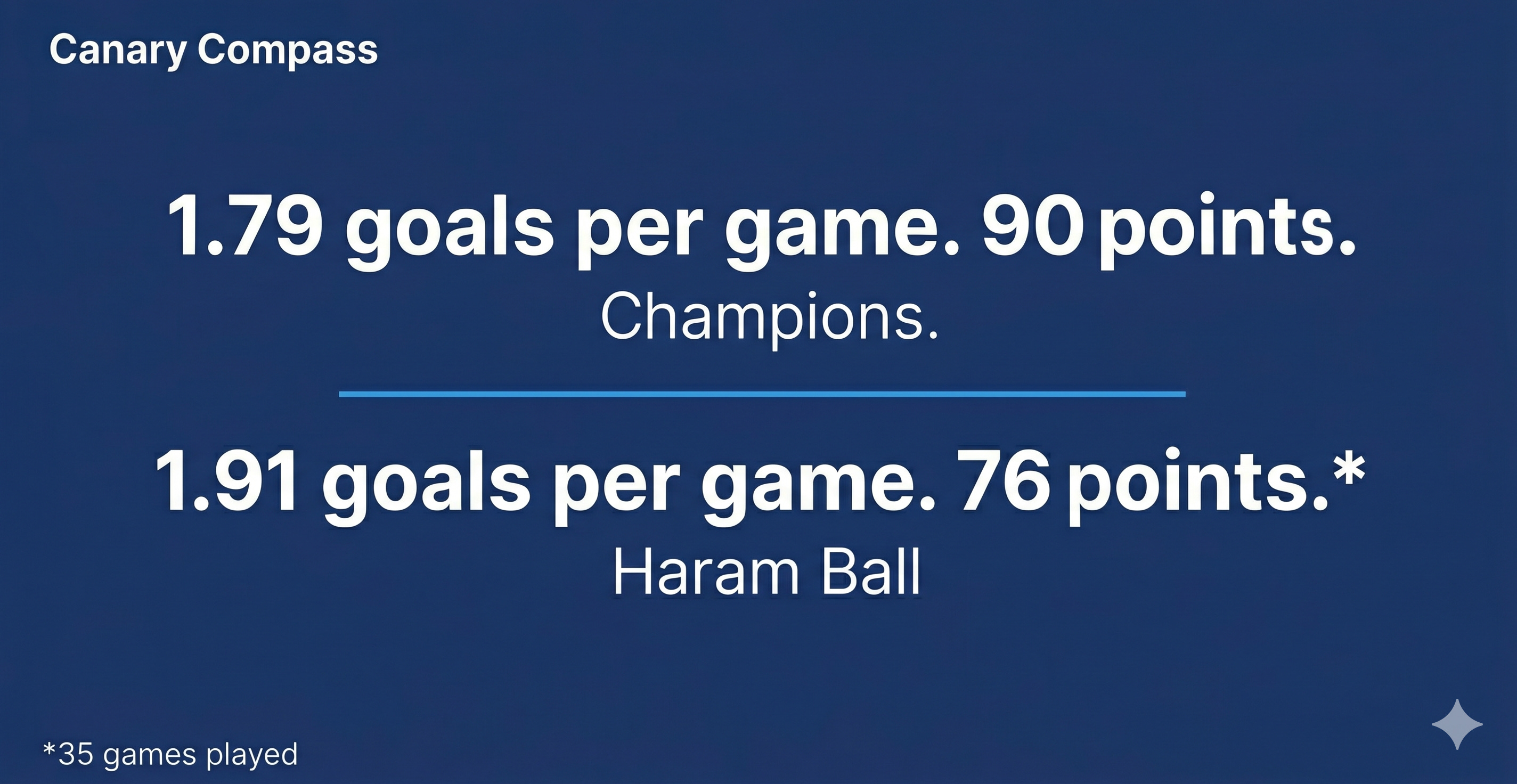
The season that should trouble every United fan who mocks Arsenal was not the season they remember with warmth. Not Ronaldo’s 31-league-goal year. Not the Treble. It was 2008/09. The season Edwin van der Sar went 1,311 minutes without conceding a goal. Fourteen consecutive clean sheets. Sixty-eight goals scored in 38 games. Just 1.79 per game. Consider what that means. The year before, Ronaldo alone had scored 42 across all competitions. Then United added Berbatov to a front line that already had Ronaldo, Rooney, and Tevez. Four world-class attackers. And the team scored fewer league goals than the season before, not more. The lowest-scoring campaign in a seven-year window. And 90 points. Only the 1999/00 squad, scoring 97 goals, ever collected more in the 38-game era. United’s second-highest points total came from their lowest-scoring season. That is not a coincidence. It is a statement about what defensive solidity can produce, even when the attack has every reason to produce more.
My attacking club’s second-best ever points haul came from a season where we added a world-class striker and scored fewer goals. I just never looked at the numbers until this week.
Now look at Arsenal in 2025/26. Five points clear at the top of the Premier League with three games to play. A Champions League final in Budapest at the end of the month. And somehow, the most criticised side in English football.
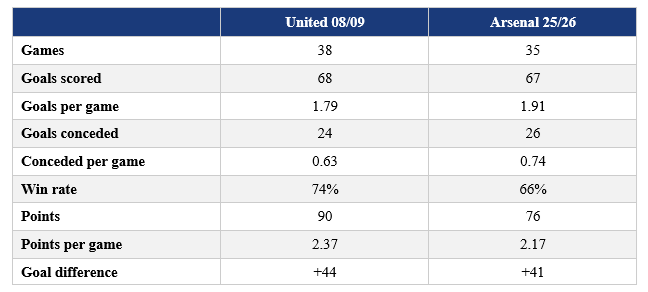
Both campaigns produce under two goals per game. This is not because Arsenal sit deep and defend. They average between 55 and 58 per cent possession this season depending on the source, they dominate territory, they keep the ball. But when it comes to converting that possession into goals, the output is remarkably low for a title-leading side. For reference, Manchester City’s centurion season in 2017/18 produced 106 goals, or 2.79 per game. Liverpool’s title in 2019/20 hit 2.24. United’s own 1999/00 squad managed 2.55. By those standards, both the 08/09 United and this Arsenal side produce elite defensive profiles with attacking output that looks modest by champion standards. Arsenal can be attractive. They have the players for it. But not often enough, and not consistently enough, for the numbers to show it.
Ferguson’s side was more efficient at converting that defensive platform into wins. A 74 per cent win rate versus 66 per cent. Only six draws in 38 games versus Arsenal’s seven in 35. In a defence-first campaign, draws are where points leak. United’s ability to grind out 1-0 results rather than settling for goalless stalemates is what pushed them from an 82-point season into a 90-point one.
But the profile is the same. Two sides winning through solidity, not volume.
Where they diverge is how the goals arrive. United’s 68 goals in 2008/09 came through a front four who were individually among the most watchable attackers in the league’s history. Ronaldo’s free kicks. Berbatov’s first touch. Macheda’s injury-time curler on his debut against Villa. The goals were rare but often spectacular. Individual brilliance behind a wall of defensive structure. United do not appear in the all-time Premier League records for corner goals that season, suggesting fewer than 13 from set pieces. Open play and moments of genius were the primary engine.
Arsenal in 2025/26 are a different machine. They can play. Saka on the right, Eze cutting inside, Odegaard threading passes through lines. On their best days, they are as watchable as anyone in the league. But the goals tell a different story. They have scored 17 from corners, breaking a Premier League record first set in the league’s inaugural season. Declan Rice delivers. Gabriel and Saliba attack the ball. Timber arrives at the back post. Set pieces account for a striking share of their goals, and the corner record alone is enough to show how deliberately this attack has been engineered. When open play does not produce, the corners do. It is tactically impressive and objectively effective. It is closer to manufacturing than improvisation.
Both sides win ugly by modern standards. Neither is consistently entertaining over 38 games. United’s 2008/09 campaign has been mythologised around the moments that survived in memory: a Ronaldo free kick, a Berbatov touch, Macheda off the bench. But those were the exceptions. Most of the 68 goals were 1-0 grinds behind a defensive wall. Arsenal are the same: Saka can beat three men, Eze can curl one into the top corner, but most of the output comes from Rice’s delivery meeting Gabriel’s forehead. The difference between the two campaigns is not that one is beautiful and the other is ugly. It is that the memorable goals from 2008/09 came from open play, while Arsenal’s come from dead balls. An individually brilliant goal and a corner headed in by a centre-back produce the same point. They do not produce the same highlight reel. That is the gap people are reacting to, even if the goals-per-game numbers are almost identical.
I put this data in front of a group of friends this week. Fellow United fans, mostly. Intelligent people. The response was instructive.
One friend argued from the wrong season entirely, citing 2007/08 when United scored 80 goals, rather than 2008/09 when they scored 68. When corrected, he said “Bye” and left the conversation. Another questioned where I got the data, as though the source of the compilation could change the numbers. A third said I was spreading propaganda to suit my narrative. Nobody engaged with the actual comparison. Nobody said: that is interesting, I did not know that. The tribal instinct overrode the evidence. A United fan cannot see the defensive record that defined his club’s 2008/09 title reflected in Arsenal’s current campaign. It is like complimenting your rival’s wife. The data is right there. The loyalty says no.
But what struck me was not the tribal refusal. It was the pattern underneath it.
The same week, I published an essay about the global content economy. I had spent weeks convinced that controversy was the only product that worked in the podcast market. The data said otherwise. Fewer than twenty of the top-ranking programmes across the major US charts are built on political controversy. The loud ten per cent commands ninety per cent of the cultural oxygen. I had been measuring my work against a room that did not represent the market.
I watched the same thing in financial markets. The current bull market sits at all-time highs, yet the mood is universally miserable. People trained on smooth, controlled, upward trends do not know what to do with a market that grinds higher through volatility and narrow breadth. They call it broken. It is not broken. It is winning ugly.
In every case, one dominant style had trained people to expect a particular version of the thing. Possession football. Viral controversy. Smooth returns. When the thing showed up in a different form, they rejected it rather than recognised it. The style became the standard. The standard became invisible. And serious people started abandoning what worked because it did not look like what was winning.
A friend in my football group called Arsenal’s style a total disgrace to the football world. Another said he would rather watch the women’s league than accept defensive football as a benchmark. They have a word for it. They call it haram ball. Forbidden. Illegitimate. Not real football.
I do not find it hard to watch. I find it hard to watch consistently over a 38-game season, the way I find any single approach hard to sustain interest in over that stretch. But in a knockout tournament, where every game is squeaky bum time, where one goal decides everything? I am more than comfortable with it. I grew up watching it through Italy. Baggio’s Italy were capable of brilliance in flashes and suffocation in between. So were Maldini’s Milan. I did not expect to find the same profile in my own club’s second-best ever points haul. And I certainly did not expect to find it in Arsenal. The tradition is not about refusing to attack. It is about controlling the game and being ruthlessly efficient when the moments arrive, even if the moments arrive from a corner. I just never had to defend that tradition until the people calling it haram were my own United fans, looking at a mirror they refused to recognise.
This is why I think it matters that Arsenal win.
Football felt richest to me in the 1990s. I was a boy, and the game I was watching had room for everything. Capello’s defensive Milan coexisted with Cruyff’s total football Barcelona. Sacchi’s pressing sat alongside Hiddink’s counter-attacking Netherlands. Multiple systems could win. No single style was orthodoxy. The ecosystem was diverse. Then Guardiola flattened it. First at Barcelona, then at Bayern, then at City. Tiki-taka and its descendants became the only acceptable way to play. The rest of the sport followed. Possession coaches were hired across the continent. Playing out from the back became mandatory. The tactical diversity that defined the game I grew up watching compressed into a single model. I may be romanticising the era because I was young, but I am not romanticising the compression. You can see it in the prestige language of the sport: the coaching hires, the academy curricula, the obsession with playing out from the back, and the suspicion directed at anything that wins another way. Italy, the country that defined defensive football, abandoned its identity to chase what looked like evolution. Two consecutive World Cup absences followed. The nation that won four World Cups through defensive discipline tried to become something it was not, because the dominant style had redefined what good looked like.
I said this to a friend on Wednesday. I told him: you are mistaking a dominant style for evolution.
He told me to support Arsenal in peace and stop trying to justify it.
If Arsenal win the league and the Champions League holding over 55 per cent of the ball and scoring a record number of goals from corners, it breaks the Pep-ball monopoly. Not destroys it. Breaks the monopoly. It tells every young coach on every continent that there is more than one way to build a winning side. That tactical diversity is not regression. That what the last quarter-century trained us to call beautiful is not the only version of the game that wins. The rotation has always been there. Total football arrived in the 1970s with Cruyff’s Netherlands, then faded after two consecutive World Cup final defeats: to West Germany in 1974 and Argentina in 1978. The generation aged out and the style lost its international dominance. It returned when a new Dutch generation, Gullit, Van Basten, Rijkaard, won the 1988 European Championship, then faded again when Capello’s Milan dismantled Cruyff’s Barcelona 4-0 in the 1994 Champions League final, and came back under Guardiola for the longest run of dominance any single style has held. If Arsenal win well, I think it fades again. And something else takes its place. And the game is better for it.
There is a ten-year-old boy in Nairobi who woke up on a Monday morning in July 1994, ran to his parents’ room, and learned that his favourite player had missed. The World Cup returns to the United States this summer, 32 years later. He will be 42. It took him all that time to understand that Baggio’s Italy and Arteta’s Arsenal are the same tradition, wearing different colours, playing in different decades. Both judged by people who mistake the dominant style for the only style.
The numbers do not care what you call it. They sit there, waiting for someone to look.
Statistics sourced from Opta Analyst, StatMuse, the Premier League, and FBref. Arsenal data as of 35 games played (2 May 2026).