

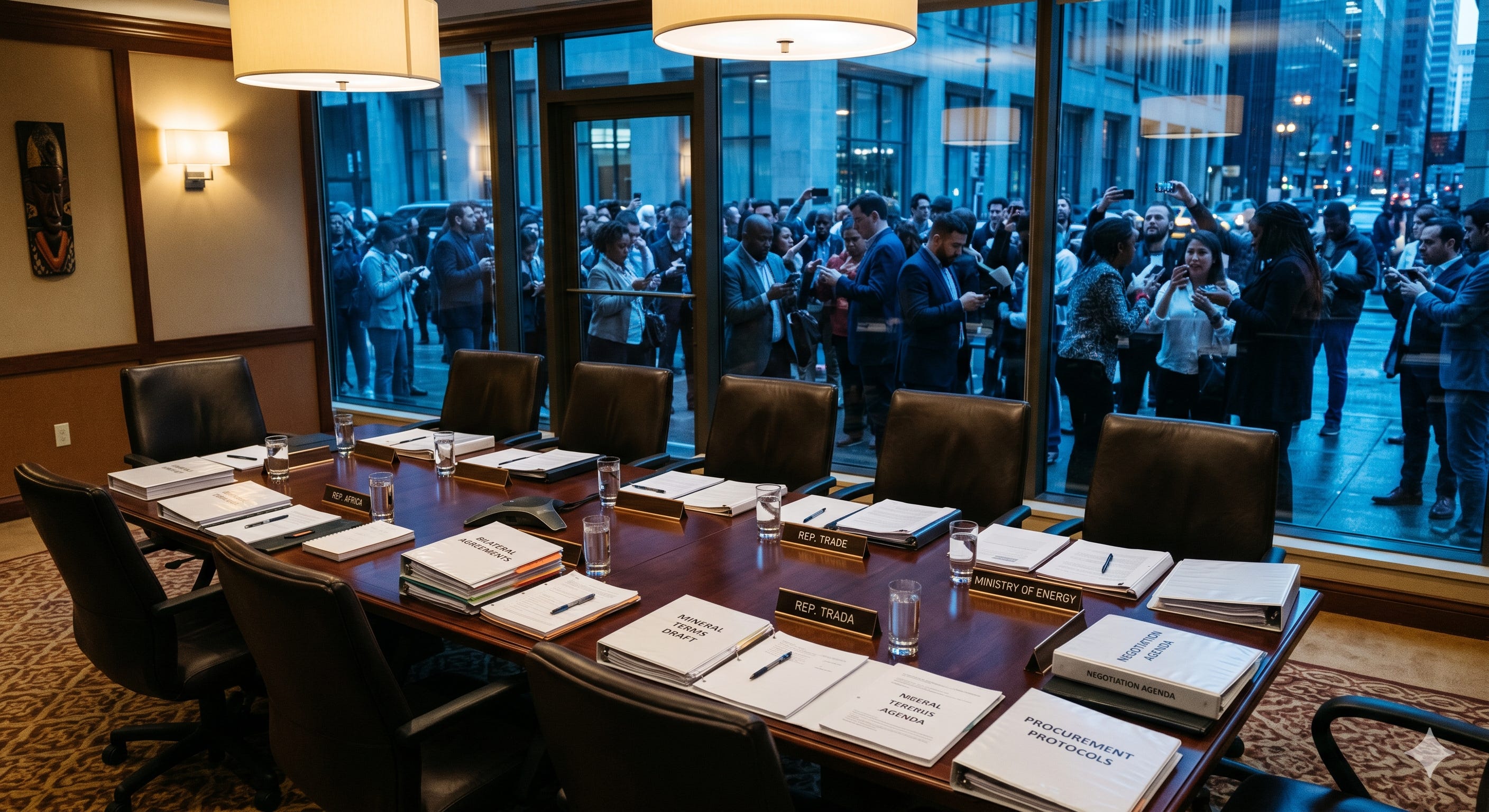
AI-generated image of the negotiation nobody attended.
The cooking video appeared on my timeline earlier this week. Dennis Ombachi, warm as always, making food with Emmanuel Macron during the Africa Forward Summit. I watched it, smiled, scrolled past. Within days it was a national conversation about colonial collaboration. By midweek someone had written a thoughtful essay arguing that Ombachi lacked the political lens to understand what he was doing because the British took the curriculum. Careful and honest in places, but the governing frame was that colonialism is the reason a grown man did not know better than to make a cooking video with a visiting president. Haibo, when did a cooking video become a crime scene?
Then the clip. Macron at a youth forum at the University of Nairobi during the summit. Thousands of delegates moving through an open hall. The presenters could not be heard above the noise. He took the microphone and asked the audience to let the speakers finish. The hall went quiet. Sections of the audience applauded. Within hours the clip was on CNN, Al Jazeera, Fox News, and ABC. A French lawmaker called it colonial behaviour. A Senegalese student told the Associated Press he had acted like a teacher scolding children. A man asked for silence so that the presenters could be heard, and we turned it into a plantation story. Wetin be this?
Then the base. By midweek, X had decided that France was building a permanent military garrison in Mombasa. The reality: 800 naval personnel on a routine training deployment docked for four days, drilled with the Kenya Navy, and left. The Defence Cooperation Agreement was ratified unanimously by the National Assembly. No clause mentions a base or permanent stationing. South African and Indian vessels made port calls the same month and nobody blinked. The parliamentary record and port logs are public. But hey, who reads documents when the feeling is already there?
Three episodes, same week, same machine. A cooking video became colonial capture. A request for courtesy in a lecture hall was reprocessed as racial discipline. And a four-day port call grew into a permanent occupation. The people running this machine? The same ones I will run into this weekend at a rooftop in Westlands. Ordering mimosas with scrambled eggs, toast and bacon. Whiskey sours and martinis in the evening. Drake on blast on the way home. Messages on an iPhone on an American platform. The colonial lens fires for Macron and goes silent at brunch and in the club. Apparently, inconsistency is no longer embarrassing. But who is going to call it out?
The same week, Trump stepped off Air Force One with Elon Musk in Beijing. Three hundred Chinese students waved American and Chinese flags on the tarmac. Nobody on African Twitter called it imperial theatre. Nobody called it submission. Kenya rolls out dancers for a French president and it is a sovereignty crisis. China rolls out students for an American president and it is diplomacy. The outrage was never about the protocol. It was about who the protocol was for. Can we at least be honest about that?
I have been watching this pattern for longer than I should admit. It used to frustrate me. Now it just makes me tired. The tiredness of watching a discourse arrive at awareness and settle there like it has nowhere else to be. Nobody asks what you build once you have seen it. Eleven bilateral agreements were signed the same week. Nuclear energy, transport, agriculture, defence cooperation. Documents with terms, procurement structures, debt arrangements. The fine print is where sovereignty is actually negotiated. The conversation never got there. Go figure! Grievance is a helluva drug.
Somewhere along the way, pan-Africanism became a checklist. Anti-Western. Pro-Chinese. Anti-Israel. Pro-Palestine. South Sudan? Somalia? Tanzania? Doesn’t generate enough outrage. We must be suspicious of any partnership that does not arrive from the East. China builds roads. But what about trade? Focus on your own country! Nobody is comparing debt structures, trade, industrialisation, capital formation or procurement terms. The question is never what serves Africa best. The question is whether the partner passes an ideological smell test that has nothing to do with leverage and everything to do with grievance. The issue is not the positions. It is that the positions replaced the analysis. If that is what sovereignty looks like, keep your pan-African label.
I know the discourse is not one thing. The person who wrote that essay responded to my pushback this week with more intellectual honesty than I had any right to expect. She conceded where the frame was disproportionate and said she wanted to write the harder argument next: the internal failure to confront our own reflection. Not everyone in this discourse is a fool. The problem is that the loudest ten per cent of any conversation sets the terms for the rest, and what is loudest right now is grievance without a blueprint. It is drowning out the people who could actually build something. So who speaks for the rest of us?
Somewhere underneath this noise a window is open, and it will not stay open long. Some of the minerals the world needs for the next thirty years are in African soil. The competition is real and the terms are being written now. Where is the conversation about us exporting the copper we will need for our own electrification? The leverage has always been in the ground. What is new is that great power competition to secure it has given us a seat we have never had. This is the moment for negotiation, not for vigils. And the movement that claims to speak for African sovereignty is spending it on a cooking video, a noise complaint, and a port call. Does anyone actually know what is in those agreements?
I do not have a clean close for this one. This week I just have the tiredness and a question that will not leave. The documents are public. The terms are readable. Is anyone going to show up to the negotiation, or are we all still outside arguing about the caterer?