

AI-generated image: Read These, She Said
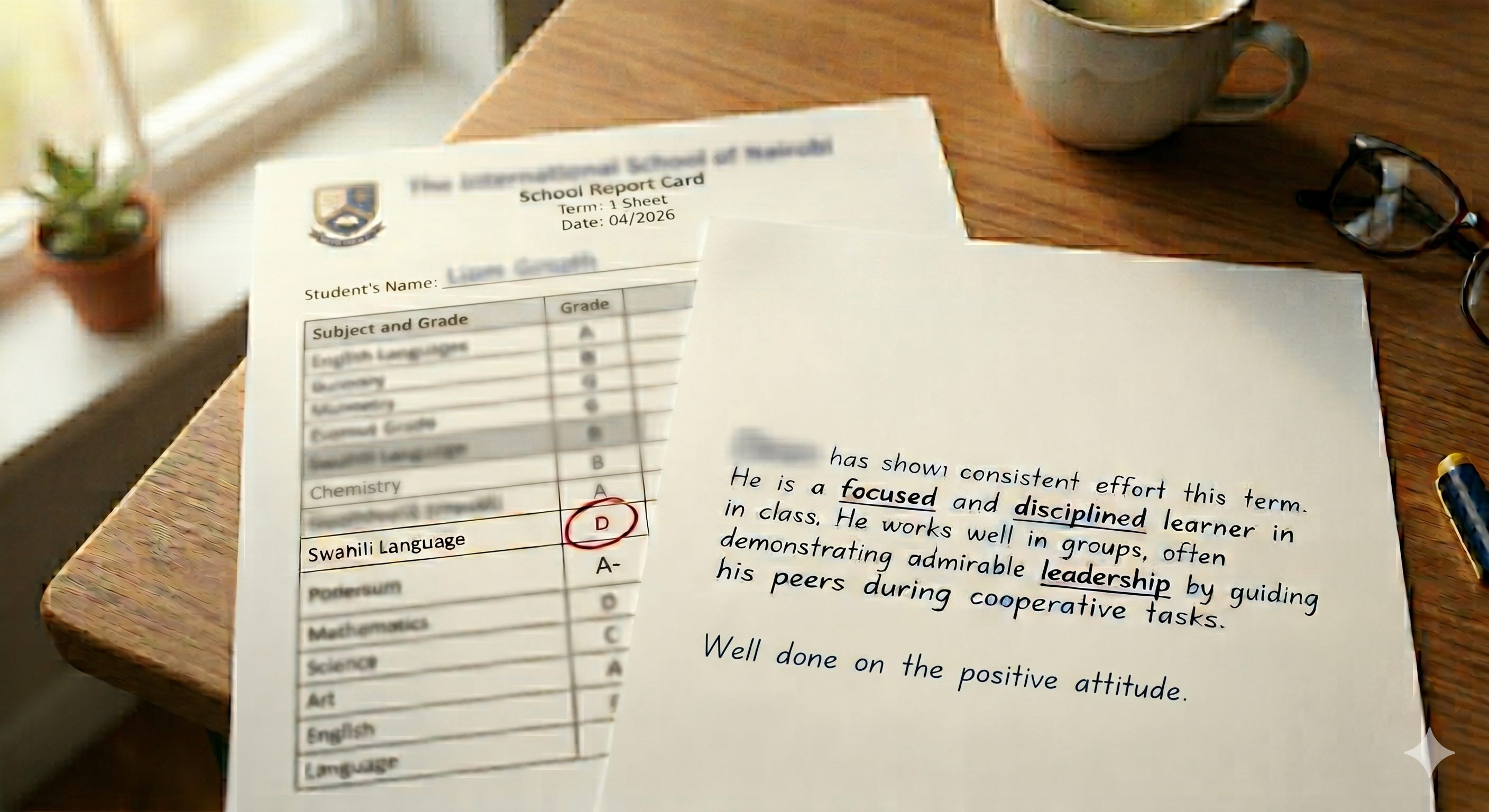
The school sent my son’s report last week. His Swahili mark came in at around half of what the school expects at his level. Below where any parent wants to see their child sitting.
Then I read the teacher’s comments.
Focused. Disciplined. A cooperative learner. Strives for excellence. Demonstrates admirable leadership by guiding peers and participating actively in group tasks.
I sat with both pages longer than I should have needed to.
I was once that boy. In primary school I was good at Swahili. My mother went to the PTA meetings and the teacher would tell her Dean is going to do well.
Then high school happened and something in my head flipped. I stopped understanding the language. I stopped enjoying it. I kept studying, but the studying was not landing, and at sixteen that is a powerful argument for giving up on yourself. For four years my mother sat across from a Swahili teacher who had a steady, polished line that gained a little more pity each time. Dean is not quite getting it. Dean struggles. Dean is not a Swahili student.
At the last PTA of the final year, the teacher gave her the definitive version. I don’t think Dean is going to do well for Swahili.
My mother did not argue with him. She went out and bought me practice papers. Not just Swahili. All the subjects. In those days, hawkers sold exam practice papers for school leaving students outside bookshops and at various spots around town. The Swahili paper covered all three components: language, essays, literature. They arrived in my room without ceremony. Read these, she said.
The night before the exam, I was not reading my mother’s paper.
I was with two of my friends and schoolmates at a dining room table. The country was in one of its power rationing seasons. This was long before solar solutions were affordable, so we worked under one of those lamps you charged during the day and ran at night. Somebody had given us a paper and sworn, on whatever is swearable at sixteen, that it was leakage. The real exam, smuggled out.
We had each put in our own work. The paper was supposed to be extra. But when someone hands you what they swear is the real exam, you take it seriously. We went through it, cross-referencing, arguing over answers, nodding wisely. Then we all went home.
Nothing from that paper came up. Not a question, not a proverb, not even a comma. Kenya has a long tradition of leakage. Ours was not leakage. Ours was stationery.
On the morning of the exam I walked into the school library. Students were quizzing each other on methalis. One boy would call out a proverb and three others would fire back the synonym and the meaning. Like a prayer they had been saying for years. Like the catechism we had crammed for two years straight in Catholic school.
I stood at the back and listened.
I did not know a single one of them.
My heart sank, flat, like a stone through still water. I was going to fail this exam. Everyone in this library was going to beat me. The teacher was going to be right.
I left the library. I went to the toilet. I locked the door. I sat down and cried.
I have not told that story to many people. My mother knows. A few of my mentees know. It was the boy version of every Idols contestant who walks in because his mother, his whole life, could not bear to tell him he could not sing. I understand that mother. My eldest son still thinks he can dance.
I prayed. I was spiritual then. I still am now, but back then it was on steroids. I did not pray for knowledge. I prayed because I had run out of anything else.
And something said, quite quietly, go and read the Swahili paper your mother bought you.
The paper was in my bag. So was the Kamusi ya Methali. I had studied the paper before, along with the other subjects, but there are over two thousand proverbs in the kamusi and a sixteen-year-old cannot hold them all. I pulled both out in the toilet stall, still crying, and went back to the paper with the kamusi open beside it. I crammed what I could in the time I had left and walked into the exam hall.
The proverb on the exam was the synonym to the one from my mother’s paper.
I had the synonym and the original. The meaning was fresh. The story wrote itself.
The literature paper came in the afternoon and that one was mine anyway, because the theme was neo-colonial and I have always had strong opinions about people putting on makeup to look like something they are not.
I came out of those final school leaving exams with an A for my worst subject. Two months later, when the results were announced, my best friend told me to my face that they had to be fake. There is no way, he said, you could have beaten me in Swahili. He had a point, statistically. He was also wrong. Because somewhere in his calculation, he forgot my mother.
I have been thinking about my mother this week because of a man on X.
He told me I only ever condemn the previous administration. That my writing on that administration is uniformly negative. He did not call it a verdict. He called it an observation. He was hoping I would hear the difference.
He is right about one thing. When I have written about the 2011 to 2021 period, the lost decade, and especially the 2015 to 2021 years, my conclusions have been almost without exception negative. Money supply, inflation, external debt, the default, the pivot to local debt, private issuances coming due as refinancing walls in someone else’s lap. That work is recent. I began publishing publicly in 2023, looking backwards at a period already closed.
I wrote back that the mirror has no favourites. It only reflects. You can dislike what it shows.
On labour policy, which is not my wheelhouse, I would credit that same administration openly for worker protections among the strongest Zambia has had. If it lands in their favour, it lands in their favour.
He was not reading me. He was reading the red marks on the page and calling them the whole page.
That exchange pointed to a wider habit. A journalist publishes a story sourced from people he will not name. Another outlet cites the journalist. A third cites the second. Each retelling hides the anonymity under one more layer of citation. By the fourth round, the claim reads as consensus, and no one thinks to ask the question the first piece never answered.
I know the habit because I have done the same thing with a public figure I had formed a view on. I had a settled position on him, and I had repeated it enough times that it felt like knowledge.
The evidence did not arrive all at once. It accumulated. For a long time I could fit it inside the position I already held. At some point the position could no longer hold it. Structure before sentiment cuts both ways. If the evidence keeps pointing, I have to let it move me, even when the direction is inconvenient.
I had to credit him on one register. I could not credit him on the rest, and the rest still stands where it stood. Holding both at once is harder than either verdict alone.
Grievance can be very addictive.
Three or four years ago, someone could send me a sharp argument and I would match grievance with grievance for two hours and walk away thinking I had won something. I had not. I had just done a longer version of what the other person was doing.
I do not know when the framework shifted. I had to sit still long enough to notice I was doing it.
Sometimes the reader is not a person.
Sometimes it is the register you have been using to grade the world. The one that circles what is wrong in red and takes the rest for granted.
The habit of only seeing what is wrong does not stay small.
My son will not remember his Swahili mark in twenty years. He will remember whether the adults in his life learned how to read him.
I am writing this because my mother learned how to read me.
I am trying to learn how to read him.
Prefer to listen? Canary Compass is now a podcast.
YouTube: Canary Compass on YouTube
Spotify: Canary Compass on Spotify
New episodes every Tuesday and Saturday, with bonus episodes on Thursday.