

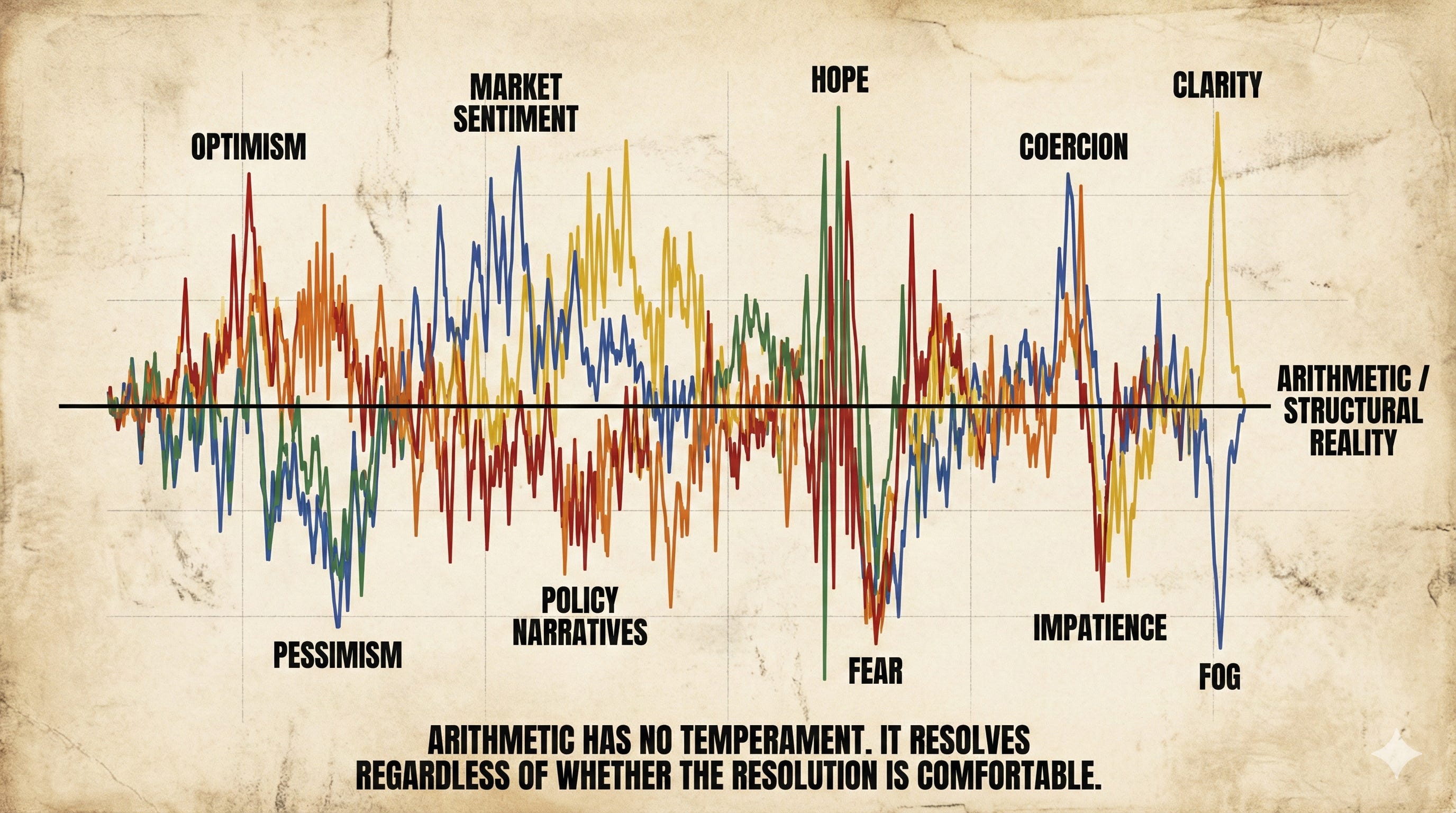
AI-generated image of Structural Reality
There is a recurring pattern in how we handle discomfort. When structural reality becomes difficult to sit with, we adjust the interpretation rather than confront what the structure reveals.
A visit transforms into partnership. Access elevates to strategy. Preliminary engagement gets narrated as institutional commitment. Capital showing initial interest becomes development partnership. Hard fiscal arithmetic gets reinterpreted as pessimistic intent. The pattern is consistent across domains. Meaning is assigned faster than structure can validate.
In markets, reserve share declining gets read as currency collapse, ignoring rails, settlement systems, and balance of payments constraints. Bills replacing bonds in Treasury management gets missed entirely while headlines focus on who said what about tariffs. In policy, commercial interest gets elevated to strategic significance. Funds seeking returns get categorised as partners seeking transformation. The capital may arrive. But return-seeking investors are not the same as patient capital building institutions. Structure is revealed by what actually gets funded, how it gets priced, and how quickly it can exit. Opportunistic capital can still be useful, but it is not the same thing as development capital.
Analysis itself faces the same distortion. Explaining fiscal and monetary constraints together, showing how progress on one side can introduce pressure on another, mapping rollover arithmetic under different scenarios becomes labelled as bearish. The numbers themselves are not disputed. The implications are resisted. Arithmetic has no temperament. It resolves regardless of whether the resolution is comfortable.
The temptation to inflate meaning is understandable. Reality often demands more patience than we want to give it. Narratives that confirm what we hope move faster than structures that constrain what we can do. Assigning weight prematurely feels like progress. It is impatience with constraint rather than dishonesty.
Last week was about what happens when data takes you where you do not want to go. This week is about what happens when you refuse to let it take you there, and what happens when you follow it too far.
Some people follow structural logic rigorously, mapping constraints honestly and stress-testing assumptions until they see clearly. And then the clarity consumes them. Every data point becomes prophetic. Every signal becomes civilisational. Every development demands immediate interpretation. The discipline that produced clarity becomes a mental trap. These are people carrying the full weight of what structural analysis reveals, and it becomes unbearable.
The realisation eventually arrives: the world does not depend on whether you interpret the signal correctly.
Seeing clearly without proper grounding produces misplaced burden. You start carrying responsibility for resolution that was never yours to carry. The analysis is rigorous. The constraint mapping is accurate. The posture becomes unsustainable.
Sustainable clarity requires grounding. Some anchor it in faith. The world is governed. Creation remains stable even when systems shake. This becomes the framework that makes structural clarity bearable without treating every development as existential crisis. Others ground it in first principles, in the limits of professional scope, in the acceptance that complexity exceeds any single framework. The foundation varies. The principle remains universal: your clarity about constraint does not make you responsible for resolving it.
Structure before sentiment requires proper grounding. Without that grounding, disciplined analysis becomes exhausting theatre where every signal demands response, every development becomes turning point, every constraint feels like personal burden. The work becomes unsustainable.
Interest, visits, and engagement serve useful purposes until preliminary steps substitute for what they have not yet become. Rigorous constraint mapping serves essential purposes until seeing the constraint gets confused with carrying its resolution.
In an age that rewards both narrative inflation and analytical exhaustion, restraint looks like weakness. Restraint is governance. It allows clear sight without consumption by what is seen.
Clarity arrives through consistency. Consistency requires knowing what you are responsible for and what you are not. You are responsible for seeing structure accurately. The responsibility for holding creation together belongs elsewhere.
That distinction is what makes serious analytical work sustainable.