

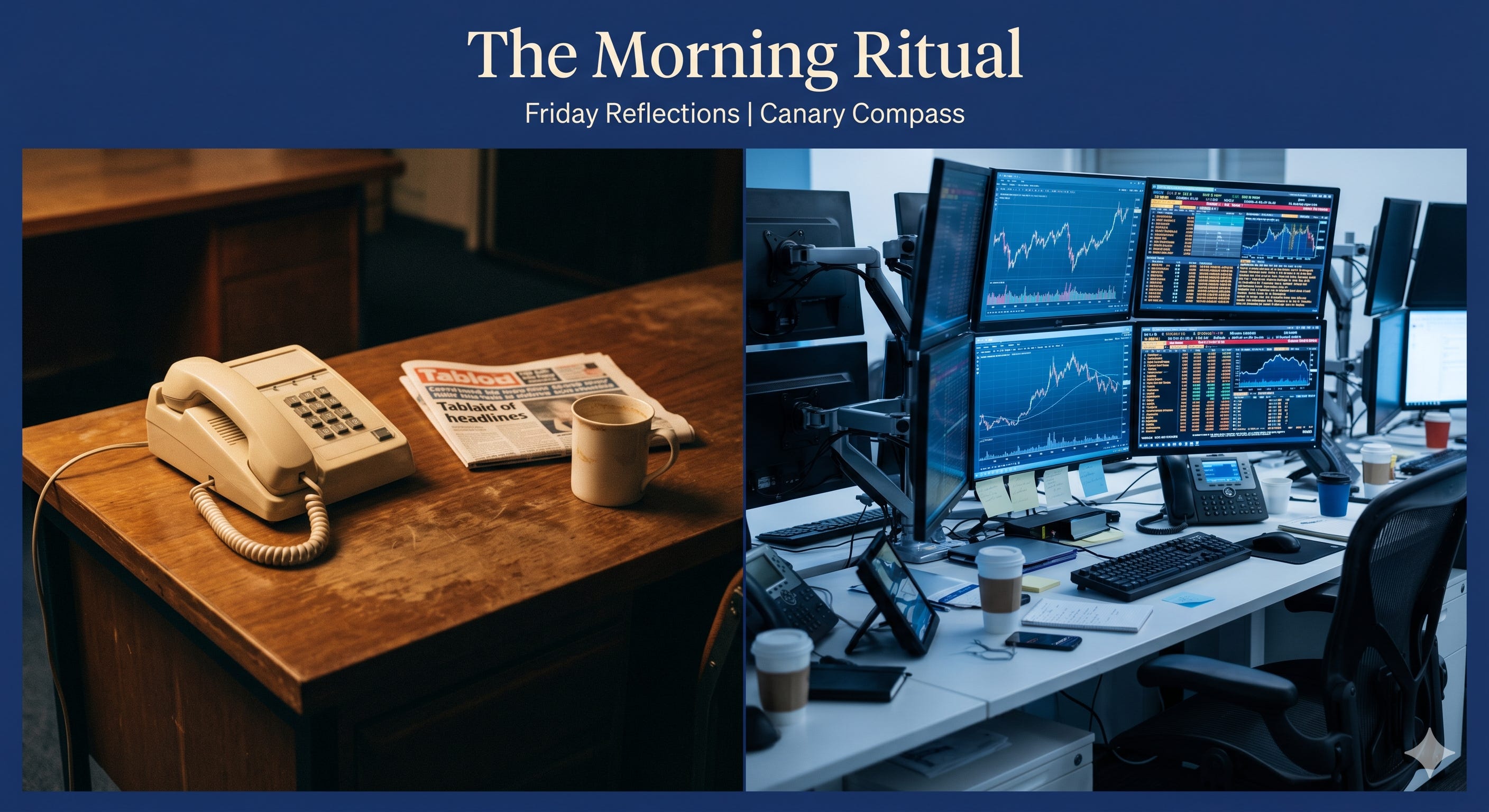
AI-illustration: The joke was the entry. The skill was the exit.
An old trader once told me he had a daily ritual for deciding direction. I cannot tell you what it was. Not because it was proprietary, but because the internet would not survive it. What I can tell you is that it involved page 3 of a tabloid called The Sun.
He started trading FX in London in the 80s. He had been at it for years by the time I met him. Grey-haired, calm, and sharp once the market was moving. He could read momentum and flow as well as anyone on that desk. But he would not pretend to know where the pound would open on any given morning. That was the point. The ritual was his way of admitting it out loud, to himself, every day. The opening signal was random. He knew it was random. What mattered was what he did after he was in. The joke was the entry. The skill was the exit.
I did not understand this when I heard it. I was young and convinced that if I studied hard enough I would eventually crack the code. I spent years building models, reading research, attending conferences where serious people would show you data and technicals and tell you they could see the future in their charts. The models helped. They made me more informed. Technicals work when enough people are using them to trade. They end up reinforcing themselves. I can form a view on direction. I can give you a range. I recalibrate that range every day as new information arrives. But after 18 years of trading currencies, I still cannot tell you what exact level a currency will be trading at on a given day, let alone three months from now. One of my more sarcastic responses to clients who wanted a precise number was that if I knew, I would not be sitting at this desk. I would be somewhere in the Bahamas sipping pina coladas.
My primary mentor gave me Reminiscences of a Stock Operator. A book about a trader from the early 1900s operating off the ticker tape. Less information than anyone in a modern dealing room would tolerate. I still reach for it when I am feeling off about catching patterns. It does not teach you what to buy. It teaches you how to sit with what you do not know. He also used to tell me about a friend who put a large position on silver. By the time the man went to place the order and came back, his stop loss had already been hit.
The old trader with his morning ritual did not want a system that predicted the future. He wanted a position he could manage. Another mentor taught me there are five possible outcomes when you trade: win big, win small, break even, lose small, and lose big. If you cut out losing big, you will always make money. That stuck with me more than any model ever did. You do not need to be right every time. A respectable hit rate is somewhere around 60 per cent. But when you are wrong, you cut quickly. When you are right, you ride the wave but take profit at intervals along the way. Never worry about exiting early. As my primary mentor used to say, there are always trains leaving the station.
The FX desk taught me that volatility is the environment, not the enemy. You do not wait for the seas to calm before you sail. The lessons were learned in rooms where the humour was filthy, the language was unreconstructed, and nobody pretended to know what was coming next. The irreverence was load-bearing. It kept things loose enough for people to make decisions worth tens of millions without freezing. The laughter was the release valve. The irreverence and the decision-making capacity lived in the same room.
I have been thinking about this because I am watching the grumpiest bull market I have ever seen. Markets at all-time highs. Commentary almost uniformly anxious. People with ten-year horizons panicking about quarterly drawdowns. Tell me where rates will be tomorrow. Tell me what to do. The old trader had The Sun and a telephone. He made his opening call by 8 a.m. and spent the rest of the day managing it. Today a junior analyst has a Bloomberg terminal, satellite imagery of oil storage, AI-driven sentiment analysis, and forty-seven indicators on a screen. And he cannot decide whether to buy or sell without checking what three other people think first. More information has not produced better decisions. It has produced longer hesitation.
The story comes back to me once in a while. His ritual was absurd but his relationship with uncertainty was honest. He knew he was guessing on the opening call, and he had made peace with it. That peace gave him the freedom to act.
This weekend, you might notice where you are waiting for one more data point before you move. One more opinion. One more signal that the path is safe. The data point may arrive. The path will not feel safe. It never does. The question is whether you have made peace with that, or whether the search for certainty has quietly become the thing that keeps you from moving forward.