
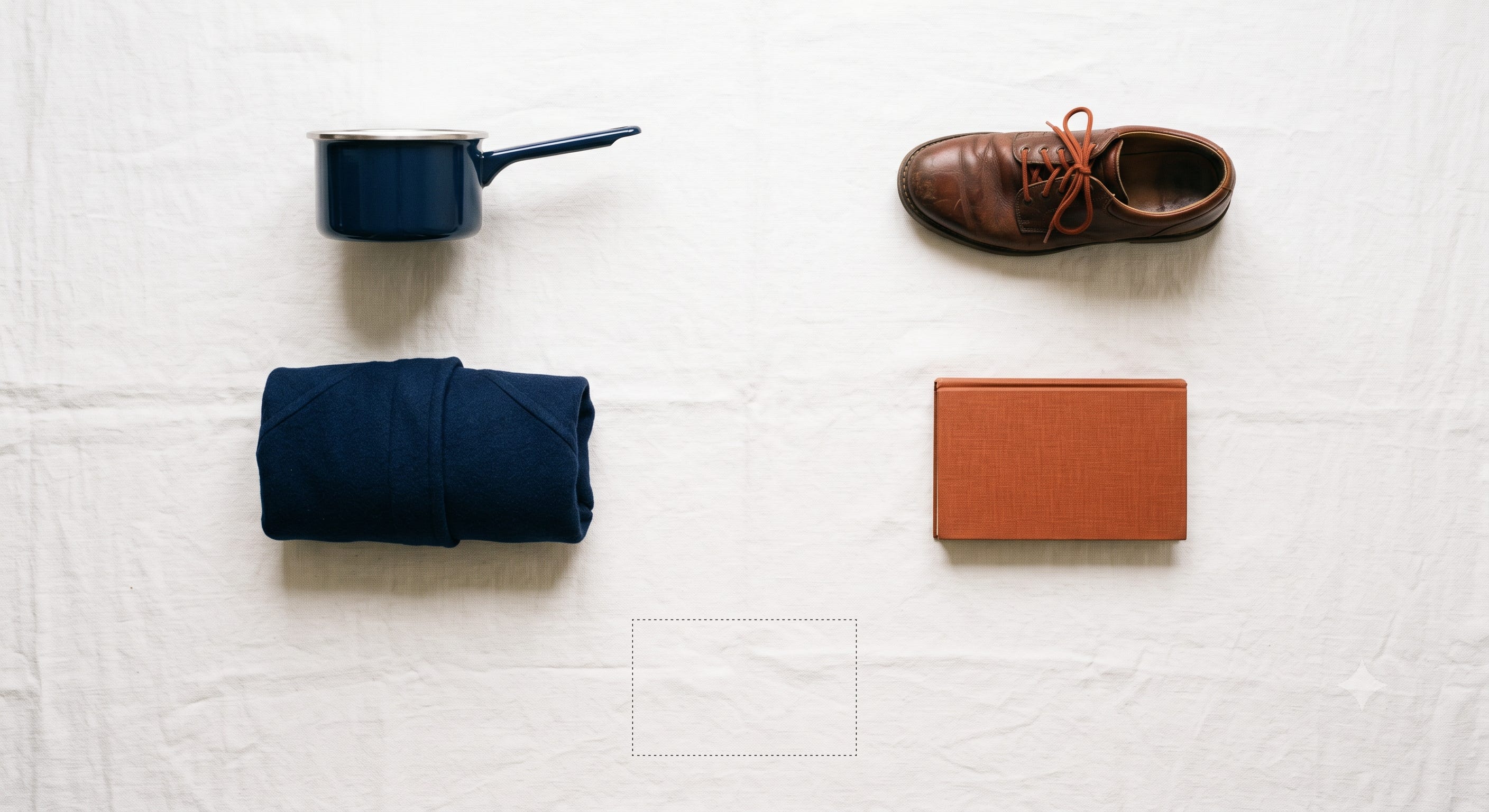
AI-illustration: Four handovers worked out fine.
Last week's reflection examined what happens when discernment is outsourced to inherited conclusions. This week a guest widens the frame and asks what our species has been outsourcing all along, and which handover we should actually be worried about. Nuru Shaba has written for Canary Compass on insurance, taxation, and market behaviour.
By Nuru Shaba
A while ago I fell into one of those late-night holes on TikTok, the sort that begins with a recipe and ends, somehow, at the dawn of human civilisation. The clip made a claim I have not been able to shake. It argued that the kitchen is basically a second stomach. Cooking does the work that other animals have to do internally, with yards of extra gut and a great deal of unpleasant fermentation. We took all that biological plumbing and moved it outside the body, into a room that happens to contain a kettle.
This struck me as both obvious and slightly mad. We have, in effect, evolved to depend on Russell Hobbs. A cow needs four stomachs and most of the day to get through a field. We need a saucepan and about forty minutes. The outsourcing went so deep that our jaws shrank and our guts shortened, which means there is no going back. Hand a modern human a raw woodland and we would not last the weekend.
Once you notice the trick, you see it everywhere. We are a species of compulsive subcontractors.
Take movement. We have legs, perfectly good ones, and we have spent several thousand years trying to use them as little as possible. First the horse, then the cart, then the train, then the car, then the moving walkway at the airport, which exists purely so that nobody has to walk while already walking. We outsourced distance. And yet we kept the legs. Nobody forgot how to walk because a bus turned up. The bus is a guest, not a replacement.
Clothes ran the same trick. Other animals grew their own central heating and have been smug about it ever since. We made coats, which have the enormous advantage of coming off, and we kept the underlying knack of noticing we were cold and doing something sensible about it.
Then came the clever one. Books. For most of history, if you wanted to keep a thought you had to keep it in your head, which is a leaky and easily distracted piece of equipment. The book let us store memory and learning outside the skull. A library is a communal brain that never needs feeding. This felt, and still feels, like a marvellous deal.
So far the pattern is rather reassuring. In every case we farmed out the heavy lifting and kept the essential organ. The kitchen handles the pre-digestion, but we still do the digesting. The car covers the miles while our legs sit there, fully functional and faintly insulted. The book holds the facts, though the understanding stayed firmly behind the eyes.
Which brings me, reluctantly, to the machines.
Computers, and now their chattier offspring, have moved past storing our thinking. They offer to do it for us. This is a different kind of outsourcing altogether. For the first time we are farming out not the muscle but the management, the bit that decides what the muscle should be doing. The trouble is not that these tools are clumsy. They are marvellous, and that is exactly what makes them risky. A tool you have to wrestle with teaches you something. A tool that hands over the answer teaches you to stop asking the question.
There is a distinction I keep circling. Some outsourcing keeps the core function alive. A calculator never stopped anyone from grasping what multiplication is for. Other outsourcing lets the function quietly waste away, because nothing is asking it to turn up for work. Cooking shortened our guts over many generations and we barely noticed. The open question is how fast the same thing might happen to judgement, and whether we will be paying enough attention to spot it.
I do not think we are past the point of no return. We are at the bit in the story where a warning is still useful. The mind is the one organ that built all the others. It invented the kitchen and the cart and the coat and the library. To hand that organ its own coat, and then forget how to feel cold, would be a peculiar way to end a very long run at the top of the animal kingdom.
So by all means, let the machine carry the load. Just keep thinking for yourself now and then. Preferably about something difficult, and without taking the moving walkway.
About the Author
Nuru Shaba writes on markets, technology, and how systems absorb change. His previous contributions to Canary Compass include "The Safaricom Playbook: Lessons for the Insurance Industry," "Kenya Finance Bill of 2024: The Unintended Consequences of the Motor Vehicle Tax on Consumer Behavior and the Insurance Market," and "AI May Be Too Infectious for Its Own Good." This is his fourth article for the publication.