

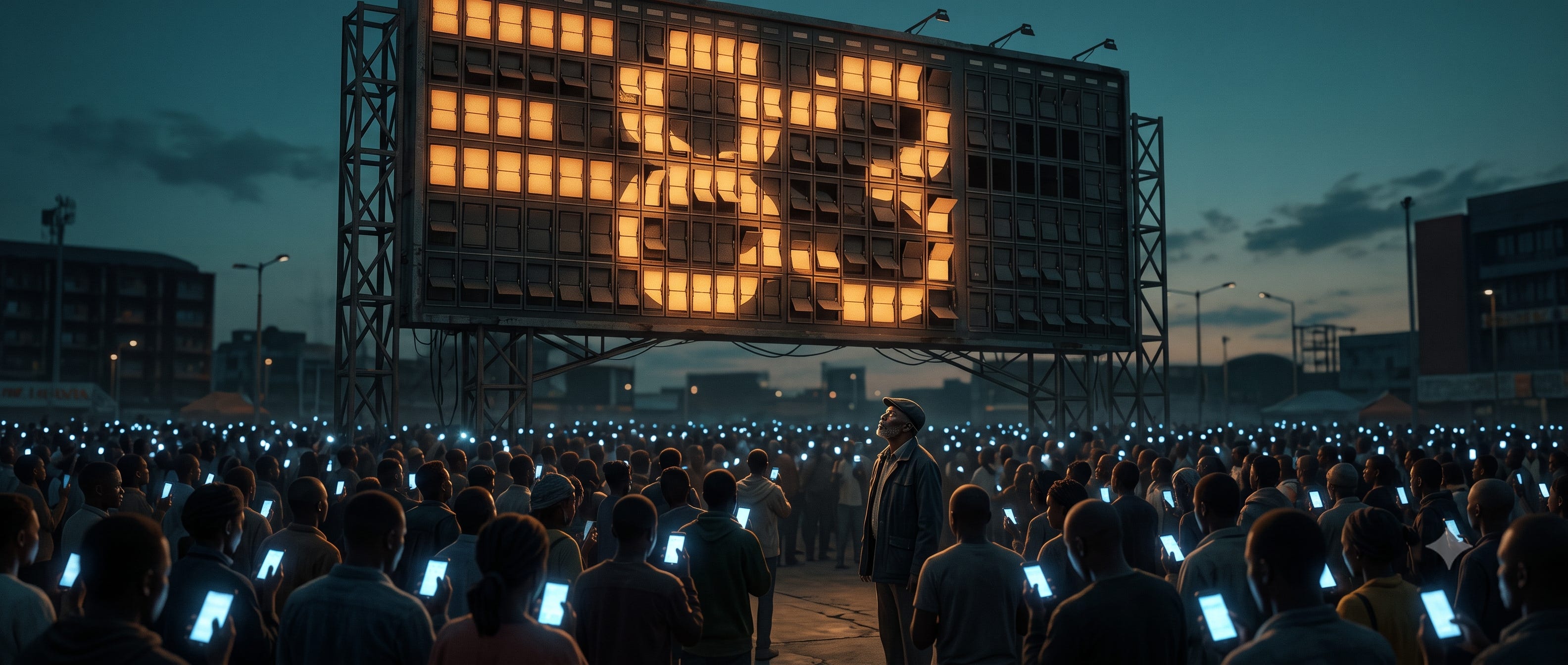
AI-illustration: The Price on the Board.
Written with Nuru Shaba
In April, Nuru Shaba, another friend and I wandered into an argument about dynamic pricing, and by noon the argument had produced a conclusion none of us wanted. Last Sunday, the World Cup final gave it a number.
Less than a day before kickoff, a seat at the World Cup final was still listed above USD2m on FIFA’s own resale platform. The match was billed as the most expensive sporting event ever staged in the United States. Two days later, FIFA closed the books on the tournament. A record 6,810,966 fans attended, nearly double the 1994 total, across a tournament with twice the matches. FIFA’s mid-tournament reporting put stadium occupancy at 99.7 per cent. The commercial cycle built around it was set to pass USD15bn, FIFA’s most valuable ever.
Hold those two facts next to each other. The most expensive World Cup in history also put more people in seats than any before it.
The press had spent June telling a different story. Nearly 180,000 resale tickets were still looking for buyers as the opening match approached. The price floor had dropped on 76 of the 78 US fixtures listed on FIFA’s platform. Close to half the group games were trading under face value. Every number was true. Every number was read as a system in trouble.
The system was never in trouble; it was doing exactly what it was built to do.
FIFA built a pricing machine with two levels, and each level had one job. The top level extracted. Primary prices sat high and moved between sales phases wherever demand held firm, and demand held firm almost everywhere; half a billion ticket requests arrived in a single application window. The bottom level cleared. In Qatar, FIFA had capped resale at face value. This time, for the United States and Canada, it removed the cap and let sellers name any price, taking 15 per cent from each side of every trade. Those late tickets and falling floors were the bottom level at work. Thousands of holders hunted for the clearing price among themselves. FIFA had already been paid once at the primary sale. Now it collected from both sides of every correction. Extraction at the top. Clearance at the bottom. Enormous gate money and full stadiums came out of one machine, and the fans carried the inventory risk the whole way down.
I have to square my own record here, because I read this machine twice before the books closed. In June I wrote that the falling floors were a price still held above clearing, and that the empty seat was the system chasing yield per seat over a full house. In July, answering the declinists, I cited Bloomberg’s account that the stadiums were full despite the ticket prices. The closed books sharpen both readings. The June call was half right: the floors were held at the top, but the falling asks I read as a price still searching were the clearing level already doing its work. And despite was the wrong conjunction to borrow. It was never choosing between yield and attendance. It took yield at the top and attendance at the bottom. Under this machine, a price is a verdict on the remaining buyers, not on the product. When a group game fell below face value, the eager had already paid everything they were willing to pay. The machine was collecting the reluctant.
The same extraction logic ran in the other direction too, though the coverage filed it as a tax story rather than a pricing story. Every host since 2010 had granted FIFA and the participating federations sweeping tax relief. South Africa signed first, and Brazil, Russia and Qatar followed. The United States declined. FIFA extracted one narrow concession instead: the 48 federations may apply, one by one, for nonprofit treatment under the US tax code. The players got no tournament exemption. A Spanish player’s share of the record USD50m prize, earned on US soil, faces 30 per cent federal withholding before any treaty relief, with state taxes behind it. For the first time in sixteen years, the champions’ pay day arrived with a host-country tax bill. And nobody withdrew. The swallowing was easy, because the party holding the exit carried almost none of the bill. The tax fell on the players; the federations sat sheltered behind the nonprofit route, collecting from a pool nearly double Qatar’s. They absorbed it the way they absorbed the visa refusals I wrote about in June. The prize was too large to walk away from, and the cost of staying was somebody else’s. A sovereign found a counterparty that could not refuse, and priced it accordingly. Keep that sentence. It is this essay in miniature.
That same June essay gave the label its full hearing too, from FIFA’s denials to the subpoenas two attorneys general have since issued, and I will not rerun it here. One finding from that essay is the hinge of this one. For all its aggression, the machine priced the match, never the person in front of the screen. Nothing in the record shows the number varying with the buyer. Even the USD2m final listing was posted for every wallet alike. The price was brutal, and the price was public. Which brings us to the part of this essay that has nothing to do with football.
That restraint, the match priced but never the person, is ending, and the April argument is how I knew to watch for it. Nuru spends his working days closer to these engines than I ever did, and he sketched the supermarket that is already arriving. Electronic shelf labels, wired to a central engine that reprices the aisle in real time. The barcodes already tell the system every item in the shop. The loyalty card already holds years of your baskets against your name. The shelf still shows one price to everyone. The price built for you rides the loyalty account and the app, and you will meet it at the till, in the member price and the coupon that fires when you scan. None of that is speculative hardware.
The bridge from the shelf to the person is no longer speculative either. In January 2025, FTC staff reported on pricing intermediaries serving at least 250 retail clients. The intermediaries could tune prices and promotions to a person’s location, demographics, browsing history, abandoned carts, and even mouse movements. Those were initial findings, proof of capability rather than universal practice. But when one major airline said it would expand AI-set fares, three US senators demanded answers about pricing tuned to each traveller’s pain point. The airline’s reply insisted the machine was neither discriminatory nor predatory. Notice the shape of that denial. It is FIFA’s denial, one industry over. For now, fear of that exposure is the most immediate brake the machine respects. The label is radioactive because everyone already understands what it implies once it attaches to a person rather than a stadium. The unit of repricing is moving from the event to the individual. When the move completes, everything you watched at this World Cup arrives at your local till, with one difference. The board comes down.
My first instinct that April morning had been arbitrage. I would send my ten-year-old to pick the items, and I wondered aloud what the machine would charge a child with no profile relative to the parent it already knows. Hold that trade. The morning killed it, and the way it died is the case this essay makes.
I recognised the machine Nuru was sketching, because he and I, between us, have spent more than thirty years operating its ancestor from the other side, across currencies and commodities. In wholesale finance, pricing the counterparty is not a scandal. It is the job. A currency desk does not quote one price to the world. The spread depends on who is asking and what the desk knows about them. A central bank gets one price. A desperate importer with a deadline gets another. Some central banks have chased this and fixed the margins a desk may quote. The game survives the rule. When the market moves lower, you hold your selling rate where it was. When it moves higher, you hold your buying rate. There is always a lag between the move and the new rate sheet, and the lag tends to open in the desk’s favour. That is why some markets moved to live screens and automated pricing, and others never have. Even where the live screen exists, the retail client is sometimes not given it, or does not look at it while dealing. And the screens themselves were tiered. Part of the job was making sure two retail clients who knew each other never saw different tiers, because the sharp ones phoned their network before dealing. What disciplined the desk was the risk that the priced compared notes. At its most aggressive, all of this approaches what the textbook calls first-degree price discrimination: charging each buyer as close to their personal maximum as the desk can find it.
Institutional clients survive this machine because they are built for it. They hold competing quotes, and they employ people whose whole job is to know when they are being widened. They trade in a two-way market, where the client can test the desk’s floor the way the desk tests theirs. The retail consumer, arriving now at the same machine, holds none of that. A second shop is just a second engine reading the same profile, so the second quote is no test of the market, only another guess at you. And the defence that disciplined the desk dies quietly here: your neighbour’s price no longer tells you anything about yours, so the priced can compare notes and learn nothing. No one on their side of the trade can read a spread. Just a person, a need, and a screen that already knows them.
The efficiency case deserves its concession, and the third man in the group carried a version of it. Perfect discrimination is the textbook’s happy ending: no seat goes empty and every buyer who can cover the seller’s cost is served, with the cautious paying less. Grant all of it. Then ask where the surplus goes. All of it goes to the seller, which is what the word extraction means. And ask what the machine does with the desperate, because the same tuning that discounts the reluctant surcharges the person who cannot wait. The cautious who waited for the match that mattered met its other face. By the eve of the final, the cheapest listing ran to five figures and the asks climbed from there to seven. It could watch those asks sit unsold without flinching, because it had been paid for every seat once already, and each trade that did clear paid it twice more. The machine rewards waiting only with the seats it was about to lose, and that lesson herds everyone else into paying early, at the machine’s price. The real question is what the price is responding to, the market or you, and whether you can ever see which.
That morning, I ran the consumer’s logic forward, the way any trader would. If the machine prices you on what it believes you can pay, then every signal of wealth you give off raises your price. Surveillance pricing works as a tax on the appearance of wealth. And the one reliable lesson a century of public finance teaches about taxes is that people rearrange their lives to avoid them. My avoidance plan was ready by mid-morning: the white t-shirt and torn jeans, the bus instead of the car. Taken to its end, everyone starts shopping like hobos, and the visible signal of wealth dies the way the peacock’s tail would die if it attracted hunters instead of mates.
Thorstein Veblen built his theory on the opposite incentive. The wealthy consume conspicuously because visible waste is the one signal the poor cannot fake. Surveillance pricing turns him inside out. Once display raises your costs, the rational consumer downgrades on purpose. Call it the Inverse Veblen effect: performative poverty as consumer strategy. You will not find it in the data yet, and you should not. The downgrading only begins once the till starts reading the shopper rather than the shelf.
Nuru took one look at my strategy and dismantled it. The torn jeans achieve nothing, he pointed out, when the expensive moisturiser on your skin is visible to the same system. Dress like a hobo and the phone in your pocket prices you anyway. Swap the phone and something else gives you away. And the child? There is already enough data in circulation, he said, to profile you and your child without ever needing to know either of you. The clothes they wear and the car they stepped out of are signal enough. The value sits with whoever can string those points together, and the stringing is exactly what the new tools make easy.
The profile, he was saying, is a composite image. It is assembled from your device, your payment method, your address, your purchase history, your movements, and the company you keep. Suppress one input and the picture barely flickers. The architecture is multi-factor authentication run in reverse. Your bank triangulates signals to prove you are you. The pricing engine triangulates the same signals to prove what you can afford.
Which leads somewhere genuinely strange. If appearing poor cannot beat the picture, the only defence left is becoming poorer in fact. Keep the old phone past its death, and pay cash even where it costs you the points. Let the presentation slide, because the presentation is an input. Self-deprivation stops being a hardship and becomes a pricing strategy. And the burden of that strategy lands in a precise place. The wealthy will buy clean privacy, the way they already buy clean everything else. The poor cannot downgrade further; the machine already holds them at their floor. It is the aspirational middle, the most legible class in any economy, that pays the full tax. Banked and M-Pesa-trailed, the Nairobi professional is documented at every step from payday to pocket change. A formal salary, digitally spent, is the most readable money in the world. Legibility is the tax base.
The question was changing under us, from how the machine will price us to whether anyone can stop the picture being built. The argument went where every surveillance conversation eventually goes, which is China. The warning there is real, though it is not the cartoon: no single national score, only scattered records and blacklists slowly becoming interoperable under state authority. The Western instinct calls home categorically different, because at home the aggregators are private. Nuru was less comforted than I expected a private-sector man to be. The moment working exchanges exist between private data holders, he argued, the composite image assembles itself regardless of who holds the pieces. Who governs the picture is the second question. The first question is whether the picture gets built. If it does, you are equally exposed whether the keys sit in a ministry or a consortium.
Then he made it worse. A citizen facing state surveillance has one adversary, and states, at least where elections work, can be fired. Elections reach a government, and so, in the limit, does the street. A consumer facing private surveillance faces a thousand aggregators at once, and there is no single surface to reach. You cannot vote out a data broker, and you cannot protest an inference engine. His analogy was torrents. Everyone has known for twenty years that the sharing is illegal, governments keep trying to stop it, and the torrents are still running, because a decentralised thing has no central place to target.
I closed the last exit myself, because the record closes it. The state route is no more reversible than the private one. Obama campaigned against the surveillance apparatus Bush built, then inherited it and kept it. Every administration since has kept it. The capability is too useful to surrender, whoever built it. Private surveillance cannot be dismantled, because it has no centre. State surveillance will not be dismantled, because no incumbent ever volunteers. Both exits are sealed for any practical purpose, and the picture is being assembled behind both doors.
The question that actually ended the morning conversation was mine. If surveillance pricing is irreversible in both its forms, why the rush for data protection laws? Stand in Nairobi and look at the record. Kenya passed its Data Protection Act in 2019. Uganda did the same year. Rwanda and Zambia followed in 2021, Tanzania in 2022, Nigeria in 2023. Public evidence of the surveillance pricing machine on this continent remains thin. The laws regulating it arrived early, and in near-uniform shape.
Later that day, Nuru and I went looking for the comfortable reading first: our legislatures saw the machine coming and built the fence in time. There is an institutional reading too, and it is true as far as it goes. The uniform shape has parents, continental harmonisation under the Malabo Convention and GDPR’s grammar of consent and adequacy travelling with the rules of digital trade. But walk both readings through everything above. The best-armed regulators on earth, holding GDPR and eight years of its enforcement, have mostly formalised the exchange rather than prevented it. The consent box nobody reads and everybody clicks is only the best-known instrument, and the exchanges route around the others too. A fence cannot explain laws that cannot stop the thing they fence. And a law passed to make a country’s data flows credible to foreign partners is no fence at all but a credential, the first of three further functions the record makes hard to dismiss.
The credential function is simple. A data protection act reassures international partners and unlocks digital-economy money, whether or not the office behind it can staff itself. The second was Nuru’s catch when I went fishing: rent. A licensing regime with registration fees and discretionary penalties is a toll booth on the data economy, and a toll booth has no interest in an empty road. The third is positioning, and it is the one we cannot prove and cannot unsee. Laws are drafted by people, and the people who shape these regimes will be unusually valuable to the firms the regimes will license. We name no one. The pattern is the point, and it carries its own test: watch where the drafters sit in five years. Whoever writes the rules of an exchange has chosen the shape of the market it becomes. Then notice the direction the road runs. The registration fee is paid in Nairobi. The picture is assembled and sold by engines domiciled elsewhere. Local rent collects at the toll booth. The cargo travels outward.
Now test the three functions against the one thing we can measure, which is enforcement. By the Act’s fifth anniversary late in 2024, Kenya’s regulator had registered more than 7,000 fee-paying data controllers and processors. By January 2026, its full record stood at 357 determinations, 134 enforcement notices, 184 compensation orders and 20 penalty notices. Reported fines through late 2024 sat around KES 26m, roughly the price of two apartments in Kilimani. It is not a sleeping office; determinations nearly doubled in 2025. But the shape is the point. Registration is broad and paid. Penalties are narrow and small. The ratio convicts nobody. It directs the question, and you can direct it at your own jurisdiction. Our suspicion remains the uncomfortable one. The laws were never mainly a fence at all, but a seat at a table, reserved before the table was built.
Here is what I keep returning to, a week after the final. Somebody offered a seat at MetLife for more than USD2m, and the number was obscene, and it was on the board. Every posted price in that stadium existed in public. You could refuse it, or take it to an attorney general, and two attorneys general are pursuing exactly that. A posted price is a published rule. It is the same number for you and for the stranger behind you. That shared number is what gives either of you standing to argue about fairness at all.
Two weeks ago I wrote about an institution that had made its questions unanswerable, and about what the silence was worth to it. I wrote it about a governing body. It applies without amendment to a till. Personalised pricing turns every transaction into unpublished discretion. You will never know what the person behind you paid, or whether you were treated fairly, because the question will have no data to stand on. The price stops measuring the seat and starts measuring you.
And measuring you for what? This is the part worth sitting with. Willingness to pay measures wealth only up to a point. At the moments that matter most, it measures need. The perfect price, the one the composite image exists to find, sits at the point where you cannot refuse. The medicine at 3am. The flight to the funeral. Nobody needs a final ticket; everybody, someday, needs the pharmacy. A machine built to find each person’s maximum is a machine built to find each person’s breaking point, and it charges most where refusal is least possible. The World Cup ran the crowd-sized version of that machine, in public, with the number on the board, and produced the most valuable tournament FIFA has ever staged. The production version runs on you, in silence, with the board taken down.
By the end of that April morning, I had told my friends exactly what they had done to it, and that remains the honest register for this ending too. Nuru and I have no defence to hand you. The counter-tools that emerge will be bought first by the people who need them least. What I can offer is older and blunter. For years I have told anyone who asked to own assets, and over the last year and a half I sharpened that to real, productive assets. This machine makes me double down and add a word: make sure a good share of them are also physical, because real is not always physical. A claim on a productive thing still lives on somebody’s screen, inside the machine’s reach. A thing you can stand on or run answers to no engine. The machine will still see what you own; it can read a title deed as easily as a basket. What it cannot do is price the meal you never had to buy, and what it never prices, it never learns from. The rest of what I can offer is the habit this publication exists for, which is refusing to let a structure operate unexamined because it is quiet. The last World Cup priced its crowd in the open. Look hard at the board while it is still up. You will miss it when the number it shows is yours.