

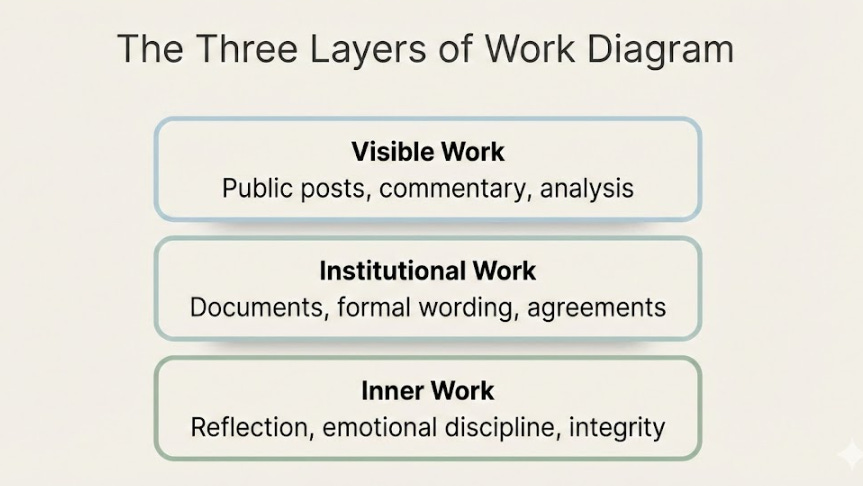
Source: AI Illustration of The Three Layers of Work
Some weeks do not explode. They just press. The data looks good, the headlines sound friendly, the posts land well. Yet by Thursday night, there is a quiet weight that never appears on any chart.
This week felt like that.
On the surface, it looked like a clean win. Reserves climbed in one of the economies I track. Ratings moved in the right direction. Markets rewarded the story. People sent congratulatory messages and shared the work. The narrative said confidence.
Underneath, it was a different kind of week. There were questions about who really holds the keys to strategic infrastructure. There were formal drafts where a single line could tilt the balance between principle and advantage. There were short messages from familiar names that used to sit much closer to the centre of my life.
None of that shows in the data, but all of it shapes the person who reads the data.
When I replay the last seven days, I keep seeing three kinds of work. There is the visible work, which lives in public articles, comments and posts. It is what people react to and what history will probably remember. There is the institutional work, in documents and quiet conversations, where you defend your position but also protect the link between your name and integrity. Then there is the inner work, where you decide how to hold all of this without losing your peace.
This week reminded me that my instinct is defensive in the best sense. Give me an upgrade, and I will test the structure. Give me a celebration, and I will look for the exits. I do not dislike good news. I just refuse euphoria without brakes. I want markets, institutions and households to win in a way that can survive the next shock.
It also reminded me that coherence matters more to me than noise. I do not want isolated hot takes. I want my public writing, my formal wording and my private reflections to sound as if they all came from the same mind. If I say Structure Before Sentiment in policy, it must also hold in how I speak, negotiate and respond when the week turns personal.
The final lesson is that I am more tender than my language sometimes suggests. I think about justice and rehabilitation, not only punishment. I worry about what social spaces do to people who already carry silent weight. I know how a simple greeting can steady a person, or unsettle them, in the middle of a heavy week. Charts never show that, but leadership lives there.
The real test behind the numbers was not whether I could read a balance of payments table or a rating report. The test was whether I could hold firmness without aggression, caution without fear, and authority without performance. That, for me, is the governance of peace. It is the decision to speak and act in a way that you can defend in front of overseers, mentees and your own children on the same day.
If your week felt crowded in the same way, one small practice helps. Ask yourself what you celebrated, and whether you also tested the structure behind it. Ask where you protected integrity even when leverage was tempting. Then name one or two open loops you will close next week so your mind can rest.
Structure Before Sentiment is not only about economies. It is also about you. Build a structure for how you speak, how you contest, how you care and how you close your week. Let sentiment sit inside that frame, not outside it. The markets will move, the headlines will change, relationships will evolve. Your work is to remain the same person in all three arenas.
Elegant and accurate narrative of how work happens!