

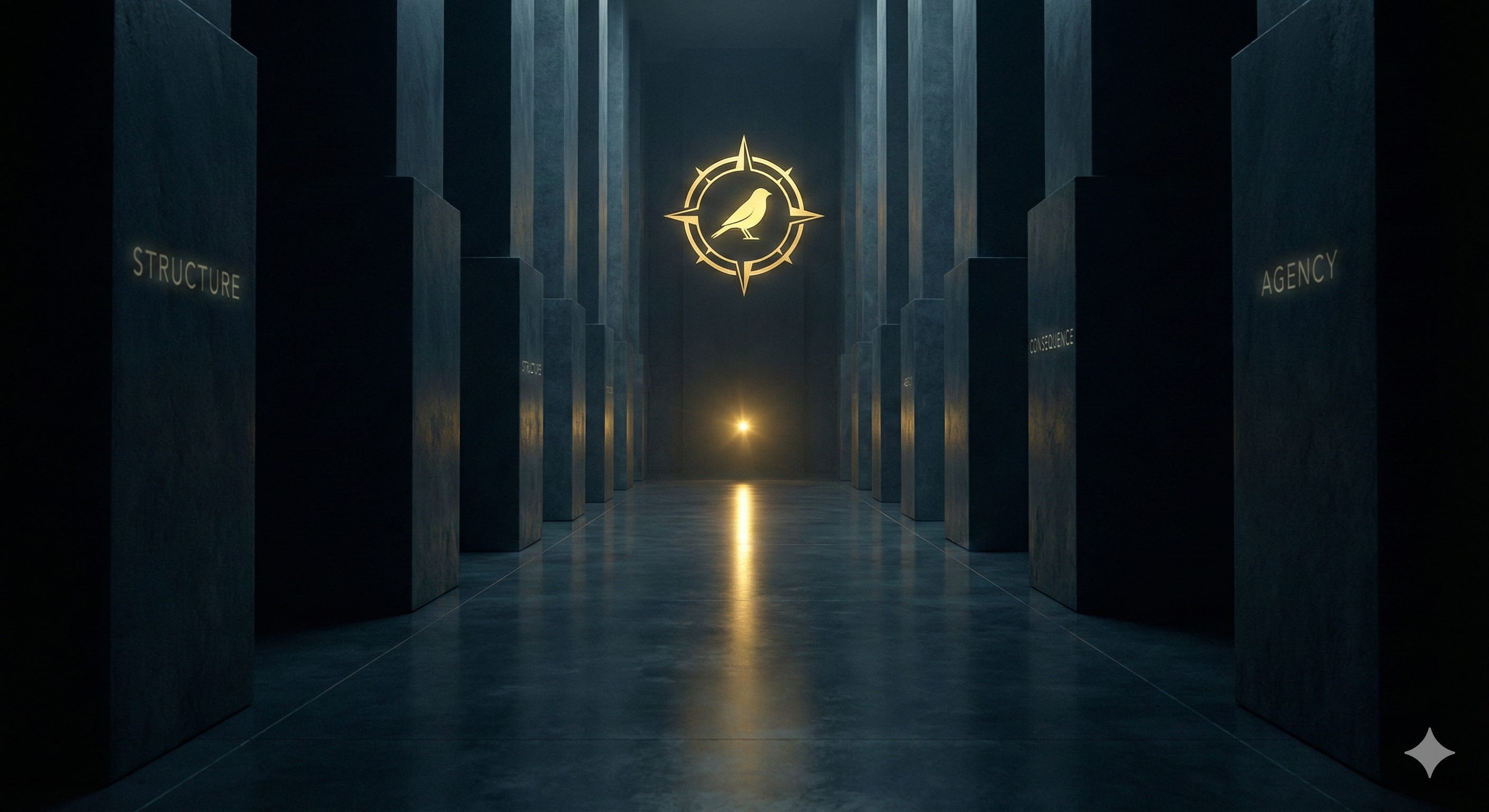
AI-generated image: The architecture that constrains is the same architecture that makes agency real.
A conversation earlier this week stopped me. Not because of where it went, but because of the question underneath it. We were talking about time. Not time management. Time itself. What it is. Why it carries weight. And why certain choices seem to return long after we think we have moved past them.
Physics has no settled answer on this. Some models suggest past, present, and future coexist. Others insist the future is genuinely open until it becomes the past. Relativity complicates the idea of a shared present. Entropy gives time a direction. When these frameworks are brought together, time becomes the unresolved problem rather than the answer.
I am not going to resolve any of that. What caught my attention is something simpler. Whatever time is, it seems to be the arena where meaning is revealed.
Physics debates what time is. Spiritual traditions debate what time means. Most of us live inside the gap between those debates, experiencing time not as theory, but as pressure, as consequence, as formation.
This gap keeps surfacing in mentoring conversations. The same question returns in different voices. The cost of decisions. And the strange way certain roads seem to disappear, only to return later, no longer as options, but as inevitabilities.
My first academic training was in probability and statistics, and it shaped how I instinctively read these patterns. Statistics trains you to think in distributions rather than moments. In likelihoods rather than certainties. In paths that widen early and narrow over time.
People do not start from the same place. We carry different exposures, advantages, and constraints. As life unfolds, choices interact with those starting conditions. Habits form. Skills compound. Character takes shape. Some doors open more easily. Others drift out of reach. Not because they become impossible, but because their likelihood drops sharply given the path already taken. Probability concentrates. And lives do not unfold in isolation. Each person is a moving trajectory intersecting with other moving trajectories. Some of the most consequential moments happen where those paths cross, often without either party realising it.
I have lived that tension.
Early in my career, there was a fork I was very aware of at the time. One path leaned heavily into economics and research. It was there. It was visible. And I did not take it. I stayed with trading. Markets. Execution. Speed.
Life moved on. The sense was not regret. Just choice.
Years later, something unexpected happened. That same economist path came back. It came back not as an option, but as the only road available. And what made it stranger was that the circumstances pushing me into it were created by people who had no idea this had once been a genuine choice earlier in my life.
From the outside, it could easily look like fate.
From the inside, it felt more like convergence.
I embraced it. And even after returning to trading, economic research was no longer something I could switch on and off. It had become part of how I see the world. Writing. Explaining. Teaching. Connecting dots. At some point, I realised I was no longer doing research as a tool. I was doing it as identity.
That raises the question I keep circling. Was that predetermination? Or alignment finally catching up with time?
What once felt like freedom starts to feel like direction. And what eventually feels like fate may simply be freedom that has already been exercised.
It may not be that outcomes are scripted. It may be that after enough choices, fewer outcomes remain coherent. The architecture that constrains is the same architecture that makes agency real. Without narrowing, decisions would carry no consequence. Without consequence, freedom would be meaningless.
Theology arrives at the same place through different language. Covenant secures the destination, not the route. The victory is certain because the structure is weighted toward truth, justice, and restoration, because evil is self-consuming, and truth simplifies over time. But participation still matters. Judgment still makes sense, because choices are real.
There is a harder truth inside this that scripture captures quietly. Sometimes we say God does not wait for us. That sounds harsh, but it may simply be honest. Certain goods require timing. Certain outcomes require intersection with people, moments, and conditions that will not remain in place forever. When we keep choosing away from a path, we do not cancel those possibilities morally, but we drift out of alignment with the conditions under which they were likely to occur. Prayer and discipline can reposition us within the structure. They change posture, persistence, and alignment. But they do not reverse time. What feels like God moving on is often just time and choice doing what they always do.
This is why conversations with mentees about decisions are never really about the moment itself.
Decisions are not single acts. They are votes cast repeatedly. And time tallies votes. The cost of a decision is not only what you choose in the moment. It is what you train yourself to become by choosing it again and again.
Time does not remove agency. Time reveals what we did with it.
Maybe the deeper question is not whether the future is fixed. Maybe it is whether we are becoming the kind of people who can live inside the future we keep asking for.
And perhaps the quiet work of a life is not trying to outrun time, but allowing it to finish its work in us.