

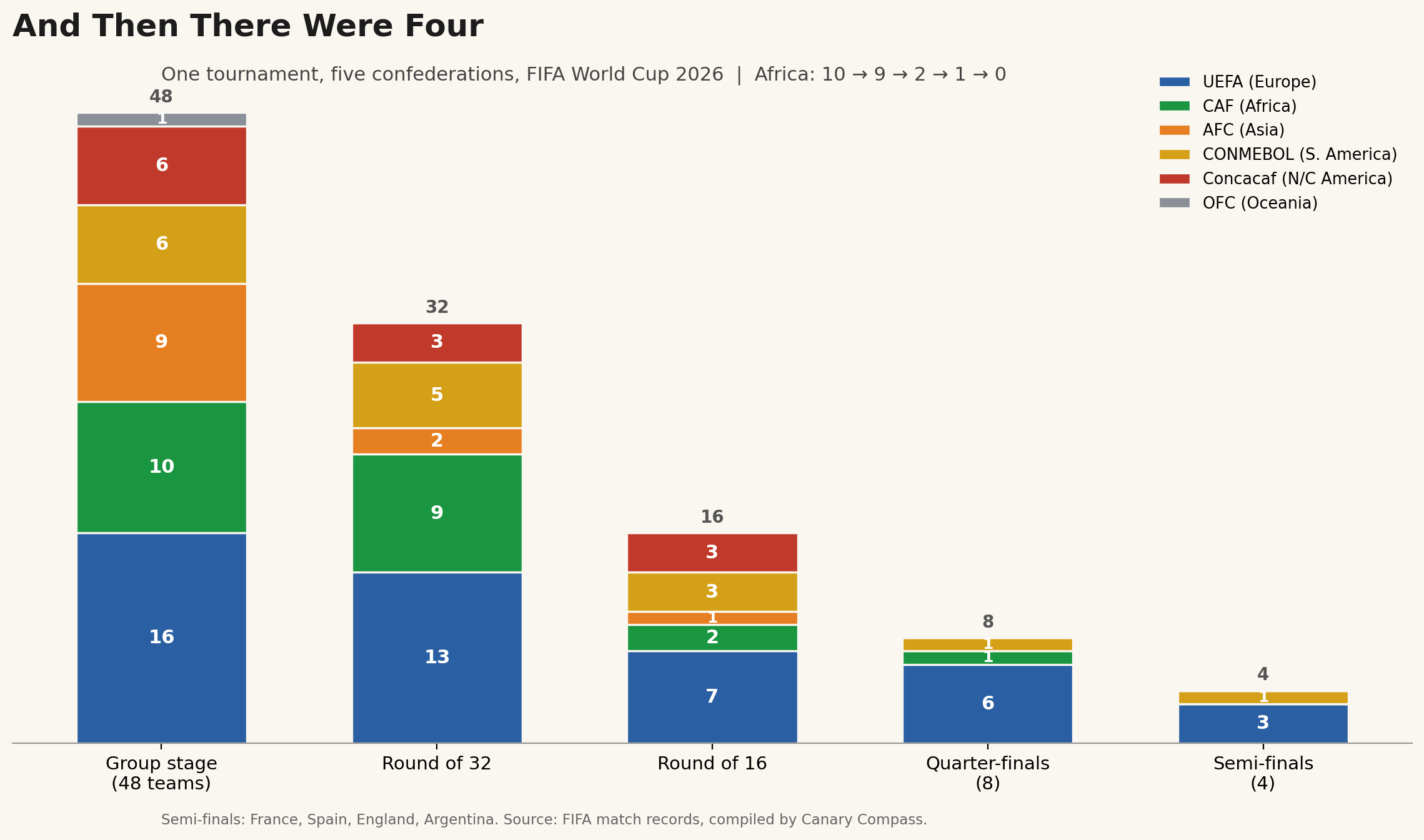
AI-generated Image: And Then There Were Four
On the World Cup, the 86th minute, and an institution that has made its questions unanswerable.
This Reflection was written for Friday and held. The quarter-finals deserved to finish speaking, and on Friday the questions in this piece began acquiring answers; a piece about unanswered questions does not publish hours ahead of them.
My first World Cup was 1990. I was six. Baggio slalomed through Czechoslovakia and I was decided for life. Two weeks later came the first thing I truly remember about football, and I have told this story in these pages before: crying, not mine, the Italians’, weeping in Naples while Maradona’s Argentina went through on penalties. Baggio had come off the bench, scored his kick, and lost anyway. Everything before that came off my father’s VHS tapes, which reached back to 1986, to a hand in Mexico City and to what followed it four minutes later. I learned the game twice: once live, once from the archive. Keep the tears and the drawer of tapes in mind. This piece returns to both.
On Tuesday night in Atlanta, Egypt led Argentina 2-0 with eleven minutes of normal time left. Salah had been magnificent. Ziko had scored twice, though only one of them still existed. The other had been erased around the hour, when the video assistant reached back through a completed passage of play and found a foul by Attia on Lisandro Martínez that the referee had not called live. A shirt held, a boot on a foot. Under the phase-review protocol, the intervention was defensible. ESPN’s technical review upheld it. And the referee’s largest discretionary award of the night had gone to Argentina, a first-half penalty minutes after Egypt’s opener, which Shobeir saved from Messi. I want that on the record early, because this piece concedes every correct call, and the concessions are load-bearing.
Then Romero scored in the 79th minute. Messi equalised in the 83rd. Deep in stoppage time, Egypt pressed for a winner of their own. Fathy went down in the area with Mac Allister’s hand in his shirt. In the same passage, Salah went down under contact from Álvarez. Play waved on, both times. Argentina broke the length of the field, Lautaro crossed, and Enzo Fernández headed the winner with the clock at 93. The Egyptian federation filed a formal complaint against the referee, Letexier, and said it could not remain silent.
Alan Shearer said it in seven words: “Either both are fouls, or neither is.” This piece is about why nobody can answer him.
Begin with the tournament’s other scandal, because the two are one. Folarin Balogun was sent off against Bosnia after the referee was shown slow-motion replays of the incident, a use of replay that CNN reported, and ESPN’s referee-led VAR review concluded, was out of protocol, slow motion being reserved under IFAB’s own text for facts and point of contact, never for judging the intensity of a challenge. The card was widely called harsh. Within minutes, Andrew Giuliani and Lutnick, watching from the stadium, had alerted the president. White House lawyers offered assistance. US Soccer’s own legal team prepared and submitted the formal challenge. Trump called Infantino and asked for a review. FIFA’s disciplinary committee found him guilty of both infringements, upheld the one-match suspension the red card had already triggered automatically, expressly confirming it covered the Belgium match, fined him $40,000, half for the foul and half for returning to the field to celebrate while ejected, with US Soccer jointly liable, and then applied Article 27 of its Disciplinary Code to suspend that same ban’s implementation for a year. Read that sequence slowly. Guilt affirmed on every count, twice in money, and the one consequence that carried sporting weight waived for precisely the match that mattered. The committee’s statement called this a balanced measure.
Reporting marked it as the first time in more than sixty years of World Cup matches that a player featured after a red card, a clock that runs to Garrincha, 1962, sent off in a semi-final and permitted to play the final. FIFA’s own statement preferred the opposite emphasis, that the mechanism was not unprecedented, and on that narrow point it was right: Portugal had used Article 27 before the tournament to defer Ronaldo’s suspension from qualifying, which is precisely why asking was rational. The door was open. The Americans walked through it.
I hold an unfashionable position here. The United States did nothing wrong. Pursuing every available remedy for your player is what a competent federation owes its squad. The whole point of institutional life is that you query. Other federations were not wronged by America’s initiative. They were exposed by their own passivity. Trump taking public credit was in character and cost the optics dearly, but a president lobbying for his team is not the scandal. Governments and football have never been separable: states sign the hosting guarantees, Mussolini staged 1934, the junta staged 1978, and last December the president of the United States received the inaugural FIFA Peace Prize at the draw. The question was never whether power calls. The question is how the institution answers, and whether anyone gets to read the answer.
Here is how it answers. Belgium’s federation wrote to FIFA asking for a copy of the Balogun decision and an explanation of the process. FIFA treated the letter as an appeal, then dismissed the appeal it had created for lack of standing, and Belgium says it has never received the reasoned decision or the referee’s report, which it calls a breach of FIFA’s own regulations. The standing doctrine is formally sound. The path to it was manufactured. A request for explanation was converted into a dead procedure rather than answered with one page of reasoning.
Then, this week, the control experiment ran itself. Jarell Quansah was sent off against Mexico. An English MP wrote to Infantino citing Balogun by name and asking only for consistency, arguing that a tournament cannot justify one player benefiting from a delayed suspension while another in materially similar circumstances does not. On Thursday, FIFA answered: two matches, serious foul play. Quansah duly sat out the Norway quarter-final and will now miss the semi-final against Argentina. And here the merit records make the outcome stranger, not simpler. Balogun’s card was widely judged harsh, with ESPN’s referee-led review ruling it a wrongly awarded red born of misapplied protocol; Quansah’s was judged correct by everyone including the MP lobbying for him. Yet FIFA’s own statement insisted Balogun’s card was upheld, valid, never overturned, which forecloses the one defence, that the cases differed on merit, the institution never offered anyway. By FIFA’s own paperwork, two equally valid red cards produced a reprieve for one man and a doubled ban for the other, and no reasoning has been published for why Article 27 reached one and not the other. By the quarter-finals even France had petitioned FIFA over a yellow card. The channel Ronaldo’s deferral opened and the Balogun case proved is now a thoroughfare, and still nobody has seen its rules.
So assemble the tournament’s grievance ledger by federation. A presidential phone call preceded a suspended ban. An MP’s letter preceded a doubled one. Egypt’s formal complaint received, eventually, a public assurance from the referees’ chairman that the Laws had been correctly applied, an answer with no file attached. Belgium’s information request became an appeal engineered to die. Haiti, whose group-stage matches produced their own contested non-interventions, filed nothing and received nothing. Five federations, five grievance capacities, five outcomes, and the responses rank precisely by proximity to power. That is a sorting, produced by a published discretion with no published criteria for its use, and it requires no allegation.
And the 93rd minute in Atlanta completes it. The tournament’s own precedent, set in that very match, is that the video assistant reviews the attacking phase that produces a goal and retrieves fouls from anywhere inside it. That is the stated basis on which Ziko’s goal died. Apply the same standard to the phase that produced Argentina’s winner, a phase containing the Fathy shirt-pull and the Salah contact, and at minimum you look. Here precision matters, and it cuts both ways. The appeals were checked: under IFAB’s published protocol the booth automatically checks every potential penalty incident, silently, which is why players are told never to request reviews, and the reporting confirms both were examined and cleared as no clear and obvious error. The technical case for the clearances exists, and it is ESPN’s review that states it: the grab brief, and the Salah contact a lateral boot-to-boot collision in a mutual challenge, where the Attia foul had been a boot planted down onto a standing foot with a fistful of shirt attached. Perhaps that reading is right. Millions who watched the same frames read them otherwise, and the reason the argument cannot end is that nothing was published against which either reading can be checked. The asymmetry is therefore not review against no review. It is visible review against invisible review. One class of decision arrives with a monitor visit, a stadium announcement, and the referee’s voice over the public address. The other happens in silence and publishes nothing, so no one can distinguish a rigorous clearance from a rubber stamp. The grievance that survives the clearances is therefore procedural rather than sporting, and it should be stated exactly, including its basis. No rule in the book entitles Egypt to an explanation, and this piece claims none. The claim rests on FIFA’s own adopted standard: an institution that now explains its interventions to eighty thousand people, in the referee’s voice, over the public address, has itself conceded that officiating decisions warrant public reasoning, and cannot coherently confine that concession to the decisions it takes while refusing it to the decisions it declines. By its own precedent, then, Egypt is owed an account of why one class of decision arrives with an explanation and the other with silence. Nothing more, and nothing less. What arrived instead, days of noise later, was the referees’ chairman’s assurance that the Laws had been correctly applied, a verdict without a file. Egypt, note, were themselves spared by the machine in the group stage, when Iran’s 93rd-minute goal against them, a strike that would have carried Iran to the knockouts for the first time, was erased for an offside measured at barely a millimetre, correct under Laws that carry no tolerance band. The instrument points both ways. Only the explanations are one-directional.
FIFA can explain itself, and this tournament contains genuine reform, credited here in full before a single criticism. Referees now announce review decisions to the stadium in their own voice, a real advance borrowed from rugby, and it works. Hold that credit. The argument stands on it.
Because the institution has also shown how fast it moves when the evidence flatters it. When Croatia’s 103rd-minute equaliser against Portugal was erased, the fury was immediate, and the call was right. Matanović’s flick-on was invisible to the eye but present in the data. Veiga ducked, so his touch was an instinctive deflection rather than a deliberate play, and under Law 11 the offside phase never reset. Fans claimed a gift to Portugal. The law says otherwise, and I say so here. What followed was remarkable: FIFA published a statement the same day, on its own channels, citing sensor telemetry from the ball, complete with a heartbeat graphic for broadcast. Evidence, reasoning, proactive disclosure, deployed within hours.
Hold that beside the silences. Belgium has waited a week and counting for a decision that has never arrived. Egypt’s complaint draws a chairman’s assurance with no file attached. The 92nd-minute clearances in Atlanta go unexplained to this day. The obvious objection writes itself, that sensor telemetry is objective and publishable while subjective judgement is not, and it fails on the evidence: rugby broadcasts its review deliberations live, Formula 1 publishes written stewards’ reasoning on subjective calls, and FIFA’s own announcement protocol already voices subjective decisions to eighty thousand people in real time. The capacity question is settled. Only the selection criterion remains, and the pattern resolves it into a policy: when the data flatters the institution, disclosure is instant and evidenced. When the question runs the other way, the institution discovers it has nothing to say. That is a disclosure policy whose criterion is the verdict.
And observe what the announcement protocol concedes: that the crowd is owed reasoning, in real time, in the referee’s own voice. Every argument against fuller accountability is surrendered by the announcement’s existence. What remains withheld is everything upstream and downstream of those thirty seconds: the booth audio that produced the recommendation, any account of the reviews declined, which is where Atlanta’s scandal lives, and any forum where the day’s decisions can be questioned at all. Coaches face the press by contract. Players face it routinely. The president faces it when it suits him. The one actor whose decisions are irreversible faces no one.
Irreversibility is the heart of it. A league amortises officiating error across thirty-eight matches. A knockout tournament capitalises it instantly and forever. A four-year cycle, a generation’s window, ends in one unreviewable moment, and no later remedy returns a second of it. Football has known this and managed it in the dark. In 2022, Lahoz kept Paredes on the pitch after he scythed Aké and drove the ball into the Netherlands bench, in one of the most card-strewn matches in World Cup history, and Van Gaal’s team went out on penalties. Lahoz did not referee again at that World Cup. A sanction was applied, no reasoning was published, no standard was articulated. Consequence management exists. It simply operates in shadow, which preserves the discipline and destroys the deterrence.
How far can the shadow bend? In September 2024, on ESPN’s F Show, the retired Chilean referee Carlos Chandía told a story from the 2007 Copa América semi-final. Messi, already booked, handled the ball late in a decided match. By Chandía’s own account, he kept the second yellow in his pocket and told him “it will cost you your jersey.” The shirt went to the referee’s dressing room, and, by that same account, Messi played a final he should have missed. Chandía believes the choice cost him the final’s whistle, an informal sanction, again unpublished. If his story is true, nobody organised it. No syndicate, no federation, no phone call. The corrupting gradient was one man’s fandom, priced at one jersey. Systems that rely on officials feeling nothing in the presence of greatness are structurally unsound, which is why serious sports stopped relying on feelings and started publishing files.
The literature says the ambient version is universal: studies of injury time, card rates, and crowd effects have long shown officials favouring bigger teams and louder rooms without a corrupt intention anywhere in the chain. Video review was sold as the corrective. Structurally, it relocated discretion from the pitch, one man’s split-second in front of eighty thousand witnesses, into a booth where an unseen official decides what gets reviewed, when the retrieval happens, and which frames at which speeds the referee is shown. The Balogun protocol breach proved that last channel is live. Whoever curates the replay diet shapes the decision without making it. And the booth adds a product the old match-fixers never had: review decisions move live betting markets violently, and the review process manufactures a window, minutes in which the booth knows the direction before the stadium does. Advance knowledge of an honest decision, leaked seconds early, is a tradeable asset that fixes nothing and profits anyway. Any financial regulator shown this architecture would classify it as high-risk by design before asking whether anyone has exploited it. Football built a trading desk with no compliance function and no tape.
Except there is a tape. Every review is recorded. The audit trail exists, match by match, and is withheld, while rugby has broadcast exactly this material for years. Whether the booth is clean is not unanswerable by nature. It is unanswerable by policy.
Into that policy vacuum, the world has poured. Fans compile card-per-foul ratios from official statistics because the institution publishes no officiating data of its own; tallies and manufactured pundit transcripts circulate at industrial speed, unfalsifiable and therefore immortal. Melissa Reddy, one of the most credentialed football journalists working, posted that VAR interventions have been heavily weighted toward certain teams, adding that if you have followed everything and still believe it is all fair, “delusionville must be a lovely place to reside.” Louis van Gaal, nine months after managing the Netherlands at the 2022 quarter-final, told NOS “it was all a premeditated game” and, asked whether he meant Messi was intended to become world champion, answered that he thought so. Egypt’s coach wondered aloud this week whether they wanted Messi kept in the running. Modric, after Croatia’s exit: “If it were the other way around, VAR would never have been involved.” Even the neutral bench joined: the American broadcaster Alexi Lalas, on the Balogun red, said that “if his name was Messi, he would still have played.” Mido, the former Egypt striker, went further, saying FIFA would have lost millions in sponsorship money had Egypt won, an assertion this piece does not adopt and no evidence supports; it is filed as a measure of what participants now say aloud. All of these voices speak from elimination, and the discount applies to every one of them equally. The ladder’s point is that no rung, from Van Gaal’s premeditation charge in September 2023 to this weekend, has been answered. Even the tournament broadcaster’s own desks now carry the word fixed in chyrons. Anonymous fans, a journalist of record, two national coaches, a legend, a former international, the partner network’s analysts. At every rung, the institution’s response class has been identical: nothing, until this weekend, when referees’ chairman Pierluigi Collina publicly defended the Egypt decisions as correct applications of the Laws. Note the response class when it finally came. A verdict restated, with no audio, no reasoning, and no data attached. The institution’s answer to show us remains trust us.
Two specimens from the same vacuum. One partisan account, rewatching the Atlanta footage, publicly downgraded his own side’s grievance, concluded Salah’s fall was no penalty, and upheld the Mac Allister complaint on stated evidence: a fan doing FIFA’s job, reasoning in the open, revising against his own interest. Another opened with the verdict and captioned the video Fixed? Rigged? Quite possibly. An information void does not select for truth. It selects for confidence, and the institution prefers the noise.
Bloomberg this week priced the preference. FIFA expects roughly $9 billion from this World Cup, about $2 billion more than Qatar. The prize pot doubled to $871 million. Host-city card spending is up 6.3 per cent, non-local spending up 16.7 per cent. A sports lawyer told them the question is no longer the red card but whether FIFA has undermined its own authority as the game’s regulator, and Bloomberg’s own assessment was that the complaints will likely fade once the tournament ends. Infantino stands for election early in 2027, at the 77th Congress in Rabat, unopposed. Klopp can say “This is our sport, not theirs” and the AFC president can answer “FIFA is in its best position ever,” and only one of them is describing the balance sheet. Institutions publish reasoning when silence costs something. FIFA’s silence pays nine billion dollars. Opacity is not a failure the institution has neglected to fix. It is a feature that has never once been priced.
Now Argentina, and let me be precise, because precision is the protection. No fix is alleged in this section. None is needed. The argument is about structure, and structure is documented. For the removal of doubt: this piece does not claim the 2022 or 2026 tournaments were fixed, and nothing in it should be read as that claim.
Begin in 2016, at MetLife Stadium, where Messi missed in the shootout, lost his fourth major final in nine years, and retired from international football in tears. A FIFA match organiser put a number on the grief: the Argentine federation stood to lose more than $25 million through 2018 if the retirement held. Hold that number. It is the honest unit of account for everything after.
In 2022, Argentina were awarded five penalties across their seven matches, the most any team has received in a World Cup, a record that had stood since 1966 and was broken in the final itself, on the contested Di María call. The base-rate defence is real and I will make it myself: deep runs mean more matches, attacking volume earns penalties, and Argentina played the maximum seven. The defence may be entirely sufficient. Here is the problem. Nobody can test it, in either direction, because the institution publishes nothing: no rationale, no audio, no criteria, no data. The question “does the champion get special officiating” is not unanswerable because it is metaphysical. It is unanswerable because the filing cabinet is locked, and the lock is renewed annually, on budget.
The incentive the locked cabinet protects is not a secret. It is a corporate structure. Adidas has been FIFA’s deepest commercial partner for over half a century and supplies the tournament ball, the same Trionda whose sensors convicted Croatia. Messi is Adidas’s lifetime athlete, the house’s answer to Nike’s Ronaldo in the defining sponsorship war of the era. His 2022 coronation, in an Adidas shirt, with an Adidas ball, at Adidas’s partner’s tournament, was worth more to the brand than any campaign money could buy. The tournament’s governing body and its flagship sponsor hold a concentrated, correlated position in one player’s mythology. In any market Canary Compass covers, that sentence alone, before any conduct, triggers disclosure obligations, information barriers, and independent oversight. Football has none of the three. State it unmistakably: no inference of conduct is drawn here, and none is needed. The point is the absence of the apparatus that makes such structures safe everywhere else. A clean institution with this exposure builds that apparatus by reflex. This one has not.
The gradient operates on whoever the asset is, which is what separates structure from partisanship. In October 2024, Infantino personally announced Inter Miami’s place at the Club World Cup through the host slot, justified by a regular-season points trophy, announced before the actual champion had even been decided. LA Galaxy won the title and stayed home. It is difficult to find anyone in football who believes the host slot finds a points trophy that is not wearing Messi. The control case: Infantino then publicly floated engineering Ronaldo into the same tournament via a transfer-window workaround. It failed, because no institutional lever existed. Superstar-seeking is policy. Where the lever exists, it is pulled. The officiating questions that cluster around Argentina are what the same gradient looks like where the last of the sport’s superstars still standing wears one shirt.
And as this piece was being finished, the questions acquired subpoena power. La Nación reported, and the Miami Herald confirmed through two law-enforcement sources, that the FBI is investigating the Argentine federation for possible fraud and money laundering: roughly $300 million in AFA-linked revenue routed through a Florida commercial agent with accounts at five American banks, a contract reportedly worth 30 per cent of the federation’s international revenue, and some $57 million flowing onward to entities whose economic purpose the reviewed banking records do not explain. An Argentine appeals court separately upheld the indictment of the federation, its president, and its treasurer in June. The investigative journalist Romain Molina further reports that the agency contract was signed nine days before the 2022 final, a claim noted here as his and not adopted. The AFA denies all wrongdoing, says the contract has survived judicial review in both countries, and calls the coverage a destabilisation campaign; the inquiry is preliminary, no charges have been brought, and that defence deserves its full weight. But mark the shape of the moment. The witness now giving testimony is the same match organiser who once priced the federation’s exposure to one man’s retirement at $25 million. The questions this piece said no one could answer are now being asked by people with the power to compel answers, and the institution that could have answered them voluntarily, for years, will answer them under oath instead.
Even the narrative layer is documented, by the most unimpeachable witness available. Diego Maradona, on Telesur in 2014, on the Golden Ball awarded to Messi at a World Cup Argentina lost: “I’d give the sky to Leo,” he said, but when the marketeers want him to win something he did not win, that is not fair. The Ballon d’Or’s criteria disputes across the following decade ran the same way, and the flaw is precise: the award publishes its criteria and even its jury’s votes, but no document weights individual brilliance against collective triumph, so the operative hierarchy is discovered fresh each year in the result, statistics decisive in 2010, titles decisive in 2023, the same published words accommodating opposite verdicts. Unweighted criteria are discretion wearing a rulebook. The disease is the same everywhere it appears.
A viral post this week made the best case for the defence: imagine being so good that people believe the sport is rigged for you. As a tribute it is charming. As an explanation it fails a one-step test. Nadal, Serena, Federer, Hamilton, Woods, and Kohli are all era-defining, and none carries rigging folklore, and the reason is not that their sports lack discretion. It is that their sports adjudicate discretion in daylight. Hawk-Eye shows the crowd the bounce. Formula 1 publishes stewards’ reasoning, and when a title actually did turn on an official’s discretion in Abu Dhabi, the FIA ran an inquiry, admitted human error, and restructured race control. The suspicion had somewhere to go, so it went there and died as reform. Football is the one major sport where a generational player’s record and his governing body’s opacity have been left to compound each other for twenty years. Greatness explains why fans doubt. It does not explain why the doubt is unresolvable. The doubt is unresolvable because resolution is in a drawer.
For the record, since this piece has audited everyone else’s allegiances: my greatest ever is Roberto Baggio, Il Divin Codino, and Messi is not even my greatest Argentine, because that privilege belongs to Maradona. Messi is a great player and his generation’s crown is his. I leaned into the Messi-Ronaldo war on Ronaldo’s side, for a reason I will defend, he proved himself across multiple leagues, but neither man was ever my greatest, and even Ronaldo never entered my top three. These debates are cohort effects wearing the costume of analysis. Your GOAT is timestamped by whoever was incandescent when you were six. Mine slalomed through Czechoslovakia in June 1990. A generation that never watched Maradona crowns Messi for exactly the reason I crown Baggio. The piece holds no brief in that war. It holds a brief against locked cabinets.
FIFA’s vacuum is not the only one being filled this week. Football’s oldest superpower is filling its own, the same way. Brazil went out to Norway in the round of 16, and the inquest reached, with remarkable speed, for theology. The argument runs through long threads and broadcast panels: evangelical Christianity, most of it Pentecostal, now roughly 27 per cent of Brazil against 6.6 per cent in 1980, has remade the favela social fabric, pulled children from the street, replaced communal flair with individual salvation, and thereby killed the ginga. The sophisticated version argues a full mechanism: Catholic glory is communal, Pentecostal victory is individual, so the dressing room stopped dancing. The crude version arrived a day later, at scale: the sects destroyed Brazilian society, and the Chinese communists, who ban them, stand vindicated. A discourse that began by blaming a church for a football result ended, within one news cycle, by applauding a state for banning one. When analysis fails, it is never the analysts who pay first. It is the people whose worship becomes the explanation.
I write from inside faith, so I can say what a secular critic would be accused of sneering at. The sophisticated version refutes itself in two paragraphs. It claims the new theology dissolves personal responsibility, and its own stated mechanism is “if you lost, you lacked faith,” which is the most personal attribution imaginable. It cites Weber as the knowing old man, and Weber’s entire thesis was that this style of Protestantism produced discipline and relentless worldly achievement. It built the spirit of capitalism, in his telling. An ethic cannot be the engine of industry and the assassin of flair in the same footnote. And the theory sits awkwardly against the exact squads it must explain: the team that broke Brazil’s first great drought in 1994 carried the most visibly evangelical core the Seleção had fielded, Taffarel foremost among the Athletes of Christ, and the 2002 champions carried Kaká and Lúcio. The doctrine’s predicted losers won Brazil’s last two stars. The doctrine did not change in 2003. Something else did.
Here is what changed, and it is arithmetic before it is anything, the same discipline this piece keeps demanding of FIFA, applied now to a country’s grief. Brazil went from 1970 to 1994 without a World Cup, twenty-four years and six tournaments. From 2002, a win this month would have closed the current gap at exactly twenty-four years and the same six tournaments. Until that night, the drought the nation has been mourning for a decade sat entirely within its own lived precedent, a precedent Brazil survived and ended with two more stars on the shirt. The panic preceded the anomaly. And the interim record reads as variance rather than decay. The first wilderness contained group-stage exits. This one is a wall of quarter-finals, a home semi-final that ended in the Belo Horizonte 7-1, the one true trauma in the set, and a 2022 exit on penalties to a deflected equaliser, which is coin-flip territory. One catastrophic evening is a scar. It is still not a twenty-four-year decay curve. On the night, Guimarães had a penalty saved, Haaland scored twice after the 79th minute, and Neymar’s stoppage-time reply may have been his last act in the shirt. Norway were excellent. A mechanism is still required, and grief does not supply one.
The mechanism is on the tapes in my father’s drawer. What ended the first drought was not a séance for the samba. Europe industrialised the game across exactly those years: Michels and Cruyff’s total football beat Brazil directly in 1974, and Sarriá in 1982 remains the hinge of the whole story, the most beautiful team of its generation dismantled by Italian structure. Romance met system and lost. Brazil answered by adapting. The 1994 side was Parreira and Dunga’s pragmatic machine, and it won a goalless final on penalties while Brazilians complained it had won without magic. The exit from a diffusion-driven drought is adaptation. Brazil has executed it before.
What is genuinely different now is not where Brazilians play but when they leave. The 1994 and 2002 cores were formed at home and sold as finished product: Rivaldo left at 24, Ronaldinho at 21, Kaká at 21, each carrying a completed Brazilian formation into Europe. The current generation is sold as ore, contracted to Madrid in mid-adolescence, finished abroad in other systems’ idioms. The sale moved upstream of formation, and it moved for balance-sheet reasons: Brazilian clubs ran for a century as insolvent member associations, and selling sixteen-year-olds is the revenue model that closes their books. The 2021 corporate-conversion reform was the system’s own confession that the institutional form had failed. Every party in the chain behaves rationally, and the national team absorbs the externality. Not duende. Debt.
And the street itself was enclosed, from three directions at once. Land: São Paulo’s várzea commons, the informal pitches that were the actual production floor of improvisation, eaten by real estate for forty years. Time: academies now sign children before the street can shape them, so the family steering a child from the road into structure makes the same decision whether the structure is a church or a youth contract, and only one of those gets blamed on Sunday. Attention: the screen replaced the road as the default location of childhood, everywhere, in every football culture at once, no theology required.
I know the production floor they are describing, because I came off one. My first ball was paper bags bound with rope. We played on the road, small goals, and when a car came we paused the game and resumed behind it. Nobody organised us, which was the point. That system produced everything the nostalgists mourn, and it produced it as waste product, thousands of nothing for every Garrincha. And here is the sentence the Brazilian inquest has not written: that street is not dead. It has an address. It runs today in the lower-income communities of Lagos and Kinshasa and Nairobi, on the same roads, with the same paused games. The generator did not disappear from the earth. It migrated.
One more claim before Africa, and it is mine, argued, so take it as position rather than finding. It belongs here because it is the weld between this piece’s two halves: the game’s production system and its governing incentives are one machine. The average footballer is better than ever. The product has declined anyway, because the product was never the average. Rosen wrote it up in 1981 as the economics of superstars: in talent markets, small differences at the very top capture almost all the value, so revenue, cultural weight, and era-memory are priced off the outlier. The outlier is what the modern production system stopped making. Academies are risk-managed institutions. They raise floors and shave peaks, and they select against idiosyncrasy because idiosyncrasy is risk. The street was an unsupervised variance generator. Enclose it and you keep the mean and lose the tails.
Run the audit era against era. Italy gave me Baggio, Maldini, Baresi, Schillaci, Beppe Signori inside one squad window. Brazil answered 1994’s Romário and Bebeto with 2002’s front line of Ronaldo, Rivaldo, Ronaldinho behind Cafu and Roberto Carlos, a constellation in one team photo. Germany, France, and Argentina ran equivalent skies, Matthäus to Sammer, Zidane to Henry to Thuram, Maradona to Batistuta. Now stand in the present. France beyond Mbappé is excellent rather than eternal. Germany offers prospects where it offered monuments. Brazil’s answer to that 2002 photograph is Matheus Cunha, an honest professional standing where R9 stood. Argentina’s present tense contains Messi, and then silence.
The obvious rebuttal is Germany 2014, and it proves the point instead. Neuer, Lahm, Kroos, Müller: world-class, all, and every one a system position. The first World Cup won by a machine with no poet, and German fans said so at the time. Compression does not abolish greatness. It relocates it into structure, because structure is what academies can manufacture, and it leaves the expressive, meaning-organising attacker, the one children imitated because he looked like the street, as the discontinued line. Yes, a comet still lands, and a compressed distribution still emits them. The claim is about rates. One comet does not restock a sky that used to hold constellations. And yes, I preferred the football of the nineties, and part of that is a six-year-old with his father’s tapes. I own the bias in writing. The census stands anyway. Follow the economics one step further and the piece closes its own loop: if the system stopped producing outliers, the scarcity value of the remaining ones explodes. Football’s last generation of true superstars, Ronaldo, Messi, and a step behind them Neymar, with Mbappé closing fast, is leaving the stage at this tournament: Ronaldo’s World Cup ended against Spain, Neymar’s era likely closed in stoppage time against Norway, and the last of them still standing plays his final World Cup for the sponsor’s house team, at the partner’s tournament, under an institution that publishes nothing. The production story and the incentive story are the same story.
The saddest document in the file belongs here. A decade ago, Roberto Baggio led the Italian federation’s technical sector and delivered a reform dossier reported at nine hundred pages, whose core observation was that the children had left the streets. The federation shelved it. He walked away. Italy went on to miss consecutive World Cups. The greatest player I ever saw diagnosed the structural break early, wrote it down, and handed it to the institution that owned the problem, and the institution declined to read it. Analysis was never the scarce input. Governance was.
Now turn the same results table around, because diffusion has another face, and it is the one this publication exists to describe. The audit does not change its standard when it crosses into home territory. Ten African teams qualified for this World Cup, a record. Nine reached the round of 32; the previous African knockout record was two. The 48-team format opened the door, and honesty concedes it: entry breadth was given by design. The format did not, however, score twice on the world champions, hold Spain scoreless, or lead Belgium 2-0 into the 86th minute. Cape Verde, half a million people, did the first two and advanced on debut. Senegal did the third. The Athletic looked at the same tournament and wrote that six of the eight quarter-finalists are European, that academies in Europe are “producing better players than anywhere else,” and that this does not look like changing. The fact is correct. The reading is upside down. Norway, counted in Europe’s six, is five million people at a first World Cup since 1998, reaching a first quarter-final ever. That is diffusion arriving inside Europe itself, and nine African knockout teams are the same wave wearing different shirts. The veteran African football journalist Osasu Obayiuwana mourned this week that our teams now play “pseudo-European” football, the mosaic of styles gone. He is right, and the lament and the arrival are one fact. Convergence is what closing the gap looks like from the aesthetic side. The tapestry was the price of the table.
Then look at where the African runs ended, because the endings have a timestamp. South Africa were level with Canada at the 85th minute and lost in the 91st. Ivory Coast were level with Norway and lost in the 86th. DR Congo were level with England and lost in the 86th. Cape Verde were level with Argentina after ninety and lost in the 111th. Senegal led Belgium 2-0, conceded in the 86th and 89th, and lost to a contested penalty in the 125th. Egypt, level after leading, lost in the 93rd. Six eliminations. At the 85th minute, not one African team was losing. One was winning, five were level, and all six were dead by the whistle, every decisive goal arriving in the 86th minute or later. Honesty requires the tournament-wide context, because the death zone itself is universal: Brazil died to a 90th-minute goal, the Netherlands conceded to Morocco in the 91st, Croatia’s rescue was erased in the 103rd. Late goals decided eliminations everywhere in this format. What marks the African six is not when they died but what they held when the hour arrived: six level-or-better positions, six exits, and not one converted the crisis into survival. I am calling it the 86th minute, and I intend the name to be tracked to 2030.
The one African team the 86th minute found trailing survived it. Morocco were 1-0 down to the Netherlands as the round-of-32 clock died, and Issa Diop headed the equaliser in the 91st. Cameras caught the squad in a prayer circle before the shootout. In the same week, another football nation was blaming prayer for its failures. I leave the two images side by side. Bounou saved, Saibari converted, and Morocco went on to dismantle Canada and become the first African nation ever to reach consecutive quarter-finals. Same fifteen minutes. Opposite direction. Survivable.
Both things are therefore true, and this piece insists on holding them in one hand, refusing to let either excuse the other. Egypt have an officiating grievance that the institution has chosen to make unanswerable. And Egypt, 2-0 up with eleven minutes of normal time left, joined a continental pattern that five other teams had already written that week. The first is FIFA’s to answer. The second is ours. And the second is the good news, because the 86th minute is a conditioning, substitution, and game-management problem, coaching-staff and federation-investment territory, which is to say, fundable, fixable, and on a four-year clock. Talent gaps take generations. This takes budgets. A tournament that reviewed consistently would have let Egypt’s exit be argued on football terms alone. That is what the institution’s inconsistency actually stole. Not the match. The ability to know what the match was.
The deeper build is the one this publication has written before, in another commodity. Africa now holds the last functioning street, the sport’s surviving high-variance generator, and converts it through a value chain someone else owns. Recognition is performed by European scouting networks. Formation happens in European academies. The continent exports ore and buys back finished product, holding neither the players nor the margins, and any Canary Compass reader has seen this contract before. Europe did build African football a development pathway. It runs one direction, and the returns are banked at the destination. That is a concession agreement rather than a partnership, and this continent has signed enough of those to know one on sight. The 2030 work programme therefore has two lines: close the 86th minute, and build the beneficiation layer, domestic recognition density and formation capacity good enough that the street’s output is finished at home and sold at finished prices, the way Grêmio once sold the world a completed Ronaldinho. Africa does not need more slots. This tournament just proved ten are enough to put nine in the knockouts. It needs conversion, and conversion is a governance choice.
Which brings us to who governs. Bloomberg’s ledger again: every participant is guaranteed a minimum $12.5 million, Cape Verde’s run earned over $21 million, roughly three-quarters of one per cent of GDP, and for most of FIFA’s 211 member associations that distribution is the football economy. The loudest calls for Infantino’s head come from UK and Belgian politicians and European dressing rooms. The declared support comes from Asia, South America, and Africa, with the Moroccan federation praising his development of the African game while Morocco prepares to host both the next Congress and the next World Cup. Read it as an interest map, because that is what it is, and pay the credit first, because it is owed: the support is earned as well as funded. Infantino’s expansion delivered Africa ten places where it had five and Asia nearly double its old share, and ten African slots are why nine African teams could reach a knockout round at all. More money for every federation, more matches for more of the world. That record is real, and it is his. Europe can afford integrity posture; it owns the club game’s revenue machine, and its critique arrives compromised, since the confederation lecturing FIFA on rules is the one whose club economy runs on extracting the periphery’s talent at ore prices. Africa’s support is real, and it operates inside a funding structure that makes dissent expensive, transfers that are development money and political capital in the same wire. Nobody at the Congress votes for the game as such. The game has no seat. And the consequence lands where it always lands: the constituency with the most riding on officiating integrity, the continent whose teams died six times after the 85th minute, is structurally the least positioned to demand it. A continent that converts its own talent at home eventually stops needing the largesse. That, and not slot counts, is what sovereignty looks like in this industry.
One more correction before the close, in the opposite direction, because this audit runs both ways. The declinist chorus called this World Cup a disaster before it kicked off: empty seats at dynamic prices, a hostile host, a diminished FIFA. The verifiable record says otherwise. The US round-of-16 match became the most-watched soccer telecast in American history. Stadiums, by Bloomberg's account, have been full despite the ticket prices, with fans spending nearly double NFL rates on match days. And the largest volume of first-person fan documentation any World Cup has generated, now covered as news in its own right, runs overwhelmingly one way, one viral British fan conceding that "America is nothing like the media tells us." Algorithms amplify delight, and I say so before a critic does. But ratings and receipts are not vibes. The same commentators who pronounced FIFA fallen over Qatar crossed over and watched in record numbers, twice now. Consumption is the confession. Even the hydration breaks, ad-loaded and irritating, hide a sporting question worth studying rather than sneering at: a structured stoppage in each half is two extra coaching touchpoints and a fitness-differential compressor. I raise it as a question and park it as one. So the pundit class was reduced, to two complaints: the water breaks, and the White House. On the second, they attacked the one party in the Balogun affair that used a lawful process, and ignored the institution that has none. This has been a magnificent World Cup wrapped around an unaccountable one, and the refusal to hold both truths is how the discourse got everything backwards. The event is not the institution. The product deserves better governance than its owner.
The demands, then, stated as the disclosure requests they are, because every accusation in this piece is a request for a document. Publish the VAR audio; the tape already exists. Explain declined reviews with the same voice that announces conducted ones; the protocol already exists. Put match officials in front of questions after the final whistle, as every other actor in the stadium already is. Publish written reasoning for any Article 27 activation, and publish appointment criteria for officials in the knockout rounds. Nothing on that list requires building anything. Every item completes something FIFA has already conceded in principle and rationed in practice.
The demands have a venue and an electorate. The 77th FIFA Congress meets in Rabat in early 2027, on African soil, one federation one vote, and the president stands unopposed. Fifty-four of the 211 votes are African. The continent that supplied this tournament’s story, its records, its heartbreaks, and its longest-surviving underdog holds, collectively, the largest bloc that could ever put a price on the silence. It will not do so this cycle; the funding structure is real and the behaviour inside it is rational. But equilibria that look permanent have a base rate. Blatter’s FIFA was unassailable right up until the morning the American prosecutors arrived. Costless has always meant not yet priced.
One question in this piece was logged before it could be answered, and honesty requires reporting the answer. On Wednesday I flagged FIFA’s appointment of an all-Argentine crew, the tournament’s first single-nation officiating team, to the France and Morocco quarter-final. French fans and media flagged it too, furiously, and pause on that, because it completes the map: the suspicion this piece describes now runs in every direction at once, with the tournament’s strongest team distrusting the officials of a match it was favoured to win. Then the match answered. The crew’s most consequential discretionary act was a first-half penalty awarded to France, saved by Bounou, and France won 2-0 without a single disputed call on the record. Tello’s night was clean, so the question retires, and the retirement is the method working: a question logged in advance, answered by the event, closed in public. That is all this piece has asked the institution to do. FIFA has a tournament’s worth of such paragraphs sitting unwritten in a locked drawer, and the distance between suspicion and trust is exactly the distance between this paragraph existing and not. Morocco’s run ends on a line no African nation had held before, consecutive quarter-finals, beaten by a better team on an honest night, which is all any team in this piece ever asked to be able to say.
Saturday’s quarter-finals then supplied two closing exhibits unprompted. FIFA assigned Brisard, the video assistant from the Egypt match, to Norway and England, an appointment reported as controversial in itself. The night performed this piece’s thesis in miniature: Kane’s foul appeal before Norway’s opener was waved away, correctly by expert consensus; Bellingham’s equaliser followed a goal kick that appeared to clip the overhead camera cable, a reviewable incident by the laws that the booth let pass, wrongly by Clattenburg’s reading; and Heggem’s header was erased for a Haaland push before the corner, correctly again. Two right calls, one contested one, each defensible only to viewers with an expert attached. Then the pattern completed itself in real time. Within hours, FIFA published a telemetry statement on the cable, the Connected Ball’s heartbeat showing no contact, the Croatia reflex to the letter. The two judgement calls beside it remain unexplained to this day. Disclosure arrives at speed precisely where the data exonerates. England won it through Bellingham in the 93rd minute of play, the same minute that took Egypt, the death zone claiming Norway as it claimed the African six.
Argentina reached the semi-final hours before this piece published, through one more late night and one more decision the machine will feed on. Level at 1-1, Paredes was booked for catching Embolo. The review found Embolo falling before contact. The card was cancelled under the amended mistaken-identity rule, rewritten by IFAB this year so that a booking is reviewable where the offence was “committed by another player of either team”. And Embolo, already booked, went off in tears for simulation, the first player in World Cup history, by SI’s records, dismissed by second yellow through a VAR intervention. The dive was real, and I say so plainly. But mark three things. The mechanism is a lottery: had the referee booked no one, the dive stood unexamined, and IFAB’s own protocol says a missed second-yellow offence cannot be raised by the booth at all. The rule’s reach is disputed at the highest expert level: when this same mechanism debuted earlier in the tournament, to America’s benefit, ESPN’s review desk endorsed it as a good application of the new laws while the BBC reported well-placed sources calling it wrong because the offence itself cannot be reviewed, and FIFA, asked to adjudicate between its own experts, never has. And the silence held even as the unclarified reading expelled a man from a quarter-final. Álvarez curled the decisive goal in the 112th minute, Lautaro Martínez sealed it 3-1 late in extra time, and Argentina meet England in Atlanta, where this piece began. For the record: I have not supported England in years. That changes Wednesday.
And maybe, at the end of it, the machine is simply correct. The matches have been extraordinary. The comebacks, the shootouts, the small nations standing up in great stadiums: a steady stream of some of the greatest games I have watched. And laced through them, just enough unresolvable grievance to keep every bar on five continents arguing until the next fixture. Bad publicity is still publicity, and better: it is engagement with no marketing budget. Perhaps the controversy is a feature of the product rather than a leak in it, and the opacity this piece has prosecuted is simply the packaging. The revenue chart, six cycles of uninterrupted growth through every scandal on record, votes yes.
I have one data point the nine billion dollars cannot metabolise. I watched every match. I watched the last quarter-final end a few hours before this published. My attention was the product, my outrage was the engagement, and I know it, and I am still livid about Egypt. Retention is not consent. The anger does not appear in the card-spend data; it accumulates somewhere off the balance sheet, and institutions that mistake captive audiences for satisfied ones have a long history of discovering the difference suddenly.
The tapes in my father’s drawer taught me the game twice, and the paper-bag ball taught me where it comes from. The first thing I ever knew about football was tears at a World Cup, with Argentina on the other side of them. Thirty-six years later, Embolo went down the tunnel weeping, and I am still writing about the same picture. The street still runs, on our roads now. May we love this game enough to demand its receipts, may our teams learn to hold the 86th minute the way Morocco held it, and may the house that keeps the files locked remember whose game it is keeping them from. The dignity of the game and the order of its governance are not opponents. They are the same system.