

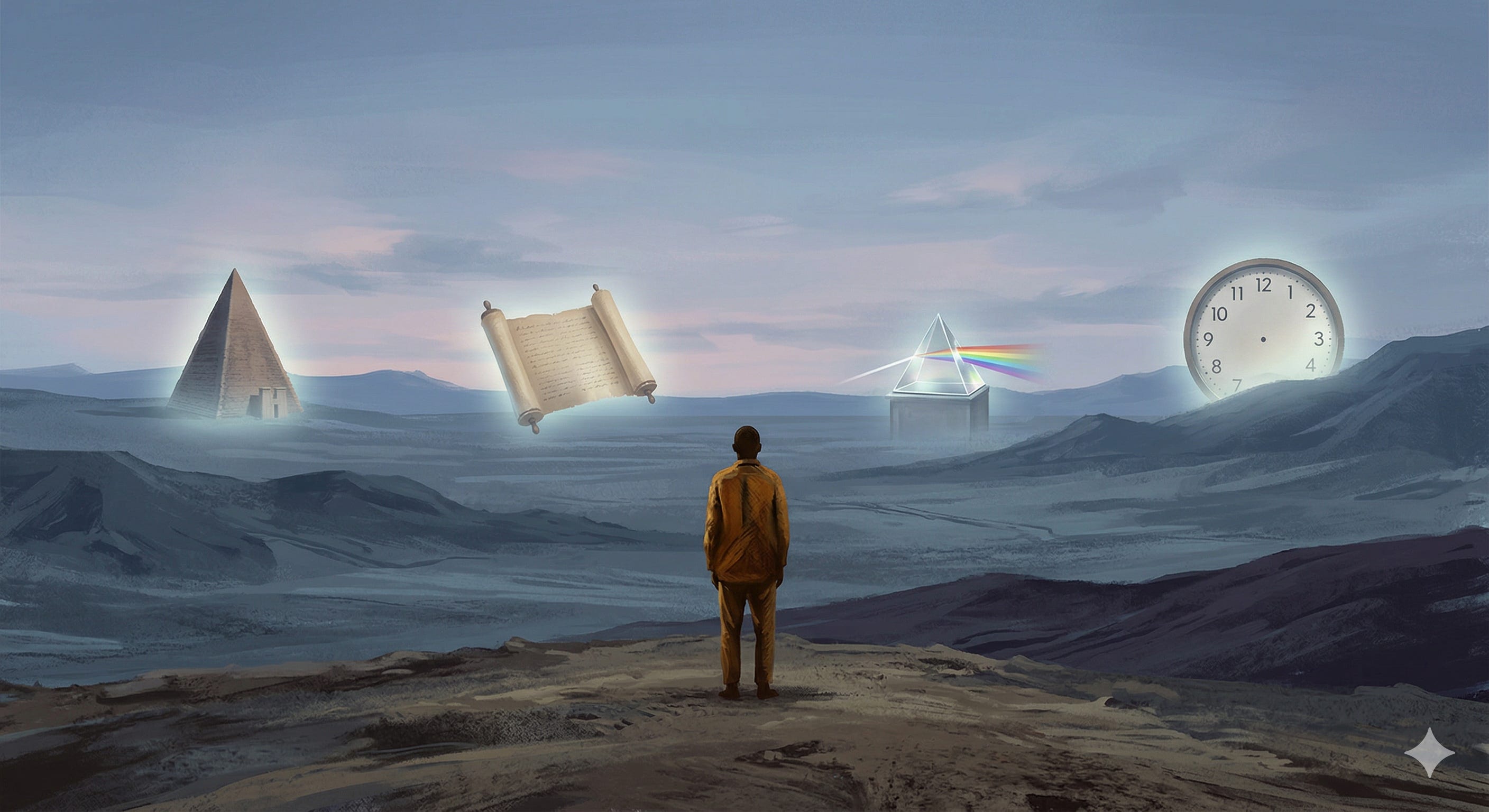
Image: AI-generated illustration of carried frames becoming visible across four domains
Sudan has more pyramids than Egypt. More than 200 of them, scattered across Meroe, Nuri, and Jebel Barkal. Kingdoms that once ruled Egypt itself built them across eight centuries. Almost nobody mentions them.
The Hebrew scriptures were oral before they were written. For centuries, the Torah moved voice to voice, generation to generation, long before ink met parchment. Every serious scholar treats this as legitimate pre-literary theology. In the East African interior, entire kingdoms maintained their histories, their laws, their cosmologies the same way. The dominant scholarly framing treats this as evidence that complex civilisation had not yet arrived. Same medium. Different verdict.
When you borrow money from a bank in Zambia, you see two numbers: the central bank rate and your margin. The rate is public. The margin is a black box. Inside it sit six distinct cost layers, each driven by a different input, each governed by a different policy lever. The person who pays for them has no way to see which layer moved, by how much, or why. I recently published an essay decomposing each layer to its regulatory source. They have always been there. They were just invisible to the person paying for them.
I have believed since secondary school that I work best under pressure. Read broadly, absorb widely, compress everything into the final window before a deadline. The pattern followed me through university, through 18 years in financial markets, through every major publication I have produced. I have never questioned it. It has always delivered.
Four scenes. Four different domains. History, scripture, banking, a personal habit formed decades ago. The thread underneath them is the same.
Intelligence analysis uses a framework that divides knowledge into four categories: what you know you know, what you know you do not know, what you do not know you know, and what you do not know you do not know. Most people build their confidence in the first two. I know my field. I know where my gaps are. That feels like the complete map.
The third category is where the ground shifts. These are the things you carry without realising you carry them. The assumption that civilisation requires monuments. The assumption that oral tradition is theology when it comes from one tradition and folklore when it comes from another. The invisible architecture inside a price you pay every month. A habit you have never examined because the results kept coming. None of these feel like assumptions. They feel like facts. And each one arrived from somewhere, at some point, and stayed because it was never examined.
When you start to see the carried frames, the discomfort is immediate. Most people respond in one of two ways. They run harder: refresh the feed, add another analysis, check the numbers one more time. Or they retreat to familiar ground, where the map feels complete and confidence feels earned.
There is a third response. Stillness. Sitting in the discomfort long enough to let it do what discomfort is designed to do: stretch the capacity of what you can see. The connection between a Sudanese pyramid and a lending margin and a study habit does not reveal itself under pressure. It surfaces when you stop.
I have always trusted the pressure more than the preparation that preceded it. This week, I ran multiple review cycles on that essay, coming back to edit it just a few hours after publication. What each cycle surfaced was not new. The pressure was the extraction method. It was never the source.
The search determines the finding. And the frame you carry determines the search. What you have never examined, you will never see. What you have never questioned, you will mistake for truth. The pyramids were always in Sudan. The layers were always inside the margin. The knowledge was always underneath the pressure. The only thing missing was the willingness to sit still long enough to notice.