

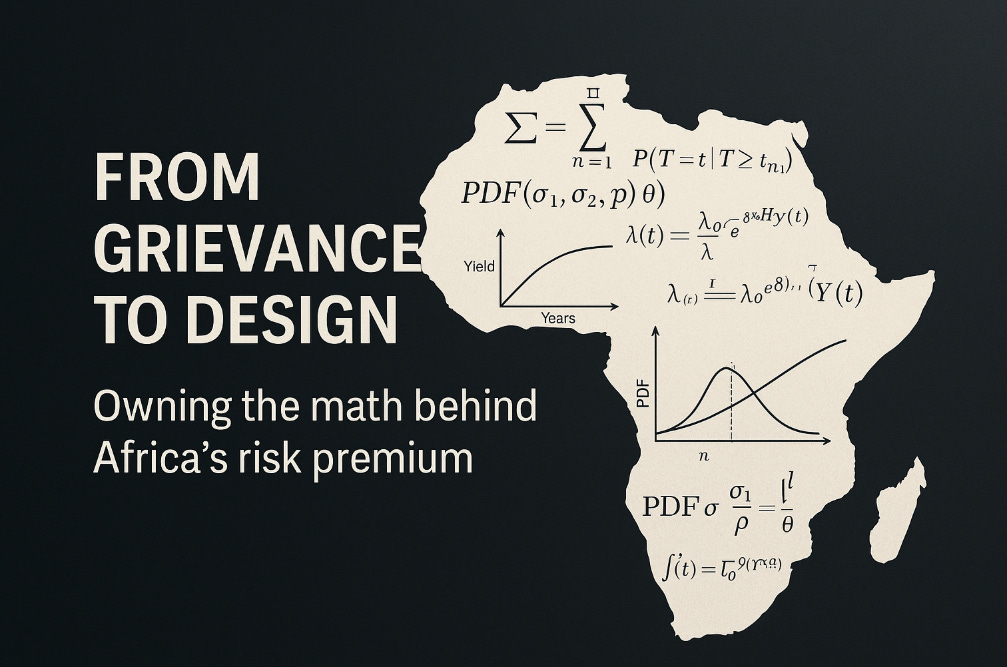
Figure: From grievance to design. Stylised illustration of Africa “filled” with the mathematics of risk, signalling that the continent must own the models, data, and code behind its sovereign risk premium.
On Friday, Mutisunge Zulu published one of the strongest interventions so far on Africa’s ratings debate. I shared his article with my own reflections, and both pieces triggered exactly the kind of reaction we need: serious disagreement, challenging questions, humour, and long voice notes from people who live inside markets every day. That broader conversation, especially one long East African chat on Saturday morning, is the foundation for this article.
Mutisunge’s core point was correct and straightforward. The spread Africa pays is not mainly a story of Western emotion. It is a story of institutional probability. Markets do not price fairness. They price the likelihood that contracts will be honoured through full political and economic cycles. Data helps, but data alone cannot close a $75 billion gap in annual interest costs that some estimates attribute to Africa’s risk premium.
This follow-up piece does not repeat his argument. It builds on it. The first step was to move from grievance to structure. The next step is to move from structure to design. That means asking a more complex question: if the models that price our risk are so central, why are we not building and funding our own versions at scale?
What Mutisunge already got right
His article did three important things.
First, it pulled the debate away from pure victimhood. Instead of blaming everything on bias, it showed that investors are looking at institutional continuity, enforcement, political predictability, currency stability, and the depth of domestic savings. That is uncomfortable, but it is true.
Second, it reminded readers that visibility and credibility are not the same thing. You can publish perfect spreadsheets and still pay a high premium if investors doubt that policies, courts, and contracts will survive the next election cycle.
Third, it put capital at the centre. Africa cannot set its own price of risk without its own pools of patient savings. Without continental liquidity, an African rating agency becomes a mirror, not an engine. It shows us how we look. It does not change the way the world prices us.
All of that stands. The question is what we do with it.
Default, probability, and why history is not enough
A friend in that weekend chat kept returning to one puzzle. If historical default rates in Africa and Europe are similar, why do African sovereigns still pay so much more to borrow?
It is a fair question. It is also the wrong anchor.
Default is a rare, tail event. It is the crash. A spread is the cost of insurance. Insurers do not set your premium based only on last year’s accident record. They look at the volatility of your environment and the quality of your brakes, roads, and traffic laws. In sovereign space, those brakes and roads are institutions. Even more tellingly, the rise of AI-driven insurance has only accelerated the shift toward real-time, forward-looking hazard modelling, built on the same core logic that drives sovereign spreads today. Credit ratings are just a formal label on that same default probability. Spreads are the live market price of it. This article focuses on spreads because they reveal in real time what the engines believe about our risk.
Over the past twenty-five years, many African countries have repaid their debts, but often with training wheels. The continent received considerable relief under the HIPC and MDRI processes. Since then, a long line of IMF programmes has provided balance-of-payments and fiscal support whenever shocks hit. That support has helped keep the repayment record intact, and it is a testament to the commitment to meeting obligations. At the same time, it has signalled that the system cannot yet ride alone.
That is the idea behind the “supervised adult versus unsupervised adult” line from our chat. Europe and other advanced issuers can be clumsy and political, but they rarely need an external supervisor to hold the bike. African sovereigns often do, because the architecture of global finance still treats them as users of other people’s capital. The market prices that difference as structural risk.
The academic work lines up with this intuition. Cristina Arellano’s work on sovereign spreads shows that high historical repayment rates, combined with high income and policy volatility, can justify persistent high spreads, because the probability of a bad tail event rises non-linearly. In options language, no one trades historical volatility. They trade expected future volatility. Africa’s premium is, in large part, the price of expected turbulence when the next shock arrives. In a sovereign setting, that turbulence is not only about swings in GDP. It is about volatility in the net resources available to service debt, which includes export income, tax revenue, the interest bill on external borrowing, and the risk that capital can be withdrawn quickly when global conditions turn. Reducing that turbulence in practice means building broader and more diversified tax bases, deeper export baskets, stronger automatic stabilisers, and financial systems that can absorb shocks without forcing abrupt fiscal or currency adjustments.
This is not a moral judgement. It is a description of how the pricing engine thinks. To understand why this outcome is almost inevitable once you write the problem down properly, we need to open the hood on the models themselves.
If you are not a quant, you do not need every equation behind these models. What matters is one idea. Markets do not only care whether you have defaulted before. They care how close you tend to travel to the edge when times are bad. The following section shows, in formal language, why that logic produces exactly the pattern of rare defaults and high spreads we see in many African credits.
Theory lens: what the math actually says about spreads and volatility
Cristina Arellano (2008), “Default Risk and Income Fluctuations in Emerging Economies,” American Economic Review.
There is a reason serious sovereign risk work moved from slogans to models. Once you write the problem down correctly, the story changes.
In the modern literature, crystallised by Cristina Arellano’s 2008 American Economic Review paper, a sovereign is treated as a small open economy that chooses each period whether to repay or to default. Its income follows a stochastic process that resembles that of an emerging market: persistent, noisy, and exposed to real shocks. At every point in time, the state of the system is simply “how much income do we have today” and “how much debt is already promised for tomorrow.”
Foreign investors look at that state and ask a single question: What is the probability that this country will choose to default between now and the next coupon date?
The answer is not guessed. It arises from a set of value functions. On one side is the value of repaying and keeping market access. On the other side is the value of defaulting, taking a hit to income, and living for a while without access to new borrowing. The default region is the part of the state space where the value of default is higher than the value of repayment. When income is high and debt is low, the country sits far from that region. When income falls, and debt is high, it moves closer to the edge.
Bond prices in these models are simply the discounted probability of still being in good standing next period. Spreads are the reward investors demand for bearing the risk that the state will drift into that default zone. The key object is not the historical frequency of default. It is the hazard rate: the conditional probability that the country will cross that boundary in the near future, given where it stands today.
This is the single most important number in sovereign finance. It is the core input that rating agencies, after lags and judgment, translate into a letter grade, and that traders turn into a yield spread, either directly or through a related default intensity (you can think of this as the live default probability per year). In practice, spreads also embed compensation for liquidity, risk appetite, the shape of the yield curve, and market microstructure effects, but the hazard rate remains the anchor. This is why two countries with the same rating can trade at very different spreads. The letter compresses a wide band of hazard rates into one symbol, while the market continuously prices the exact point in that band together with liquidity, investor base, and issue characteristics. If you understand and influence the drivers of your hazard rate, you can shift both your rating and your price.
Arellano shows that once you calibrate income volatility to something that looks like a real emerging economy, you can easily generate two facts that sit at the centre of the African debate. Defaults are rare tail events, and spreads are high on average. The reason is non-linear. With volatile and persistent income, a one-standard-deviation negative shock does not move you much closer to the default region. It can push you from the safe interior to the edge of the cliff. The hazard rate jumps. Even if the country manages to avoid default this time, investors now know how close it can get under stress. That memory lives inside the pricing kernel.
In simpler terms, imagine two countries with the same rating. Country A has relatively smooth income and deep buffers. Country B has very jumpy income and thin buffers. A large negative shock nudges Country A closer to the edge but does not bring it near default, while the same shock pushes Country B from discomfort to the cliff. The probability of default for Country B jumps much more, so its spread widens even though the rating label looks the same. The same intuition shows up outside sovereigns. Speculative-grade corporates in advanced markets can, at times, record higher default rates than peers in emerging markets and still borrow at tighter spreads, because investors are also pricing legal regimes, liquidity, and the strength of domestic backstops. A simple default count never tells the full story of risk.
In more intuitive language, the model tells us that a long stretch of repayment history in a volatile system is not evidence that spreads are unfair. It can be the exact pattern you expect when tail risk is high, and institutions do not absorb shocks. The mathematics forces that outcome. High historical repayment rates and high income volatility are consistent with high spreads, not low ones.
That is why the Africa-versus-Europe comparison based on raw default counts is misleading. Advanced economies combine lower income volatility with deeper buffers and stronger enforcement. The default region in their state space is small and remote. Emerging economies sit in a larger, more jagged region where shocks and politics push them closer to the boundary. Pricing follows that geometry. Investors do not care only about whether you have crashed before. They care about how close you travel to the guardrail every time the road bends.
In that sense, the models quietly confirm the central argument of this article. The premium is not about mood. It is about structure. Once you write down the stochastic process for income, the decision rule for default, and the mapping from hazard rates into bond prices, you get something that looks a lot like African spreads today. Until we change that underlying process and the scaffolding around it, the price of risk will not move just because we feel it should.
The models are not hidden in a Western vault
Once you accept that spreads reflect forward probability rather than backward outcomes, you have to talk about the machinery that turns that probability into a number.
These models are not mystic recipes locked away in some London basement. They are built from tools that every advanced mathematics of finance student learns:
· Stochastic calculus to describe how variables like growth, interest rates, and exchange rates evolve with randomness over time.
· Differential equations that link the current price of a bond to the expected path of future states of the world.
· Hazard rate or intensity models that translate economic and political conditions into a time-dependent probability of default.
· Recovery assumptions that convert that probability into expected loss, which then feeds directly into spreads.
· Volatility modelling that captures how sensitive the system is to shocks and how quickly stress can build.
If traders on an options desk can work with these concepts, so can African policymakers, technocrats, and central bank staff. Many already do. Quants in Johannesburg, Nairobi, Lagos, Cairo, and Lusaka use this machinery every day to price swaps, options, and structured credit.
So, the question is not whether Africans understand the models. The question is why the people who manage national balance sheets and negotiate with creditors often speak as if the models are a black box. The distance between trading floors and policy memos is political, not mathematical.
The real constraint is capital and political will
At this point, the conversation loops back to capital.
If we want a different price of risk, we need two things that sit well outside a Bloomberg terminal.
First, we need deep domestic and regional savings pools. Pension funds, insurance balance sheets, sovereign funds, and securitised diaspora flows that can buy and hold local currency and hard currency paper on African terms. Without this, the marginal price setter is always external, and external money will always demand a premium for shocks it cannot control.
Second, we need political systems that can live with the discipline that real models impose. A credible African sovereign risk engine will not always say what we want it to say. It will sometimes confirm that spreads are high for good reason. It will penalise policy slippage, election-year fiscal expansion, and legal uncertainty. That is the point. The barrier is not knowledge. It is priority and comfort.
This is why the conversation about models cannot be separated from the conversation about capital.
I have argued elsewhere that the same architecture shows up in how African multilateral institutions are treated under the G20 Common Framework. African development banks such as Afreximbank and TDB are asked to behave like global multilaterals, yet they fund themselves in expensive private markets rather than through cheap callable capital from G7 treasuries. When the framework pressures them to take haircuts alongside commercial creditors, it effectively penalises them for operating inside a system that never gave them the subsidies and guarantees that Bretton Woods institutions enjoy. That is not simply a question of fairness. It is the same structural problem in another form. Africa is priced as a user of other people’s capital, not as a continent with its own deep pools of savings and its own institutional backstops.
From grievance to design
So, where does this leave us?
First, Africa needs to move from reacting to prices to building the engines that produce them. The mathematics is complex, but it is not sacred. Ministries of finance, central banks, and regional bodies should be funding a generation of African PhD students and quants to build transparent, Africa-calibrated sovereign risk models, publish the code, and subject the assumptions to open critique.
Second, we need to be honest about what those models will show. They will not wash away the premium through clever algebra. They will probably confirm, at least for a while, that the world has been roughly correct about the direction of structural risk, even if it has sometimes mispriced the level. That is a hard pill to swallow, but it is better to swallow it with our own numbers in hand, because only then can we see precisely which parts of the premium reflect genuine risk and which parts reflect mispricing, politics, or inertia. The models themselves will not magically lower the true component of that premium, but they will make it harder for markets and agencies to hide behind noise when a portion of the spread is no longer justified by the data.
Third, we need to match this analytical build with a capital build. Securitised diaspora flows, deeper pension reforms, regional reserve pooling, and African-owned liquidity facilities are not talking points. They are the only path to a world where African capital has enough weight to influence the price of African risk.
Pieces of this architecture already exist in fragments. The African Development Bank is building market infrastructure through its domestic markets and bond programmes. The African Union has backed plans for a continental financial stability mechanism and is supporting an African credit rating agency, AfCRA. Networks such as the African Economic Research Consortium, central bank training institutes, and university programmes are already producing African macroeconomists and quants. What we still do not have is a single mission whose sole task is to fuse the mathematics, the data, and the capital into a single open, continent-calibrated risk engine.
Call that combination a Genesis Mission for African risk. In practical terms, it would link three communities that rarely sit in the same room. Universities and research centres that train the quants. African financial institutions that actually hold the risk. Continental bodies such as the African Development Bank, the African Union, and Afreximbank that can turn models into policy and balance sheet decisions. It would be funded by a consortium of African pension funds, sovereign funds, and these institutions, with an initial seed of perhaps $50 million to $100 million to build, maintain, and publish the engines. The hardest part is not the mathematics. It is getting rival institutions and sovereigns to pool sovereignty, trust one engine, and live with what it says. That coalition work is slow, but it is unavoidable. The mandate would be narrow and practical. Build open-source African risk engines, wire them into real decisions, and update them as data deepens and markets evolve.
When those two tracks come together, the conversation changes. At that point, Africa will not show up in the room with grievances and guessing. It will arrive with its own models, its own capital, and its own institutional scaffolding. The debate with rating agencies and investors will still be hard and political, but it will shift from plea to design, arguing over our hazard curves rather than only our rating letters.
The spread will not fall because we complain more loudly. It will fall when the architecture underneath it changes, and the math eventually has to reflect that new reality. That is the mission.
Disclaimer
This article does not constitute legal, financial, or investment advice. The author shares views for perspective and discussion only. Do not rely on them as a substitute for professional advice tailored to your specific circumstances. Always consult a qualified legal, financial, investment, or other professional adviser before making decisions based on this content.
Canary Compass and the author accept no liability for actions taken or not taken based on the information in this article.
About the author
Dean N. Onyambu is the Founder and Chief Editor of Canary Compass. His insights draw on experience across trading, fund leadership, governance, and economic policy.
The Canary Compass Channel is available on @CanaryCompassWhatsApp for economic and financial market updates on the go.
Canary Compass is also available on Facebook: @CanaryCompassFacebook.
For more insights from Dean, you can follow him on LinkedIn @DeanNOnyambu, X @InfinitelyDean, or Facebook @DeanNathanielOnyambu.