

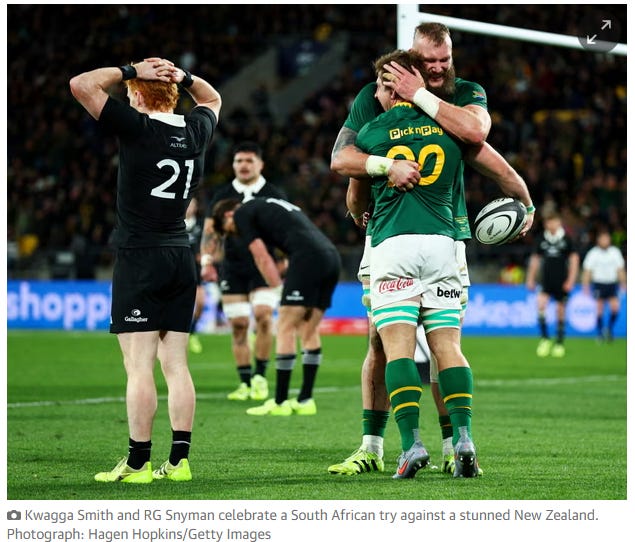
Picture from The Guardian
The Boks picked, and the All Blacks paid.
I am a Kenyan who chose the All Blacks a long time ago. I did not inherit them. I found them in 1995 when the World Cup beamed into our house from South Africa. I did not yet understand Pan-Africanism. I only understood that a man called Jonah Lomu could move a stadium with his shoulders. If I had known more, maybe I would have become a Bokke fan. I apologise to my Pan-African comrades. First love is stubborn.
This morning in Nairobi, Wellington felt personal. 43-10. The number sat like a stone. The stadium grew quiet around it. At 22-10, I tried to look away, but the pattern kept tapping my shoulder. South Africa looked the better team again. They did not steal this. They built it, brick by brick, then blew the doors off after the break. It finished as New Zealand’s heaviest defeat, and it happened at home.
And yes, it was morning where I was, and night where they were. That odd split mattered. Nairobi sunlight on my curtains, Wellington under lights. It felt like watching a storm from a different season, knowing the thunder belongs to you all the same. The score travelled cleanly across the latitudes and kept all its weight.
I used to watch the All Blacks with the loose shoulders of a believer. Lately, I watch them with one eye closed. Something has changed. My All Blacks have become my Manchester United. Hope in one hand, dread in the other. I love the All Blacks more than I love United, yet I have started to approach them the same way, a little afraid of what the night or morning might choose.
There is a leadership debate waiting in the corner of the room. Scott Barrett or Ardie Savea, and what that choice says about the All Blacks. That is for another day. This morning (Nairobi time) was not about a single armband. It was about the long stretch when a match is decided by patience and posture.
At fifty-two minutes, I wrote to my friends that this was loading. South Africa had already lost bodies, and it did not matter. One of my friends said Cobus Reinach was kicking us into a cage and controlling everything. Another said we were not winning a single contest, not rucks, not high balls, not the calls that swing a mood. I tried to argue for a slower, structured game as a short-term fix, even if it was boring. I also asked whether a more expansive path still made sense if we were looking toward 2027. They told me to accept what I was seeing.
They were right. The game turned on repeatable things. A box kick that fell like a verdict. A chase that arrived on time. A scrum engagement that didn’t need a penalty to announce who owned the next ten minutes. Not every stat will show it, but the rhythm did. New Zealand’s set piece survived the first acts. In the second half, South Africa’s pressure began bending the exits and the body language. You could feel possession turning heavy, field position turning steep, and every restart carrying a little more green.
I kept thinking about Old Trafford. Teams that used to shrink now walk in without fear. That was how the Springboks felt in Wellington. No hurry. No panic. A calm belief that the second half would belong to them if they kept asking the same hard questions.
People keep saying South Africa left New Zealand. They did not leave the Rugby Championship. Their clubs left Super Rugby and went north, where the calendar and the money and the habits fit them better. Up there, the weekly diet is different. Fewer flights that bend the spine. More matches that reward patience in the tight. They found a place that pays them to be themselves, and they have settled in.
When I look back at the last few seasons, I do not see a table. I see postcards. Townsville, where the squeeze arrived quietly and never left, though New Zealand escaped with a late penalty. Mbombela, where shoulders did not blink. Twickenham, a cut that bled longer than it should. Paris, a one-point lesson in endurance. Eden Park last week, a momentary reminder that the old house still holds its weather. Then Wellington, the loudest postcard of all. A tight first half turned into a different sport. South Africa outscored New Zealand 36-0 after the break, and nobody needed slow motion to understand why.
And somewhere inside that run came the image I cannot shake. A scrum that looked level on paper but felt slanted in the soul. Not collapses and theatrics, just the kind of shove that moves a mood, the kind that says the next carry will be theirs and the next whistle will live in their pocket. Such daylight between a team ranked 1 and a team ranked 3 should not exist in that part of the field. It did, and the scoreboard learned it before we admitted it.
I thought for a while that my son was the unlucky charm. Every New Zealand match we watched together ended badly. This time I watched alone. We still lost. Last week I did not watch, and we won. Maybe it is me. Maybe I should stop watching. I laugh because superstition is a shelter when the truth has sharp edges.
There is also the forest. I like to see the forest, sometimes too much. Maybe I am overreading one test match, and maybe this is just one chapter in a rivalry that rises and dips in long seasons. Maybe it is talent cycles and coaching cycles and nothing more. I keep a little room for that. Then I remember what changed when South African clubs left the Super Rugby week. I remember how my United became a cautionary tale about lost habits. I think the forest matters here.
This is where some people bring up loyalty to Australia or obligations to three or four letters. I owe Australia nothing as a fan in Nairobi. New Zealand owes them nothing beyond what the contracts say. This is not romance. This is craft. Keep the company that hardens the craft. Move on from the company that does not.
What hurts is not only the score. It is what the score says about the week that leads to nights (Wellington time) like these. When South African clubs went north, New Zealand did not just lose familiar opponents. They lost the weekly stress test that used to live in their calendar. The lesson that teaches you to love boredom in the tight before you earn the wide pass. The habit that turns a maul into a sentence instead of a phrase. Super Rugby still gives us speed and ambition. The hardest matches ask for speed plus calm. Calm in the slow places. Calm when the lungs are empty and the whistle is listening.
So, I am asking for Tuesday. Not a theory. A Tuesday. A scrum that resolves instead of resets. A maul that moves even when everyone in the ground knows it is coming. A ruck that punishes lazy entry. Keep the ball alive. Make the collisions count. This morning, the curriculum was taught better than any coach could.
I am also asking for memory. Pin the last four years to a wall and build a school from them. Townsville. Mbombela. Twickenham. Paris. Johannesburg. Cape Town. Wellington. Not as talk show fuel. As a class. Body height here. Exit choice there. A kick you do not chase. Start every Monday with a clip and do not move on until the habit has a name.
Last week at Eden Park, the jersey felt heavy. There was pride in that weight. This morning (night in Wellington), it felt lighter. That is not shame. That is diagnosis. The prescription is work that does not need permission. Make the week harder. Pick men who live in the tight and still have breath to run. Say it out loud so the country understands why a clean bind in March becomes a win in September.
New Zealand should not ask South Africa for anything. They have already given the lesson. Choose a world that fits you and live in it. Good for them. New Zealand Rugby’s answer is not to borrow their grindstone. Their answer is to build one. The calendar will not do this for them. The school will.
I am a Kenyan in black, and I am not leaving. I did not choose this team for easy moments. I chose it for a standard. To New Zealand Rugby, start in February. The jersey will meet you there in July.
The All Blacks do not need charity from their oldest rival. They need a school that makes the last ten minutes feel inevitable again.
Disclaimer
This article does not constitute legal, financial, or investment advice. The author shares views for perspective and discussion only. Do not rely on them as a substitute for professional advice tailored to your specific circumstances. Always consult a qualified legal, financial, investment, or other professional adviser before making decisions based on this content.
Canary Compass and the author accept no liability for actions taken or not taken based on the information in this article.
About the author
Dean N. Onyambu is the Founder and Chief Editor of Canary Compass. His insights draw on experience across trading, fund leadership, governance, and economic policy.
The Canary Compass Channel is available on @CanaryCompassWhatsApp for economic and financial market updates on the go.
Canary Compass is also available on Facebook: @CanaryCompassFacebook.
For more insights from Dean, you can follow him on LinkedIn @DeanNOnyambu, X @InfinitelyDean, or Facebook @DeanNathanielOnyambu.