


AI-illustration: a cutaway of a building’s hidden wiring, with one new line run from its core to East and West Africa
Canary Compass will move to paid subscriptions soon. Founding members put two questions a month to Dean and join a quarterly call. Founding membership is limited to 10 people. Pledge now; you pay nothing until paid publishing begins. Friday Reflections will stay free. See every plan and what it includes. Institutional licences: dean@canarycompass.com
Chart data: institutional licence readers receive the values behind this Note’s charts on request.
Two verdicts landed on the morning of 4 November 2026. In Nairobi, Kenya’s transition window for existing virtual-asset providers closed. From that day, an issuer offering Kenyans dollar stablecoins, tokens that track the dollar one for one, needs a licence. Across the Atlantic, Americans woke to midterm results that handed Congress to the opposition and the Texas governorship to a candidate who campaigned on pausing new data centres. Both verdicts priced parts of the same system: Nairobi set terms for the dollar’s newest payment rail at its African end, and American voters reset the timetable of the machine that funds Washington’s debt.
The post-1945 dollar order still stands, though its architects are rewiring it, some deliberately and some inadvertently, and none of them understands it in full. Inside that architecture, Washington is rebuilding the machinery that funds its debt, and the machine is recruiting its next holders in Africa. The one actor that can break the architecture is its custodian, the country rebuilding it.
SERIES ACCESS. Part 1 of The Great Rewiring stays free. From the paid launch, the later parts are for paid subscribers. Until then, every part is free in full.

1. Three Propositions and the Arithmetic Against Them
Three propositions organise the public conversation. Dollar reserves are collapsing. China and the BRICS bloc (Brazil, Russia, India, China, South Africa and later members) are replacing the dollar. The petrodollar died and the system died with it.
The headline that gold overtook Treasuries, American government debt, in central banks’ reserves in 2025 counts that gold at market value and counts America’s own gold too. Even without America’s gold, gold led at the end of 2025, by USD4.0trn to USD3.9trn, but Treasuries were ahead again by June 2026, a Federal Reserve note of 3 September 2026 shows. Price is the main driver of that headline. Gold traded at about 3.2 times its 2015 average on 23 November 2026, on the London Bullion Market Association’s prices, so the gold central banks already held is worth far more. The dollar’s share of reserves including gold falls with no central bank selling a dollar. Buying is real too. Central banks added more than 1,000 tonnes a year from 2022 to 2024 and 863 tonnes in 2025, on the World Gold Council’s Gold Demand Trends of 29 January 2026. They added 675 tonnes more in the first three quarters of 2026 and did not report most of the 321 tonnes they bought in Q3, on the edition of 3 November 2026. That is diversification at the edge of the reserve pool, while the dollar core stays in place.
Leave gold out, as the IMF’s Currency Composition of Official Foreign Exchange Reserves data do, and the dollar held 56.7 per cent of global foreign-exchange reserves in Q2 2026. The IMF’s release of 30 September 2026 shows dollar holdings flat in the quarter. The share fell from 57.2 per cent because euro holdings rose by nearly USD100bn, mostly through active purchases, and several other currencies rose too. The sharpest valuation headline, the Q2 2025 drop in the dollar’s share, fell apart: currency moves explain 92 per cent of it, on the IMF’s blog of 1 October 2025.
Gold at market value and currency moves are two of six ways the data mislead. The Treasury International Capital (TIC) data record the country where a bond sits in custody. So Belgium, home of the Euroclear securities depository, can look like a buyer while the real owner looks like a seller. Headlines read a sale of Treasuries as a sale of dollars, though the money often moves into the bonds of government-sponsored agencies, bank deposits or dollar loans. Headlines also treat private holders as if they were central banks. And they tell a slow trend as a sudden one. Serkan Arslanalp, Barry Eichengreen and Chima Simpson-Bell, in an IMF working paper of March 2022, found the dollar’s share fell from 71 per cent in 1999 to 59 per cent in 2021. That is about 0.5 percentage points a year. Exchange-rate moves do not explain the fall. That is a generation-length drift away from concentration, never a run on the asset.
The petrodollar claim gets the history half right. Bretton Woods tied the dollar to gold in 1944, and when Washington closed the gold window in 1971 the dollar lost that anchor. Oil filled the gap. Under the 1974 arrangements with the United States, Saudi Arabia kept selling its oil in dollars and the Gulf recycled its surpluses into dollar deposits and Treasuries. Washington took on the security of Gulf oil with the reserve role. That energy leg has weakened, and what recycling remains has changed channels, as Brad Setser of the Council on Foreign Relations documented in “Petrodollars: Myth and Reality” on 14 April 2026 (Table 1). Yet sellers still invoice oil overwhelmingly in dollars, Riyadh has kept the riyal pegged to the dollar, and the surplus dollars that once came from oil now come from manufacturing Asia.
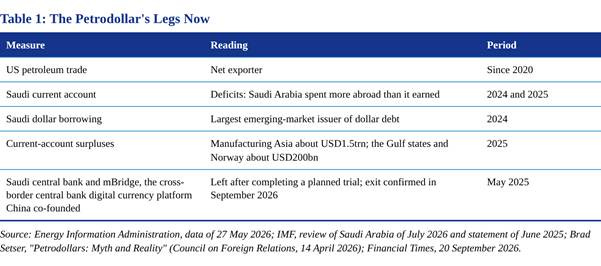
The anchor is moving from oil to finance: the depth of the Treasury market, and now dollar tokens. The GENIUS Act, the US stablecoin law of July 2025, confines their reserves to a short list, chiefly cash, deposits and short Treasury paper. The denomination did not move.
China, the proposed replacement, is not bidding for the dollar’s role. What has eroded is the quality of the holders: whether they keep holding under stress. Foreign official holders buy and sell for reserve policy, not yield, and no margin call or redemption forces them to sell. They owned USD3.7trn of Treasuries at the end of September 2026, 11.3 per cent of the debt held by the public, on the TIC data of 18 November 2026 and the Treasury’s daily debt statement. That was 39.8 per cent of all foreign holdings, against 41.9 per cent a year earlier. Two kinds of holder are growing. Leveraged funds buy with borrowed money. Hedge funds held about USD2.0trn of Treasuries at the end of 2025, nearly three times the level five years earlier, the Office of Financial Research estimated in August 2026. That was about 6.5 per cent of the debt held by the public, on the Treasury’s statement for 31 December 2025. It points to trades that pair the bonds with futures as a likely driver. Government money-market funds and token issuers owe their customers redemption on demand. Money-market funds must hold short paper by rule, and US law requires the same of licensed token issuers from 18 January 2027.
2. What Dollar Dominance Actually Rests On
A reserve currency, the money other countries’ central banks hold as reserves, does three jobs, and each job runs on a different market. Store of value runs on deep capital markets: USD32.2trn of marketable Treasuries were outstanding on 31 October 2026, on the Treasury’s monthly debt statement. Unit of account is the denomination itself, and the collateral markets carry it. Chains of derivatives and of repurchase agreements (repo), short loans against bonds, run in dollars, and much else takes its price from them. Medium of exchange runs on transaction rails, the networks that move payments: correspondent banking (banks’ accounts with each other abroad), card networks and now tokens. The prerequisites for the first two jobs at scale are an open capital account, which lets money move freely in and out of a country, enforceable contracts and trust. Several economies offer all three prerequisites, but none at the dollar’s scale (Table 2). The euro area comes closest, but it has no single government bond market. Europe’s largest stock of common bonds, the European Union’s, was 2.9 per cent the size of the Treasury market at the end of June 2026. So the euro gains at the edge of the pool, and the dollar keeps the core.
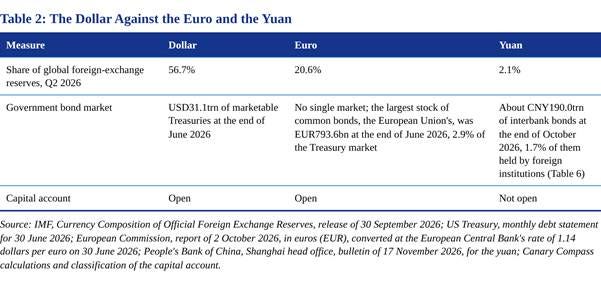
Three layers reinforce the structure. The first is credit architecture. Non-banks outside the United States owed USD15.1trn in dollar bank loans and bonds at the end of June 2026, on the global liquidity indicators the Bank for International Settlements (BIS) released on 29 October 2026. The same release shows international bonds in euros growing almost twice as fast as dollar ones, which grew 6.7 per cent in the year to June. A debtor cannot abandon the currency of its liabilities without refinancing them. The second is market exceptionalism. Capital flows in because US stocks returned 14.4 per cent a year in the decade to December 2025, against 8.5 per cent elsewhere on Morningstar’s count of 12 January 2026. The rest of the world led in 2025, Morningstar reported on 4 February 2026. The artificial intelligence (AI) boom concentrates the pull in American companies. Foreign private holders can hedge the currency without selling the asset. That moves the exchange rate and the extra cost of borrowing dollars through swaps, not the architecture, because the hedge is itself a dollar funding trade. The third is transactional reach, the layer that statute and private issuers are now rebuilding in public.
The old dollar system ran on the first and third layers (credit and reach), and surplus recycling from Asia and the oil exporters funded it from the top down. The new system keeps the first and leans harder on the second and third (returns and reach), with token holders adding funding from the bottom up, at the margin. AI promises the returns that keep foreign capital coming to America. That inflow finances the external deficit and helps sustain the demand for dollar assets that keeps Washington’s borrowing cheap. The stablecoin law spreads Treasury demand across millions of token holders and makes the dollar harder to escape at the transaction level. Both legs are bets.
3. The Price of the Privilege
Reserve status never compelled the deficits. It enabled them, by removing the market brake that would have forced adjustment on any other borrower. The older tradition, from Robert Triffin’s Gold and the Dollar Crisis of 1960, which he wrote while foreign central banks could still turn dollars into gold, runs the causality the other way. On that reading, the world’s demand for reserves imposes deficits on the issuing country, and the United States, as custodian of the reserve currency, is a victim of its own privilege. The tradition concerns the external deficit, and even there Washington chose not to use the tools that would refuse the inflow, such as a charge on foreign official purchases of Treasuries. Such a charge would close part of the open capital account that the reserve role rests on (Table 2), so keeping the role was itself the choice. The budget deficit is a plainer choice still, because no inflow forces a government to borrow at full employment. That distinction, enablement rather than compulsion, places the dollar’s only real enemy inside the custodian’s own choices.
The bill for the privilege was industrial. Reserve demand kept the dollar stronger than trade alone would have, and a strong dollar made American factory goods dear at home and abroad. Table 3 counts the loss, to which the strong dollar was one contributor among several. Factory jobs are down by more than a quarter since 2000, and America’s share of world manufacturing value added fell by more than a third between 2000 and 2021. Real median pay has gained 0.2 per cent a year since 1979. Communities that grew around production lost their factories, and both parties in Washington now treat the loss as a strategic vulnerability. The restructuring programme of tariffs, reshoring and AI-led productivity tries to rebuild what the privilege allowed to lapse.
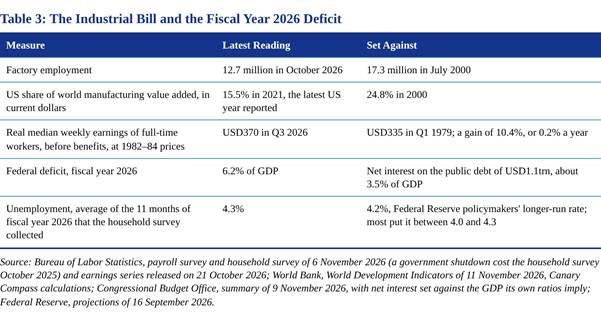
The programme needs funding. In fiscal year 2026 Washington ran a deficit of 6.2 per cent of GDP, with net interest equal to more than half of it. Unemployment sat within the range most Federal Reserve policymakers expect in the longer run (Table 3). So the United States ran that deficit at full employment. A government borrowing this much at full employment pays a lower rate with every buyer who has to hold its paper. Washington is building that demand at the transaction layer, in statute.
4. The New Layer and What Its Holders Actually Hold
Table 4 sorts the things the public conversation blurs into one word, on a single column: what the holder actually holds.
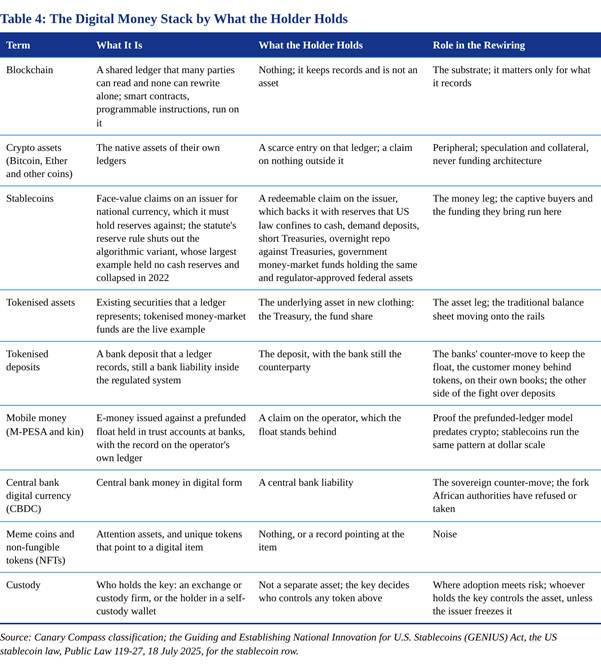
The rows that matter here are the ones whose holders end up with claims that sovereign paper backs, and the ones that keep the float inside the banking system. The Office of the Comptroller of the Currency, the regulator of national banks, applied the statute’s reserve list (Table 4) to the issuers it supervises in its final rule of 21 October 2026. The final rule dropped the proposed 20-day limit on the reserves’ average maturity and cut the proposed daily liquidity floor from 10 per cent to 5 per cent. It left the statute’s 93-day ceiling on each Treasury held outright and capped exposure to any one counterparty at 40 per cent, exempting the US government, assets held in custody and centrally cleared repo. In practice issuers hold mostly Treasury bills, US government debt that matures within a year, and Treasury repo. So each newly minted token from an issuer under US law adds demand for the shortest Treasury debt, the front end of the yield curve. That demand is new only when the dollars behind the token did not already sit in bills, repo or a government money-market fund. Dollars that leave a bank deposit for a token count as new demand for bills.
The stablecoin market stood at USD281.1bn on 24 November, USD174.6bn of it in USDT, the token of Tether International (Tether), on DefiLlama’s count. The Federal Reserve Bank of San Francisco (San Francisco Fed) finds the two largest issuers’ Treasury holdings up more than tenfold in five years, in its Economic Letter of 28 September 2026. That is about USD200bn more in bills and repo, more than 40 per cent of the fall in China’s reported holdings over the same five years, and more short-term Treasury buying since 2023 than Japan’s. China’s reported fall was mostly in longer debt, the letter notes, while the issuers buy short, so demand moves to the front end. Against the USD6.7trn of bills outstanding at the end of June 2026 on the Treasury’s monthly debt statement, that USD200bn increase, repo included, equals at most 3.0 per cent. “Who Owns the Stack”, Part 4 (Canary Compass, 8 October 2026) put issuers’ holdings near USD200bn and called the token a manufactured buyer for the front end.
A compliant dollar token is a claim on its issuer for dollars. For a holder of dollar reserves, swapping bills for tokens leaves the dollar exposure where it was and adds issuer and plumbing risk on top. The token is interchangeable in denomination with the dollars the world already holds. Against the de-dollarisation headlines, it looks like Washington’s answer to a falling dollar share, but a token cannot win back a share the dollar never lost in the way the headlines claim. The first phase gets the token working as a dollar, and that changes who holds the dollar.
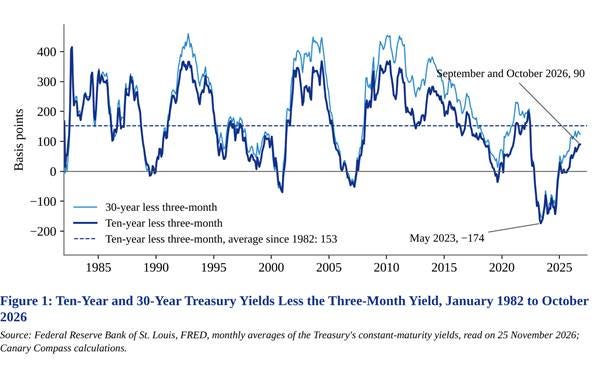
The token’s front-end demand serves a Treasury already leaning on bills. They made up 23.0 per cent of marketable debt on 31 October 2026, against 22.0 per cent a year earlier, on the Treasury’s monthly debt statements. The bid is captive in what it buys and flighty in how much: a wave of redemptions turns the issuer from a buyer of bills into a seller. That is the change in holder quality at the front end. Rashad Ahmed and Iñaki Aldasoro’s BIS working paper, revised in 2026, finds that a USD3.5bn inflow into stablecoins lowers three-month bill yields by up to 4 basis points within ten days. The paper prices an inflow over the following weeks, controls for bill supply, and finds no effect on longer maturities. Short paper is the cheaper place to borrow only when the curve slopes up. It was not for the two years to November 2024, when the three-month bill yielded more than the ten-year note (Figure 1). The ten-year note yielded 90 basis points more than the three-month bill on average in September and October 2026, the widest gap since June 2022, though below the 153-basis-point average since 1982. By 23 November it had narrowed to 55 basis points, and stood at 92 for the 30-year bond, on the Federal Reserve’s H.15 release of 24 November. On that release the three-month bill yielded 4.37 per cent against an effective federal funds rate of 3.88 per cent, a gap that prices a higher policy rate, heavier bill supply, or both. On USD200bn, each 50 basis points of that gap is worth about USD1.0bn a year against funding at ten years, for as long as it lasts. Bills also reprice at every rollover, so the same borrowing costs more within months when the Federal Reserve raises rates. Cheaper short-term funding matters to a state whose net interest bill was USD1.1trn in fiscal year 2026. At its present scale the token helps at the margin and does not fund the deficit. New demand for dollars, as distinct from bills, arrives only when someone sells local money for tokens.
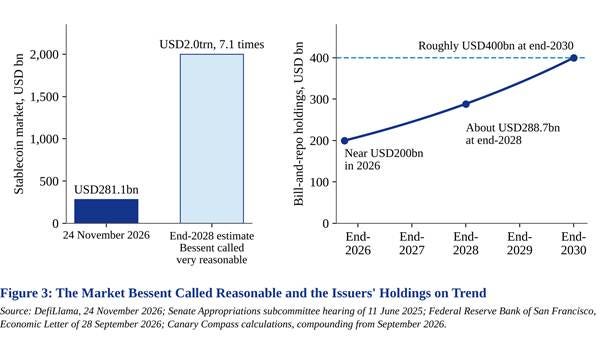
Treasury Secretary Scott Bessent reads the token more boldly. On the GENIUS Act’s enactment on 18 July 2025, he said stablecoins would buttress the dollar’s reserve status and bring a surge in Treasury demand. At a Senate Appropriations subcommittee hearing on 11 June 2025, the committee cited an estimate of a USD2.0trn market by the end of 2028, and he called it a very reasonable number, The Block reported. From the 24 November level, the market would have to grow to 7.1 times its size in about two years. It stood at least 9.2 per cent below its May 2026 peak on DefiLlama’s count, a first sign that growth will run slower than he expects.
The split between dollars swapped and dollars newly bought sets the risk, and the risk depends on the phase. On the host side, the licensed build starts wholesale and cross-border, with banks, dealers and company treasuries moving dollars they already hold. In that phase the token replaces existing dollar holdings, whatever the size of a country’s reserves, and the macro risk is what it was, plus the issuer’s. Retail is a different phase. Households in weak-currency economies already hold tokens outside the licensed system. For them a licence changes the provider, not the holding. Nigeria’s domestic exchanges took half of the country’s centralised-exchange inflows in the 12 months to June 2026, up from 7 per cent in 2022, Chainalysis reported on 29 October 2026. Where controls ration dollars, a retail token makes dollars easier to get, and when the issuer and its reserves sit abroad, the new demand is capital leaving the country. That is the phase a host can refuse to license.
The statute is the first step of a possible sequence. First, build an American-regulated payment lane on front-end paper. Then raise the cost, through a fee or tax, of holding Treasuries directly from abroad, one option Stephen Miran, then at Hudson Bay Capital, set out in November 2024 and Washington has not yet taken. The market’s largest issuer shows the first step at work. Tether operates from El Salvador. From July 2028, three years after the GENIUS Act became law, it cannot serve the US market lane without a US registration and a finding that El Salvador’s regime is comparable. It must also hold reserves in a US financial institution sufficient to meet its American customers’ liquidity demands. It held USD122.8bn of its USD191.5bn of reserves in US Treasury bills at the end of September 2026, on its accountants’ report of 30 October; Tether’s own count, with indirect holdings, is USD132.4bn. So it sits inside the machine’s funding and outside its market. Its answer was to split: in January 2026 it launched USAT, a separate American token that Anchorage Digital Bank issues for the compliant lane. In the end state, holding Treasuries as a reserve asset would get more expensive for foreign officials, while the dollar’s payment role would expand through US-regulated issuers. The first step is law and sets the direction even if Washington never takes the second.
Hosts are setting their price too, and Table 5 sets Kenya’s and Nigeria’s terms beside Washington’s. Regulation 77 of Kenya’s Legal Notice 134 of 22 July 2026 keeps the whole float in Kenya, and its Regulation 83 reaches tokens issued abroad. Nobody had reported a Kenyan licence by 24 November.
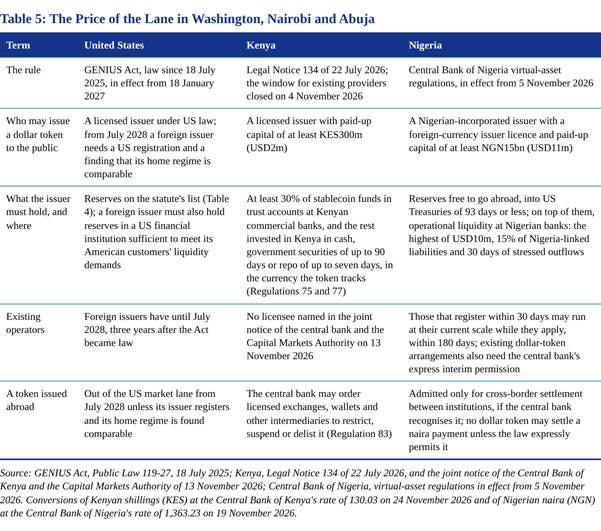
A day after Kenya’s deadline, Nigeria went further. The Central Bank of Nigeria’s virtual-asset regulations took effect on 5 November. Washington pushed the largest issuer into an American vehicle; Abuja now demands a Nigerian one. Abuja has kept the licensed retail phase shut to foreign issuers. Households may trade a Nigerian-issued dollar token through licensees, but a foreign issuer’s token comes in only between institutions. A regulator that cannot stop the rail has started charging for access and keeping money at home: the whole float for a Kenyan licensee, a liquidity buffer in Nigeria. That price costs Washington something: a float that Kenya’s rule holds and invests at home can spread the dollar without the issuer buying a US bill. The token’s safety then rests partly on the Kenyan banks that hold the float, and those banks may still buy US bills with it. So the cost to Washington is the issuer’s bid for bills, not the dollar. Nigeria’s rules leave the token’s reserves free to go abroad, into short US Treasuries, so its buffer costs the issuer, not Washington.
5. The Challenger That Is Not Bidding
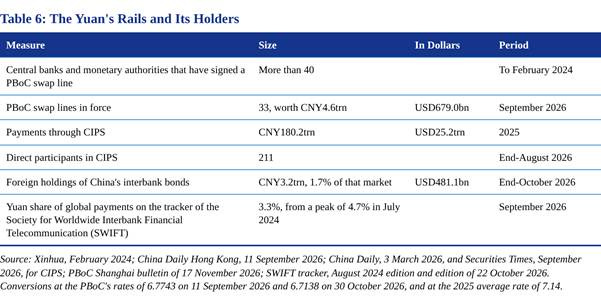
If the dollar were replaceable, China, the world’s largest trader of goods, would be the one replacing it, and the record shows otherwise. Its current-account surplus reached USD735.0bn in 2025 and USD654.1bn from January to September 2026, on the balance of payments its State Administration of Foreign Exchange published on 13 November 2026. On net, a surplus country lends to the rest of the world and does not borrow from it. Foreigners can hold Chinese yuan (CNY) only as China supplies it: through yuan lending, payment for imports or swap lines, standing agreements between central banks to lend each other currency. Offshore yuan credit exists, and Beijing keeps it within set bounds. Table 6 sets the yuan’s rails beside its holders. The People’s Bank of China (PBoC) has 33 swap lines in force, and China’s Cross-Border Interbank Payment System (CIPS) moved CNY180.2trn of payments in 2025. CIPS moves yuan and creates none. The plumbing exists, but foreign institutions hold 1.7 per cent of China’s interbank bonds, and the yuan makes up 2.1 per cent of global reserves (Table 2). The holders have not come at reserve scale, because trade settlement is a different function from reserve storage, and storage at that scale needs an open capital account Beijing has chosen not to grant.
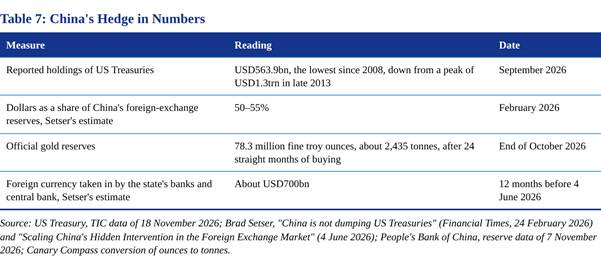
China’s numbers show a hedge (Table 7). Setser showed in “Finding China in the U.S. TIC Data” (Council on Foreign Relations, 18 May 2026) where much of the fall in its reported Treasury holdings went. On his estimates, China now holds Treasuries through custody centres in Belgium, Luxembourg, France and Britain, and probably some of its agency bonds through a custody bank in Canada. His estimates also suggest China cut its share of long-term Treasuries, added bills, and holds agency bonds worth about a tenth of its reserves. China’s gold, 78.3 million fine troy ounces after 24 straight months of buying (Table 7), carries no claim on the custodian. Setser’s USD700bn estimate (Table 7) adds two series: the foreign-currency deposits state banks invest abroad, and the foreign currency the settlement data show the state buying, on and off the central bank’s balance sheet. It assumes the two series do not overlap. China’s reported reserves have stayed basically flat, his May post notes, so the official reserve line does not show that money. The same post adds that the state banks’ biggest effect on Treasuries is indirect: they fund investors, hedge funds among them, that hold Treasuries on borrowed money. So more of China’s foreign-currency inflow now sits with its state banks, and part of it funds leveraged holders of Treasuries.
The BIS Quarterly Review of September 2026 finds that, between 2015 and 2020, Chinese banks’ loans grew to a third of all cross-border bank lending to sub-Saharan Africa, the largest share of any banking system. Even so, it finds that dollars still denominate most international credit to the region. China has begun moving some of that lending into yuan, and Kenya announced on 7 October 2025 that it had moved its Chinese railway loans into yuan. A creditor whose African borrowers owe it dollars still needs the dollar system to keep working. Yuan borrowing reaches only as far as what a borrower owes or buys from China, because China’s closed capital account (Table 2) limits what else it can do with yuan. Beijing’s own stated aim is narrower than replacement. The excerpt of President Xi Jinping’s speech that the Communist Party journal Qiushi published on 1 February 2026 lists global reserve-currency status as a mark of a financial power and does not mention the dollar. PBoC Governor Pan Gongsheng, at the Lujiazui Forum in Shanghai on 18 June 2025, expected a system where “a few sovereign currencies coexist and compete”. China’s balance sheet shows its base case: dollar dominance with Chinese rails alongside, a choice Beijing has held for two decades because reversing it would cost control of the capital account. A reversal of that choice would change the reading, and even an open capital account would win Beijing its bull case, a rival reserve currency, only after an American blunder.
For a sanctioned state the aim was to trade without American permission rather than to replace the dollar, and Russia shows how far that goes. Its central bank had moved part of its reserves into yuan from 2018. After sanctions froze much of its reserves and cut its main banks off from dollars and euros in 2022, Russia moved its trade and bank deposits into yuan at speed. In December 2023 Washington exposed foreign banks that serve Russia’s war economy to secondary sanctions, penalties on third parties, and widened the net in June 2024. China’s largest lenders stepped back. On a calculation Bloomberg published on 11 November 2026 from Bank of Russia data, the yuan’s share of payments for Russia’s exports has halved from its mid-2024 peak to 22 per cent in 2026. Russia now takes roubles for 69 per cent of its exports to Asia on the same calculation, and payment agents often net the flows offshore. The episode showed Washington’s reach: a sanction it aimed at Moscow worked through Beijing’s largest banks, because those banks need dollar access more than Russian business. The reach is not complete: smaller banks and payment networks keep some of the flow moving. The Treasury sanctioned the company A7 on 14 August 2025 and the whole A7 network, which serves Russia’s trade and which Iran also used, on 1 October 2026. The Financial Crimes Enforcement Network traced more than USD17bn that the network’s agent companies processed from January 2025 to June 2026, the Treasury said that day. Those companies held accounts at about 435 institutions in at least 83 countries, on the agency’s alert of the same day.
On the tracker of SWIFT, the bank messaging network, the yuan’s share of global payments has fallen since its July 2024 peak (Table 6). Chinese economists argue that China’s own network makes up the gap. Martin Chorzempa counts the volumes in “Has the Chinese yuan’s rise in global usage hit a wall?” (Peterson Institute for International Economics, 2 September 2026) and finds that it does not. The BRICS route is still a plan. The New Delhi Declaration of 12 September 2026 does not mention BRICS Pay, a business-council project still in pilot. It asks the bloc’s payments task force, in place since 2020, to keep studying how members’ systems might connect. India, in the chair, planned to propose linking members’ central bank digital currencies to make payments faster, with no aim of replacing the dollar, Reuters reported on 10 September 2026. The declaration commits to no such link.
A newer version puts gold at the centre: central banks would post bullion in Shanghai or Hong Kong and borrow against it, beside the system that runs on Treasuries. The vaults are real: the Shanghai Gold Exchange opened one in Hong Kong in June 2025, and the city’s central gold clearing system began trial operation on 7 July 2026. The collateral system does not follow. The Basel bank-liquidity rules of January 2013 do not count gold as a high-quality liquid asset, the class banks hold against a funding squeeze. The global margin schedule of April 2020 for derivatives not cleared through clearing houses cuts gold’s collateral value by 15 per cent, against 0.5 per cent for high-quality government paper under a year. A bar that sits in one holder’s name backs one loan at a time. To back many, a lender must take title and re-pledge the bar, which leaves the owner a claim on the lender, not the metal. Claims that outnumber the metal are the paper gold the idea set out to escape. The stock cannot grow in a crisis either: mining added 1.7 per cent to it in 2025, on the World Gold Council’s supply data of 29 January 2026 and its end-2025 stock estimate. Between 6 and 19 March 2020, gold fell 12.4 per cent on the London Bullion Market Association’s afternoon price as holders sold it for dollars. If the loan comes in yuan, it pays yuan invoices, which are growing, but China’s swap lines already supply yuan without gold. Dollar debts still need dollars, and any dollars Shanghai lends come from the dollar system. And bullion a central bank posts in someone else’s vault no longer insures it against the vault’s owner.
6. The Barbell and the Missing Middle
Adoption of the new layer is forming as a barbell, heavy at both ends and thin in the middle, and the shape is the new layer’s weak point. At the bottom, households in weak-currency economies adopted first, before any licence. In sub-Saharan Africa, the value of stablecoins received peer to peer rose more than sixfold between Chainalysis’s 2022 and 2026 report years, from USD2.3bn to USD14.6bn, Chainalysis reported on 29 October 2026. At the top, the statute makes the choice for issuers under US law: their reserves go where the law says, not where they prefer. The regulated middle, where banks, large-company treasuries and funds carry size, adopts last, and it is where the licensed build has to start. An institution cannot hold a working position in a token it cannot convert into local currency at institutional size and price. In the 270 country-to-country corridors IMF staff priced in a working paper of October 2026, a USD200 stablecoin transfer cost 2.2 per cent on average, a retail price no treasurer would pay at size. Standard Chartered Bank has let institutional clients mint and redeem USDC, the dollar token of Circle Internet Group (Circle), in Dubai since July 2026. In South Africa, the exchange Luno listed ZARU, a rand token whose reserves Standard Bank of South Africa holds, against USDT and USDC in August 2026, ITWeb reported on 7 August. That is an exchange’s order book, not a bank’s quote. But as far as we could check, nobody has yet recruited the African banks that could quote local-currency conversion at scale, and that gap is the missing middle. Until it fills, Africa’s new demand for dollars, and for the bills behind them, stays at household scale.
Issuers have begun recruiting distributors, and the float pays for it. Circle, whose USDC is the second-largest token, reported Q3 2026 results on 4 November. Distribution and transaction costs took 62.2 per cent of what its reserves earned (Figure 2), most of it as contracted revenue shares to partners, Coinbase Global first among them. The share was 61.5 per cent in Q2, on Circle’s results of 5 August 2026. Its headline USD865m of total revenue and reserve income included USD182m from a token presale. Outside the presale, reserve income was 96.3 per cent of that total. The float pays whoever distributes the token. Open USD, which went live as Stripe’s default stablecoin on 30 September 2026, writes that rule into its design: the partners that distribute it keep the reserve income, less a fee. Through 2026 Circle invested in African payment firms, Flutterwave in July and CrissCross in October, and in November hired a Head of Africa, Gillian Darko.

7. Synthesis: What 4 November Changed
The architecture holds, and the only actor that can break it is still its custodian. Nothing in the midterm result touches the credit architecture or the statute. The GENIUS Act is law and takes effect in January, and with the president who signed it in office until January 2029, repeal would need a veto-proof two-thirds of both chambers. What the election changed is the timetable of the machinery that funds Washington’s debt, in two places.
First, both chambers of Congress pass to the opposition in January, which takes the party-line legislative routes off the table and leaves the executive and regulatory ones. Second, the governors-elect of Texas, Georgia and Ohio all campaigned on pausing or restricting new data centres until the states write rules. Together those states hold 130.5 gigawatts (GW) of planned US data-centre capacity on the count of 4 November 2026 by Cleanview, an energy-project tracker. With six other states whose governors back a pause, the exposed pipeline reaches 158.6GW, 41 per cent of the national total. And the pause predates the vote: Texas Governor Greg Abbott, who lost his race, paused new grid approvals for data centres on 3 August 2026, and nobody had reported the pause lifted by 24 November. The AI leg of the new funding system now answers to state permits and household power bills, while the stablecoin leg stands in statute.
The San Francisco Fed’s letter projects that, on the recent trend, the two largest issuers’ bill-and-repo holdings could double to roughly USD400bn by the end of 2030, which puts them near USD200bn in 2026. Compounding from September 2026, that trend puts them at about USD288.7bn at the end of 2028. They will hold below USD400bn through that year (Figure 3), far short of the USD1.4trn that today’s ratio of their holdings to the whole market would give in the USD2.0trn market Bessent called very reasonable. Through 2028 a USD3.5bn inflow lowers the three-month bill yield by only a few basis points. Bill yields track the Federal Reserve’s policy rate, and even USD400bn would equal at most 6.0 per cent of the bills outstanding at the end of June 2026, a stock that has grown since. The token’s lasting use to Washington is a captive buyer at the short end of the curve.
For African hosts the vote changed little, because the statute takes effect in January whatever Congress does. The token reaches them as a dollar that someone else issues. For a reserve manager, swapping bills for tokens adds issuer risk and no diversification. A regulator can set the price of entry, as Nairobi and Abuja have, and can refuse the retail phase. As far as we could check, the middle is still missing: banks that turn tokens into local money at size.
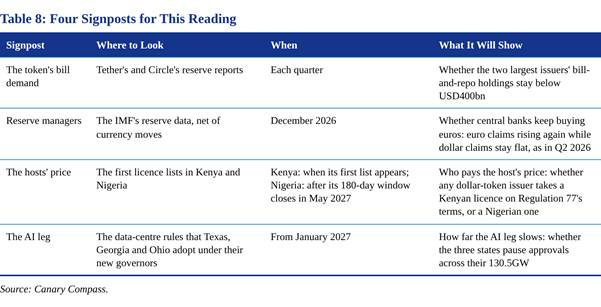
Four signposts will test this reading (Table 8).
Part 2 follows the custodian’s funding machinery and what the election did to its timetable, and Part 3 takes up Africa’s choice.
Sources
Ahmed, Rashad and Iñaki Aldasoro, Stablecoins and Safe Asset Prices, BIS Working Paper 1270 (Basel, May 2025, revised in 2026 with data to March 2026)
Arslanalp, Serkan, Barry Eichengreen and Chima Simpson-Bell, The Stealth Erosion of Dollar Dominance: Active Diversifiers and the Rise of Nontraditional Reserve Currencies, IMF Working Paper 22/58 (Washington, 24 March 2022)
Associated Press, Democrats Win Control of US House and Senate in Strong Rebuke to Trump and Republicans (Washington, 4 November 2026)
Bank for International Settlements, global liquidity indicators, US dollar credit to non-banks outside the United States, series Q.USD.3P.N.A.I.B.USD, data to end-June 2026 (Basel, 29 October 2026)
Bank for International Settlements, International banking statistics and global liquidity indicators at end-June 2026, statistical release (Basel, 29 October 2026)
Basel Committee on Banking Supervision and International Organization of Securities Commissions, Margin requirements for non-centrally cleared derivatives (Basel, April 2020)
Basel Committee on Banking Supervision, Basel III: The Liquidity Coverage Ratio and liquidity risk monitoring tools (Basel, January 2013)
Bloomberg, calculation from Bank of Russia data on the currencies of Russia’s export payments (New York, 11 November 2026)
Board of Governors of the Federal Reserve System, Selected Interest Rates (Daily), H.15 (Washington, 24 November 2026)
BRICS, New Delhi Declaration, Ministry of External Affairs, India (New Delhi, 12 September 2026)
Bureau of Labor Statistics, Current Employment Statistics, All Employees, Manufacturing, series CES3000000001, October 2026 data (Washington, 6 November 2026)
Bureau of Labor Statistics, Labor Force Statistics from the Current Population Survey, unemployment rate, series LNS14000000, October 2025 not collected (Washington, 6 November 2026)
Bureau of Labor Statistics, Median usual weekly earnings of full-time wage and salary workers in 1982–84 dollars, series LES1252881600Q (Washington, 21 October 2026)
Bureau of Labor Statistics, The Employment Situation: October 2026 (Washington, 6 November 2026)
Canary Compass, Who Owns the Stack, Part 4 (Nairobi, 8 October 2026)
Central Bank of Kenya and Capital Markets Authority, joint public notice on the operationalisation of the Virtual Asset Service Providers Regulations, 2026 (Nairobi, 13 November 2026)
Central Bank of Kenya, indicative exchange rates (Nairobi, 24 November 2026)
Central Bank of Nigeria, official exchange rates (Abuja, 19 November 2026)
Central Bank of Nigeria, Regulations for the Operations of Non-Security Virtual Assets (Abuja, effective 5 November 2026)
Chainalysis, The 2026 Geography of Cryptocurrency Report: Sub-Saharan Africa (New York, 29 October 2026)
Chorzempa, Martin, Has the Chinese yuan’s rise in global usage hit a wall?, Peterson Institute for International Economics (Washington, 2 September 2026)
CIPS Co., 2025 business volume and participant data, as reported by China Daily (3 March 2026) and Securities Times (September 2026)
Circle Internet Group, Circle Reports Second Quarter 2026 Results (New York, 5 August 2026)
Circle Internet Group, Circle Reports Third Quarter 2026 Results (New York, 4 November 2026)
Circle Internet Group, Form 10-Q for the quarter ended 30 September 2026 (US Securities and Exchange Commission, EDGAR database, 4 November 2026)
Cleanview, Newly Elected Governors Could Pause 41% of America’s Planned Data Centers (4 November 2026)
Congressional Budget Office, Monthly Budget Review: Summary for Fiscal Year 2026 (Washington, 9 November 2026)
DefiLlama, stablecoin dashboard (24 November 2026)
Energy Information Administration, US petroleum trade data and Today in Energy (Washington, 27 May 2026)
European Central Bank, euro foreign exchange reference rates (Frankfurt, 30 June 2026)
European Commission, Half-yearly report on the implementation of borrowing, debt management and related lending operations, COM(2026) 542 (Brussels, 2 October 2026)
Federal Open Market Committee, Summary of Economic Projections, Table 1 (Washington, 16 September 2026)
Federal Reserve Bank of San Francisco (Leduc, Oliveira and Sawyer), Stablecoin Issuers’ Growing Appetite for Treasury Securities, Economic Letter 2026-26 (San Francisco, 28 September 2026)
Federal Reserve Bank of St. Louis, FRED, Treasury constant-maturity yields at three months, ten years and 30 years, monthly averages (St. Louis, read 25 November 2026)
Financial Crimes Enforcement Network, FinCEN Alert on the A7 Network, FIN-2026-Alert007 (Washington, 1 October 2026)
Fisher, Paul, Editorial, The Alchemist, issue 97, London Bullion Market Association, for the LBMA Gold Price PM of 6 and 19 March 2020 (London, 2020)
Flutterwave, announcement of a strategic investment from Circle Ventures (Lagos, 7 July 2026)
GENIUS Act, Public Law 119-27 (Washington, 18 July 2025)
Hardy, Bryan, Swapan-Kumar Pradhan and Előd Takáts, International credit to Africa, BIS Quarterly Review (Basel, 14 September 2026)
Hong Kong Financial Services and the Treasury Bureau, press release on the Shanghai Gold Exchange’s Hong Kong vault (Hong Kong, 26 June 2025)
Hong Kong Financial Services and the Treasury Bureau, press release on the trial operation of the gold central clearing and settlement system (Hong Kong, 7 July 2026)
International Monetary Fund, Currency Composition of Official Foreign Exchange Reserves, data brief (Washington, 1 July 2026)
International Monetary Fund, Currency Composition of Official Foreign Exchange Reserves, data brief (Washington, 30 September 2026)
International Monetary Fund, IMF Executive Board Concludes 2026 Article IV Consultation with Saudi Arabia (Washington, 29 July 2026)
International Monetary Fund, Saudi Arabia: Concluding Statement of the 2025 Article IV Mission (Washington, 26 June 2025)
ITWeb (Nicola Mawson), Rand goes on-chain as ZARU hits Luno Global (Johannesburg, 7 August 2026)
Kenya, National Treasury, Cabinet Secretary John Mbadi’s briefing on the status of public debt (Nairobi, 7 October 2025)
Kenya, The Virtual Asset Service Providers Act, 2025, Act No. 20 of 2025 (Nairobi, commenced 4 November 2025)
Kenya, The Virtual Asset Service Providers Regulations, 2026, Legal Notice 134 (Nairobi, 22 July 2026)
Kwende, Glen, Erin Nephew and Carlos Sánchez-Muñoz, Dollar’s Share of Reserves Held Steady in Second Quarter When Adjusted for FX Moves, IMF Blog (Washington, 1 October 2025)
London Bullion Market Association (LBMA), LBMA Gold Price PM of USD3,667.55 on 23 November 2026, as tabulated by GoldSilver, against the LBMA Gold Price PM 2015 annual average of USD1,160.06 (London, 23 November 2026)
Miran, Stephen, A User’s Guide to Restructuring the Global Trading System (Hudson Bay Capital, November 2024)
Morningstar, Why International Stocks May Win Gold Again in 2026 (Chicago, 4 February 2026)
Morningstar, Why International Stocks Still Matter: Diversifying Beyond US Winners in 2026 (Chicago, 12 January 2026)
Office of Financial Research (Ted Berg and Daniel Stemp), Hedge Funds’ Cash Treasury Holdings Reach $2 Trillion, OFR Blog (Washington, 19 August 2026)
Office of the Comptroller of the Currency, GENIUS Act Regulations: Final Rule, Bulletin 2026-50, with Davis Polk’s summary (Washington, 21 October 2026)
Office of the Governor of Texas, directive to the Public Utility Commission of Texas and the Electric Reliability Council of Texas (ERCOT) (Austin, 3 August 2026)
Open Standard, Introducing Open USD (30 June 2026); Stripe, OUSD is now the default stablecoin on Stripe (San Francisco, 30 September 2026)
Pan Gongsheng, A few observations on global financial governance, keynote speech at the 16th Lujiazui Forum (Shanghai, 18 June 2025)
People’s Bank of China, bilateral currency swap agreements in force, as reported by China Daily Hong Kong (Hong Kong, 11 September 2026)
People’s Bank of China, central parity of the yuan, announced by the China Foreign Exchange Trade System: 6.7743 on 11 September 2026 and 6.7138 on 30 October 2026, and monthly average central parity for 2025 (Survey and Statistics Department, December 2025)
People’s Bank of China, official reserve assets, October 2026 (Beijing, 7 November 2026)
People’s Bank of China, Shanghai head office, Brief Report on Overseas Institutions’ Investment in the Interbank Bond Market, October 2026 (Shanghai, 17 November 2026)
President of the United States, Executive Order 14114, Taking Additional Steps With Respect to the Russian Federation’s Harmful Activities (Washington, 22 December 2023)
Reslow, André, Edona Reshidi, Andrew Usher, Jeanne Verrier and Marcello Miccoli, Deconstructing the Stablecoin Sandwich: The Cost of Cross-Border Stablecoin Transfers, IMF Working Paper 26/230 (Washington, October 2026)
Reuters (Nikunj Ohri and Jaspreet Kalra), India to push BRICS digital currency link despite hurdles, sources say (New Delhi, 10 September 2026)
Sanlam, Sanlam launches ZARU Stable Coin with Industry Partners (5 February 2026)
Saudi Central Bank, statement on its mBridge participation, given to and published by the Financial Times (20 September 2026)
Setser, Brad, China is not dumping US Treasuries, Markets Insight, Financial Times (London, 24 February 2026)
Setser, Brad, Finding China in the U.S. TIC Data, Council on Foreign Relations (New York, 18 May 2026)
Setser, Brad, Petrodollars: Myth and Reality, Council on Foreign Relations (New York, 14 April 2026)
Setser, Brad, Scaling China’s Hidden Intervention in the Foreign Exchange Market, Council on Foreign Relations (New York, 4 June 2026)
Society for Worldwide Interbank Financial Telecommunication (SWIFT), Global Currency Tracker, October 2026 edition, data for September 2026 (La Hulpe, 22 October 2026)
Society for Worldwide Interbank Financial Telecommunication (SWIFT), RMB Tracker, August 2024 edition, data for July 2024 (La Hulpe, August 2024)
Standard Chartered, Standard Chartered and Circle launch first G-SIB-led integrated access to USDC minting and redemption (Dubai, 2 July 2026)
State Administration of Foreign Exchange, China’s Balance of Payments, 2025, and preliminary data for the first three quarters of 2026 (Beijing, 13 November 2026)
Stitch, announcement of Circle Ventures’ investment in CrissCross (Johannesburg, 27 October 2026)
TechEconomy, Circle Appoints Former Yellow Card Executive Gillian Darko as Head of Africa (Lagos, 3 November 2026)
Tether International, Financial Figures and Reserves Report as of 30 September 2026, with BDO’s assurance opinion, and Tether’s release of the same day (San Salvador, 30 October 2026)
Tether, Tether Announces the Launch of USA₮, the Federally Regulated, Dollar-Backed Stablecoin, Made in America (27 January 2026)
Triffin, Robert, Gold and the Dollar Crisis, Yale University Press (New Haven, 1960)
US Department of the Treasury, Debt to the Penny, the daily debt statement, for debt held by the public (Washington, 30 September 2025 and 30 September 2026)
US Department of the Treasury, Major Foreign Holders of Treasury Securities, Treasury International Capital data, with foreign official holdings (Washington, 18 November 2026)
US Department of the Treasury, Monthly Statement of the Public Debt, read on FiscalData on 25 November 2026 (Washington, editions for 31 October 2025, 30 June 2026 and 31 October 2026)
US Department of the Treasury, Operation Economic Outcast Takes Unprecedented Action Against Sanctions Evasion Network Used by Iran, press release sb0644 (Washington, 1 October 2026)
US Department of the Treasury, press release jy2404 on new sanctions authorities and secondary sanctions risk for foreign financial institutions (Washington, 12 June 2024)
US Department of the Treasury, press release sb0197 on the enactment of the GENIUS Act (Washington, 18 July 2025)
US Department of the Treasury, Treasury Sanctions Cryptocurrency Exchange and Network Enabling Sanctions Evasion and Cyber Criminals (Washington, 14 August 2025)
US Senate Committee on Appropriations, Subcommittee on Financial Services and General Government, testimony of Treasury Secretary Scott Bessent (Washington, 11 June 2025)
Weiss, Colin, Why Gold Didn’t Actually Overtake Treasury Securities as the World’s “Favorite” Reserve Asset, FEDS Notes, Board of Governors of the Federal Reserve System (Washington, 3 September 2026)
World Bank, World Development Indicators: manufacturing value added, current US dollars, NV.IND.MANF.CD (Washington, updated 11 November 2026)
World Gold Council, above-ground stocks, end-2025 estimate of 219,891 tonnes (London, 2026)
World Gold Council, Gold Demand Trends: Full Year 2025 (London, 29 January 2026)
World Gold Council, Gold Demand Trends: Q3 2026 (London, 3 November 2026)
Xi Jinping, excerpts of a speech of 16 January 2024 on building China into a financial power, Qiushi, issue 3 of 2026 (Beijing, 1 February 2026)
Xinhua, China’s central bank signs 40 currency swap agreements with foreign counterparts, on a People’s Bank of China report (Beijing, 16 February 2024)
Disclaimer
Canary Compass research is published by Canary Imara Ltd, a private company incorporated in Kenya (PVT-3B15OQP7). Canary Imara Ltd also trades proprietary capital in markets covered by this research and may hold positions in instruments discussed. Canary Imara Ltd and anyone who works on a Canary Compass piece do not trade an instrument it names between its final draft and its publication.
This publication is for information only. It is not investment advice or a recommendation to buy or sell any instrument; readers should seek independent advice before acting on it.
Canary Compass and the author accept no liability for actions taken or not taken based on the information in this article.
The views expressed in this article represent the author’s independent professional analysis and do not constitute an endorsement of any individual, institution, or position. Canary Compass and the author accept no responsibility for how this content is interpreted, excerpted, or recontextualised by third parties not involved in its production and publication.
All views, projections, and forecasts reflect the author’s assessment at the time of writing. Data sourced from third parties is believed to be reliable but has not been independently verified. Past performance does not indicate future results.
All content published by Canary Compass is the intellectual property of the author. Reproduction, adaptation, or redistribution, in whole or in part, requires written permission.
About the Author
Dean N. Onyambu is the Founder and Chief Strategist of Canary Compass, a financial research publication focused on African monetary architecture and financial sovereignty. He brings 18 years of experience across trading, fund leadership, and economic policy, with senior roles at Standard Bank, First Capital Bank, and Opportunik Global Fund.
Read and subscribe at www.canarycompass.com.
The Canary Compass Channel is available on @CanaryCompassWhatsApp for economic and financial market updates on the go.
For more insights from Dean, you can follow him on LinkedIn @DeanNOnyambu or X @InfinitelyDean.