

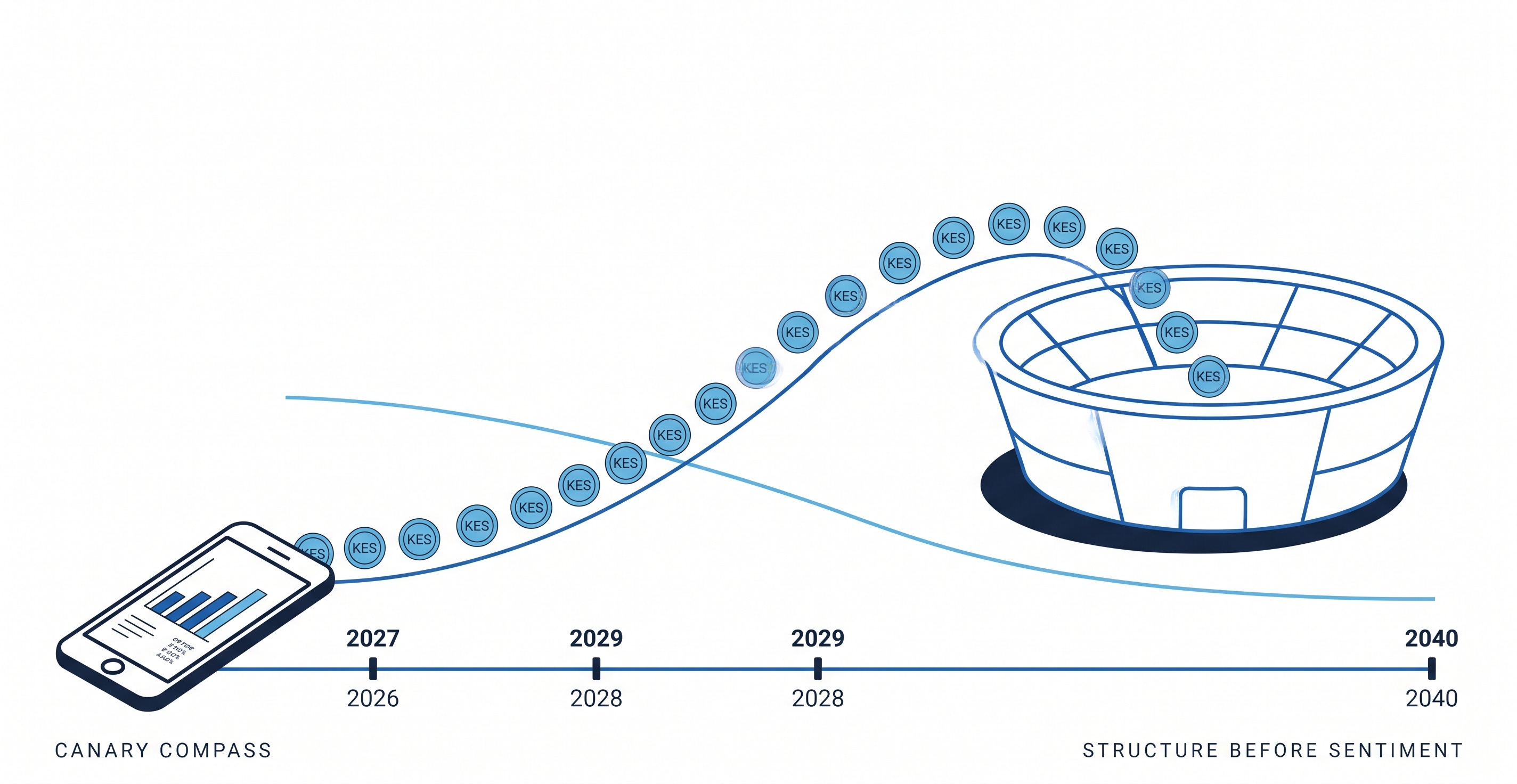
AI-illustration: 15.04 per cent to 2040: the bond behind Kenya's hosting decade.

Sometime today a young man in Nairobi will deposit two hundred shillings into a betting account. Ten shillings of excise will arise on that deposit, under the 5 per cent deposit tax Parliament introduced in mid-2025. The excise joins the pooled collections of the Kenya Revenue Authority (KRA); appropriations flow from there to the Sports Fund, and an escrowed portion services a special purpose trust called Linzi FinCo 003. In January the trust pays its noteholders again, and the largest of them are two public retirement funds, PSSF and NSSF. A portion of the pooled receipts will have travelled from betting wallets to retirement accounts, by way of a construction site on Ngong Road. There a 60,000-seat stadium, Talanta Sports City, approved for renaming as the Raila Odinga International Stadium at its official opening, is rising to host AFCON from June 2027. Across town, the older Kasarani stadium has just been named host of the 2029 World Athletics Championships, awarded by Tuesday’s World Athletics Council vote, the first ever held in Africa.
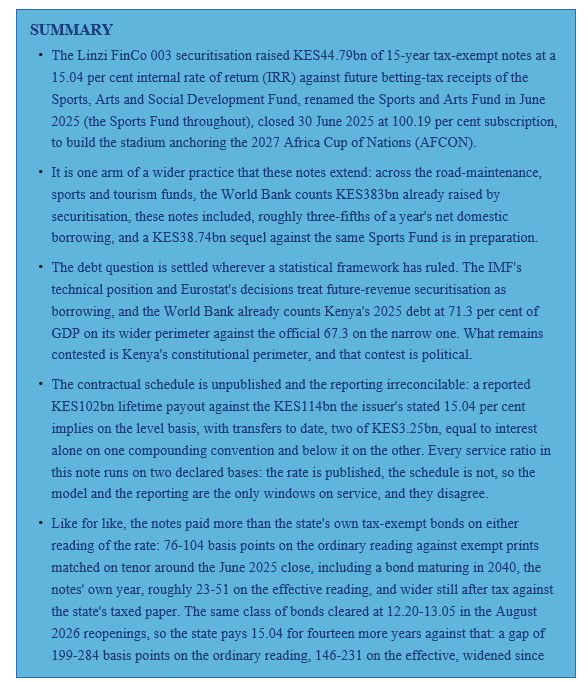
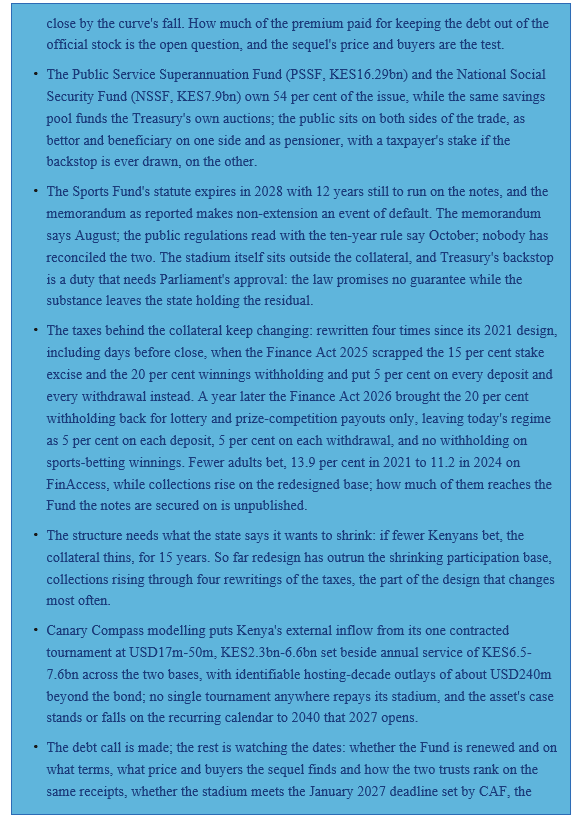
Award week set off an argument about whether Kenya deserved the Worlds. The argument missed the machine paying for the decade: Kenya finances its hosting ambitions by selling the future, and the next sale, KES38.74bn against the same Fund, is already in preparation. Two outcomes are possible. Arbitrage is value that lasts only while the debt stays off the official count; architecture is value that survives being counted.
1. The Machine
The Talanta financing closed on 30 June 2025. Linzi FinCo 003 Trust, arranged by Liaison Financial Services with KCB Investment Bank and CPF Capital, raised 44.79 billion Kenyan shillings (KES44.79bn) against future Sports Fund receipts at a subscription of 100.19 per cent. The established terms: 15 years to July 2040, an IRR of 15.04 per cent, 30 semi-annual redemptions beginning January 2026, interest tax-exempt like government infrastructure bonds, a GCR rating of AA(KE)(IR), and a listing on the Nairobi Securities Exchange’s restricted segment in KES100,000 multiples, a sub-segment that carries no public-disclosure obligation, so the offering memorandum circulates among qualifying investors only. Protections: assigned receivables, an escrow account, a reported three-month debt service reserve, and a standby letter of credit from KCB against delays in Treasury disbursement, an instructive choice of insured peril. Reported offer terms also include government safeguards against Sports Fund shortfalls, which sit uneasily beside the absence of a formal guarantee.
Start from what the public actually has, set out in Table 1.
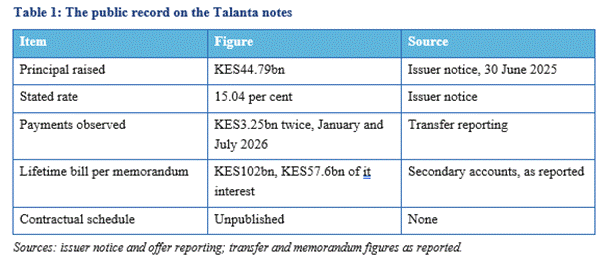
Ordinary bond quotation reads 15.04 as compounded semi-annually, NACS in market shorthand: 7.52 per cent per half-year, KES3.37bn of interest on the full principal, and no day-count convention closes the gap to the KES3.25bn observed. The payments instead sit on 7.26 per cent per half-year, a 14.51 per cent NACS rate, which is identically 15.04 compounded annually, NACA. So the observed cash reads the issuer’s 15.04 as the annually compounded quote: on it, the two payments match the interest to within rounding, and none of the principal has moved yet. In what follows, the ordinary reading takes 15.04 as NACS and the effective reading takes it as NACA. The distance from the KES3.25bn seen to any full instalment is the puzzle itself, and Table 2 tests every simple shape the bond could take.
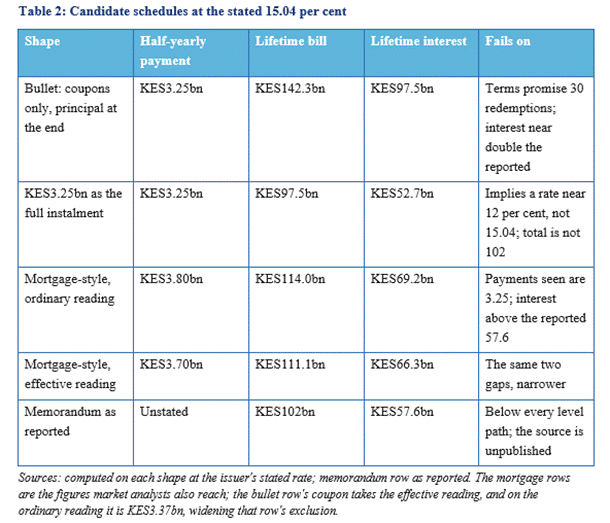
The table is the argument, and the Fails-on column does the excluding; the bullet row’s KES97.5bn is, in passing, where the KES100bn-plus political claims come from. What the surviving pattern most resembles is a bond’s cash on a mortgage’s paperwork: money going out like fixed coupons on the annual quote of the rate, while the terms and every analyst model amortise on the other; no one has observed a KES3.80bn payment, only inferred it. And the Fund’s transfer need not equal the holders’ payout, because the reporting notes investor payouts include escrow investment income, so the gap between 3.25 and a full instalment may be bridged inside the trust, out of sight. Failing that, the triad closes. Lifetime interest of 57.6 requires principal repaid faster than level; transfers that match full interest, if they are the whole payment, mean principal repaid slower and more interest than level, not less. No single schedule squares the stated rate, the payments made and the reported total, so something else has to give: a stub period, fees inside the transfers, or the reporting itself. One document ends the argument, the repayment schedule; the issuer holds it and has not released it. Until then, every service number in this note is computed twice, on the two readings defined below. That a public bond held by public pension funds against a public levy must be modelled at all is the finding.
Bases and conventions, used throughout. The level basis is Table 2’s mortgage-style schedule on the ordinary reading: service of KES7.6bn a year, weighted life near ten years because equal payments repay principal late; equal chunks of principal instead would give 7.75 years. Its effective-reading twin, KES3.70bn per payment and KES7.4bn a year, sits between the two bases and is not carried separately. The reported basis doubles the KES3.25bn transfer: KES6.5bn a year. Which reading governs is, like the schedule itself, nowhere disclosed.
Two further facts from the memorandum, as reported, matter more than the arithmetic. First, the Fund’s statute runs out in 2028, 12 years before the notes mature; the memorandum as reported dates the sunset August, while the regulations’ 26 October 2018 commencement read with the Act’s ten-year rule points to October, and nothing public reconciles the two. If the Fund is not extended, that is an event of default. Commencing the Fund’s winding-up then triggers acceleration, all outstanding amounts immediately due and payable from a Fund whose reported assets stood at KES5.6bn in mid-2023, the notes holding a priority charge on them. That is thin against KES44.79bn, but more than ordinary public debt offers: unsecured sovereign paper meets acceleration with no ring-fenced assets at all, only the taxing power, the contrast Table 5’s security row draws. Second, the stadium itself is not collateral: the state holds it through Sports Kenya, and noteholders can reach only the receipts. If the Fund is ever wound up, the law says the Cabinet Secretary shall pay any deficit from the Exchequer, with the National Assembly’s approval: a statutory duty, behind a parliamentary gate. So the documents answer what the rhetoric leaves open: no guarantee in law, a residual in substance. The sunset, the default and acceleration provisions, the shortfall safeguards and the competing payment readings all come from the memorandum as reported, not documents in hand; each is flagged at first use, and later mentions inherit the flag.
The holders and the asset, from the reported record. Regulatory filings show PSSF at KES16.29bn and NSSF at KES7.9bn, 54 per cent of the issue between two public retirement schemes. The filings also name County Pension Fund at KES1.98bn, CPF Individual Pension Scheme at KES790.5m and the Local Authorities Pension Trust at KES197.7m, taking disclosed retirement-scheme holdings to about 61 per cent; every disclosed shilling is visible through the buyers’ regulator rather than the listing, and the residual is not publicly broken down. The works contract was signed at KES45.85bn, USD344.5m in the audit papers, up from an approved estimate near KES35bn; the government attributes the escalation to taxes, levies and import charges, and Parliament keeps questioning it with the Auditor-General’s findings on the table. The build stood at 68 per cent complete in February’s Budget Policy Statement and about 89 per cent by the May Senate hearing, with remaining proceeds directed to training facilities, pools and an indoor arena. The arithmetic does not close: a KES44.79bn raise, transaction costs, a KES45.85bn contract that alone exceeds it, and further scope besides. The offer material had projected the proceeds covering the stadium with room for the Ngong Road flyover and satellite pitches; the schedule bridging raise, costs, contract and scope is one more gap in the public record. A second facility of KES38.74bn, the sequel throughout this note, is being prepared against the same receipts for 33 county stadium projects, a transaction advisor under recruitment and a similar tenor expected.
None of this stands alone. The flagship of the family is the roads securitisation: KES7 of the KES25 fuel levy committed for ten years against a KES175bn target to clear contractor arrears, bridged by KES104bn from four banks, TDB, KCB, Absa and UBA, with UBA’s leg signed at USD150m. By December 2025 the Cabinet declared certified road arrears to end-2024 settled at KES123bn, with 875 contracts accelerated since April. The take-out bond remains unissued, its target cut to KES120bn by June 2026 with no disclosed timeline, while a further KES5 per litre has entered securitisation. The Railway Development Levy and part of the tourism levy are committed, a rail-levy tranche is planned for the standard-gauge railway extension toward Kisumu and Malaba, and press reporting puts the near-term pipeline toward a trillion shillings. National pending bills stood near KES470bn in early 2026, counties roughly KES160bn more per the Controller of Budget, so the practice has demand whatever the statisticians rule.
The fiscal frame, each figure dated. Kenya’s FY2025/26 plan projected a deficit of KES923.2bn, about 4.8 per cent of GDP, with net domestic borrowing of KES635.5bn; the enacted FY2026/27 budget carries a reported borrowing gap near KES1.15trn. Against that scale, the KES383bn the World Bank counts as raised from the three funds, these notes included, is real money: roughly three-fifths of one year’s domestic borrowing, accumulated across the deals. The Fund’s own money comes in three counts that do not describe the same thing, set out in Table 3.
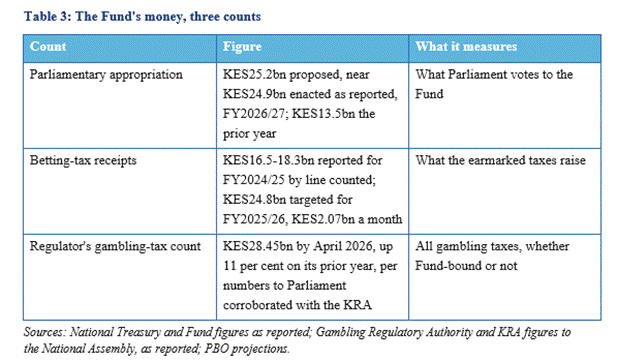
The regulations name the Fund’s statutory feeders, proceeds payable under the Betting, Lotteries and Gaming Act, the Income Tax Act’s winnings withholding and the Excise Duty Act, plus appropriations; the Finance Acts of 2025 and 2026 have since rewritten or repealed the taxes behind those very provisions. No public document reconciles what today’s regime actually delivers into the Fund by line: the Parliamentary Budget Office (PBO) projects the excise at KES11.4bn while the Fund targets 24.8, a KES13.4bn gap. The two transactions differ where it matters most: roads sold the future to pay for the past, arrears on works already built, while sports sells the future to build the future. Same instrument, different risk.
2. The Price
Was a middle ground discovered between concessional and commercial money? Judge the pricing at issue against the sovereign’s own auction prints on either side of the close. Table 4 sets them out. The differences are between reported rates, an unpublished-schedule IRR against weighted-average auction yields, not traded spreads, and Section 1’s fork follows the rate here: the auction yields share the market’s NACS shorthand, so if 15.04 is the ordinary quote the raw differences stand, and if the cash’s effective reading governs the comparable figure is 14.51 and every difference narrows by 53 basis points.
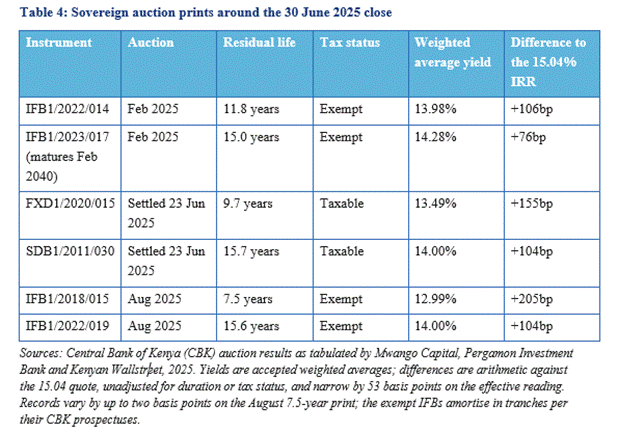
The clean comparison is exempt against exempt. The 2040 print, at the notes’ own residual life, gives 76 basis points. The August amortising analogue gives 104. The gross premium around the close therefore runs 76 to 104 basis points on the ordinary reading against tax-exempt paper matched on tenor and structure, roughly 23 to 51 on the effective; the February print, off the tenor match at 11.8 years, sits at 106 and is excluded for tenor, not for size.
Two clocks matter here: residual life, the time left to final maturity, and weighted life, the average time each shilling of principal stays out; amortisation shortens the second without touching the first. Both sides tick on both clocks. The notes amortise by their terms’ 30 redemptions, and every exempt print in Table 4 is a CBK-titled amortised bond with a published tranche structure, so quoted residual life overstates weighted life on both sides. How closely on the notes’ side, nobody outside can say; that depends on the unpublished schedule. On the level model their weighted life runs near ten years, against nine and eleven for the matched prints whose tranche dates are published; if principal is moving late, the notes’ true figure runs longer, and the 15-year prints stay the conservative match on every reading. The shorter prints in Table 4 show yields falling inside the curve.
The taxable prints price a different holder and a different structure. For an exempt holder, who receives their gross yields untaxed, and the two public funds holding 54 per cent of the issue are exempt institutions, the gross differences are the live ones. Against the longer print the difference on the residual clock is 104 basis points. The shorter one is a conventional bullet, its two clocks one and the same, sitting where the notes’ level-model weighted life does: 155. For a taxable holder the comparison moves the other way: the 10 per cent withholding cuts the after-tax return on those June prints, so on the simple approximation the tax-free rate is worth about 16.71 per cent taxable on the ordinary reading, 16.12 on the effective, and the notes’ advantage widens on either; an exact comparison needs each bond’s coupon and price cash flows. A price above the curve on every tax basis and either reading still filled its book with two exempt state funds; the concentration is not explained by tax arithmetic.
Future-flow finance is sold on one promise, cheaper access: collateral is supposed to price the paper below the sovereign’s own curve. This deal carried security over a named levy, an escrow, a reserve and a letter of credit, and still priced above that curve against every matched tax-exempt print, on either reading. So the promise inverted. What the structure bought is not in doubt, the off-book label, exclusion from the official debt stock, a benefit the World Bank’s recount has already begun to erode; how much of the price paid for the label, against the risks investors bore, is the hypothesis the sequel’s print will test. Fees, the reserve and the letter of credit add to the all-in cost, their amounts undisclosed.
The state’s rate is locked for fourteen more years, and the raw differential now stands at about 199-284 basis points against the August 2026 infrastructure bond reopenings of 2035-2042 paper, which cleared between 12.20 and 13.05 per cent. No trading price exists on the restricted segment, so the number is a differential of rates rather than a traded spread, and it bundles limited recourse, illiquidity, novelty, complexity, concentration and fees. The illiquidity is concrete. An IFB qualifies for banks’ statutory liquidity ratios and carries a CBK rediscount window of last resort, per its own prospectus; for these notes, on the restricted segment already described, no such window, qualification or repo use appears on the public record. Buy-to-hold books hold both instruments, so the difference is the instrument’s utility, not the buyer’s intent, and a holder prices it.
The test runs through the sequel, on thresholds set from the fork itself: 50 basis points sits inside what convention and structure alone could explain, 150 exceeds the first print’s premium on any reading. A print within about 50 basis points of the then-sovereign curve into a broad book would compress the hypothesis; a print 150 or more over, absorbed again by the same two public funds, would deepen concern about concentrated demand and weak price discovery, the standing ambiguity a 100.19 per cent subscription does nothing to dispel. Rates fell after the close; that proves nothing about the price on the day. What it creates is a paper gain for holders, the value of collecting 15.04 while the curve sits near 13, borne through the earmark by the Fund’s beneficiaries, and paper it stays unless the restricted segment ever offers an exit. It also raises the obvious question, whether the state can refinance at today’s rates, and the answer sits in call provisions the public record omits: a second missing document beside the schedule.
Table 5 sets Kenya’s four borrowing channels side by side.
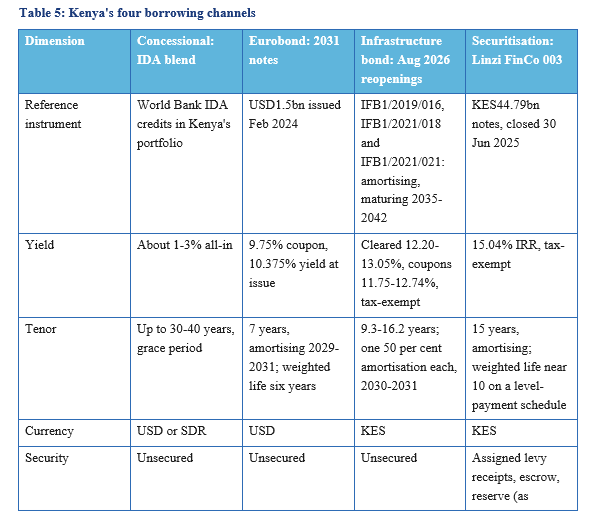
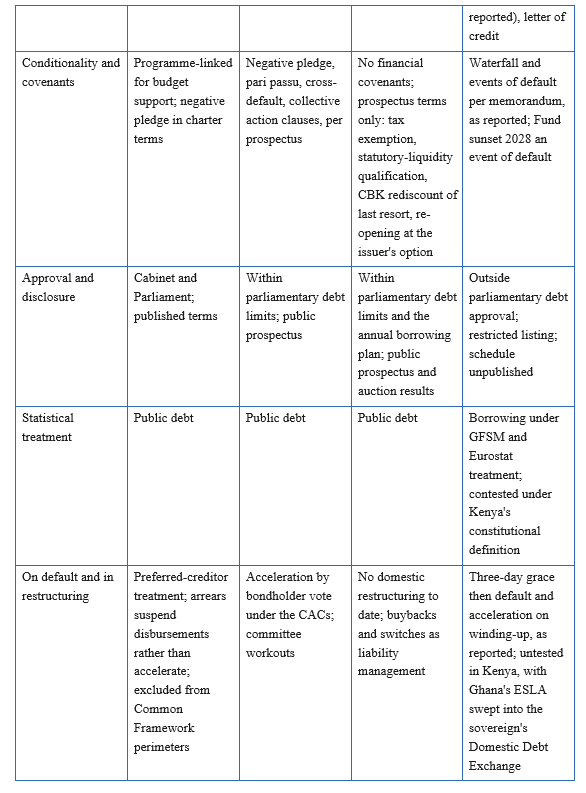
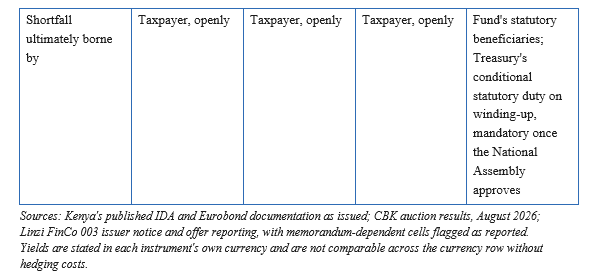
The money is the same money: the savings buying this paper are the pool that funds the Treasury’s own auctions, so for at least the anchor half of the book the state changed the price it pays to reach its own savers, not the source. One mismatch rides underneath. The state owes shillings, but part of what the shillings built was imported and paid in dollars, and the roads deal already put a dollar leg inside a shilling-levy structure at pricing nobody outside has seen, powers to inspect it now before Parliament. So the space between concessional money and commercial money is real, but it is not a price; it is a gap between oversight regimes. The observed differential is the visible financing price; the all-in cost stays incomputable and the off-book share of the premium unidentified.
3. What It Is
Three questions hide inside the classification fight, and they resolve differently. In every statistical framework that has ruled, the question is settled: the IMF’s April 2026 assessment of Kenya’s debt statistics states that the road-levy securitisation and similar securitisations of future revenue flows should be recognised as debt liabilities under the international statistical standards, the Government Finance Statistics Manual (GFSM) and the public sector debt statistics guide. The World Bank’s May 2026 assessment already expands the perimeter. It counts 2025 debt at 71.3 per cent of GDP on the wide perimeter against an official 67.3 on the narrow one, with securitised obligations and verified arrears among the additions, a definitional recount, not a policy verdict. Economically, the structure is debt-like: future public revenues service fixed investor claims, and the state stands behind the Fund. Under Kenya’s narrower constitutional and statutory perimeter, the treatment remains contested. The Transport Cabinet Secretary told Parliament the state has no further liabilities once the rights are sold; the National Treasury Cabinet Secretary calls the disagreement an accounting matter. The dispute sits among several items between Kenya and a successor programme since the USD3.6bn arrangement lapsed in April 2025.
Two precedents point the same way for different reasons. The statistical one: Eurostat, in decisions beginning July 2002, ruled that securitisation of future revenues not tied to an existing asset must be recorded as borrowing. Securitisations of fiscal claims are borrowing by convention, because government keeps direct or indirect control of a tax. The decision text goes further in a direction Nairobi should read closely: where government compensates the vehicle beyond its contractual obligations, the entire operation reclassifies as borrowing. Kenya’s reported shortfall safeguards live one step from that rule. The restructuring one: Ghana’s ESLA PLC, created in 2017 to bond energy-levy receivables against sector arrears, was defended in parliament on the same non-sovereign grounds Nairobi argues now. When distress came, its paper was swept into the Domestic Debt Exchange, settled in February 2023 with roughly 77 per cent of its paper tendered against 85 on the sovereign’s own book, restructured alongside the sovereign it legally was not. What remains open is domestic and political: when Kenya’s official statistics, and any new programme, say what the substance already says.
On a household’s books the shape is familiar: a mortgage, the same payment every period until the balance dies. Except a mortgage secures the lender twice, on the house and, in practice, on the income that pays it. This one runs the other way: the receipts are assigned but the stadium is not; the house stays outside the deal. A family that signed these papers would call it debt, whatever the paperwork calls the lender.
4. The Collateral
The literature documented this asset class before Kenya adopted it. World Bank research by Ketkar and Ratha traced future-flow securitisation from the first Telmex transaction in 1987 through more than 200 rated deals worth USD47.3bn by 1999, and analysed its promise for developing-country access; an IMF working paper by Chalk examined securitising public revenue flows as early as 2002. There is no contradiction between that literature and today’s institutional objections: a structure can widen access and still be debt. The mechanism the successful deals relied on is the part Kenya’s version removes. They securitised hard-currency export receivables paid by offshore obligors into offshore accounts, beyond the sovereign’s reach. Kenya’s collateral is a domestic tax, collected and regulated by the state whose behaviour investors are exposed to. The nearest structural cousin is the American tobacco settlement bond, where receipts eroded as regulation did its intended work, stretching maturities and forcing refinancings; the parallel is the collateral’s decay, not the recourse, at least not yet.
Kenya has already demonstrated the mechanism, in dates. Two Finance Acts materially rewrote the betting-tax base within 12 months, while a new Gambling Control Act separately replaced the regulator, and Legal Notice 106 of 2025, in force from 12 June 2025, rewrote the Fund’s own governing instrument, renaming it the Sports and Arts Fund and narrowing its mandate to sports and arts alone. The sequence: excise on stakes at 7.5 per cent in 2021, 12.5 in 2023, 15 in late 2024. Then the Finance Act 2025, assented in the final week of June, abolished the stake excise and the 20 per cent withholding on winnings in favour of 5 per cent on deposits and 5 per cent on withdrawals. Assent came days before the notes closed on 30 June; effect, the day after. Then the Finance Act 2026, effective this July, reinstated the 20 per cent withholding on winnings over the new regulator’s reported objection. The enacted definition is confined to lottery and prize-competition payouts, leaving ordinary sports-betting winnings outside it, narrower than the Bill’s full reversal.
The standing regime after all four rewritings: 5 per cent on each deposit and each withdrawal, 20 per cent withheld from lottery and prize-competition winnings, nothing withheld from sports-betting winnings. Four rewritings of the collateral’s tax law since its 2021 design, two of them rate steps and two base redesigns, the latest already unwinding part of the 2025 design, though not the wallet base the receipts projections rest on. That is the record: collateral rewriting in Kenya is demonstrated practice rather than hypothesis.
The receipts consequence has cut favourably to date, the PBO projecting excise collections more than doubling, from KES5.4bn to KES11.4bn, on the broadened deposit base. The nationally representative FinAccess survey shows participation falling, from 13.9 per cent of adults in 2021 to 11.2 per cent in 2024, so higher collections cannot safely be read as more bettors. The contributions of base redesign, compliance, nominal growth and intensity are not publicly decomposed. Falling participation beside rising collections is also what a per-transaction wallet tax on a concentrating core would produce, fewer bettors transacting more, the reading with the sharpest distributional edge. The wallet design narrows one offshore route, since deposits move through regulated mobile money; it does not close the question. What nothing in the structure covers is the next stroke of the same pen. The protections insure Treasury delay, and no clause reaches statutory redirection. Whether an assignment of receipts survives a future Finance Act is the untested legal heart of every deal in the family.
Rank the family’s collaterals by that logic: the fuel levy broad but hostage to pump-price politics; the rail levy tied to the import cycle; the tourism levy shock-prone; the betting excise most fragile of all, because its erosion is what public-health success looks like. A state that collateralises betting receipts for 15 years hardens its fiscal interest in gambling volumes into a contracted one. Every future stake limit or advertising restriction now carries a debt-service cost, a design property that will outlive its designers. The virtuous cycle is the credit’s headwind: if conversion succeeds and betting fades, the collateral fades with it unless redesign or compliance compensates, and Kenya’s redesigns have so far more than compensated, collections rising through each rewrite. Conversion and the credit are in tension by construction, and the reconciler to date has been the tax code, the least stable element in the whole structure.
5. The Worth-It Test
Two curves run through this decade, and the machine’s fate is the race between them. The first curve is the debt. The observed instalments imply KES6.5bn a year, and modelled service reaches KES12.1-14.2bn once the sequel prices at similar terms, payable for 15 years from the assigned betting receipts. Today the base covers it. Declared receipts lines cover the first deal’s modelled service 2.2 to 3.8 times, depending on basis and fiscal year, and the combined programme 1.75 to 2.05 times on projected receipts, the higher figure resting on the interest-only reading. Both ratios are computed before the Fund’s statutory spending, which the escrow subordinates in practice, and before the sequel trust, whose priority on the same receipts is undisclosed. So sufficiency is not the question. Duration is. The participation base is measurably thinning while collections ride the redesigned taxes, so the asset must build its earning calendar before the receipts themselves turn. That calendar is the second curve, and it matters to the credit through politics rather than cash: renewal in 2028, every further redesign and any Exchequer backstop are political acts, priced cheaply for a full stadium and dearly for an idle one.
The calendar’s one contracted football peak is AFCON, 19 June to 17 July 2027 per CAF’s May 2026 announcement. The tournament closes weeks before the August general election, so delivery incentives run as strong as incentives get, and everything downstream passes through a campaign. Kenya’s designated match venues are Talanta and Kasarani, both in Nairobi, with Nyayo relegated to the training list. In August the state reinstated Eldoret’s Kipchoge Keino Stadium as an alternative match venue, the organising committee’s chairman saying Kenya wants venues in use beyond the tournament. CAF toured it during the eight-day tri-country inspection concluded on 4 September. February’s report found none of Kenya’s proposed stadiums fully met CAF Category 4, itemised Kasarani’s deficit down to pitch reconstruction and 3,000-lux broadcast lighting, set an 80 per cent completion milestone for August, and fixed January 2027 as the deadline for full operational readiness of every match venue and training ground. The September visit returned a positive read on Talanta, the government citing 92 per cent completion, while Kasarani’s works stay under watch.
Kenya has already rehearsed under this examiner. At the African Nations Championship (CHAN) in August 2025, CAF’s reported sanctions on the local federation, fines, a ticket freeze, an attendance cap at Kasarani and a threatened relocation of fixtures, showed enforcement is real. The hosts of the opening match and the final remain CAF’s to announce, reporting presuming the final for Talanta.
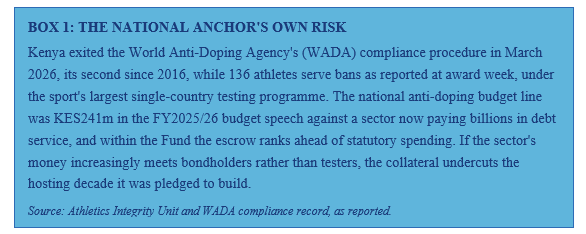
The 2029 Worlds belong to the country, not to this credit, because they cannot come to Talanta at all: Talanta is a football and rugby ground with no athletics track, so the championships were never Talanta’s to host, and Kenya’s winning bid stood on Kasarani. So the 1987 stadium captured the decade’s biggest prize while Talanta holds one contracted tournament, and the substitution runs one way, Kasarani able to host Talanta’s codes but never the reverse, which reframes the utilisation question. Box 1 prices the national anchor’s own risk beside it.
Tournament money sits in three pockets that never mix, the organiser’s, the teams’, and the host’s, and the host’s pocket has two sides, outlay and measured gain. Gross-impact projections belong to no pocket at all. Table 6 separates the five.
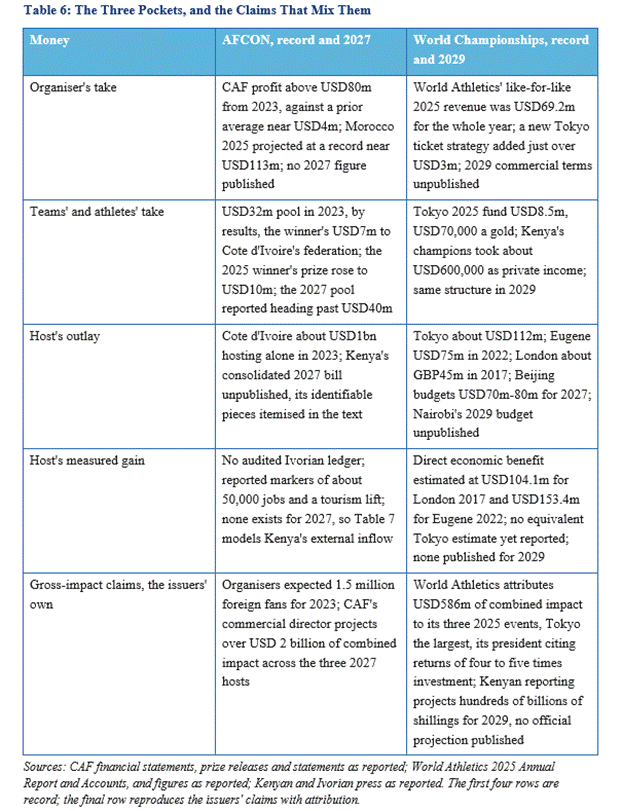
The organiser’s take is federation income, and the athletes’ take is prize money, paid by results as private income; the winner’s cheque followed the trophy, a fact hosting did not buy. The host’s outlay is what staging costs, and the host’s measured gain is what post-event studies find in direct visitor and event spending, the only pocket a country keeps and the smallest number on the table in every measured edition. Gross economic impact is the issuers’ own projection genus, multipliers and exposure included. That genus is how World Athletics attributes USD586m of impact to a year in which it earned USD69.2m, and how measured gains two orders below the talk attract hundreds of billions of shillings in Kenyan headlines. Organisers expected 1.5 million fans from outside Cote d’Ivoire; the country’s own aviation figures recorded a first-quarter rise of roughly 65,000 passenger movements, attributed to AFCON. Set the measured row against this credit: a full championships hands its host, once, about two to three years of this bond’s service in gross activity. The 2029 edition hands that to the country across town, and the state’s own take is only the tax on that sliver. One measured benefit sits outside all five money types; Section 8 prices it.
Kenya’s own ledger opens on the cost side, and the cost side is the unpublished half. The fee runs host to CAF: KES3.9bn remitted in March 2026 after nearly missing a deadline its partners had met, KES1.6bn for CHAN before it. To that add the KES45.85bn Talanta contract financed by these notes, and a separate KES26.4bn Exchequer earmark announced at the Finance Act 2026 assent, covering the Kasarani and Nyayo works among wider preparation. Add the commuter rail spur whose costs the railway has not disclosed, and an operating model, who runs the stadium and who funds its upkeep, that no public document yet shows, on which Sports Kenya already reports shortfalls. A Principal Secretary said the AFCON budget sat in no current budget; Parliament heard renovations had stalled on unpaid contractors.
Cote d’Ivoire’s precedent prices both columns. It spent about USD1bn hosting alone, one 60,000-seat stadium at USD260m, the benchmark Parliament’s questions about Talanta’s USD344.5m contract now sit beside. And the billion was capitalised rather than consumed, leaving roads, hospitals, hotels and four upgraded grounds the country keeps. Kenya’s consolidated bill exists nowhere in public. Break-even at the sovereign level is therefore not computable by anyone outside government, and the missing documents are cost documents.
Table 7 builds Kenya’s 2027 external inflow bottom-up: matches from the tournament’s format and the CHAN precedent, attendance from the measured Ivorian average, foreign arrivals anchored to the Ivorian aviation record, spend anchored below Kenya’s own average arrival.
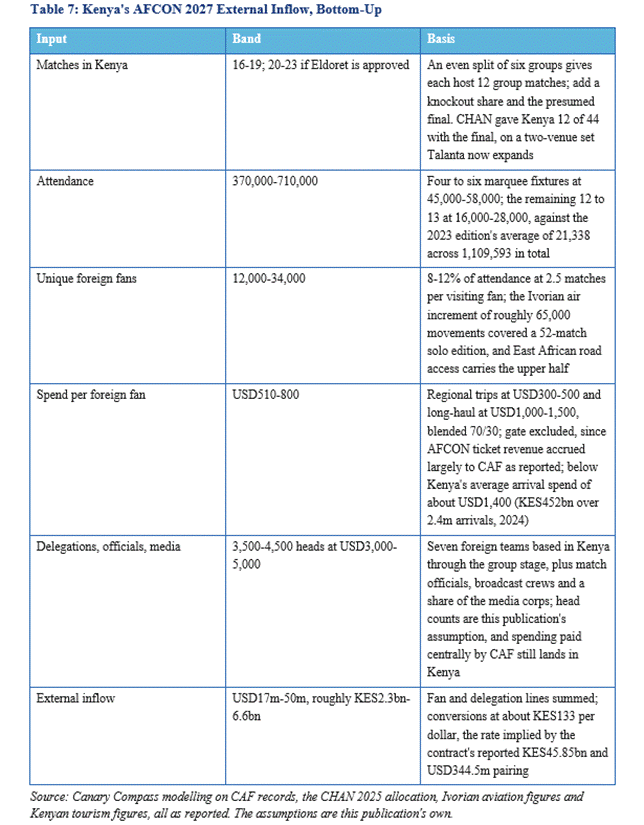
The bands are wide where the record is silent, and the verdict survives their whole width. Against annual service of KES6.5-7.6bn on the two bases, USD49-57m at the same rate, the inflow runs from three-tenths of one year’s service at the floor to roughly one year at the ceiling of every assumption simultaneously, a comparison of scale, not coverage. The state’s own take, tax on that inflow at an assumed effective 12-20 per cent, this publication’s assumption, runs USD2m to 10m against the hosting fee of about USD29m paid before a visitor landed. Eldoret’s approval would add a second host city and a few million dollars without moving that range; no allocation outcome changes the verdict. The peaks cannot carry the notes, and nothing in the structure asks them to. No public document maps a shilling from either tournament to these notes; any route is indirect and unmapped, and the analysis runs on the assigned betting receipts, never on event money or multipliers.
That separation is the strongest honest statement of the title’s thesis. The tournament economy keeps its earnings gross, hotels, transport, trade, visibility, while the debt is assigned to the vice base, so no contract connects them. What the tournaments earn the economy still reaches the state as ordinary revenue, easing the budget that appropriates to the Fund and stands behind it on winding-up: separate by assignment, joined through the fisc. A declining vice financing a permanent asset that attracts recurring external revenue is a defensible conversion.
The opportunity side is on the record too: the first AFCON in East Africa in five decades, and CAF’s stated reach of 400 million people. Even the hotels and airlift pass, on the local organising committee’s account of CAF’s own view. The arithmetic above has already priced one peak. And the identifiable outlays beyond the bond, the CHAN and AFCON hosting fees and the Exchequer earmark, already run to about USD240m equivalent before the undisclosed rail and operations. Recurrence is therefore the entire economic case: the identifiable outlays alone equal five to fourteen tournaments of modelled inflow. No tournament anywhere repays the ground built for it; a calendar might. The peaks’ function is to seed that calendar, and CHAN has already banked the first proof.
Beyond the contracted peaks lies a biddable frontier, and to July 2040 it is deep enough to name in tiers. The standing tier is annual and continental: CAF’s club finals already travel, and Zanzibar staged a Confederation Cup final leg in 2025. The contest tier is dated and priced: rugby’s new Nations Championship finals opened a neutral-venue market at a reported GBP800m over eight years, London 2026 then Doha 2028, with later editions returning to the market if targets slip. The one-off genre is live, a Test of the Washington 2018 kind. The ambition tier is what the estate was sized for: a solo Kenyan AFCON in the quadrennial era that begins after 2028, each edition scarcer and richer for it, and an African Commonwealth Games in 2034 still unawarded. Each prospect divides by the same one-way line, football and sevens to Talanta, track and cross country to Kasarani; the athletics frontier fills the other stadium with every prize the country wins.
Every tier above the contracts is a bid, and bids are won on the readiness record the examiner is writing now; 2027 is the audition for the whole calendar. Peaks justify scale; the payments are made on the floor, the league finals, concerts and gatherings of a growing city. And the floor now has more claimants than the order book assumed. The programme has two physics, the flagship carrying the order book while the 33 county facilities carry the pathway, and averaging them flatters whichever is failing. Should CAF approve Eldoret, the state exits the decade with three large grounds, two of them 25 kilometres apart sharing one city’s bookings, the third in a city whose sporting identity is Kasarani’s code. The only Kenyan evidence on that floor is Kasarani itself, built for the 1987 All-Africa Games, carrying the national stock alone for four decades, its ordinary calendar undocumented; Cape Town’s Green Point and much of Brazil’s 2014 stock name the genre this build must escape. The 60,000 seats on Ngong Road will be judged on what fills them between the fortnights the world visits. And the judging is a race: that calendar must establish before the collateral turns, because the bridge between the two is the tax code.
6. The Demographic Ledger
The Saturdays and the payments are serviced by the same constrained flow of young Kenyans’ money, which is where the ledger turns demographic. Who is in this transaction? Start with prevalence. The nationally representative FinAccess survey puts active betting participation at 11.2 per cent of adults in 2024, down from 13.9 in 2021. That is the participation measure; the survey’s separate betting-as-income series printed its own 11.2 back in 2021, and the two are distinct. Mobile-panel surveys of the connected young run far higher, an upper bound for the digital cohort rather than the nation. Young people are overrepresented on several legs of the structure, to different degrees on each. The same survey puts male participation at 18.4 per cent against 4.4 for women, highest in the 18-25 and 26-35 brackets. They are overrepresented among bettors, among the Fund statute’s intended beneficiaries by its own text, in the construction labour of a rebounding sector, and, through the NSSF’s widening enrolment, among eventual claimants on the creditor side. Today’s payout accrues mostly to established balance sheets, over half of it to two public retirement funds.
Kenya’s population skews young by any bracket: roughly three in ten Kenyans are aged 18-34, over half of adults, and about three in four are 35 or under. Something near a million people enter the labour market yearly on the standard estimate, into youth unemployment near 15 per cent on the strict ILO definition and roughly double that on broader measures of those seeking work.
Where the education-to-employment channel is congested, alternative pathways gain value, and sport is one of the few where Kenya exports at the global frontier. The verdict question is precise, and it is still a hypothesis awaiting evidence. The channel is virtuous if it converts the revenue base into the productive base. It is regressive if two hundred shilling deposits, drawn disproportionately from young men, fund a 15 per cent tax-free return to established pension balance sheets against a monument. Conversion can be measured: county facilities completed and used, academies and athletes coming through, event-days and paid attendance at the stadium, jobs in the sector. The overlap between the transaction’s legs is not measured, and the incidence is undemonstrated either way. The strongest defence of the whole practice belongs here at full strength. The window is open now. Saving receipts for 15 years first would serve a cohort already aged past the pathway, so time-shifting capital to meet the cohort while it is young can rationally justify borrowing. Its limit: the case licenses borrowing at the sovereign’s own rate, on the books. Nothing in it requires the differential, or the opacity of structures Parliament cannot inspect.
7. What Travels
Nigeria, Ghana, Uganda and Tanzania all tax betting without a conversion channel, and Kenya’s experiment is the one their treasuries will study. Four conditions on the structure and one on the project decide whether it should travel. Count the obligations from day one; the statistical and restructuring precedents have both ruled on models that hide. Ring-fence in law that survives the Finance Act cycle, the live threat Kenya’s own record proves. Build pension demand that is market-made. African retirement capital will buy 15-year local paper, an encouraging discovery only if the buying was chosen, and replication needs a broad book rather than two state-adjacent anchors: an auctioned or widely syndicated book, priced against a published curve, is what chosen looks like. Choose collateral for political durability; a levy whose erosion is a policy success is the weakest class. And contract the order book before pouring concrete. What should not travel: dollar legs inside local-levy structures, sunset clauses that park an undisclosed statutory residual on the Treasury, and single-event business cases. Whether Kenya’s own version clears these conditions is what the verdict now assembles.
8. The Verdict, in Instalments
Count it as debt in every ledger beyond Nairobi’s statute book; the domestic classification is a political timetable rather than an analytical question. The opening’s two outcomes are now the two live questions, and both stay open here. Arbitrage is the premium question: secured paper priced above the sovereign’s own unsecured tax-exempt curve on either reading, the promise of cheaper access inverted; whether the premium was earned, against the counterfactual of a mid-2025 infrastructure bond at the sovereign’s own curve with undisclosed fees and enhancement costs added, is what the sequel facility’s print and book will inform. Architecture is the keep question: the one contracted peak is priced and cannot carry it, four months to a year of service, once; the keep is earned on conversion, the county programme, the operating model, and the ordinary calendar.
The observables are dated. First, the terms on which the Sports Fund is renewed ahead of its 2028 sunset, August on the memorandum, October on the regulations’ commencement and the ten-year rule: non-renewal would default paper held by the state’s own pension funds, so renewal is the likely path. The discriminating question is whether the earmark and the assignment survive intact, since June 2025 rewrote both the tax base and the Fund’s own name and mandate; redesign reaches the instrument itself. Then the KES38.74bn print and who buys it; the January readiness deadline; receipts against the reported payments, and the year they first turn, the moment redesign stops compensating for a thinning participation base, visible only if the state publishes the decomposition. The rest of the list: priority between the two trusts once the sequel’s documents surface, secondary prints if the restricted segment ever produces one, and who operates and maintains what has been built.
One benefit is real and measured, and it sits in no ledger above. The wellbeing literature finds hosting is the channel that moves a population. Across twelve European countries, Kavetsos and Szymanski measured a large and significant lift in reported life satisfaction from hosting football tournaments, while the effect of winning alone was statistically indistinguishable from zero. Dolan and co-authors found London 2012 lifted Londoners’ happiness during the Games, peaking at the ceremonies, gone within the year, and worth its cost only if the rest of the country shared a modest part of the feeling. Kenya has consumed the winning kind for four decades and is buying the hosting kind for the first time. A first African Worlds and a first East African AFCON in five decades present every condition the literature ties to its largest effects: hosting rather than winning, novelty, national reach. Pride of that order is a legitimate public purchase. The question that remains is the price and the financing, because the lift fades by the following year and the schedule does not.
Who bears a failure is already filed. The Fund’s statutory beneficiaries absorb the first fiscal adjustment; Treasury payment of a winding-up deficit is a statutory duty conditional on National Assembly approval, and neither the approval nor direct noteholder recourse is automatic. That is the public, as beneficiary and pensioner, and potentially as taxpayer, on both sides of a trade currently paying its pension side handsomely, on paper.
The young man’s two hundred shillings has a long itinerary. The stadium his deposits are building opens for a continental tournament in June 2027; the championships that crowned award week play across town in 2029; the last payment his successors will fund falls due in July 2040. The verdict arrives in instalments between those dates, and the first two are already scheduled: CAF’s readiness deadline in January 2027, and, likely sooner, the print on the next facility. The race inside those instalments is simple: the ordinary Saturdays must arrive before the betting base turns. Whether the machine converts vice into virtue rides the same calendar, county grounds and operating model beside the prints; like the debt, the cycle will be counted, not believed.
Sources
AFP, AFCON 2023 preview reporting on expected foreign attendance (January 2024); Athletics Integrity Unit and WADA compliance record, as reported (Monaco and Nairobi, 2022-2026); Bowmans and McKay Advocates, Finance Act 2025 client alerts (Nairobi, July 2025); Business Daily, reporting on the Linzi FinCo 003 offer terms, the Fund sunset provisions in Kenya Risks Asset Seizures over the Talanta Bond, current-year payments, the roads bond target, corporate bond market and pension holdings from RBA filings (Nairobi, 2025-2026); Cabinet Office, statement on road sector pending bills (Nairobi, December 2025); CAF, AFCON 2027 kick-off and final date announcement (May 2026), inspection releases (September 2026), the KSh3.9bn 2027 hosting-rights fee as reported (March 2026), financial statements to the 47th General Assembly and President Motsepe’s AFCON 2023 profit and prize statements, AFCON 2023 host-economy markers as reported (2024-2025), CHAN 2025 fixtures and venue allocation (2025), AFCON 2027 venue inspection reports as reported (February and September 2026), the Zanzibar Confederation Cup final staging (2025), the post-2028 quadrennial cycle announcement as reported (December 2025), the Morocco 2025 profit projection and prize structure as reported (2025-2026), and the commercial director’s AFCON 2027 combined-impact projection as reported (May 2026); Central Bank of Kenya, 2024 FinAccess Household Survey (Nairobi, 2024); Central Bank of Kenya, Treasury and infrastructure bond auction results, February to August 2025 and August 2026, as reported (Nairobi, 2025-2026); Chalk, Nigel, The Potential Role for Securitizing Public Sector Revenue Flows, IMF Working Paper 02/106 (Washington, 2002); Controller of Budget, county pending-bills reports (Nairobi, 2026); Daily Nation, AFCON 2027 venue and inspection reporting (Nairobi, 2026); Dolan, Paul, Georgios Kavetsos, Christian Krekel, Dimitris Mavridis, Robert Metcalfe, Claudia Senik, Stefan Szymanski and Nicolas Ziebarth, Quantifying the Intangible Impact of the Olympics Using Subjective Well-Being Data, Journal of Public Economics 177 (2019); Eurostat, decisions on securitisation operations undertaken by general government (Luxembourg, 2002 and 2007); Finance Acts 2025 and 2026 as recorded by Kenya Law, with the 2026 winnings provisions as reported; Gambling Regulatory Authority and Kenya Revenue Authority, gambling-tax figures presented to the National Assembly, as reported (Nairobi, May 2026); GeoPoll, Betting in Africa reports (2022-2025); Ghana Ministry of Finance and Domestic Debt Exchange records on E.S.L.A. PLC, including the 13 September 2023 reopening release with instrument-level tender rates, as reported (Accra, 2017-2023); IMF, Kenya: Data Quality Assessment for Public Sector Debt Statistics, High-Level Summary Technical Assistance Report 2026/020 (Washington, April 2026); Ivorian civil aviation authorities, first-quarter 2024 passenger figures as reported (Abidjan, 2024); Kavetsos, Georgios and Stefan Szymanski, National Well-Being and International Sports Events, Journal of Economic Psychology 31 (2010); Kenya Railways, Nairobi commuter-rail works for AFCON as reported (January 2026); Kenya National Bureau of Statistics, Economic Survey 2026 and census analytical reports (Nairobi); Kenyan Wallstreet, Linzi 003 listing and amortisation analyses and CBK auction results (Nairobi, 2025-2026); Ketkar, Suhas and Dilip Ratha, Development Financing During a Crisis, World Bank Policy Research Working Paper 2582 (2001) and Innovative Financing for Development (2009); Lawton, Matt, The Times (London, 15 September 2026); Ministry of Sports Principal Secretary, venue readiness statements as reported (Nairobi, September 2026); Ministry of Tourism, 2024 tourism earnings and arrivals as reported (Nairobi, 2025); Mwango Capital, market reporting on the February 2025 infrastructure bond reopening (Nairobi, 2025); National Assembly and Senate records on the Talanta contract and securitisation oversight (Nairobi, March and May 2026); National Treasury, 2026 Budget Policy Statement (Nairobi, February 2026), Annual Borrowing Plan FY2025/26 and Budget Statement FY2026/27, as reported; Parliamentary Budget Office, Budget Watch 2025 (Nairobi); Pergamon Investment Bank, Fixed Income Pre-Auction Notes carrying CBK auction results tables (Nairobi, 2025-2026); President’s Finance Act 2026 assent statement on the sports-infrastructure earmark, as reported (June 2026); Public Finance Management Act, Cap 412A, section 24(9), and the Public Finance Management (Sports, Arts and Social Development Fund) Regulations, Legal Notice 194 of 2018, as amended by Legal Notice 106 of 2025 (Nairobi); Six Nations Rugby, SANZAAR and World Rugby, Nations Championship structure and finals hosting, London 2026 and Doha 2028, as reported (2024-2026); The Star, reporting on projected 2029 Worlds economic impact (Nairobi, September 2026); Wales v South Africa Washington DC Test, as reported (2018); World Athletics, 2025 Annual Report and Accounts (September 2026), Tokyo 2025 prize schedule, attendance, staging cost and prior host-city gain estimates as reported (2017-2026), and award coverage including Reuters, AP and BBC reporting (September 2026); World Bank, Kenya debt assessment (Washington, May 2026).
Disclaimer
This article does not constitute legal, financial, or investment advice. The author shares views for perspective and discussion only. Do not rely on them as a substitute for professional advice tailored to your specific circumstances. Always consult a qualified legal, financial, investment, or other professional adviser before making decisions based on this content. The analysis reflects proprietary research undertaken by Canary Compass and the author.
Canary Compass and the author accept no liability for actions taken or not taken based on the information in this article.
The views expressed in this article represent the author’s independent professional analysis and do not constitute an endorsement of any individual, institution, or position. Canary Compass and the author accept no responsibility for how this content is interpreted, excerpted, or recontextualised by third parties not involved in its production and publication. Reproducing any portion of this work in isolation, or in combination with other material, in a manner that misrepresents the author’s original meaning constitutes a distortion of the published record.
The author may hold positions in financial instruments, currencies, or assets discussed or referenced in this publication. Such positions do not constitute a recommendation to buy or sell.
All views, projections, and forecasts reflect the author’s assessment at the time of writing. Data sourced from third parties is believed to be reliable but has not been independently verified. Past performance does not indicate future results.
All content published by Canary Compass is the intellectual property of the author. Reproduction, adaptation, or redistribution, in whole or in part, requires written permission.
About the Author
Dean N. Onyambu is the Founder and Chief Strategist of Canary Compass, a financial research publication focused on African monetary architecture and financial sovereignty. He brings 18 years of experience across trading, fund leadership, and economic policy, with senior roles at Standard Bank, First Capital Bank, and Opportunik Global Fund.
Read and subscribe at www.canarycompass.com.
The Canary Compass Channel is available on @CanaryCompassWhatsApp for economic and financial market updates on the go.
For more insights from Dean, you can follow him on LinkedIn @DeanNOnyambu or X @InfinitelyDean.