

Why banks (and wealth managers) won in Zambia’s Court
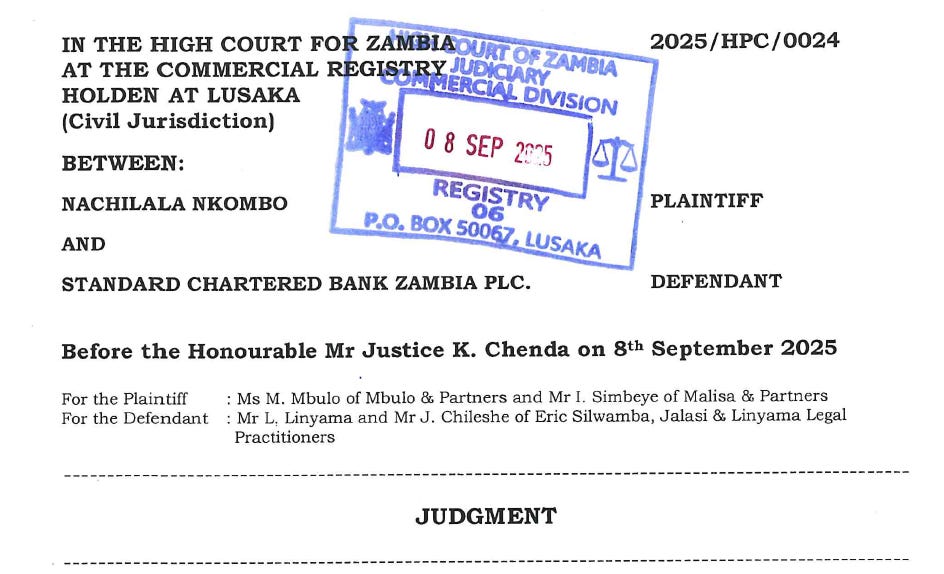
On January 13, 2025, I warned that blurring the lines between distribution and advice would penalise intermediaries for global shocks and reduce product choice in Zambia. I also argued that selective enforcement would chase capital away and that a fee regime that taxes innovation would keep the market shallow. The High Court has now delivered judgment in Nkombo v Standard Chartered Bank Zambia. The Plaintiff's claims failed on statute, contract, and tort—legal duties, agreements, and wrongs. The Court accepted that Standard Chartered acted as a distributor and not as an adviser in relation to the Sino Ocean bond. Then, the Court ordered the Bank to pay the Plaintiff's costs because its conduct fell below its own code of ethics, which, in some respects, sets a higher standard than the law. Law drew the line. Ethics set the cost.
Read my January analysis here.
Refer to the supporting analysis in Commentary 1 for further details.
See investor duty emphasis in Commentary 2 here.
Findings at a glance
· Court: High Court for Zambia, Commercial Registry. Judgment dated 8 September 2025.
· Holding: Plaintiff failed on statute, contract, and tort. Claims dismissed.
· Costs: Bank to bear the Plaintiff’s costs because the conduct fell short of its own ethics code.
· Why it matters: The Law preserved distributor versus adviser. Ethics still added a cost.
Court’s key rulings
· Section 7.1: “The Plaintiff has failed to prove that the Defendant was in breach of statutory duty, or otherwise liable in contract or tort for the service provided to her over the Sino bond.”
· Section 7.2: “Consequently, the Plaintiff’s action against the Defendant fails and the substantive claims are hereby dismissed.”
· Sections 7.5 and 7.6 - Costs rationale: “I have in this judgment found that there was no infraction by the Defendant, whether under statute, in contract or tort. However, I did find that the Defendant’s conduct fell short of its internal code of conduct and ethics, which is (in some respects) more stringent than the dictates of the current law. I deem that event as sufficient to condemn the Defendant to bear the Plaintiff’s costs of and occasioned by this action. So it shall be, to be taxed in default of agreement.”
The issues and the Court’s answers
Framed issues (section 3.2)
1. Nature of the relationship between the Plaintiff and the Bank regarding the Sino bond.
2. The governing terms of that relationship.
3. Whether the Bank induced the investment by fraud or misrepresentation.
4. Whether the Bank was negligent in its obligations to the Plaintiff.
5. Whether the Plaintiff suffered a compensable injury attributable to the Bank.
6. Whether any relief lay against the Bank.
Court’s answers in plain language
1. The Court held that the role was one of distribution, not advice.
2. The Court held that the governing terms did not impose an advisory or fiduciary duty.
3. The Court found that the Plaintiff failed to prove misrepresentation and fraud on the evidence and documents.
4. The Court found that the Plaintiff failed to establish negligence and statutory breach.
5. The Court found no compensable injury attributable to the Bank.
6. The Court dismissed the claims but ordered the Bank to bear the Plaintiff’s costs due to a shortfall against its own ethics code (see costs rationale below).
Why the cost order landed despite success on the merits
· The Court relied on its discretion regarding costs and the Bank's higher internal standard.
· The shortfall did not create liability but justified a departure from the usual costs rule (the winner typically recovers costs).
The approach tracks established principles. Caparo v Dickman (1990) frames duty through foreseeability, proximity, and what is fair and reasonable. Hedley Byrne v Heller (1964) recognises that clear disclaimers and defined roles can limit responsibility for alleged advice. The Court applied that structure and found no advisory duty on these facts.
Law, ethics, and the future of Zambia’s markets
In my January analysis, I questioned the SEC's action against Standard Chartered for allegedly mis-selling Sino Ocean bonds. I argued that confusing distribution with advice would chill innovation and reduce investor choice. The High Court has now delivered judgment. The Plaintiff’s claims failed on statute, contract, and tort. The Court accepted that the Bank acted as a distributor and not as an adviser. That reinforces the boundary I highlighted in January, with important caveats that I address below.
The judgment carries a second message. The Bank must bear the Plaintiff’s costs because its conduct fell below its own ethics code. The Court noted that the code in parts is stricter than the current law. Compliance cleared the Bank of liability. Conduct still carried a price. That signal is healthy for a system that wants depth with trust.
The Plaintiff’s account and why the Court was unpersuaded
Sections 4.7 to 4.64 of the judgment record the Plaintiff’s testimony. Allegations included verbal assurances of safety, references to Chinese government backing for the bond, lack of a prospectus at the moment of decision, a change in risk profile from moderately aggressive to aggressive, and pressure to sign without adequate reading time. The Court assessed demeanour and documentary consistency and found the evidence did not dislodge the signed acknowledgements and the formal allocation of risk in the papers. That outcome matters for process design. Oral comfort words do not survive well against clear written disclaimers. If a bank wants to avoid this collision, it must either prevent the words from being spoken or document any risk softeners with precision.
I acknowledge the Plaintiff’s position. A long-standing relationship can create trust that feels like advice even when the paperwork says distribution. That human reality does not erase signed acknowledgements. It does strengthen the case for post-sale updates, a pause before signature for review, and a written note that confirms any change in risk profile, including reasons for the change and a cooling-off period.
The SEC issued a breach letter, which the Court placed alongside the transaction documents. The Court still found no liability in statute, contract, or tort. That outcome reflects how written allocations of risk and role withstand regulatory claims when the facts support a distribution model.
Trust is earned in the file and in the follow-up. That is how adult markets protect clients without denying them choice.
The ethical sting
Costs followed ethics, not liability. The judge used the Bank’s own code as a benchmark (section 7.5). That precedent matters. It tells boards that internal codes now carry financial weight. It signals that courts can enforce ethics through costs even when the law finds no liability.
Boards should take three lessons. First, codes must be operational, measurable, and auditable. Second, ethics must shape front-line scripts and follow-ups, not sit in induction slides. Third, cost risks will rise if conduct falls materially short of what the Bank promises to the public, even when the law is satisfied. Banks should treat this as a governance risk, not a public relations point.
Costs hurt. They send a message that practice must meet promise. I accept that message. A market that wants depth may pay this governance price while it establishes consistent norms that keep global providers present and counterparties better informed.
One concern remains — proportionality. If courts impose costs as a routine penalty for any code deviation, even where the counterparty suffers no legal wrong, firms may overcorrect and withdraw products. The right balance is to reserve costs orders for specific, material deviations that connect directly to the transaction.
That concern links to a deeper truth. A code that pays no rent in daily behaviour, unused in daily operations, is a liability. Think of it like a rented office: if Standard Chartered’s code sat idle while staff gave vague assurances (sections 4.9-4.12), it became a burden, costing them in court (section 7.6). Markets, through lost investor trust or competitor gains, will price that neglect long before a court does.
The credit story that investors should have tracked
Sino Ocean debt sat in a Chinese property sector that was under pressure by early 2022. Market signals were visible. In March 2022, the credit still carried a rating that many would call investment grade (low-risk rating) on some scales, with a negative outlook (risk warning). Downgrades (risk increases) followed in August and September that year, then into 2023, with the initial default hitting on 13 August 2023. The Plaintiff’s bond default was recognised on 6 February 2024 (section 4.13), reflecting a missed market signal.
Clearly, this was a visible and evolving risk story. A sophisticated investor reads the offering materials, monitors rating actions, and reassesses the position when facts change, including selling a bond after a downgrade. If you buy credit, you must track the credit by following rating changes and market news. If you fail to track it, you speculate rather than invest. Refer to Commentary 1 for the timeline and Commentary 2 for the investor duty statement.
Sino Ocean Ratings and default timeline
· March 2022 Fitch at BBB- with a negative outlook. The sector is already under stress in the Chinese property market.
· August 2022 downgrade to BB+ on negative watch.
· September 2022 further downgrade to BB.
· November 2022 BB affirmed on negative watch.
· March 2023 downgrade to B+ as conditions worsened.
· August 2023 missed interest payment of about 20.9 million dollars on overseas bonds (initial default). The Plaintiff’s bond default was recognised on 6 February 2024 (section 4.13).
Banks can help without crossing the line into providing advice. A standard rating alert, a neutral risk reminder, and a request for written client instructions after a downgrade respect execution only while improving client outcomes. That is a fair response to the trust dynamic in long-standing relationships.
Why does this judgment help market depth?
The ruling preserves the boundary between advice and distribution. Markets rely on clear roles. If courts treat distributors as advisers by default, global firms will revert to plain instruments; choice narrows, and hedging tools (risk management products) will vanish. Zambia needs the opposite. It requires responsible access to more complex and international instruments, clear documentation of risk transfer, and enforcement that targets actual breaches rather than outcomes from macroeconomic trends.
Role letters carry weight, and appropriateness checks matter even when not strictly required. A clean evidence file that clearly shows what the bank sent, what it stated, and what the client acknowledged will prove decisive. The Defendant’s witnesses reinforced the distributor role and the absence of an advisory mandate. Their testimony aligned with the documents and with the outcome.
Capital stays when rules stay clear, investors own responsibility, and regulators treat product choice fairly instead of punishing intermediaries for macro cycles.
Asymmetry in enforcement still erodes trust
Commentary 1 anchor
A. The SEC penalty against SCB highlights gaps in Zambia’s regulatory framework.
1. Government versus private securities
Zambia’s Securities Act exempts government securities from its provisions, which creates a double standard. Intermediaries involved in distributing Zambia’s Eurobonds, which were B+ at issuance in 2012 on Fitch and later defaulted, faced no penalties. Private intermediaries like Standard Chartered were scrutinised by the SEC (later cleared by the Court: sections 7.1-7.2) for distributing Sino Ocean bonds, which at the time of sale in March 2022 carried a BBB- on Fitch with a negative outlook. Different treatments for similar credit risks (i.e., similar probabilities of default) at issuance can weaken fairness and damage confidence.2. Sino Ocean ratings and default timeline
- March 2022 Fitch at BBB- with a negative outlook as the sector faced pressure.
- August 2022 downgrade to BB+ and placed on negative watch.
- September 2022 further downgrade to BB and negative watch maintained.
- November 2022 BB affirmed on negative watch.
- March 2023 downgrade to B+ as fundamentals worsened.
- August 2023 missed interest payment of about 20.9 million dollars on overseas bonds, which crystallised default (official failure).
Selective enforcement that targets intermediaries for evolving credit dynamics while exempting government securities and their intermediaries from equivalent scrutiny discourages product diversity and encourages capital outflows.3. Investor accountability and Standard Chartered’s compliance framework
High net worth investors must understand the risk–reward dynamics of speculative credit. Standard Chartered applies global processes that cover suitability checks, recorded calls, and risk disclosure. With those controls in place and with the sector’s risks already public, the investor had the tools to monitor and act after each rating action. Failure to act after the August 2022 and March 2023 downgrades reflects a lapse in portfolio management. Once an investor chooses an execution only path, the responsibility for managing the position rests with that investor.4. Market confidence
Regulatory inconsistencies erode trust and drive wealth offshore. Fees and levies then add friction (extra costs). The Securities Fees and Levies Rules of 2020 impose uniform minimums that overburden smaller funds and suppress innovation. Zambia must calibrate fees to the scale of its market, which remains small with limited product diversity and investor capacity.
Key point: Confidence requires one sunlight standard (equal application of rules = no bias based on issuer). The issuer type must not dictate how bright the room is; the SEC’s scrutiny of SCB for Sino Ocean, while ignoring Eurobond defaults (Commentary 1), unfairly dims the light for private issuers.
Commentary 2 anchor
Active (hands-on) portfolio management is hard work. Even sophisticated high-net-worth investors cannot apply full-time attention to investments while running demanding careers unless they choose to. Active management requires continuous monitoring, research, and timely decision-making. If you do not track rating actions or sector conditions, you are not managing risk. That is the investor’s responsibility when they choose an execution-only approach.
What should the SEC do next?
· Issue an official guideline that clearly distinguishes between distribution and advice.
· Provide practical tests and examples across bonds, structured notes, and cross-border products.
· Specify what an execution only appropriateness check looks like and when it is required.
· Publish a rating action protocol that sets reasonable time frames and content for disclosure updates after a watch placement or downgrade.
· Calibrate fees toward supervision rather than presence.
· Tier fees by activity and complexity.
· Reduce barriers for hedging products and diversified global instruments that pension funds and high-net-worth portfolios need.
· Publish a joint note with the central bank that aligns disclosure norms across government and private issuances, so that investors feel the same level of transparency regardless of the issuer.
· Expand investor education with plain guides on ratings, covenants (loan terms), event of default triggers, liquidity risk, and the difference between advice and execution only.
I invite the SEC and market participants to co-draft a short rating action protocol and a fee calibration note. We can start with a public workshop and publish the first draft for comment. That is a practical step that helps investors and keeps providers engaged.
Supervise risk, not presence—price integrity, not lack of progress.
What should banks (and asset managers) change now?
· Map every wealth product to a role. Advisory. Discretionary. Execution only. One product. One role. One script.
· Place the role statement, issuer relationship, and risk transfer on the first page of the client pack.
· Run an appropriateness or knowledge check (suitability review) even where the rules only suggest it.
· Capture a clear client election if they decline advice and choose execution only.
· Build a living evidence file (ongoing record) for every sale. Store documents sent, deliver risk summaries, and manage client acknowledgements and follow-ups after rating actions.
· Supervise communications outside formal packs. Emails and chat messages must avoid advice language unless an advisory mandate exists.
· Train relationship managers with short scripts that repeat role, counterparty, risk, and investor responsibility.
· Audit against the ethics code, not only against the law. If your code sets a higher bar, test against it and close the gaps.
Practical disclaimers and scripts you can drop into client packs
Below is a sample. It is not legal advice. Seek counsel before adoption.
Role and service
We act as a distributor of third-party securities. We do not provide investment advice for this product. If you want advice, request an advisory mandate (see examples cited from Standard Chartered below—also available in the full judgment).
“We will not provide an advisory service to you in relation to the merits of dealing in one or more investments but will avail you with all the necessary documents, terms and conditions for the investments that will be availed to you without assuming any responsibility for such dealing or investment or any ongoing management or performance of any portfolio or investments of yours. This does not mean that we will not take due care and diligence to ensure that only investment grade investments are availed to you through us.”
“If we have agreed to provide you with any advisory service, it is important that you discuss your investment objectives and risk requirement with us, and for your own protection, you must inform us immediately if your circumstances of objectives change.”
Counterparty and recourse
Your contractual counterparty is the issuer named in the offering document. Your rights and claims are against the issuer and not against the Bank. We do not guarantee payment of principal or interest.
Risk acknowledgement
The price and value of this security can fall as well as rise. Credit quality can change. A rating is not a recommendation. Past performance does not predict future results. You may lose some or all of your investment.
Appropriateness and knowledge
We assess whether this product is appropriate based on the information you provide about your knowledge and experience. If you decline to provide information, we will treat this transaction as execution only and will not assess appropriateness. Please confirm that you understand this outcome.
Ratings and event updates
If a rating agency places this issuer or security on watch or downgrades the rating, we will notify you on a best-efforts basis. That notice is not advice. You remain responsible for your decision to hold, buy or sell the security.
Conflicts and remuneration
We may receive distribution fees from the issuer. The fee structure is available upon request and does not affect the execution-only status of this transaction.
Client confirmation
I understand that the Bank acts as a distributor and not as an adviser. I have read the offering document. I accept that my contract and recourse are with the issuer. I accept the risk of loss.
Optional recorded call script
Thank you for your instruction. We are acting as a distributor and not as an adviser. Your counterparty is the issuer. We do not guarantee payment. This security carries credit and market risk. You have confirmed that you understand these risks and wish to proceed on an execution only basis.
Investor responsibility in plain words
Execution only gives you a choice but not advice. That choice carries work. You must read the documents, follow rating actions, monitor covenant triggers (covenant triggers are contract terms that cause default or restrict actions when financial ratios or events breach set thresholds), and take action when facts change. If you want a partner to shoulder that work, request an advisory or discretionary mandate and pay for it. If you want execution, only accept accountability for the outcome.
Investor duty is now a slogan that investors must tattoo on their chests. It involves monitoring, decision-making, and owning the outcome of one’s investment choices. If in need of help, seek a licensed investment professional adviser.
Investor takeaway
Ratings outlooks and watches are decision points. Sophisticated investors must monitor these developments and take action accordingly. See Commentary 2 for the duty to manage positions actively.
Note: For clarity, in this article, distribution and ‘execution-only’ mean the same thing. The Bank executed trades but did not provide a personalised advisory service. It carried out a compliance suitability check to confirm access to the product, but the Court confirmed this did not create an advisory duty. The Bank acted solely as a distributor, commonly defined in industry practice as execution only.
Disclaimer
This article does not constitute legal, financial, or investment advice. The author shares views for perspective and discussion only. Do not rely on them as a substitute for professional advice tailored to your specific circumstances. Always consult a qualified legal, financial, investment, or other professional adviser before making decisions based on this content.
Canary Compass and the author accept no liability for actions taken or not taken based on the information in this article.
About the author
Dean N. Onyambu is the Founder and Chief Editor of Canary Compass. His insights draw on experience across trading, fund leadership, governance, and economic policy.
The Canary Compass Channel is available on @CanaryCompassWhatsApp for economic and financial market updates on the go.
Canary Compass is also available on Facebook: @CanaryCompassFacebook.
For more insights from Dean, you can follow him on LinkedIn @DeanNOnyambu, X @InfinitelyDean, or Facebook @DeanNathanielOnyambu.
For clarity, in this article, distribution and execution only mean the same thing. The Bank executed trades but did not provide a personalised advisory service. It carried out a compliance suitability check to confirm access to the product, but the Court confirmed this did not create an advisory duty. The Bank acted solely as a distributor, commonly defined in industry practice as execution only.