

AI-illustration: Permission to Ask
On Saturday a man landed at Miami International Airport on a flight from Istanbul. He held a valid United States visa and travelled, according to Somalia’s Ministry of Youth and Sports and a Somali embassy official in Nairobi, on a diplomatic passport issued to ease earlier visa difficulties. The year before, the continent had named Omar Abdulkadir Artan its best match official, and FIFA had placed him among the 52 referees for the World Cup, the first Somali selected for the men’s finals. He never left the airport as a visitor. After what Customs and Border Protection (CBP) called additional inspection, he was placed on a return flight. The agency found him inadmissible, cited “vetting concerns”, and gave no specific reason.
Within a day the story had a settled shape. Somalia sits on the United States travel ban, so the ban caught the referee. The framing is clean, widely shared, and wrong on its own documents. The instrument everyone blamed is the one instrument that did not fire.
1. The Instrument That Did Not Fire
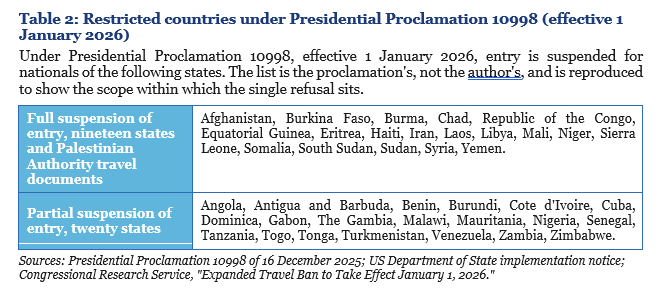
Read the proclamation, then read what sits beside it. Somalia is in the fully restricted category. But the same framework that bars the nationality exempts his role. The proclamation carves out travel connected to a major sporting event, and the State Department’s visa rules route a hired match official to a business visa written for exactly that purpose. He was not a man the system grudgingly let slip through a crack. He was a man the system was built to admit. The category was exempted, the visa was issued, and he was cleared to board the flight. Each of those is a decision the state made in his favour, on the record, before he ever reached Miami.
Then, at the port, the same state refused him. So the question worth asking is not why the ban caught him. It did not catch him; the ban was switched off for his category and the documents say so. The question is harder. What, then, refused a man the system had already cleared, at the last gate in the chain, the one place where a decision needs no telling?
2. Three Gates, Three Powers
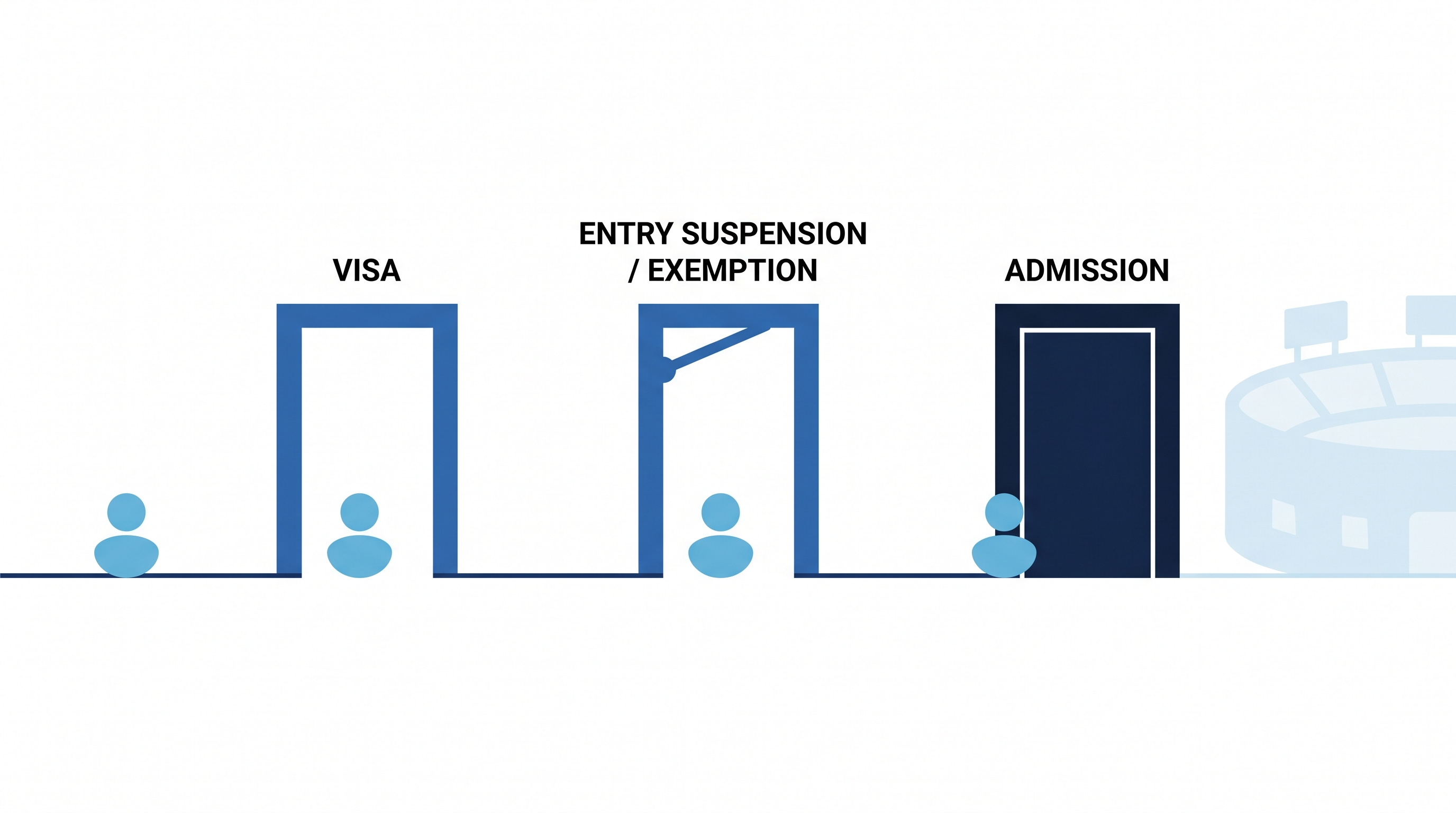
A foreign official reaching the field in the United States passes three separate gates, each operated by a different actor under a different power.
The first is the visa. A consular officer abroad grants it under the Immigration and Nationality Act, on the information held at that moment. He cleared it. The second is the proclamation’s entry suspension. The President imposed it, an exception lifted it, and he cleared that too. Visa eligibility and the entry bar are distinct legal tests. In the general case the bar can stop a valid visa holder, which is why the exception mattered here, and his category had one. They are not one gate. The third is admission at the port. A CBP officer decides it on arrival under the same Act’s inspection power. Here he was refused.
The decisive fact, the one the headlines skip, sits in the law itself. A visa permits travel to the border and an application to enter. It is not admission. The Congressional Research Service draws the line directly: visa validity is the window in which a holder may travel to the country and seek entry, which differs from what is granted on arrival. Guidance from Harvard’s general counsel states the consequence plainly, that an officer may rule a traveller inadmissible even where the State Department issued the visa. The visa opens the door to the inspection booth. It does not open the country.
Three gates, three powers, three actors. He failed only the third. The State Department did its job at the first gate. The proclamation’s exception did its job at the second. Whatever happened, happened at the one gate that owes no public, reviewable reason for what it decides.
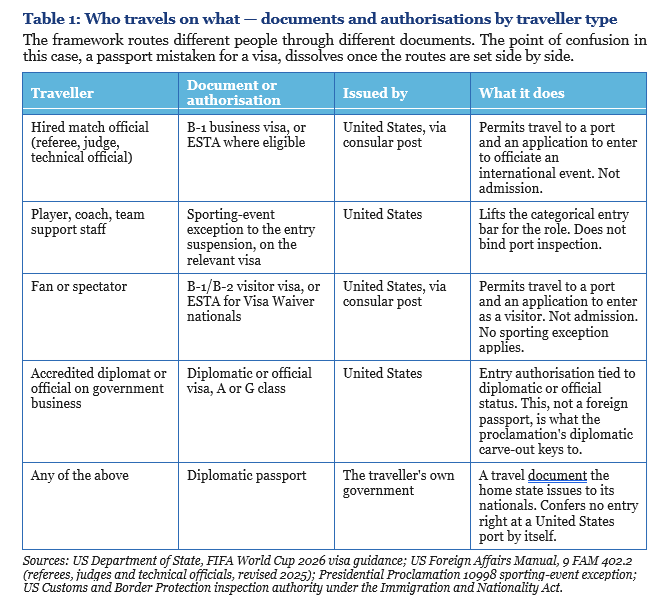
One distinction has to be fixed here, because the public conversation keeps collapsing it. A diplomatic passport is not a diplomatic visa. A diplomatic passport is a travel document a government issues to its own nationals. A diplomatic visa is an entry authorisation the United States issues in a specific class, the A and G categories, to accredited diplomats and officials posted on government business. The proclamation’s diplomatic carve-out is keyed to the United States visa class, not to the foreign passport. So a Somali diplomatic passport confers no special entry right at a United States port. It is his government’s document, not Washington’s permission. A match official does not travel on a diplomatic visa at all. The route written for him is a business visa for hired officials, the same B-class a referee, judge or technical official uses for an international event. He held the document his role required. The diplomatic passport, when it appears in the story, is a detail the coverage has misread, and it matters later for a different reason.
3. What Lives in the Gap
The useful question becomes narrow and answerable. What can be flagged after a visa is granted that defeats admission at the port? The categories are bounded, even if the signals inside them are broad.
New information can surface after issuance, a record match or watchlist update that did not exist when the consular officer decided. The port can query systems the visa stage did not reach, take biometrics again, and review devices and accounts at secondary inspection, where a refusal to answer can itself justify refusal. The grounds of inadmissibility apply a second time. A visa can be revoked while its holder is in the air. Beneath all of these sits discretion, exercised under a standard that names no reason and grants no appeal.
The state said as much itself, before any of this. When it built the tournament’s fast-track credential, the FIFA Pass, the Secretary of State disclaimed it in public, beside the FIFA president. The pass is not a visa, he said, and does not guarantee admission. It moves an applicant up the queue and changes nothing else, because the vetting is unchanged. That is the government stating in advance what the final gate is: a power no tournament credential, no ticket, no expedited status reaches or binds. The gate was reserved from the start, and it refused a man who had cleared every rung beneath it.
This is a map of what the gap can hold. It is not a claim about what it held here. Nothing in the public record indicates that any specific ground was found against him, and this analysis asserts none. The point is structural: the gate that decided his case is the one built to operate without explaining itself.
Now set the proclamation’s stated rationale for listing Somalia beside the phrase the officer used. The order says Somalia lacks a competent or cooperative central authority for issuing passports and civil documents, and lacks adequate screening and vetting. Separate two things the word “ban” is doing, because the separation dissolves an apparent contradiction. There is the ban as categorical instrument, the entry suspension, switched off in his case. And there is the ban as declared premise, an official judgement that Somali documents and Somali vetting cannot be relied upon, which no exception touches. The first did not fire. The second never had to. It can reappear at the port as “vetting concerns” without the bar applying at all. The exception lifted the instrument. It left the premise standing, and the premise is what can reach his case. The diplomatic passport, offered as reassurance, runs straight into it, because the order’s position is that documents issued by the Somali state cannot be trusted.
That premise is not mere posture, and this is where the state’s case must be stated at its strongest. The inability to verify Somali travel documents is a documented reality, not an invention to justify a refusal. Somali diplomatic and service passports have been sold through trafficking networks to people with no government role. Turkey suspended visas for Somali service-passport holders over the same abuse. United States officials have found Somali diplomatic passports discarded at the southern border with no traceable owners. A Somali member of parliament has raised the alarm over fraudulent diplomatic-passport applications, the abuse reaching into official channels. So a CBP officer who distrusts a Somali document at the port is acting on a real condition, not a fantasy. Andrew Giuliani, who runs the White House task force on the tournament, put the official position plainly when asked about Artan by name at a public event in Washington. He could not go into the details, he said, but the refusal was for a very good reason. He added that no players and no coaches had been denied, that the people turned back were officials, and that this too was for good reason. Taken at its strongest, the state’s case is coherent.
The strongest version of the state’s case is exactly what exposes the structural problem, rather than resolving it. Grant that Somali document integrity is a real concern. Grant that the officer may have acted on something specific. The chain still ends at that same reasonless gate, which offers no appeal. That is true for every traveller, guilty or innocent, flagged or clean. This is the objection that defends the refusal: every border runs on unreviewable discretion, thousands are turned away each year with no public reason, so there is no scandal here, only immigration. The objection is correct about the baseline. What it misses is what the baseline does once a designation is laid on top of it. The traveller is told he is inadmissible. He is not told the operative ground, the public is not told it, and by statute no court may review whether he was in fact inadmissible. The decision is final on arrival. The other gates leave a record with an author. The consular decision is documented. The proclamation is published. The exception is written down. Only the final, decisive determination carries no public author and no record anyone can test from outside. Hold that asymmetry in view. The full weight of it is taken up at the close.
Widen the frame one step, and resist the easy charge against FIFA. Every host bid carries government guarantees, and guarantee one asks the host to facilitate entry and to apply visa procedures without discrimination. On the facts here, that machinery largely worked. Officials were exempted, his visa was issued, he was cleared to board. The guarantee and the exemption delivered him all the way to the port. So the honest reading is not that FIFA’s guarantee was a dead letter. It reached every gate it could reach.
The trouble sits one level up, in the guarantee itself. No guarantee binds a CBP officer’s discretion at the port, and no bid book could, because admission is a sovereign power the host reserves and never transfers. The promise reaches the visa and the exemption. It stops at the port, where the sovereign decides alone and owes no account. This is not a feature of this host. It is true of any host a global tournament could choose.
The easy answer is that the tournament should have gone to a gentler host. That answer mistakes the structure for the instance. A more permissive government would refuse fewer travellers, but it would not make the guarantee enforceable. It would only decline to test it. The reserved power is identical in every sovereign state. What varies is how often, and how hard, a government chooses to use it. This host uses it strictly, so the gap between what FIFA promised and what it can deliver becomes visible here. Strict enforcement did not create the gap. It exposed it. Award the same tournament to a lighter-touch host and the promise is no more binding, only less often tested.
So FIFA’s position that it is not involved in host immigration is true, and it is also the quiet admission that the central promise of the bid was never FIFA’s to keep. The non-discrimination guarantee is not weak in this host and sound elsewhere. It is empty against any sovereign, because the one decision that matters was never within the giver’s power to guarantee. That is the institutional finding, and it is narrower and harder than the charge usually thrown. FIFA did not choose the wrong country. It extracts and sells a promise it cannot honour in any country.
4. The Turnstile
The three gates decide who may enter the country. A different barrier decides who may enter the stadium, and it is not a gate at all. It admits no one and refuses no one. It sets a price. The story now circulating reads the empty seats as the work of the border, immigration fear keeping fans away. That is the same error this essay has been taking apart, a mechanism mistaken for a grievance, and the evidence points the other way.
This is the first World Cup to price tickets by what the coverage calls dynamic pricing, applied at scale. The cheapest ticket available to the general public, setting aside a small federation-only supporter tier, runs at roughly twice the Qatar equivalent. By BBC Sport’s estimate, following a team through to the final costs between about USD7,000 and USD16,000, cheapest tier to dearest. The attorneys general of New York and New Jersey have opened an inquiry, and Football Supporters Europe has filed a complaint over access. Almost 180,000 tickets sat unsold on resale platforms days before the opening match, the lower end of the public inventory failing to clear while demand at the top held firm.
Even the name is contested, and the dispute is worth pausing on, because the coverage has not. FIFA rejects the term dynamic pricing. Its own ticketing guidance says prices are not automatically modified, that it applies variable pricing and may adjust prices through the sales phases on a review of demand and availability. The press calls it dynamic pricing and treats it as algorithmic, prices set in real time by demand, fixture, host city and remaining inventory. Set the labels aside and test the behaviour. Prices moved continuously, match by match, falling late where seats went unsold and holding or climbing where demand was firm. That is demand-responsive repricing, run to a target the seller chose, which is what a dynamic engine does. FIFA’s denial rests on a single claim no one outside can check, that a human reviews each move rather than an algorithm. But that distinction changes who approves the figure, not what the figure does. Reviewed by a person or executed by code, a price that tracks willingness to pay rather than the seats it leaves empty is dynamic in all but name. The label is FIFA’s to dispute. The mechanism is not.
Asked to defend this, the FIFA president said that because the United States is the most developed entertainment market in the world, the tournament has to apply market rates. Test that against the market evidence. A market price is not whatever a seller posts; the test is whether the inventory clears at that price by the deadline. Those 180,000 did not, and in the final weeks the lowest available price was reported still falling across 76 of the 78 United States matches. A price that leaves that much inventory unsold, and that the seller keeps cutting as the deadline nears, is not the price at which the market cleared. It is a price held above that level.
Why hold it there. A seller with unsold stock and a fixed deadline has two moves. Cut hard until the seats fill, which lowers the reference price, cannibalises the higher tiers, and teaches buyers to wait. Or cut only as far as the yield target allows, sell fewer seats, and protect the return on each one sold. FIFA did the second. It removed the resale price cap it had used at past tournaments and set the system to chase yield per seat over a full house. That objective is chosen once, by people. From there the price tracks demand, but only down to the floor that objective fixes, and no buyer is judged on anything but what the seat will fetch. The empty seat is not the system failing. It is the system working as priced, toward yield, not attendance.
What this pricing does as it spreads beyond stadiums is the larger question. Whether charging each buyer closer to the most they will pay widens access in some markets or narrows it in others, as the model migrates into everyday commerce, is not a question this section settles. What it establishes is narrower and firm: here the price was set above the level that fills the seats, and the empty rows are that choice, not fear at the border.
So the tournament excludes in two unlike ways, and the difference is what makes the call at the moment of exclusion. At the gate a person does: an officer admits or refuses a named traveller under a power that need give no public account. The price wall rules on no one. FIFA set the objective and the bounds. Within them the price moves with demand, sorting the crowd by what each part can pay and pricing the rest out. No judgement is passed on any single buyer. One excludes by a discretion exercised traveller by traveller, the other by a price that judges no one, weighing only what the seat will fetch. Folding them into a single complaint about the ban hides how each works. The mechanism is the discipline. The grievance is the shortcut.
This pricing architecture is its own subject, and Canary Compass will treat it in full in a companion essay in late July, written with Nuru Shaba.
5. What Can and Cannot Be Said
Here is the structural finding. A discretionary gate that owes no public reason is universal in form. It is not uniform in effect. The reasonlessness that looks like neutrality removes the only check a designation could face. A gate that need not explain itself cannot be made to show that the designation, not the person, decided. A prior designation that formally brands a nationality untrustworthy therefore does not need to change the gate. It loads it, so that when a reasonless refusal falls, it falls more readily on the designated traveller, and no public record will ever say so. No single officer need intend a pattern for the architecture to tend toward one. This is a claim about propensity, about how the design loads the outcome, and it stands on the structure alone. It is not a claim that the outcome has been measured, because the measure does not exist. The published figures are land-border encounter data, counts of people stopped at crossings, swollen by asylum claimants, crew and repeat attempts. They do not isolate the population this claim is about: visa-holding, exception-eligible travellers cleared to fly and then refused at an airport on discretionary grounds. The cut that would convert propensity into a counted pattern has not been assembled: the refusal rate for designated-state nationals set against comparable travellers from elsewhere. The loud individual cases now circulating are not a substitute for it.
Two readings follow, and the honest course holds both.
On the first, nothing unusual occurred. A national of a designated country met the enhanced inspection the proclamation expressly preserved, and something cleared a low, discretionary bar. United States vetting is continuous, so records are re-screened while a traveller is in transit. Information surfacing at the port that was absent at issuance is routine. The questioning and the return flight are the ordinary mechanics of a refused entry.
On the second, that same low bar is the difficulty. The exemption lifted the categorical bar for his category. It did not, and could not, bind the inspection power at the port, because that is a separate gate with a separate authority. An exemption decides that the nationality is not, by itself, a reason to refuse. It leaves wholly intact the officer’s discretion to refuse for a reason he need not give. So a refusal at the final gate erases the exemption in a single case, under a standard requiring no stated reason and offering no appeal. Whether the officer acted on specific new information or on bare discretion is, from outside, indistinguishable, because both produce the identical record: a finding, a flight home, silence.
What cannot be said is which reading is true in Artan’s case. The reason was not disclosed. To call it bias is to claim knowledge the record withholds. To call it justified is to grant trust the record has not earned. The comparisons now circulating do not settle it. The United States is admitting Iran’s players, from a nation under the same full restriction and recent military conflict, while it turned Artan back. That contrast shows the gate sorts individuals rather than blanket-refusing a nationality. It is not evidence of a counted pattern. One refusal establishes nothing on its own. A documented distribution across many refusals, every one a national of a designated state and none from elsewhere, would be data. That distribution has not been assembled, and until it is, the comparisons are suggestive, not probative.
The silence at the gate is not neutral ground. It is a vacuum, and a vacuum is filled from both directions. The state fills it with the presumption of a good reason it will not state. The critic fills it with the presumption of animus it cannot prove. Each reads its own certainty into the same blank space, and the blank space was built to accommodate both. To refuse both fillings is not timidity, and it is not a service rendered to power. It is the only position the evidence licenses. Calling the refusal racism claims to see through a wall the state built precisely so that no one can see through it. It stakes the whole charge on an intent that a single undisclosed fact would overturn. The structural reading asks for no such x-ray. It works from what is visible: a published designation, an exempted man, and a gate engineered to refuse him without ever having to say the designation did it.
This is the part the even-handed framing must not duck. The structure described can let a nationality designation weigh on a lawful refusal without any person intending it to, and without any record able to show that it did. Naming that is not an evasion. It is the heavier finding, heavier than calling one officer a bigot, because it survives the officer being entirely reasonable.
One question is left, and it is not the one the coverage asks. Not why the gate refused him, but why the tournament sits where the gate is hardest. The structure is not inescapable. FIFA can move a tournament over a host’s entry politics, and has, pulling the 2023 youth World Cup from Indonesia when a host province refused an Israeli team. Africa has walked away from a World Cup before. In 1966 the continent boycotted in full over a single shared qualifying place for Africa, Asia and Oceania together, and the withdrawal won it a permanent berth. Both levers exist. Both have been pulled before. Neither will move now.
The reason is not in the architecture. It is in the receipts. This is the most lucrative World Cup ever staged, its revenue projected past USD11bn, and it is lucrative because it is American. The deepest entertainment market on earth is what sets the records, and the same market depth that fills FIFA’s accounts is what priced the ordinary supporter out of the stadium. The strict gate and the rich tournament are not two facts. They are one large, confident sovereign seen from two sides, the market that pays the most and the border that answers to no one but its own electorate.
And the silence that matters, the federations’, is not bought. It is structural. The expanded tournament handed Africa the largest presence it has ever had, nine direct places where it once had five, a tenth won in the play-off. But weigh what the record actually rests on. More teams meant more matches, more than sixty per cent more, and that lifts every stream a tournament sells. The record is not there. Matchday revenue more than tripled, a jump of over two hundred per cent against a rise of little more than sixty per cent in matches, and that gap is not the format. It is what a seat fetches in the deepest market on earth. Larger venues, hospitality taken in-house, and the same dynamic pricing that emptied the cheap rows together lift the gate take past anything in the tournament’s history. The matches could be played elsewhere. That revenue could not. So the continent that once boycotted because it had no direct place at all will not boycott now that it holds ten. The only lever that would force a change is withdrawal, and withdrawal lands on the federation that pulls it, not on the host. A federation that withdrew would forfeit its players’ one tournament and its nation’s place on the field, and the revenue that place now carries, while the host’s gate stayed exactly as it was. Iran’s federation boycotted the December draw over visa refusals to its officials, but it kept its place and will play, because the place is one thing and a ceremony another. The economics run one way. The place is worth too much to give up, and the cost of giving it up falls on the giver. So the lever sits unused, and the arithmetic, not anyone’s resolve, is what holds it there. The places and the gate arrive in a single market. You cannot take the revenue and the slots and decline the sovereignty the market carries with it. The gate did not have to be American. It is American because the money is, and the cost of changing it falls on whoever would try, never on the gate itself.
A visa is not a key. It is a permission to ask. The asking was answered at a gate that need give no account, and the absence of that reason, not the travel ban, is the true subject here.
Reference Exhibits
The following exhibits are reference material, current as at the date of writing. They are provided so the reader can locate any traveller, not only a match official, within the framework described above. Immigration designations change, and the lists below should be checked against the primary sources named before they are relied upon.
Sources
Sources: Presidential Proclamation 10998 of 16 December 2025 and Proclamation 10949 of 4 June 2025; the Immigration and Nationality Act; the US Foreign Affairs Manual (9 FAM 402.2, revised 2025); US Department of State FIFA World Cup 2026 visa guidance and the remarks of Secretary of State Rubio, November 2025; Congressional Research Service; Office of the General Counsel, Harvard University; US Customs and Border Protection statements; FIFA, the Somali Football Federation, and the Somalia Ministry of Youth and Sports; the account of Omar Abdulkadir Artan as reported by The New York Times; Andrew Giuliani, Atlantic Council, Washington, 9 June 2026 (Agence France-Presse); the remarks of the FIFA president at the Milken Institute Global Conference, May 2026; Agence France-Presse, Middle East Eye, The Jerusalem Post, BBC Sport, the Financial Times, and Horn Observer; the New York and New Jersey Attorney General inquiry; the Football Supporters Europe and Euroconsumers complaint; and reporting on Somali diplomatic and service-passport misuse; FIFA’s removal of Indonesia as host of the 2023 U-20 World Cup; contemporary accounts of the 1966 African World Cup boycott over confederation qualifying allocation; the Iranian Football Federation’s boycott of the December 2025 World Cup draw over United States visa refusals to its officials; FIFA 2023 to 2026 cycle revenue projections; and the Confederation of African Football 2026 World Cup slot allocation. Canary Compass analysis.
Disclaimer
This article does not constitute legal, financial, or investment advice. The author shares views for perspective and discussion only. Do not rely on them as a substitute for professional advice tailored to your specific circumstances. Always consult a qualified legal, financial, investment, or other professional adviser before making decisions based on this content. The analysis reflects proprietary research undertaken by Canary Compass and the author.
Canary Compass and the author accept no liability for actions taken or not taken based on the information in this article.
The views expressed in this article represent the author’s independent professional analysis and do not constitute an endorsement of any individual, institution, or position. Canary Compass and the author accept no responsibility for how this content is interpreted, excerpted, or recontextualised by third parties not involved in its production and publication. Reproducing any portion of this work in isolation, or in combination with other material, in a manner that misrepresents the author’s original meaning constitutes a distortion of the published record.
The author may hold positions in financial instruments, currencies, or assets discussed or referenced in this publication. Such positions do not constitute a recommendation to buy or sell.
All views, projections, and forecasts reflect the author’s assessment at the time of writing. Data sourced from third parties is believed to be reliable but has not been independently verified. Past performance does not indicate future results.
All content published by Canary Compass is the intellectual property of the author. Reproduction, adaptation, or redistribution, in whole or in part, requires written permission.
About the Author
Dean N. Onyambu is the Founder and Chief Strategist of Canary Compass, a financial research publication focused on African monetary architecture and financial sovereignty. He brings 18 years of experience across trading, fund leadership, and economic policy, with senior roles at Standard Bank, First Capital Bank, and Opportunik Global Fund.
Read and subscribe at www.canarycompass.com.
The Canary Compass Channel is available on @CanaryCompassWhatsApp for economic and financial market updates on the go.
For more insights from Dean, you can follow him on LinkedIn @DeanNOnyambu or X @InfinitelyDean.