

The original article was published on the Canary Compass LinkedIn page on October 23, 2023, and is available here: Time to Aggressively Adjust the Statutory Reserve Ratio: A Tactical Prescription for the Bank of Zambia to Stabilize the Kwacha
You can also follow Canary Compass on WhatsApp @CanaryCompassWhatsApp and Facebook @CanaryCompassFacebook
As the kwacha experiences volatility, this piece explores a pivotal policy the Bank of Zambia (BOZ) could implement to stabilize the currency. Specifically, we propose that the BOZ consider increasing the Statutory Reserve Ratio (SRR) by 3-6 percentage points to bolster the local currency.
Zambia has recently inked a Memorandum of Understanding (MOU) with bilateral creditors, setting the stage for a similar agreement with commercial creditors. This likely heralds the restructuring of Eurobonds and potential upgrades in credit ratings. While the timeline for a sovereign credit rating boost can vary—subject to both domestic and global economic variables—the ripple effect could accelerate foreign portfolio inflows.
Yet, the backdrop is not all rosy. The nation's current account deficit has widened to $198.1 million in Q2 2023, up from $188.7 million in Q1 2023 and $77.8 million in Q4 2022. Driving this deficit are production inefficiencies in the mining sector and fluctuating copper prices. Copper’s price volatility serves as a grim reminder as global conditions into 2024 continue to cast shadows over export-dependent economies (ex-oil). Copper prices have been inconsistent, averaging $8,323.46/MT in the second half of 2023, down from $8,725.01/MT in the first half. In comparison, copper prices averaged $9,748.59/MT in the first half of 2022. Meanwhile, long-term projections suggest copper prices will average $8,051/MT in 2024, $8,246/MT in 2025, and $8,444/MT in 2026.
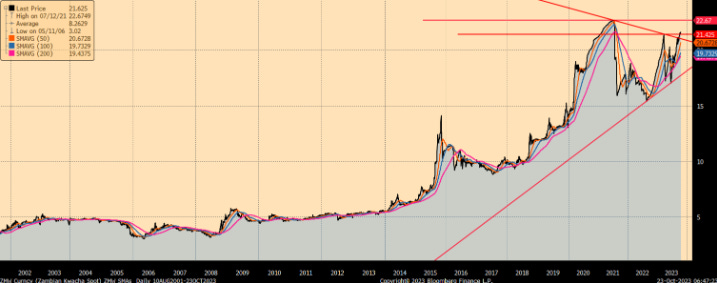
Technically speaking, the kwacha has breached the critical 21.425 level, making its all-time high of 22.670 in July 2021 a realistic target. Only a fall below the 19.4375 and 17.700 levels could dispel short-term and long-term bearish outlooks, respectively. Furthermore, a Real Effective Exchange Rate (REER) analysis potentially adds an additional tailwind to long term kwacha weakness. As per this model, the local currency is around 4-6% overvalued with the fair value estimated to be around 22.368-22.689. That said, REER models should not be treated as gospel as they often sidestep transient factors like market sentiment and more importantly, shifts in central bank policies.
The BOZ’s existing strategies have proven ineffectual in curbing inflation pressures, which are predominantly fuelled by externalities like global fuel prices and exchange rate fluctuations. Inflation is forecasted to linger above the target range until 2025, undermining current strides made in achieving macroeconomic stability. Over the last four-plus years, headline inflation has consistently outpaced BOZ's 6-8% target range, averaging 14.3% since May 2019.
Throughout this period, the BOZ has adjusted its policy rate multiple times to navigate varying economic conditions. Prior to the pandemic, the rate was nudged upward from 9.75% to 10.25% in May 2019 and further to 11.50% in November 2019. As a response to the financial strain of COVID-19, the BOZ reduced the rate to 9.25% in May 2020 and then to 8.00% in August 2020. The central bank resumed its tightening cycle in February 2021, incrementally raising the rate to 8.50%, 9.00% in November 2021, and most recently to 9.25% in February 2023.
Interestingly, over the course of this period, the reserve ratio—another critical monetary tool—has been less frequently adjusted. It was increased from 5.00% in May 2019 to 9.00% in December 2019 and then to 11.50% in February 2023, with the BOZ showing more restraint in its utilization compared to the policy rate.
The BOZ’s current strategy for controlling inflation appears to have a significant drawback. It is not effective when the root of inflation comes from external factors like global fuel prices and currency rates. Right now, the BOZ aims to curb inflation by managing consumer spending. However, this approach isn't very useful when inflation isn't being predominantly driven by demand.
A more effective approach could be to focus on the statutory reserve ratio, which is the percentage of deposits that banks are required to keep in reserve. By increasing the statutory reserve ratio, the central bank could tighten money supply more directly, by pulling kwacha liquidity out of the system and placing upward pressure on the domestic currency, which could in turn help ease imported inflation. This is particularly relevant given constraints in the BOZ’s foreign exchange (FX) interventions due to dwindling FX reserves which stood at USD 2.8 billion (3.0 months of import cover) in July 2023, from USD 2.7 billion (2.9 months of import cover) in June 2023, USD 2.9 billion (3.3 months of import cover) in March 2023 and USD 3.1 billion (3.8 months of import cover) in December 2022. Here, also bear in mind that similar to hiking the reserve ratio, the BOZ’s FX interventions were also useful in mopping kwacha liquidity out of the system.
Of course, increasing the reserve ratio isn't without drawbacks. It could slow down economic growth, affect the conditions for extending credit, and increase the government's cost of borrowing. That said, the economic outlook for 2023 is already grim, especially in sectors like mining, education, and electricity. With inflation contributing to the economy's struggles, as evidenced by a decline in the Purchasing Managers’ Index (PMI) to 48.1 in September 2023 from 49.2 in August 2023, it might be more critical to focus on controlling inflation than worrying about additional economic downsides.
Adding weight to this argument for increasing the reserve ratio is the current weak state of loan growth relative to GDP. Although loans in kwacha, from the financial sector to the private sector, increased to 10.8% of GDP as at end of August 2023, from 10.4% of GDP as at end of 2022 and 10.1% of GDP as at end of 2021, credit extension in kwacha remains subdued in real terms. In fact, since 2018, credit extension in kwacha has only breached 11.0% of GDP twice; in 2019 and in 2020 (largely due to BOZ measures to counter Covid-19). In an environment where credit extension is already tepid, the fear that tighter liquidity conditions would stifle lending becomes less of a concern. Essentially, the downside risk of reducing liquidity—namely, dampening credit extension—is already muted given its current weakness.
Regarding government borrowing costs, it is important to note that interest rates are already elevated. Increasing the statutory reserve ratio would likely push interest rates higher, making borrowing more expensive for the government. Importantly as well, the government is behind on its domestic financing requirements. As at end of July 2023, net domestic financing lagged by around ZMW8.79bn or 1.6% of GDP while external financing lagged by around ZMW1.62bn or 0.3% of GDP. That said, although raising the reserve ratio could push interest rates higher, as well as widen the government’s financing underperformance, the pressing need to control inflation outweighs the downside of higher borrowing costs for the government, at least in the short term. Given that the current policy rate mechanism appears ineffective and the economy is already facing weak growth and credit extension, the immediate need may well be to stabilize inflation and restore confidence in the currency. Also, given significant upcoming debt maturities in early 2024, the long-term impact on government borrowing could be manageable.
To summarize, the BOZ may find the reserve ratio a more potent tool for managing both inflation and the kwacha, even if it increases the government’s short-term borrowing costs. By increasing the reserve ratio by 3-6 percent, the BOZ could remove between ZMW2.7 billion to ZMW5.3 billion from the money market, potentially reducing the need for USD sales in the FX market and allowing time to rebuild FX reserves. Amidst similar economic conditions, this approach previously succeeded in November 2015, leading to a kwacha gain of 29% within two weeks, as well as underpinning kwacha stability over the next 2 years.
Sources: Bloomberg, BOZ, IHS Markit, MOFNP, Own Compilation
#zambia #kwacha #zmw #reer #fx #fxreserves #usd #dxy #debt #debtrestructuring #boz #mof #mofnp #imf #china #g20 #commonframework #bonds #eurobonds #eurobondholders #creditratings #taxpayments #copper #mining
Dean N Onyambu is the Executive Head of Trading at Opportunik Global Fund (OGF), a CIMA-licensed fund for Africans & Diasporans (Opportunik), and is a co-author of Unlocking African Prosperity. His 15-year journey in financial markets has been fueled by passion and mentorship. He is a proud former VP of ACI Zambia FMA (@ACIZambiaFMA) and founder of mentorship programs that have shaped and continue to shape 63 financial pros and counting! When he is not knee-deep in charts, he is all about rugby. His motto is about exceeding limits, abounding in opportunities, and achieving greatness. #ExceedAboundAchieve
For more insights from Dean, you can follow him on LinkedIn @DeanNOnyambu , X @InfinitelyDean , or Facebook @DeanNathanielOnyambu .