

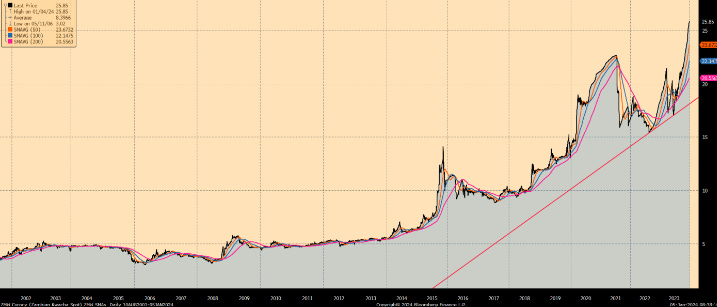
The original article was published on the Canary Compass LinkedIn page on January 5, 2024, and is available here: Unraveling the Kwacha’s Dive: Is it a 51.84% Plunge or a 34.14% Slide? Decoding Currency Depreciation Through Two Lenses
Unraveling the Kwacha’s Dive: Is it a 51.84% Plunge or a 34.14% Slide? Decoding Currency Depreciation Through Two Lenses
The Canary Compass Channel is available on @CanaryCompassWhatsApp for economic and financial market updates on the go.
Canary Compass is also available on Facebook: @CanaryCompassFacebook.
Yesterday, after we published a tweet on the Kwacha's depreciation, we received some pushback on the technical methodology backing our calculation, which precipitated a change in our initial statement. Which method truly captures the Kwacha's depreciation? The answer varies based on perspective.
The Direct Method: A Practical View
On 23 June 2023, the USD/ZMW exchange rate was 17.025. By 04 January 2024, it climbed to 25.850. Imagine you are an importer needing USD 1,000. Seven months ago, this would have cost you ZMW 17,025. Now, it's ZMW 25,850. For importers, it appears the Kwacha has depreciated by a stark 51.84%. This figure doesn't mean the Kwacha has lost over half of its total value, but that it now requires 51.84% more Kwacha to buy the same amount of USD. The term 'depreciation' here reflects the increased cost in Kwacha terms, not a total value loss.
The Reciprocal Method: A Technical Angle
Conversely, consider saving in USD. With ZMW 25,850, you could have bought USD 1,518.36 on 23 June 2023. Fast forward to 04 January 2024, and this amount only gets you USD 1,000. Through this lens, the Kwacha has seemingly weakened by 34.14%. This percentage reflects the decreased purchasing power of the Kwacha in USD terms, indicating a relative, not absolute, decrease in value.
Why Does Perspective Matter?
The Direct Method aligns more with everyday experiences. People and businesses often consider how much more local currency they now have to provide to acquire the same amount of foreign currency. This is particularly relevant for activities like importing goods, international travel, or any transaction that involves foreign exchange. The direct method intuitively captures this change: "51.84% more Kwacha is needed for the same USD" – a simple and powerful statement.
The Reciprocal Method, though technically sound, is less intuitive. It focuses on the intrinsic value of the Kwacha itself. Economists and analysts might lean towards this for deeper economic analyses, like purchasing power or price comparisons globally. This approach tells us how the value of 1 Kwacha has shifted in USD terms.
The Ground Reality
In Zambia, where a significant portion of consumption relies on imports priced in foreign currency, the impact is tangible. If importers face a 51.84% higher cost, it's likely that local prices will adjust similarly. So, while there's room for debate on technical accuracy, for most Zambians, the Kwacha's value feels halved. They are paying 51.84% more Kwacha for the same international goods or services compared to just seven months ago. This stark reality defines the everyday economic experience in Zambia.
Policy Argument on 100% Depreciation
A key argument from policymakers is that a currency cannot lose 100% of its value against the USD, as this would imply the currency becoming completely valueless, an unrealistic scenario in foreign exchange markets. This perspective underscores why terms like "halved in value" should be understood contextually. A depreciation of 51.84% means a significant increase in the amount of Kwacha needed to buy USD, but it doesn’t signal the Kwacha moving towards worthlessness. Such terminology is meant to convey the extent of depreciation in practical terms, rather than a literal halving of the currency's total value.
Historically, even in cases of significant currency crises, currencies have not become entirely valueless, underscoring this point. Severe depreciation does not automatically spell doom for an economy. Nevertheless, it does represent a crisis that requires strategic adjustments in monetary policy and business planning. This is why we constantly highlight that an aggressive SRR adjustment is required.
In simpler terms, think of a currency as a resilient but fluctuating asset. While its purchasing power can decrease significantly, it doesn't just vanish into thin air. Policymakers advocate for this nuanced understanding, ensuring a balanced view of currency movements in the global economic landscape and, more importantly, highlighting that the currency, while under enormous pressure, is not moving towards worthlessness.
#zambia #Kwacha #zmw #reserveratio #srr #crr #monetarypolicy #inflation #fx #fxreserves #usd #dxy #debt #debtrestructuring #boz #mof #mofnp #imf
Dean N Onyambu is the Executive Head of Trading at Opportunik Global Fund (OGF), a CIMA-licensed fund for Africans and diasporans (Opportunik), and is a co-author of Unlocking African Prosperity. Passion and mentorship have fueled his 15-year journey in financial markets. He is a proud former VP of ACI Zambia FMA (@ACIZambiaFMA) and founder of mentorship programs that have shaped and continue to shape 63 financial pros and counting! When he is not knee-deep in charts, he is all about rugby. His motto is exceeding limits, abounding in opportunities, and achieving greatness. #ExceedAboundAchieve
For more insights from Dean, you can follow him on LinkedIn @DeanNOnyambu, X @InfinitelyDean, or Facebook @DeanNathanielOnyambu.