

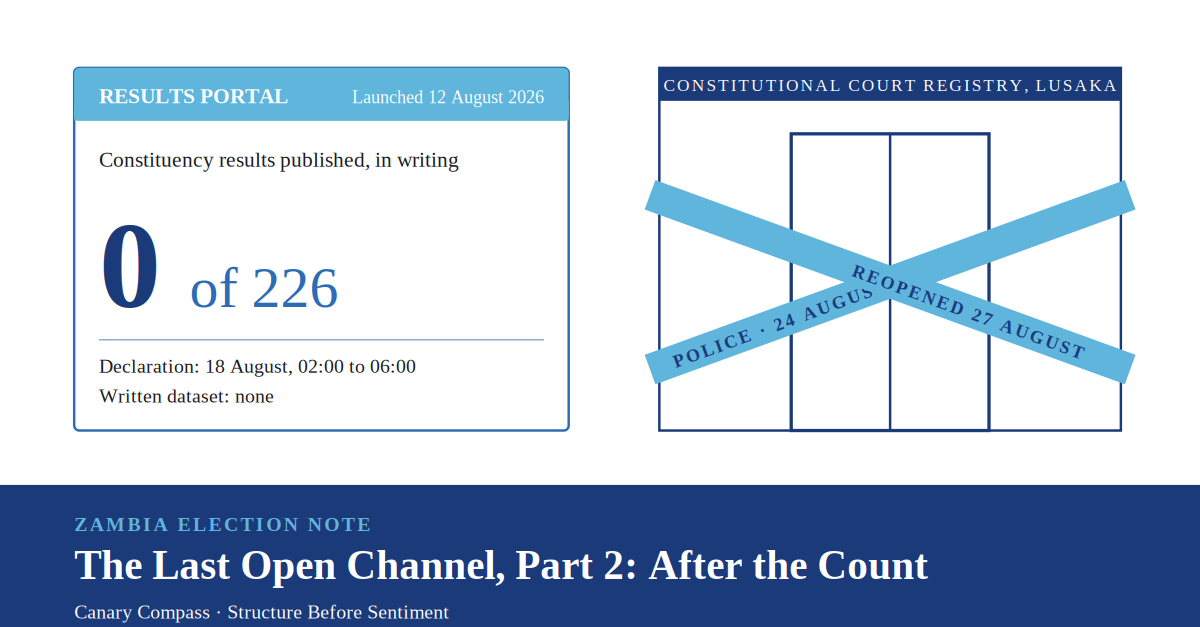
AI-illustration: A results portal at zero of 226, and police tape across a courthouse door.
Part 1, Before the Vote, priced what the 13 August ballot tested. Part 2 reads the answer. It is the final entry in this lane; if the Constitutional Court acts on the documents before it, a dated addendum attaches here, and the economy moves to the September fiscal note.
Part 1, “Before the Vote” (Canary Compass, August 2026), put the election inside one system with two channels. Policy passes down through banks, prices and credit to households, or bypasses them by direct delivery that lasts as long as it is financed. Information passes up from citizens through speech, the press and assembly, including what the state does not want to hear, and without it the state receives only confirmation. Part 1’s scope condition was that stabilisation could be delivered without the second channel and that diffusion and integrity could not. Its rule was that the incumbent is assessed on state power exercised and challengers on record and conduct. Part 2 was to print on the results and score that test. The count that would let it do so did not come, and the fortnight that followed is the subject instead.
Zambia declared a winner and published no written constituency count. The courts were sealed by police from the morning of the 24th to the 26th, across the last day a citizen could contest the result. They reopened the day after the Judiciary declared no petition had been filed. The downward channel, policy reaching households through banks and prices, is intact and legislated to widen. The upward channel, narrowed by statute over the past year as Part 1 set out, still carried more than usual this fortnight. Observers, the press and citizens reported everything set out below, and the state heard it. What closed were the two points at which what citizens know can bind the state: the written count that would let the declaration be checked, and the courtroom that could act on the check.
1. What Is Settled and What Is Not
1.1 The Count
In the fortnight after the vote, opposition members were arrested, a former Cabinet minister, Mutotwe Kafwaya, was shot dead during a security operation, the count was suspended, and the courts were sealed. None of those settles the result.
On 14 August, the day after the vote, the Electoral Commission of Zambia suspended the counting and announcement of results throughout the country for about six hours under section 67(3) of the Electoral Process Act. It cited violence against poll staff and the theft of marked ballots. On the 18th it declared President Hakainde Hichilema the winner. The Commission read constituency figures aloud on air and declared national totals from them, and the announced figures reconcile to themselves. But the Commission has published no written record of them. The portal it built for every constituency, and launched the day before the vote, still shows zero of 226. There is no published dataset of votes cast, presidential and parliamentary, valid and rejected, across the 226 seats. It is the plain constituency results the Commission's own officers read out, put in writing on the Commission's own website. Part 1 asked that the chain from station to declaration stay public. The ask since the Friday Reflection is narrower, and the Commission has not met the narrower one. Without it there is no complete official record of the votes cast to examine.
1.2 The Remedy
Article 103 allows seven days from the declaration. The Judiciary’s own letter to Secretary to the Cabinet Patrick Kangwa placed the declaration between 02:00 and 06:00 on 18 August, so the window ran to the same hours on the 25th. Under Order XVII rule 8 of the Constitutional Court Rules, Statutory Instrument 33 of 2026, the registry sits from 08:30 to 18:00 and does not sit before dawn. The last hours in which a petition could be lodged therefore fell within the working day of the 24th. Under Order III an electronic filing is made through the Master’s filing system, with a user identity, an acknowledgment and a stamp, and an email to the Registry is not one. The system those rules describe was still in development at the last public statement on it, a contractor’s notice published in January 2025 and last updated that August. No court has announced it in service since.
On the morning of the 24th the superior courts in Lusaka were sealed by police and heavily armed military personnel, as the Law Association of Zambia recorded. The Judiciary’s Chief Administrator, Nalishebo Imataa, told staff by memorandum not to report, for security reasons, with guidance to follow once the situation was contained. The Law Association saw the memorandum unsigned and recorded that no further explanation was given. Police tape marked some premises as crime scenes. The police described the closures as intelligence-led and preventive security assessments at several government premises, without detail. State House said the President had neither ordered the closure nor any power over what the courts receive. That day the lawyer Linda Kasonde, a former Law Association president, emailed a petition to Chief Justice Mumba Malila after, she says, a message to the registry’s address bounced. On the last filing day the physical route was sealed, and no public record shows the electronic route existed.
On the 25th the Judiciary’s letter to Kangwa reported no petition filed in the Registry as at 18:00 on the 24th, counting the window exactly as above. Kangwa announced that the swearing-in proceeds on 1 September. The same day the Judiciary confirmed that Malila had referred the documents to the Constitutional Court on the question of whether they constitute a filing. He presides over the Supreme Court, not the Constitutional Court, which alone hears a presidential petition. That is the head of one apex court passing papers to the separate court that would rule, not the Constitutional Court receiving a petition. On the 26th the Judiciary, through its administration, closed the question. The Registry had received no Presidential Petition as at the close of business on the 25th, and so, in its own words, there is none before that Court. This is the administration reporting an absence; the Constitutional Court itself has ruled on nothing. That evening the Chief Administrator told staff that, “following the de-escalation of the security threat”, they could return to work on the 27th. The courts had been sealed for three days. The security threat named in the memo appeared on the last day a petition could be lodged and was gone once it could not.
1.3 The Attempts
The alliance says it holds signed forms and tendered copies to the observer missions, and its candidate filed nothing. Kangwa’s statement on the Kabulonga operation said the opposition candidate Brian Mundubile was found at the scene; Mundubile says he was detained and released the same day. From 17 August he and his running mate Makebi Zulu were sheltering at United Nations premises in Lusaka. On 20 August the police issued a call-out for both over treason and insurrection allegations, which they deny. His camp says lawyers and officials assembling the case were arrested; that is not verified. The governing party said he was free to use the legal routes available, and the government says the operation concerned a militia and not the petition. Kasonde had told stakeholders the day before that efforts to get a citizens’ petition off the ground had not succeeded, then emailed one anyway. It cites the observer network’s estimate against the declared share, the tally-centre discrepancies and the Kabulonga killing. Whether those grounds would have held is not before any court, because no court has taken the petition up. No timestamped record of the attempt has been produced by either side. Kasonde faced no allegation and could act from outside the building. The candidate was in shelter under a summons, with no registry open to his lawyers.
A presidential petition is built in seven days from the station record, the signed result forms held by party agents and observers. Between the vote and the declaration that record was degraded at the stage where it is consolidated. The European Union mission rated tabulation very good in 43 per cent of its observations before the six-hour suspension on the Friday and found it deteriorated significantly after it. It recorded a military presence at totalling centres that left fewer party agents and citizen observers in the room. An armed group took almost all the result forms from the Makeni totalling centre on the Saturday. The record was thinned by the deployments the mission observed and by the Makeni seizure, whose perpetrators are not identified. Whether it was thinned enough to stop a petition, no petition tested.
1.4 What Hardened and What Did Not
The reconciliation is set out in “Polished Teeth, Blank Portal” (Canary Compass, August 2026). The reading has hardened across three dates. On 12 August the note priced an offer and a record. On 21 August the reconciliation ran into a wall the Commission built, with no figures published in writing to check against. On 24 August the remedy closed, and on the 25th the state proceeded on an administrative letter. The verdict on the count itself still waits for the record. What has hardened is not a verdict on the count but the reading of what the state did around it.
What is not settled is the count itself, and it cannot be, on the present record. A declaration is a claim; the published dataset is the document that would test it; Zambia has the first without the second. Others have reached for a forensic audit of the polling-station forms. That sits a level above where this stands, because the layer beneath it is empty. No swing, no share, no provincial reading can be built from a published record that does not exist. The inauguration proceeds on 1 September with none before the court.
2. The Dashboard Has a Second Term in It
At end-May, on the Ministry's cash figures against a 2026 GDP of K821bn, the overall fiscal balance stood at minus 2.15 per cent and the primary balance at plus 0.2. That GDP is the 2025 preliminary outturn grown at the International Monetary Fund's May projections for real growth and inflation, and it sits a ninth below the K924bn the budget assumes. Part 1 priced the direction. The primary surplus was 3.1 per cent in 2025 and the budget's K39.2bn target for 2026 is 4.8 on the same base. The Fund's May projection was 1.1, and at five months it is 0.2. Debt service did not do that; interest ran below a straight twelfth of its annual line, the measure used here for every line beneath the totals. Revenue did, 14 per cent under its monthly targets, with value added tax (VAT) collecting half its twelfth. Grants ran at a quarter of theirs on the monthly returns, a third once an unattributed K458m appears in the cumulative line. One spending line did, transfers and subsidies a quarter over on the agricultural lines Part 1 called the bypass bill, measured before the April reclassification of K2.8bn of input-support spending to assets. Total spending was 5 per cent under the Ministry's own monthly profile at five months, and the shape matters more than the average. January ran a fifth over profile on interest and capital spending, and March 41 per cent over on wages and the transfers month. Then April, the largest month in the profile, came in a third under and May a fifth under. The pullback came in the two months before the campaign's climax, and revenue fell faster than spending was held. The deficit at K17.7bn had used nine tenths of the year's original K19.4bn room by May. Against the budget's own GDP that room is the 2.1 per cent of the budget speech; against the K821bn it is 2.4. The outturn, at 2.15, had already passed the budget speech's ratio for the year. The supplementary estimates approved on 11 May added K26.3bn of spending, K16.3bn net of rationalisation, and the revised deficit is still unpublished. External programme money is barely moving, and net external financing at end-May was negative once amortisation is counted. In an election year the state is a net external payer, and the deficit is carried at home.
Copper is the offset, and the royalty line qualifies it. Over the five months the royalty line covers, the London price set its record in January and posted in April its second-highest monthly average since 2014. Mineral royalty over the same months stood at 97 per cent of its twelfths, on pace and no more. A record dollar price collecting a budget-pace kwacha royalty is the exchange rate at work, the trade-off set out in “Copper Output and the 2026 Royalty Arithmetic” (Canary Compass, January 2026). August's prices, London within sight of the January record and New York at records, are the second half's revenue question, not the first five months' answer. On the Bank of Zambia's own real effective exchange rate index, a lower reading is a stronger kwacha. In May the kwacha was at its strongest level in the series since 2003, a third below its long-run average. The kwacha spent the election month between 18.70 and 19.05 on the interbank daily average, inside the 18 to 20 band that suited stabilisation, when the price level was the priority. With the vote behind it, the priority changes. The Bank has room to buy reserves into the offshore inflow and let the kwacha drift, 20 to 22 first and 22 to 24 over the medium term. That lifts kwacha revenue per tonne and gives the returning offshore bid a cheaper entry into bonds whose seven-year yield fell 101 basis points between the June and August auctions. The drift is not free on the budget's own lines. The budget carries K21.7bn of external interest and principal, about K17bn of it still to pay after May on the amortisation paid to date and interest taken pro rata, so every 1 per cent the kwacha loses adds about K170m to it. The same 1 per cent adds about K110m to the K10.8bn of royalty still to collect and about K80m to the mining company tax line, budgeted at K13.2bn. Together they only bring the two sides level. What makes depreciation pay is import VAT, K42.5bn in the budget, because the tax is charged on the kwacha value of imports. A weaker kwacha raises that value, the same rate collects more, and the consumer pays it in the price of every imported good. The fiscal gain from a weaker kwacha and its inflation arrive through the same import prices. The cost sits in the price level. The 6.5 per cent print is held down by fuel relief that expires on 30 September, the day the Monetary Policy Committee announces. The relief ends ahead of the months from November to April when inflation seasonally rises. The World Meteorological Organization (WMO) expects a strong El Niño through October. The US National Oceanic and Atmospheric Administration (NOAA) gives a greater than 90 per cent chance of a very strong event this winter. NOAA also gives a 69 per cent chance that the October to December season exceeds every El Niño since 1950 on its index. The September fiscal note takes that arithmetic up in full.
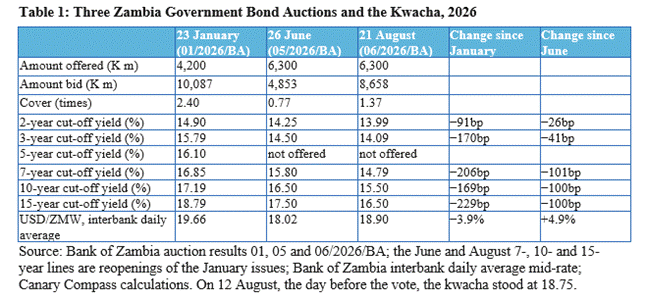
The market read the week and moved on. Table 1 sets three of the year’s six bond auctions, the first, the last before the vote and the first after it, against the kwacha on the day of each. The February auction covered 5.08 times and April’s 0.43, and that arc is among the September note’s subjects. Since the January auction every tenor has fallen, the seven-year by 206 basis points, and the cover has gone from 2.40 times to 0.77 in June and 1.37 in August. The kwacha opened the year at 22.07 to the dollar and stood at 18.90 on the August auction day. Bloomberg read the August auction as a bet on continuity, and Citi had published a buy recommendation two days before.
There is a second reading the auction covers do not rule out. By Circular 10 of 2026, dated 31 July and effective 3 August, the Bank cut the statutory reserve ratio on kwacha deposits from 26 to 21 per cent. Foreign currency stayed at 26. That was ten days before the poll and between meetings of the Committee. Governor Denny Kalyalya had announced it at the Agricultural Show on 31 July, and compliance moved from a daily test to a weekly average. Statutory reserves fell by about K6.5bn in the first week of August. Central bank term deposits rose first, then the bids at the bill sale of 6 August and the bond of the 21st. The August tender sheet splits by tenor, not by holder. The two-, three- and seven-year lines covered 1.6 to 1.8 times; the ten- and fifteen-year covered 1.2, though their bids nearly doubled from June. A plausible reading is that the freed reserves sat at the front, where banks hold, and that the long end carried the returning offshore bid Bloomberg described. Whether continuity or the release was the larger draw is not settled by the covers. The October monetary statistics show the allocation: whether private kwacha credit grew, or bank holdings of government paper did.
The design of the release is on the record. “Zambia Monetary Policy, Part 3” (Canary Compass, December 2025) proposed the instrument, conditioned. Kwacha reserves down, foreign currency reserves released in kwacha, and the relief tied to private lending, so the freed liquidity could not simply return to government paper. The kwacha leg arrived alone and unconditioned. The default use of unconditioned reserves in this system is government paper, and within three weeks the bids for it had risen. The condition that tied the relief to private lending did not arrive with it, and whether the freed liquidity ends in private credit or in government paper is the allocation question above.
That matters because the economic programme legislated for the term the declaration awards is transmission. The April legislation, and the rules issued under it, carry it. The Banking and Financial Services Act with its netting provisions, the Agricultural Credits and Warehouse Receipts Act and its companion, the currency directives, the deposit insurance framework, the concentration tools in the capital rules. They exist to move bank balance sheets out of sovereign paper and into households and firms. A state that means that cannot also fund itself by deepening the banks’ holdings of its own debt; for a given deposit base the two are the same balance sheet. Two monetary measures followed that legislation, a 25 basis point cut in the policy rate on 13 May and the reserve cut of 31 July. Only the second put liquidity on the banks’ balance sheets. The demand it visibly fed, on the auction record, was for government paper; whether it stays there is the allocation question above. If the banks are to be pushed the other way, the deficit has to shrink or be funded from outside them. Mining growth under the 3 million tonne programme does the first, in time; external markets and concessional bilateral money are the second. In July Situmbeko Musokotwane, the former Minister of Finance, told Reuters the government wanted a new Fund arrangement by year end. On radio on 25 August Musokotwane said the need for a Fund programme will disappear within five years, and gave mining growth as the reason. The two are one position: the mines close the gap eventually, and something funds it until they do. Citi’s own note says there is no external return before a programme, so for those years the outward route runs through the arrangement the July request asked for. Until then the only lender available is the one that legislation is written to release.
A reader of Part 1 asked whether the narrowing of the upward channel extends to sovereign credit. The 2033 bond is the gauge. Its yield rose from 6.52 per cent on 20 July to 6.69 on 30 July and held near 6.65 to the eve of the vote. The plausible reading is that the widening tracked the late lift in Mundubile’s crowds and the probability of a run-off. It was 17 basis points, not a repricing, because the incumbent stayed the favourite throughout. For the market the worst case was an opposition win, the best an outright Hichilema win, and a run-off sat between. Our pre-vote forecast ordered it differently: a run-off at 50 per cent, Hichilema outright at 35 and Mundubile at 15. Had the market carried that ordering, a run-off as the modal case, July would have been a repricing. Seventeen basis points says it never did. The yield fell from the declaration, the claim rather than the count, 6.64 on the 18th, 6.55 on the 24th as the courts were sealed, 6.47 on the 26th. On that reading the market priced a contested result into the vote and unwound it on the declaration. What the series shows without a reading is that the yield fell through the days the courts were sealed. The sealing was not priced as a risk. The external market prices violence and fundamentals, and the quality of the political space enters only when it produces one of them. Across 27 emerging markets between 1996 and 2009, Eichler found that governance quality and political stability move sovereign spreads while the degree of democracy and elections do not. Vaaler, Schrage and Block found spreads rise as a right-leaning incumbent looks more likely to lose to a left-leaning challenger. That is the effect the July widening resembles, with a market-friendly incumbent and a challenger from the Tonse alliance, which the market read as the reverse. The last time Zambia was lent to on the dashboard alone, the arrears were insufficiently disclosed until 2020, and the market priced the failure only once the numbers surfaced. The infrastructure that would surface the next one is the upward channel, and the state has spent the year narrowing it. On the same reading, a market lending into an unpublished count at its tightest yield since June is pricing a promise, and the instruments that would report the promise breaking are the ones just closed. The measure to watch is the spread at the first external issuance, against the 9.14 per cent replacement threshold set in “The Most Expensive Recovery” (Canary Compass, June 2026).
3. What the Upward Channel Is For
Transmission is the hardest thing a state can attempt in an economy shaped like Zambia’s, because success is measured at the household and the state cannot see the household directly. Its administrative returns and its bank supervisors report what its own agents recorded. The upward channel is where it learns what they did not. Whether a cheaper loan reached a trader, or a result posted at a station survived to the tally centre. Full-file credit reporting and savings-group ledgers feeding the bureau are the plumbed part of the same disclosure.
Part 1 promised to read the result through this framework. Any analysis of a count starts with validation: the full set of observations, a consistency check on each, the failures flagged and set aside, and a test that what remains still represents the whole. That is the sequence the election forensics literature sets out, and its authors are explicit that verdicts wait for completed counts. Part 1's indicators, including the Constituency Development Fund (CDF) test, which could otherwise be run on the parliamentary vote, sit downstream of that step. Here the full set does not exist. The reconciliation compiled both ballots for 101 seats and could verify 40 to the ballot. Of those 40, 21 do not reconcile, presidential ballots exceeding parliamentary by 10 to 48 per cent, every one in a seat the President carried, the largest gaps in three provinces. The ordinary explanations, voters declining the second ballot, different rejection rates on the two, a shortage of one ballot, each leave a line in the station accounts. Mapatizya's parliamentary declaration reconciles to the ballot exactly and is still 10,154 short of its presidential count. Which explanation holds can be checked only against accounts that are not published. Data missing for a reason tied to the outcome are, in Rubin's classification, not missing at random, and a sample selected that way carries the bias Heckman identified. The selection argument rests on the pattern inside the verified 40; the other 186 are absent for one reason, that nothing was published, and that reason cannot be tested until it is. Inference from what remains is not valid, and excluding the failures would make it worse. The reconciliation, the observer network's parallel count and the academic turnout screen have each run a consistency check on what is available. That is validation, not the analysis it precedes. The observer missions, the opposition and the government's defenders abroad do not dispute that the figures are contested; the Commission and State House do; and no one can test them against a published record. The second term begins with its own count unexaminable.
There is a benevolent version of governing from authority, and it has a test its admirers would accept. The government is broadly accepted, it does not act afraid of its opponents, and when challenged in court it goes to court and wins. A state confident of its count publishes it and meets the petition in the courtroom. This one did neither. Zambia changed government at the ballot most recently by electing this President over an incumbent whose handling of the courts and the register was part of the case against him. A rule set aside for an administration one trusts is set aside for the one that follows, chosen by the same electorate. The economic case for a second term stands on its own numbers. The case for making it from behind a cordon does not, and both are read in 2031.
4. April Became August
Zambia’s fortnight is not confined to Zambia. “The Forced Choice” (Canary Compass, February 2026) set out the mechanism, and the fortnight is that mechanism landing. The global order is in rupture rather than transition, and in a rupture the great powers set terms and the states in between take them. Washington now selects partners on supply-chain alignment rather than on governance, through the mineral-security architecture built across late 2025 and early 2026. Beijing tolerates strategic ambiguity because the standing arrangement favours its positions. A government that pivots is offered statements rather than protection. India accepted the terms on 2 February, committing to move off Russian crude and toward American purchases to bring a tariff from 50 per cent to 18. When the Iran war closed Hormuz in March, Washington itself waived the Russian-crude condition, and the terms moved with the great power’s needs rather than India’s. Hichilema told the diplomatic corps on 29 January that the country was too small to be dragged into the geopolitics. The paper named the elections of 2026 and 2027, in Zambia, Kenya, Nigeria and South Africa, as the windows in which governments able to make structural commitments might be replaced by governments that cannot. Under that pricing, the external cost of an unpublished count and a sealed courthouse is close to nothing, and August is the forecast landing.
The defence offered this month was the comparison. Criticism from abroad was met with the critic’s own country’s record, and criticism at home with the record of the last government. Part of that defence is true and should be conceded. Some of those commenting on Zambia from abroad are quiet at home, some because speaking at home costs them something and some because it is easier to be brave about another country. A critic who will not read his own country’s record has no credibility reading Zambia’s. But measuring the country against its worst neighbour sets no standard it has to meet. The standard that binds is the one Zambia chose.
It ratified the African Charter on Democracy, Elections and Governance in 2011, a decade before Kenya in 2021 and Zimbabwe in 2022; 39 states have. Those states bound themselves to each other, not to a foreign audience, and the obligation runs both ways and runs first at home. The Charter is short and specific. Article 17 binds each state to independent and impartial electoral bodies and to national mechanisms that redress election disputes in a timely manner. It also requires a code under which results are accepted or challenged through legal channels only. Article 2 commits it to protect the independence of the judiciary, Article 3 to the separation of powers, and Article 14 to constitutional civilian control over the armed and security forces. Article 23 lists what counts as an unconstitutional change of government, and the list includes an incumbent’s refusal to relinquish power after a free election and any revision of legal instruments that infringes democratic change. Article 46 leaves the measures to the Assembly and the Peace and Security Council. The Union has not enforced it. Unenforced treaties fall to the citizens of the states that signed them, who may read them back to their governments.
In April, South Africans met African criticism of the vigilante campaign against migrants by telling other Africans to mind their own countries. In August, Zambia’s defenders gave the same answer. “Crime vs Crime” (Canary Compass, June 2026) argued that a continent which treats a neighbour’s governance as foreign business, rather than shared business, withdraws a goodwill no trade agreement can legislate back. A Ghanaian asking how Zambia reconciled its ballots is not proposing to govern Zambia. He is reading a charter Zambia signed. The Mo Ibrahim Foundation read it the same way on 26 August: the closure of the top courts “just before the deadline for challenging the election result, only adds to the mess”.
The external pressure that once met such moments has thinned from both directions, which “The Forced Choice” priced and this fortnight confirms. The first independence generation lived through a harder version, over 80 coups and attempted coups between 1960 and 1982, before the multiparty ballot returned in the 1990s. This generation is more connected and harder to govern by decree. The next tests are on the calendar, Kenya’s in August 2027 among them, and each will be defended by pointing across the nearest border. Each will be judged by two questions: whether the state publishes the count it declares, and whether a citizen who doubts it can reach a courtroom to say so. On both questions this fortnight, the answer in Zambia was no. South Africa in April became Zambia in August.
5. What Comes Next
A fiscal note in September, ahead of the Committee, reads how the year’s deficit room was used and what the supplementary estimates do to the ratios. The Committee announces on 30 September. The tell is whether the rate is set on an inflation print held down by the fuel-tax suspension, the excise and VAT relief extended to 30 September. The October monetary statistics show whether the August release reached borrowers or bonds. The first sittings of the new Parliament and the Bank’s directives under the April Acts show whether the transmission legislation is commenced or left on the statute book. And the Constitutional Court, the only court that can hear a presidential petition, has not acted on the documents referred to it; the Judiciary reports nothing before it. If that changes, a dated addendum follows.
Both channels were named before the vote. After the count, one channel was legislated wider and the other was left open to speak and closed where it binds, by the same state in the same season. The economic programme the state has legislated will be read through the channel it has shown it need not answer. It read the count aloud and has not published it; the one court that could test it has not been reached.
Sources
African Union, African Charter on Democracy, Elections and Governance, treaty text and status list, au.int/en/treaties/african-charter-democracy-elections-and-governance (Addis Ababa, adopted 2007).
Amnesty International, statement on the killing of Mutotwe Kafwaya and the arrests of 14 August 2026 (London, August 2026).
Bank of Zambia, Circular No. 10 of 2026 on statutory reserve ratios; Commercial Banks’ Liquidity fortnightly; auction results 01/2026/BA, 05/2026/BA and 06/2026/BA; interbank daily average mid rates to 25 August 2026; real effective exchange rate index to May 2026; Monetary Policy Committee calendar (Lusaka).
Bloomberg, reporting of 22 July and 24 August 2026, and the ZAMBIN 5.75 per cent 2033 historical price table, mid yield to convention, to 26 August 2026.
Canary Compass, The Last Open Channel, Part 1: Before the Vote (12 August 2026); Friday Reflections: Polished Teeth, Blank Portal (21 August 2026); The Forced Choice (February 2026); The Most Expensive Recovery (June 2026); Crime vs Crime (19 June 2026); Zambia Monetary Policy, Part 3 (December 2025); Copper Output and the 2026 Royalty Arithmetic (January 2026); and author’s calculations.
Eichler, Stefan, The Political Determinants of Sovereign Bond Yield Spreads, Journal of International Money and Finance 46, 2014, 82–103.
Electoral Commission of Zambia, press statement of 14 August 2026 on the suspension of counting and announcement of results; declaration of the presidential result of 18 August 2026; results portal, results.elections.org.zm, checked 26 August 2026 (Lusaka).
European Union Election Observation Mission to Zambia, Preliminary Statement of 15 August 2026 and Election Observation Update of 19 August 2026 (Lusaka).
Government of Zambia, Constitution of Zambia (Amendment) Act No. 2 of 2016, Article 103; Constitutional Court Rules, Statutory Instrument No. 33 of 2026, made 11 May and commenced 15 May 2026, Orders II, III, XVII and XVIII; Statutory Instruments Nos. 56 and 61 of 2026 (Lusaka).
Heckman, James J., Sample Selection Bias as a Specification Error, Econometrica 47(1), 1979, 153–161.
Hicken, Allen and Walter R. Mebane, Jr., A Guide to Election Forensics, USAID Research and Innovation Grants Working Paper, 2015, iie.org/publications/dfg-um-publication; Mebane, Walter R., Jr., Inappropriate Applications of Benford’s Law Regularities to Some Data from the 2020 Presidential Election in the United States, working paper, University of Michigan, 2020.
Judiciary of Zambia, Chief Administrator’s memorandum of 24 August 2026 on the closure of court premises and letter to the Secretary to the Cabinet of 25 August 2026, as reported; press statements of 25 and 26 August 2026; Chief Administrator’s memorandum of 26 August 2026 on the reopening of court premises (Lusaka).
Kasonde, Linda, communication to stakeholders of 23 August 2026 and letter to the Chief Justice of 24 August 2026, as reported.
Law Association of Zambia, statement of 24 August 2026 (Lusaka).
London Metal Exchange and COMEX, copper settlement prices, January to August 2026; World Bank, monthly copper price series to April 2026.
McGowan, Patrick J., African Military Coups d’Etat, 1956 to 2001, Journal of Modern African Studies 41(3), 2003; Powell, Jonathan M. and Clayton L. Thyne, Global Instances of Coups from 1950 to 2010, Journal of Peace Research 48(2), 2011.
Ministry of Finance and National Planning, Monthly Economic Indicators, January to May 2026; 2026 Budget Speech and resource envelope; Supplementary Estimates No. 1 of 2026 (Lusaka). GDP base for ratios: Zambia Statistics Agency 2025 preliminary nominal GDP of K725.6bn grown at the IMF May 2026 projections of 4.3 per cent real growth and 8.5 per cent inflation, K821bn; the budget’s implied GDP of K924bn is noted where used.
Mo Ibrahim Foundation, statement on Zambia of 26 August 2026 (London).
Mundubile, Brian, statements of 17 to 23 August 2026 and broadcast interviews, as reported.
Mwamba, Emmanuel, letter to the Chairperson of the African Union of 23 August 2026, as reported.
Press reporting: Africanews, Bloomberg and CNBC (US waiver on Russian crude for India, March to May 2026), Business Day, Lusaka Times, News Diggers (No. 2328, 26 August 2026, reporting the former Minister of Finance’s 5FM Radio interview of 25 August; and the Chief Administrator’s letter of 25 August, as quoted), Reuters, and the Zambian Observer.
Rubin, Donald B., Inference and Missing Data, Biometrika 63(3), 1976, 581–592.
Secretary to the Cabinet, statements of 15 and 25 August 2026 (Lusaka).
State House, statement on the closure of the courts, 25 August 2026; Zambia Police Service, statement of 24 August 2026 (Lusaka).
Synergy International Systems, Transforming Justice in Zambia with Electronic Case Management System, synisys.com/news/transforming-justice-in-zambia-with-electronic-case-management-system, published 20 January 2025 and updated 5 August 2025.
Vaaler, Paul M., Burkhard N. Schrage and Steven A. Block, Counting the Investor Vote: Political Business Cycle Effects on Sovereign Bond Spreads in Developing Countries, Journal of International Business Studies 36, 2005, 62–88.
World Meteorological Organization, Global Seasonal Climate Update and statement on El Nino (Geneva, August 2026); NOAA Climate Prediction Center, ENSO outlook (August 2026).
ZambiaLII, Acts of Parliament Nos. 6, 7, 8, 9 and 11 of 2026 (Lusaka).
Disclaimer
This article does not constitute legal, financial, or investment advice. The author shares views for perspective and discussion only. Do not rely on them as a substitute for professional advice tailored to your specific circumstances. Always consult a qualified legal, financial, investment, or other professional adviser before making decisions based on this content. The analysis reflects proprietary research undertaken by Canary Compass and the author.
Canary Compass and the author accept no liability for actions taken or not taken based on the information in this article.
The views expressed in this article represent the author’s independent professional analysis and do not constitute an endorsement of any individual, institution, or position. Canary Compass and the author accept no responsibility for how this content is interpreted, excerpted, or recontextualised by third parties not involved in its production and publication. Reproducing any portion of this work in isolation, or in combination with other material, in a manner that misrepresents the author’s original meaning constitutes a distortion of the published record.
The author may hold positions in financial instruments, currencies, or assets discussed or referenced in this publication. Such positions do not constitute a recommendation to buy or sell.
All views, projections, and forecasts reflect the author’s assessment at the time of writing. Data sourced from third parties is believed to be reliable but has not been independently verified. Past performance does not indicate future results.
All content published by Canary Compass is the intellectual property of the author. Reproduction, adaptation, or redistribution, in whole or in part, requires written permission.
About the Author
Dean N. Onyambu is the Founder and Chief Strategist of Canary Compass, a financial research publication focused on African monetary architecture and financial sovereignty. He brings 18 years of experience across trading, fund leadership, and economic policy, with senior roles at Standard Bank, First Capital Bank, and Opportunik Global Fund.
Read and subscribe at www.canarycompass.com.
The Canary Compass Channel is available on @CanaryCompassWhatsApp for economic and financial market updates on the go.
For more insights from Dean, you can follow him on LinkedIn @DeanNOnyambu or X @InfinitelyDean.