

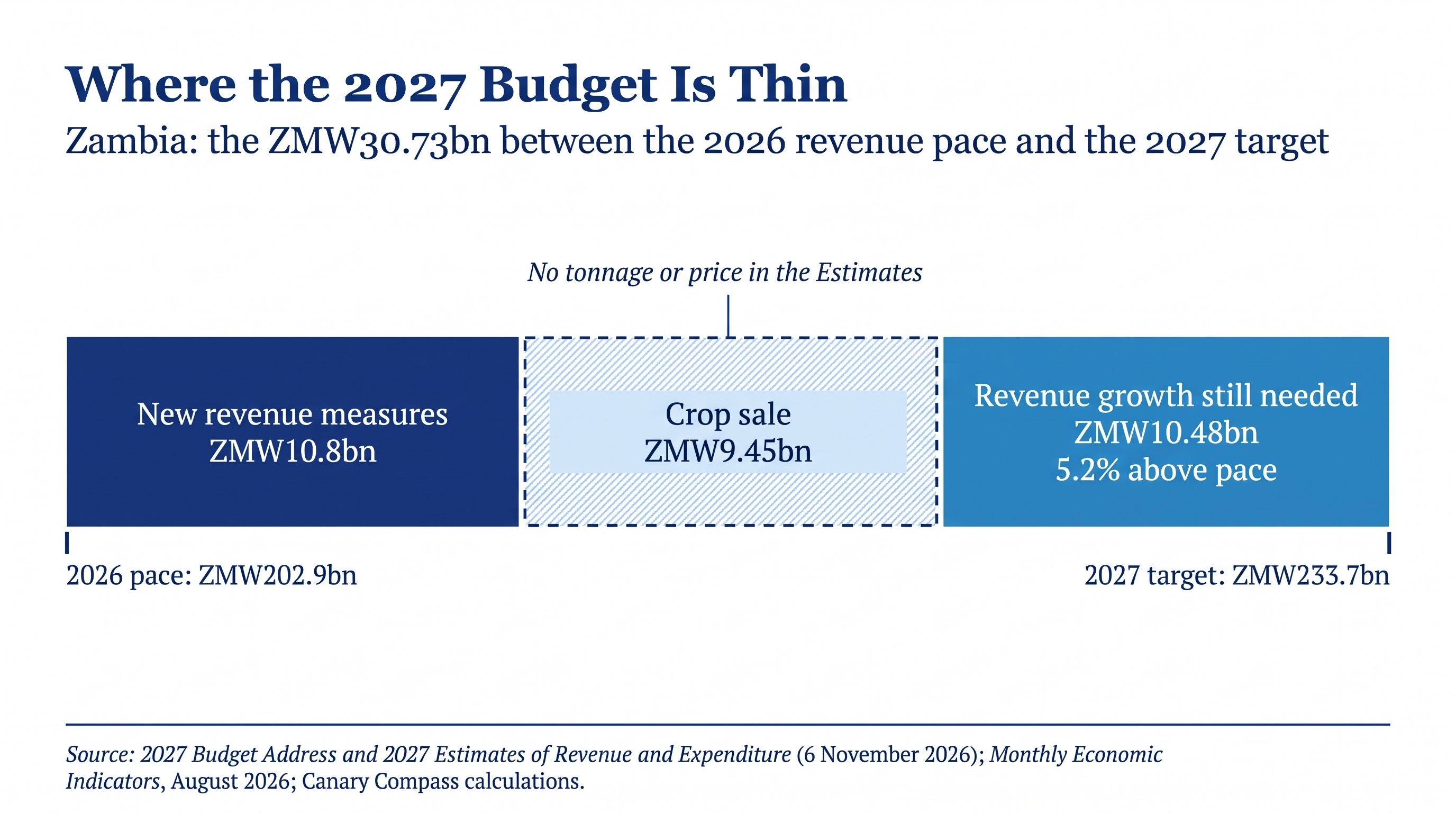
Image: Zambia’s 2027 Revenue Target, the ZMW30.73bn Above the 2026 Pace and What Fills It
Canary Compass will move to paid subscriptions soon. Founding members put a question to Dean every month and join a quarterly call. Founding membership is limited to 50 people and closes at launch. Pledge now; you pay nothing until paid publishing begins. Friday Reflections will stay free. See every plan and what it includes. Institutional licences: dean@canarycompass.com
Chart data: founding members, institutional seats and Desk licence readers receive the values behind this Note’s charts on request.
Zambia’s 2027 Budget Address, delivered on 6 November, plans a deficit of 3.0 per cent of GDP. Minister of Finance and National Planning Dr Situmbeko Musokotwane now projects the 2026 deficit at 5.9 per cent, against 2.1 planned. The Address sets spending, in Zambian kwacha (ZMW), at ZMW284.8bn including external principal repayments, domestic revenue at ZMW233.7bn and grants at ZMW9.2bn. It finances the rest with ZMW28.9bn of net domestic borrowing and ZMW13.0bn of foreign loans, and assumes real growth of 4.9 per cent.
This Note tests the Budget line by line against what the Treasury collected in the first eight months of 2026, and answers four questions. How much of the 2026 shortfall came from the exchange rate, which the Address does not name? What exchange rate does the 2027 Budget stand on, when it prints none? Which revenue lines hold at the current exchange rate with the fuel taxes back, and which do not? Who buys the government’s paper if revenue falls short?
PAYWALL LINE. From the paid launch, free readers stop here. The summary box, our numbers and the verdict below are for subscribers. Until then, this Note is free in full.

1. What 2026 Left Behind
Musokotwane gives 2026 two causes (Address, p.2). The first is the suspension of value added tax (VAT) and excise duty on fuel, which he says “largely” explains the shortfall. The second is food security spending. Inflation fell to 6.3 per cent in October, which he credits to the maize harvest and the stronger kwacha (p.2). Parliament approved a supplementary appropriation of ZMW26.3bn on 11 May (Supplementary Appropriation Act No. 78 of 2026, assented on 4 June). A second, of ZMW19.9bn, is at third reading (Supplementary Appropriation (2026) (No. 2) Bill, N.A.B. 79 of 2026). The Bill gives ZMW14.7bn to National Food Reserves Management (Head 89). Musokotwane told the House on 22 October that the money pays farmers for maize sold to the Food Reserve Agency. He said ZMW18.0bn of the supplementary would come from additional domestic borrowing (as reported, Times of Zambia, 23 October 2026). The 2027 Estimates of Revenue and Expenditure record 2,743,393 tonnes of maize bought in 2026 to 30 June against a target of 1,000,000 (Head 89, p.820). International Monetary Fund (IMF) staff agreed a new 36-month Extended Credit Facility (ECF) of about USD1.5bn on 9 October (IMF Press Release 26/331).
The revenue record supports his first cause in part and shows a larger one he does not name, the exchange rate. From January to August, revenue and grants reached ZMW127.4bn against the Ministry’s own profile of ZMW146.9bn: a 13.3 per cent shortfall (the Green Paper, the Ministry’s September 2026 draft of this Budget, Table 3, p.27). The Monthly Economic Indicators (MEI) for August 2026 carry the same outturn. Revenue alone fell ZMW14.8bn short; delayed grants were the other ZMW4.7bn.
The Government suspended excise and VAT on fuel from April. From fuel volumes and the Energy Regulation Board’s monthly price build-ups, we estimate the cost at ZMW6.3bn to ZMW7.1bn from April to August: ZMW6.7bn at the midpoint, a little under half of the ZMW14.8bn. Import VAT, the largest budgeted line at ZMW42.5bn, ran ZMW11.5bn below eight-twelfths of its budget. The fuel relief explains about ZMW5.5bn of that and the exchange rate about ZMW6.3bn, at the 2026 Budget’s rate of 26.00 (section 2). Together the two estimates cover the whole gap.
On the lines the Budget collects in dollars, we estimate the kwacha’s strength cost about ZMW20.6bn, more than the whole shortfall. Mineral royalty and mining company tax lost almost half of that, and higher copper prices more than replaced it: the two lines ran ZMW5.3bn above eight-twelfths of their budgets. The other ZMW10.8bn, on import VAT, customs duty, export duties and grants, had no such offset. On our estimates, fuel (ZMW6.7bn) and the exchange rate outside mining (ZMW10.8bn) together cost ZMW17.5bn. Against eight-twelfths of budget, revenue and grants ran ZMW18.3bn short in all and ZMW23.6bn short outside mining. The two estimates account for about three-quarters of the second figure, and domestic VAT, ZMW6.1bn short, is the largest of the other shortfalls (section 4). The Address credits the stronger kwacha with bringing inflation down, but leaves it out of the revenue account. Its own draft names “exchange rate appreciation” among the causes of the miss on import VAT and road tolls (Green Paper, paras 101 to 103, pp.24 to 25).
The public record supplies only part of the arithmetic behind Musokotwane’s deficit projection. By August, net domestic financing had reached ZMW39.0bn (MEI, August 2026, Table 1.0) against a profile of ZMW15.4bn (Green Paper, Table 3, which prints a preliminary ZMW38.6bn). The Bank of Zambia (BoZ) lent ZMW9.6bn of it towards the June Eurobond buyback. The African Development Bank lent a further ZMW10.4bn for the same buyback, which the Ministry books as foreign financing (MEI, August 2026, Table 1.0; Green Paper, para 114). Even with that loan, foreign repayments, which include the buyback (Green Paper, paras 109 and 114), exceeded foreign loans by ZMW13.8bn, so net financing reached ZMW25.2bn. The deficit to August was ZMW27.2bn; a change in balances covered the other ZMW2.0bn (MEI, August 2026, Table 1.0). At 5.9 per cent of the ZMW923.7bn the 2026 Budget assumed, the full-year deficit is near ZMW54.5bn, against the ZMW19.4bn the approved Budget financed. The last four months therefore carry about ZMW27.3bn of it. The Supplementary No. 2 Estimates and the amended 2026 borrowing plan, which the House adopted on 3 November (as reported, News Diggers, 4 November 2026), will show the split.
2. The Kwacha Across the 2026 Budget
The 2026 Budget publishes no exchange rate: the Ministry’s assumptions table, as the Zambia Revenue Authority (ZRA) presented it on 29 September 2025, carries none (slide 7). It sets copper at USD8,897 a tonne and output at 1,069,055 tonnes. The 2026 Annual Borrowing Plan, issued with the Budget, supplies the rate. It plans loan disbursements of USD494.98m as ZMW12.87bn and external principal of USD573.04m as ZMW14.90bn: USD/ZMW 26.00 on both. The approved Budget carries two of the Plan’s loans at the same rate (MEI, August 2026, Table 1.0; Plan annex). This Note uses 26.00 as the 2026 Budget’s rate. The Ministry’s Debt Statistical Bulletin schedules more dollar principal for the same year: USD747.66m in the Quarter 2 2025 edition and USD678.16m in the End Quarter Four 2025 edition (Table 15). On those dollars the Budget’s ZMW14,898m of external principal would read 19.93 and 21.97.
The kwacha’s January-to-August average of 18.91 (MEI, August 2026, Table 4.0) ran 27.3 per cent stronger than the Budget’s rate, which gives section 1’s ZMW20.6bn with each line’s dollars held fixed.
A line counts as dollar-linked only where the Budget collects or pays a dollar amount that converts to kwacha. In revenue those are import VAT, customs duty, export duties, mineral royalty, mining company tax and grants; in spending, external interest, foreign-financed spending and overseas allowances; in financing, external principal and loan proceeds. Lines with some dollar content and no published split, non-mining company tax and withholding tax among them, stay out, so the shares below are floors. Copper explains the offset on the mining lines (section 1): it averaged USD13,322 a tonne from January to August (BoZ fortnightly statistics), 49.7 per cent above the assumed price. The Address projects 2026 output at 930,000 tonnes (para 24), 13.0 per cent short of the assumed output, so price beat the plan by far more than volume missed it.
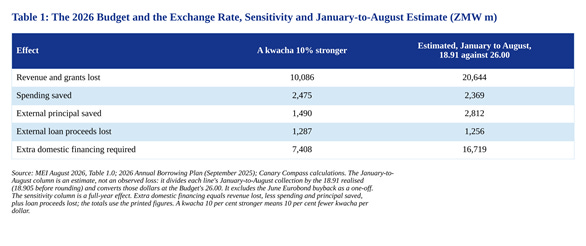
On that classification, dollar amounts make up 46.1 per cent of revenue and grants in the 2026 Budget and 10.4 per cent of spending. With excise, a wider measure, the revenue share reaches 52.6 per cent. A kwacha 10 per cent stronger therefore leaves the domestic market ZMW7.4bn more to carry. Table 1 sets that arithmetic beside the January-to-August estimate: ZMW16.7bn of extra domestic financing, 1.8 per cent of the ZMW923.7bn the 2026 Budget assumed.
3. Where the Budget Prices the Kwacha
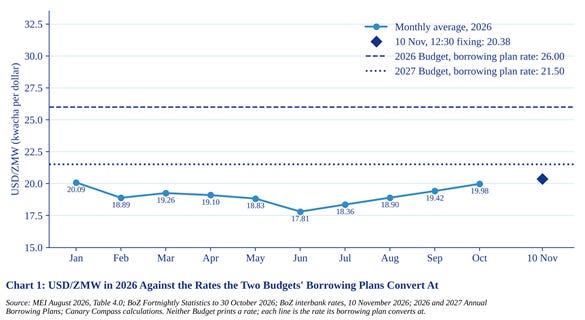
Neither the 2027 Address nor the Estimates published with it prints an exchange rate. The 2027 Annual Borrowing Plan again supplies it. The Plan puts 2027 foreign loans at USD605.99m, and the Address books them at ZMW13,029m (p.20). The Plan repays USD550.52m of external principal, and the Green Paper provides ZMW11,836m for it (fiscal framework, p.40). Both pairs give USD/ZMW 21.50, the rate this Note uses for 2027. That principal sits inside the ZMW16,764m of external debt service the Address and the Estimates carry (p.17; Head 99). The Debt Statistical Bulletin again schedules more: its Quarter 2 2026 edition (updated) projects 2027 principal of USD658.03m (Table 15), on which the same kwacha would read 17.99.
Every monthly average from January to August was stronger than 21.50; the weakest, January’s, was 20.09 (MEI, August 2026, Table 4.0). The IMF’s October figures imply USD/ZMW 20.48 for 2027, nominal GDP of ZMW933.5bn over USD45.58bn (World Economic Outlook (WEO), October 2026), 4.7 per cent stronger than the Budget’s rate. The market traded at 20.38 at the BoZ 12:30 fixing on 10 November (BoZ interbank rates; Chart 1), 5.2 per cent stronger.
The Address keeps a flexible exchange rate and will keep building reserves, lifting cover above five months of imports over the medium term, partly by buying gold at home (pp.13 to 14). Cover fell to 4.4 months at end-June from 5.2 at end-March (Debt Statistical Bulletin, Quarter 2 2026 edition, section 2.2); reserves stood at USD6.1bn at end-August (Address, para 15). Where the BoZ builds them by buying dollars at home, it takes supply out of the market, which works against a stronger kwacha.
In 2026 the current account ran a first-half surplus of USD416m, against a USD840m deficit a year earlier, as copper exports rose 54.0 per cent to USD6.1bn. Non-residents added USD604m of Zambian debt securities in the first quarter (BoZ Balance of Payments Statistics, Q2 2026). A kwacha at the Budget’s 21.50 would take less support from those two flows, more demand for dollars or more buying by the BoZ. The limit planned for non-residents at bond auctions from 2027 narrows the second flow (section 6).
The two borrowing lines, ZMW41.9bn together, are not the deficit: they also repay external principal falling due, which the Green Paper splits out. Spending excluding that principal, less revenue and grants, leaves a deficit of ZMW30.04bn, 3.0 per cent of the Green Paper’s GDP (section 5). Foreign loans exceed the principal by about ZMW1.2bn, so net domestic borrowing of ZMW28.85bn funds 96.0 per cent of the deficit.
The market sits 5.2 per cent stronger than the Budget’s rate, where the January-to-August 2026 average sat 27.3 per cent stronger than that year’s. Hold the kwacha at the 10 November fixing for all of 2027 and the Budget’s dollar lines collect about ZMW5.6bn less. The deficit runs about ZMW4.3bn wider, 0.4 per cent of GDP.
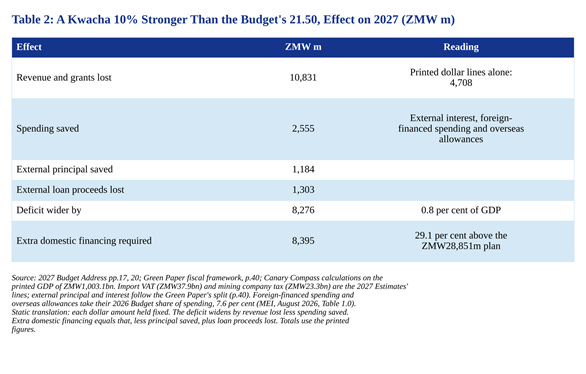
In 2027 slightly less of the Budget is dollar-linked than in 2026 (section 2), and more of that on copper. Four lines the Address prints are fully dollar-linked: customs duty, export duties, mineral royalty and grants. They make up 19.4 per cent of revenue and grants. Adding import VAT and mining company tax, which the Estimates print separately, lifts the figure to 44.6 per cent, or 50.2 per cent with excise. Within the dollar-linked total, the copper-linked lines, mineral royalty plus mining company tax, rise from 31.1 per cent in the 2026 Budget to 41.8 per cent in 2027. Table 2 shows what a 10 per cent stronger kwacha would cost; the 10 November fixing is already half that move.
4. What 2027 Asks of Revenue: The Repricing Test
The method takes each line’s January-to-August 2026 collection and scales it to a full year (Table 3). Unadjusted, that pace is ZMW186.2bn, and the ZMW233.7bn target sits 25.5 per cent above it. Two adjustments make the pace fair to 2027. First, fuel: excise came back in October and VAT comes back on 1 December (Energy Regulation Board price review, 30 September 2026), so 2027 collects both all year. The eight months hold only three months of fuel tax, January to March. Scaled to a year that is 4.5 months, so the method adds the missing 7.5 at the April-to-August cost of ZMW1,343m a month: ZMW10.1bn. Second, the kwacha: repricing the dollar-linked lines from the January-to-August average to the 10 November fixing lifts them 7.8 per cent. Adjusted, the pace is ZMW202.93bn against the target’s ZMW233.66bn. The targets are the lines of the Estimates (pp.xv to xl), which split VAT and company tax where the Address does not. The scaling is straight-line, so the figures are our estimates. The Ministry’s own profile to August expects 66.7 per cent of the year’s tax revenue and 67.3 per cent of domestic revenue (Green Paper, Table 3), so seasonality moves the total pace little.
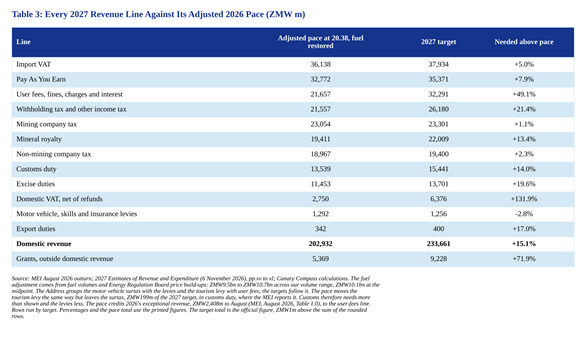
Lines carrying a third of the target clear the test (Chart 2): each needs less than the 8.6 per cent by which the Budget grows the economy in kwacha terms. Import VAT would add a sixth, but the test pairs it with domestic VAT below and the pair does not clear. That bar is the Budget’s own, and it is low (section 5). A higher bar changes nothing: no line sits between Pay As You Earn’s 7.9 per cent and the royalty’s 13.4, and the Fund’s figures grow the economy by 12.8. Company tax, mining and non-mining together, is up 42.0 per cent on the 2026 Budget, and by August it had collected 89.5 per cent of that year’s budget. The VAT rate rise to 16.5 per cent from 16.0 covers 3.1 points of import VAT’s 5.0. Pay As You Earn’s 7.9 per cent comes before the new 39.5 per cent top band adds anything. The test prices the dollar lines at the 10 November fixing, not at the Budget’s rate. At that fixing, Table 3’s five dollar-linked revenue lines need 7.1 per cent more than their pace: ZMW99.1bn against ZMW92.5bn. At the Budget’s own rate the pace rises to ZMW97.57bn and they need 1.6 per cent.
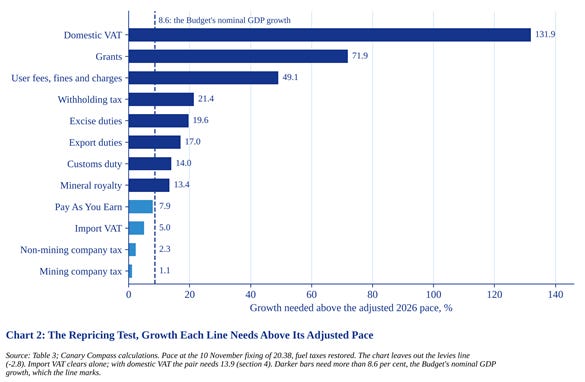
Three lines depend on their new measures. Customs duty needs 14.0 per cent, and the Address raised the line ZMW1.6bn above the Green Paper’s figure while raising duties on ceramic tiles, crude edible oils and selected aluminium products (p.21). Excise needs 19.6 per cent even with fuel excise restored, against plastics excise raised to 200 per cent from 100 and a new 80 ngwee bottle duty. Export duties need 17.0 per cent on the new 5 per cent zinc concentrate duty.
The stretch is in four lines: user fees, withholding tax, domestic VAT and mineral royalty. They carry ZMW21.5bn of the ZMW30.7bn between the adjusted pace and the target. That is 2.1 per cent of GDP out of 3.1, a gap about the size of the planned deficit. None of the four depends on the fuel estimate, which enters only import VAT and excise. Withholding tax needs 21.4 per cent. The Estimates put ZMW18.2bn of the ZMW26.2bn line on rent, interest and similar payments, ZMW4.1bn above the 2026 Budget. Dividends carry ZMW2.6bn, ZMW0.8bn more, where the new 15 per cent on mining dividends applies (Address, para 119, p.22). Mineral royalty needs 13.4 per cent and is the least stretched of the four. The Green Paper assumes 1,083,122 tonnes at USD14,292 a tonne (its Table 1, p.6). The assumption is 16.5 per cent more output than the Address projects for 2026 (section 2), at a price 7.3 per cent above the January-to-August average; the target needs far less. The royalty steps up with the price (the scale in force since 2023). It takes 4 per cent of the first USD4,000 a tonne, 6.5 per cent of the next USD1,000, 8.5 of the next USD2,000 and 10 of the rest. The assumed price alone therefore lifts the royalty on each tonne by 9.4 per cent, to USD1,124 from USD1,027. At that price the line needs 3.6 per cent more output at the 10 November fixing, and no more output at the Budget’s 21.50. At that rate and price the target implies no more than about 911,000 tonnes of copper, below the 930,000 projected for 2026. The Address also cut growth to 4.9 per cent from the draft’s 6.0 and lowered this line only by its gold royalty measure. The risk here is the copper price and the kwacha, not output: if the assumed output arrives at the assumed price, copper alone pays ZMW2.8bn more than the target at the fixing.
User fees, fines and charges must rise 49.1 per cent above a pace that already credits 2026’s exceptional revenue. ZMW9,450m of the line is “Proceeds from Sale of Crops” under the Ministry of Agriculture (Head 89), nil in 2026. The same head spends the same amount on strategic food reserves, which the Estimates assign to outstanding obligations from the crop marketing season and the Food Reserve Agency’s running costs (pp.813, 820). The head’s output target for 2027 is 500,000 tonnes of maize purchases (p.820). For the sale, the Estimates give neither tonnage nor price. The Agency’s two-season maize bill runs near ZMW30.3bn (its board statement of 29 September 2026; the 2025 cost as reported to Parliament). On the count in our post of 6 October 2026, the volume it can export across a drought cycle could approach 3.1m tonnes. Recovering the bill on that volume needs ZMW9,774 a tonne, near USD500 at the end-September rate and USD480 at the 10 November fixing. At that price the proceeds need 0.97m tonnes and recover 31.2 per cent of the bill. The Agency offered maize near USD275 in September, with the regional market near USD230 (market reporting by ZAMACE, the commodity exchange, in “The Two-Sided Coin”, Canary Compass, 2 October 2026). At those prices and the fixing, the line needs 1.7m to 2.0m tonnes, more than the 1.6m tonnes the same post counted as exportable before the next harvest. Selling all 1.6m tonnes raises ZMW7.5bn to ZMW9.0bn. Without the maize the user-fees line needs 5.5 per cent, about what its ZMW1.3bn of new measures raise (Address annex, p.26). Take out 2026’s exceptional revenue as well, a one-off worth ZMW3,612m in the pace, and it needs 26.6. If none sold and the Treasury still paid, the deficit would be ZMW39.5bn, 3.9 per cent of GDP.
Domestic VAT must more than double after collecting 15.5 per cent of its 2026 budget in eight months. The Green Paper attributes the collapse to the slow uptake of smart invoicing (para 102). The line also nets refunds, and claims stood at ZMW60.3bn at end-September (Address, p.2). The Estimates cut the line to ZMW6.4bn from ZMW11.8bn and cap refund clearance at ZMW2.5bn a month (arrears annex). Importers reclaim VAT paid at the border against domestic VAT or as VAT refunds, so the test is fairer on the two lines together. Combined, they need at least 13.9 per cent, because the fuel adjustment counts fuel VAT before any refund. Grants, outside domestic revenue, must rise 71.9 per cent after partners delivered 41.6 per cent of the profile to August. ZMW3.5bn of the target is a new line the Estimates call “Various Donors - swaps”. Table 4 shows what else changed since the September draft.
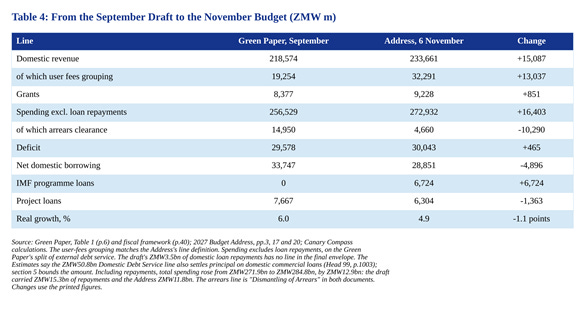
The ECF explains the financing side: staff agreed the programme on 9 October, between the two documents, and the Budget carries its money. The Address books ZMW6,724m (USD312.8m in the Plan) of programme loans it labels IMF (p.20), a line the 2026 Budget did not carry. The Plan expects the Fund to approve the programme in the fourth quarter of 2026. The revenue side is mostly the crop sale; without it, domestic revenue is 22.35 per cent of GDP, the same as in the 2026 Budget to two decimals (Table 8 rounds that to 22.3). The new revenue measures together raise ZMW10.8bn, 4.6 per cent of domestic revenue (Address, para 122, p.22). On the spending side the Address cut the dedicated arrears line by ZMW10.3bn, while its paragraph 78 commits to prioritising arrears clearance. The ZMW4.7bn left is 9.1 per cent of the ZMW51.4bn of arrears on goods and services at end-June (Address, para 13). The Estimates leave the rest to liability management and offsets (arrears annex).
5. Is the Budget Realistic?
The Address never prints its GDP. Its spending of ZMW284.8bn at 28.4 per cent, and revenue and grants of ZMW242.9bn at 24.2 per cent, place 2027 GDP within 0.2 per cent of the Green Paper’s ZMW1,003.1bn (its Table 1, p.6). The Green Paper keeps 2026 GDP at ZMW923.7bn, the figure the 2026 Budget projected in September 2025, and grows it 8.6 per cent in nominal terms. At the Address’s 4.9 per cent real growth, that implies economy-wide prices, the GDP deflator, rising 3.5 per cent, well below the 6 to 8 per cent inflation band. The deflator is a wider measure than consumer prices, so the two need not match, but this gap is large.
The outturn since that projection has run faster. The Zambia Statistics Agency’s final 2025 GDP is ZMW797.7bn, so the Budget’s figure asks 2026 for nominal growth of 15.8 per cent. In the first half of 2026 nominal GDP grew 20.7 per cent on a year earlier, 7.4 per cent in volume and 12.5 per cent in prices, each from the Agency’s levels. In the second quarter it grew 13.6 per cent, with prices up 6.0 (The Monthly, Vol 282, September 2026, Tables 1 to 5). The quarterly figures sum to ZMW785.9bn for 2025, the Agency’s estimate by expenditure, against the final ZMW797.7bn. The year can still reach ZMW923.7bn. The strain is the step to 2027: prices rising 3.5 per cent after 12.5 in the first half and 6.0 in the second quarter. “The Two-Sided Coin” (Canary Compass, 2 October 2026) put 2026 GDP at ZMW902.7bn, the final 2025 figure grown at the IMF’s May 2026 projections. On that base the same 2027 level implies prices rising 5.9 per cent, just under the band’s floor. This Note quotes the Budget’s targets and Musokotwane’s projections on the Budget’s own GDP, and names the base wherever it uses another. If 2027 GDP proves higher than the Green Paper’s figure, the Budget’s ratios, the deficit included, turn out smaller than printed. Table 5 sets the Budget beside the Fund.
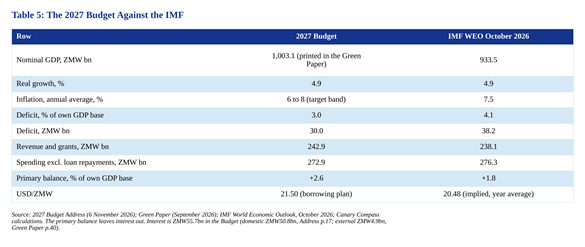
The two GDP bases in Table 5 differ by 7.5 per cent, so the kwacha figures compare better than the ratios. The Budget’s deficit is ZMW30.0bn and the Fund’s ZMW38.2bn: the Fund has ZMW4.8bn less revenue and ZMW3.4bn more spending. The Fund last updated its Zambia figures on 24 September 2026, before the Zambia Statistics Agency’s revision, the staff-level agreement and the Address; its 2025 GDP is still the preliminary ZMW725.6bn.
The White Paper on the 2026–2028 plan (January 2026), the approved version of last year’s cycle, shows how far 2027 has moved in ten months. It put 2027 GDP at ZMW1,046.6bn, which the Green Paper cut by 4.2 per cent. It projected growth of 6.5 per cent, a deficit of 1.6 per cent of GDP and net domestic borrowing of 1.9 per cent (its Tables 4 and 7). The Address plans 4.9, 3.0 and 2.9. In kwacha the deficit rose from ZMW16.25bn to ZMW30.0bn and net domestic borrowing from ZMW20.1bn to ZMW28.9bn. For 2027 the White Paper assumed USD8,983 a tonne and 1,206,410 tonnes; the Green Paper’s price is 59.1 per cent higher and its output 10.2 per cent lower (section 4). The higher price that lifted 2026’s mining lines is therefore already inside the 2027 base.
The Budget’s deficits here are cash deficits, the basis the Ministry reports (White Paper, January 2026, para 24); the 2027 figure includes the arrears paydown. Before ZMW55.7bn of interest, the 2027 Budget runs a primary surplus of ZMW25.7bn, 2.6 per cent of GDP. The Estimates say the domestic debt line, counted here as interest, also repays commercial loans (Head 99). The Address leaves little room for that: its target for net domestic borrowing, 2.9 per cent of GDP (p.3), is the full ZMW28.9bn its financing table prints (p.20). Repayments above about ZMW0.3bn inside the line would pull net borrowing below 2.85 per cent of GDP and change the printed 2.9. The primary surplus does not move with them, because repayments leave the deficit and interest by the same amount. Musokotwane’s 2026 projection leaves a primary surplus of about 0.4 per cent if interest ran to budget, against 4.2 planned.
On the Fund’s figures, gross public debt falls from 82.1 per cent of GDP in 2026 to 77.0 in 2027. The Address targets a 1.2 per cent deficit by 2029 (p.12) and the ECF a 3 per cent primary surplus by the same year (IMF Press Release 26/331). Met together, the two put interest at 4.2 per cent of GDP, against 5.6 in the 2027 Budget.
The gap between pace and target is ZMW30.73bn. Musokotwane’s measures raise a net ZMW10.8bn (section 4) and the crop sale ZMW9.45bn. That leaves ZMW10.48bn for growth to supply, 5.2 per cent of the pace. The pace includes ZMW3.6bn of exceptional revenue, 2026’s one-off scaled to a year; without it the figure is 7.1 per cent. Both are floors, because each assumes every measure delivers in full and all the maize sells. Both sit inside the 8.6 per cent by which the Budget grows the economy. At the Budget’s own rate of 21.50 the pace rises to ZMW208.0bn and the first figure falls to 2.6 per cent.
Without the maize sale, and with every measure delivered, revenue must grow 9.8 per cent above pace at the fixing, more than the 8.6 by which the Budget grows the economy in kwacha terms. The Budget is thin in three places: a maize sale with no tonnage or price, measures not yet enacted, and an exchange rate weaker than the market’s.
6. Who Buys the Paper
Foreign loans only just cover the foreign principal falling due (section 3), so a revenue miss, a stronger kwacha or a spending overrun lands on the domestic auction calendar unless the Treasury cuts elsewhere. The 2027 Annual Borrowing Plan, which the Address cites (p.16), sets gross domestic borrowing at ZMW115.0bn at cost: ZMW86.15bn to refinance maturing securities and ZMW28.85bn net.
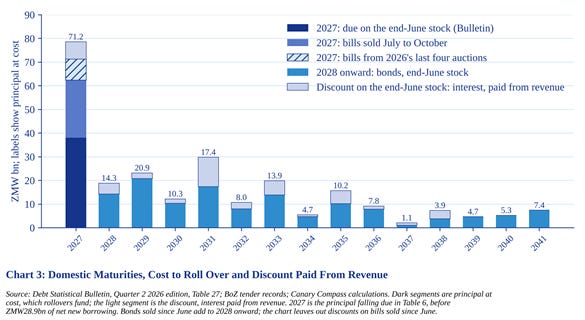
Rollovers fund maturities at cost: the Treasury borrows again only what it first received. The discount, the gap between that cost and the face value repaid, is interest, as coupons are, and revenue pays both through the Budget’s interest line (Address, p.17). In 2031, ZMW29.8bn falls due at face: ZMW17.4bn is cost to roll over and ZMW12.4bn is discount to pay from revenue (Debt Statistical Bulletin, Quarter 2 2026 edition, Table 27). For 2026 the same table showed ZMW85.9bn due at face: ZMW66.2bn of cost to roll over and ZMW19.7bn of discount (End Quarter Four 2025 edition). A count at face overstates the rollover by that discount. The 2026 borrowing plan counts at cost: principal, with an estimate for bills sold and repaid within the year. The amendment presented to the House in May 2026, with the first supplementary, set gross domestic borrowing of ZMW108.6bn, with a net limit of ZMW29.12bn, leaving ZMW79.5bn of refinancing. The Quarter 2 2026 Bulletin, published later, supports that figure. It shows ZMW35.04bn repaid at cost in the first half and ZMW42.21bn due at cost in the second (its Tables 1 and 27). With ZMW2.11bn of bills sold since June and due by December (BoZ tender results), that is ZMW79.4bn.
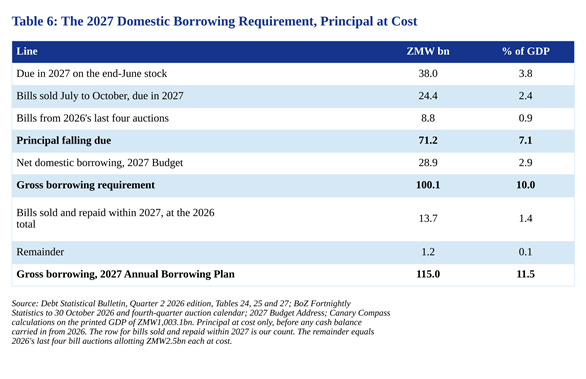
For 2027, Table 6 builds the requirement from three pieces of principal at cost. They are paper outstanding at end-June (the same Bulletin, its Table 27; Chart 3), bills sold since, and the four bill auctions left this year at the amounts offered. We rebuilt the bills tender by tender from BoZ records, and the rebuild matches the Bulletin’s end-June bill stock to within ZMW1m. No bond sold since June falls due in 2027: the two- and three-year bonds were new lines and the reopened lines run seven years and longer. With the Budget’s net borrowing, the gross requirement reaches about ZMW100.1bn, 10.0 per cent of GDP, before bills issued and repaid within the year. The Plan’s ZMW115.0bn is ZMW14.9bn higher, all of it in maturities, and on our count bills sold and repaid inside the year fill most of it: ZMW13.7bn, their 2026 total (Table 6). The remaining ZMW1.2bn would be the last four 2026 bill auctions allotting ZMW2.5bn each at cost against the ZMW2.2bn offered. The Plan’s figure is 11.5 per cent of GDP, against the amendment’s ZMW108.6bn, 11.8 per cent of the 2026 Budget’s GDP.
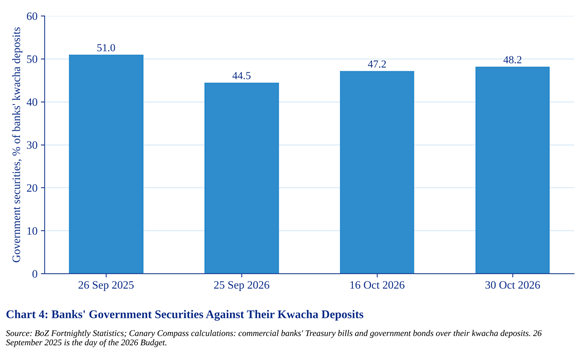
Commercial banks held ZMW62.5bn of Treasury bills and bonds on 30 October, 48.2 per cent of their ZMW129.6bn of kwacha deposits (BoZ fortnightly statistics; Chart 4). The planned 2027 net borrowing equals 22.3 per cent of those deposits, before rollovers. The ratio measures scale only: banks will not take all of it, and their deposits will grow. The authorities told the Fund they would hold non-residents to 15 per cent of primary bond issuance from 2027, after 23 per cent in 2026 (IMF Country Report 26/21, January 2026). At two ZMW6.3bn bond auctions a quarter, the fourth quarter’s calendar, that admits about ZMW7.6bn a year. Non-residents’ net purchases in the first quarter of 2026 alone (section 3) came to about ZMW11.7bn at that quarter’s average rate, across both markets. The 15 per cent binds at auction only; bills and the secondary market stay open. The balance falls to banks, pension funds and insurers. At end-June pension funds held ZMW70.9bn of the paper at face value: 45.1 per cent of the bills and 21.8 per cent of the bonds (Debt Statistical Bulletin, Quarter 2 2026 edition, section 4.3).
Yields fell through 2026. The BoZ’s policy rate fell to 10.75 per cent in September 2026 from 14.25 in December 2025 (Address, para 11). The Treasury raised most of its money early: by August net issuance of securities had reached ZMW26.7bn, 91.7 per cent of the ZMW29.12bn limit for the year. The limit covers securities: the BoZ’s buyback loan (section 1) and ZMW2.8bn drawn from bank balances are separate lines (MEI, August 2026, Table 1.0). Buyers took more than the calendar offered: from January to 25 September the tenders allotted ZMW88.8bn at cost against ZMW79.6bn offered (BoZ tender results). On our reading, with most of the year’s money raised and little room left under the limit, the Treasury could turn away expensive bids. In September it met and then exceeded its offer, and still rejected 37.4 and then 54.5 per cent of the bids for its bills (Table 7). The 364-day yield fell from 11.9 per cent to 10.0 by 1 October, below the policy rate and 3.7 points above October inflation. The 15-year bond cleared at 15.45 per cent on 25 September.

The second supplementary resets the limit. Its ZMW18.0bn of additional domestic borrowing (as reported) lifts it to about ZMW47.1bn, against the ZMW26.7bn of net issuance by August: ZMW20.4bn of room against the ZMW27.3bn deficit of the last four months (section 1). The rest falls to foreign loans, net of repayments, or to cash. At its last two October tenders the Treasury took all but ZMW4m and ZMW9m of the bids, at an unchanged yield. The calendar still offers four bill auctions of ZMW2.2bn each at cost to 24 December, against ZMW9.5bn of bills falling due at face. It offers the quarter’s two bond auctions on 20 November and 18 December (BoZ public notice on the fourth-quarter calendar). The 20-year bond, the extension the Medium-Term Debt Management Strategy 2026–2028 prescribes (p.15), debuts at the first. What the Treasury must raise in 2027 depends on the cash it closes 2026 with, and neither the opening nor the closing balance of its funding account is public. The Budget’s net domestic borrowing is ZMW28.9bn, against ZMW21.4bn in the 2026 Budget.
On our reading, the risk to 2027 yields tilts up across the curve, most for bills. Yields have already fallen far: since January bills are down 350 to 450 basis points and bonds 269 to 334 (BoZ tender results to 29 October for bills and 25 September for bonds). Bills clear below the policy rate, and the Treasury now takes almost every bid (Table 7). The Plan’s net borrowing, 2.9 per cent of GDP, sits well below the 5.1 per cent of the 2026 Budget’s GDP that year’s limit reached (as reported). The lighter supply depends on the Budget holding. If no maize sells and the kwacha stays at the market rate, the deficit is ZMW43.8bn, 4.4 per cent of GDP. If the kwacha weakens from 20.38 to the Budget’s 21.50, a holder who counts in dollars loses 5.2 per cent on the exchange rate. If it holds at 20.38, the Treasury collects ZMW5.6bn less in revenue and grants (section 3). The 15-year bond’s September cut-off yield of 15.45 per cent stood 9.15 points above October’s 6.3 per cent inflation, the widest margin on the curve. The 20 November auction is its first pricing since the policy rate cut of 30 September.
Official Figures That Disagree
Official figures disagree in at least four places, three within the Address as delivered on 6 November and one between the debt documents; these four go to the Ministry as questions.
1. The corporate income tax rise. Paragraph 117 lifts rates by 5 points on income taxed at 20 per cent and below; annex item 24 covers all income taxed below the standard 30 per cent. The two cover different companies, so the company tax line depends on which the Finance Bill enacts.
2. The top Pay As You Earn band. Paragraph 118 starts it above ZMW37,000 a month; annex item 25 starts it above ZMW34,000. The ZRA’s statement of 10 November uses the higher figure.
3. The ceramic tile duty. Paragraph 111(a) of the Address raises customs duty on ceramic tiles “to 40 percent from 25 percent”; annex item 1 raises it “from 5 percent to 40 percent”.
4. External principal in dollars. The 2027 Annual Borrowing Plan repays USD550.52m in 2027, and the Debt Statistical Bulletin schedules USD658.03m (section 3). For 2026 that year’s Plan repays USD573.04m, and the Bulletin’s two editions schedule USD747.66m and USD678.16m (section 2).
Grading and Pre-Registration
Earlier work read the Budgets’ rates from other documents. “The Forecast Is Not the Evidence” (Canary Compass, 6 March 2026) used about 20 for 2026; our posts of 7 November used 21.97, and 19.49 for 2027. The borrowing plans convert at 26.00 and 21.50. For 2026 the direction held and the posts understated the size: the estimated January-to-August loss on dollar lines is ZMW20.6bn, where the posts printed ZMW8.9bn. For 2027 the direction reversed: the market is stronger than the Budget’s rate, not weaker. Four tests follow from this Note. First, Musokotwane’s projection of a 5.9 per cent deficit for 2026 grades when the 2026 outturn publishes. Second, this Note pre-registers the base question. ZMW923.7bn for 2026, ZMW1,003.1bn for 2027 and real growth of 4.9 per cent imply a price rise of 3.5 per cent, and the White Paper on the 2027–2029 plan will not keep it. If its GDP figures and real growth still imply 3.5 per cent or less, the call fails. Third, the first Note after the March 2027 MEI grades first-quarter collections line by line against Table 3. We expect user fees, withholding tax and domestic VAT each to collect less than a quarter of its target; the call fails on any line that collects a quarter or more. The call leaves the royalty out, because it turns on the copper price and the kwacha (section 4). Fourth, a post grades the 20 November debut against the 16.4 per cent extrapolated in “The Two-Sided Coin” (Table 10A).
Revenue Ratios Beside GDP Ratios
Of every kwacha of domestic revenue the 2027 Budget collects, 23.9 ngwee goes to interest, down from 28.4 in the 2026 Budget (Table 8).

Table 8’s external debt service ratio, 7.2 per cent, covers only the Budget’s own line. The Fund’s analysis, which counts non-residents’ kwacha paper as external debt, projects 13.4 per cent on average for 2026 to 2031, against its 14 per cent threshold (IMF Country Report 26/21). On 2026’s unadjusted collection pace, domestic revenue is 20.2 per cent of the 2026 Budget’s GDP, against the 22.3 budgeted and the 23.3 the 2027 Budget targets. On the Fund’s 2027 figures, gross public debt of 77.0 per cent of GDP is 3.0 times revenue and grants.
Parked Questions
Beyond the four disagreements, eight questions go to the Ministry of Finance and National Planning and its Debt Management Office. What cash balance opens 2027 in the Treasury funding account, which the 2027 Annual Borrowing Plan does not report? Does the non-resident limit at bond auctions stand? On what estimate of bills sold and repaid within the year do the Plan’s maturities rest: 2026’s total (section 6) or another? How many tonnes of maize, at what price and to which buyers, raise the crop sale proceeds, and what does the Treasury pay if they fall short? How much of the Domestic Debt Service line is principal on commercial loans? Why do the borrowing plans convert at 26.00 and 21.50? At 21.50 the royalty target implies no more than about 911,000 tonnes of copper (section 4): does the Budget stand on that output or on the Green Paper’s 1,083,122? What 2026 GDP and price assumption stand behind the Budget? One goes to the BoZ: how much of the supplementary borrowing lands in bills against bonds. One goes to the ZRA: the age profile of the VAT refund claims, and the clearance the 2027 VAT line assumes. And one stays with the House committees that reviewed the supplementaries: how much of 2026’s deficit is food security spending, Musokotwane’s second cause.
Close
The 2027 Budget’s real growth matches the Fund’s. With every measure delivered and the maize sold, its revenue target needs revenue to grow at least 5.2 per cent above pace at the 10 November fixing. Without the maize it needs 9.8, more than the 8.6 by which the Budget grows the economy in kwacha terms. Whichever way those and the exchange rate resolve, the difference falls to the domestic market unless the Treasury cuts spending. On our reading, the risk to 2027 yields therefore tilts up across the curve, most for bills. The 20 November debut, the Monetary Policy Committee of 25 and 26 November, the ECF Board date and the amended 2026 borrowing plan will confirm or move the numbers in this Note.
Sources
Ministry of Finance and National Planning (2027 Budget Address, 6 November 2026; 2027 Estimates of Revenue and Expenditure (Output-Based Budget), 6 November 2026; 2027–2029 Medium Term Budget Plan and 2027 Budget Green Paper, September 2026; 2026 Budget Speech, 26 September 2025; White Paper on the 2026–2028 Medium Term Budget Plan, January 2026; Monthly Economic Indicators, August 2026; 2026 Annual Borrowing Plan, September 2025, and its amendment as presented to the National Assembly in May 2026; 2027 Annual Borrowing Plan, November 2026; Debt Statistical Bulletin, Quarter 2 2025, End Quarter Four 2025 and Quarter 2 2026 (updated) editions, section 2.2 and Tables 1 to 27; Medium-Term Debt Management Strategy 2026–2028), National Assembly of Zambia (Supplementary Appropriation Act No. 78 of 2026; Supplementary Appropriation (2026) (No. 2) Bill, N.A.B. 79 of 2026, 23 October 2026; Mines and Minerals Development (Amendment) Act, 2022, for the copper royalty scale), Zambia Revenue Authority (2026 Budget symposium presentation, 29 September 2025; statement on the Pay As You Earn proposal, 10 November 2026), Zambia Statistics Agency (The Monthly, Vol 282, September 2026), Energy Regulation Board (monthly pump price build-ups, December 2025 to October 2026; price review, 30 September 2026; 2025 Statistical Bulletin), Food Reserve Agency (board statement, 29 September 2026), ZAMACE (market reporting, September 2026), Bank of Zambia (Fortnightly Statistics to 30 October 2026; interbank rates, 10 November 2026; Balance of Payments Statistics, Q2 2026; Monetary Policy Committee Statement, 30 September 2026; Treasury Bill Auction Results, tenders 01/2026 to 22/2026; GRZ Bond Auction Results, tenders 01/2026/BA to 07/2026/BA; public notice on the fourth-quarter 2026 auction calendar), IMF (World Economic Outlook, October 2026; Country Report 26/21; Press Release 26/331; debt sustainability framework for low-income countries, with the World Bank), Times of Zambia (23 October 2026) and News Diggers (4 November 2026) for Musokotwane’s statements to the House on the second supplementary, Canary Compass calculations.
Disclaimer
Canary Compass research is published by Canary Imara Ltd, a private company incorporated in Kenya (PVT-3B15OQP7). Canary Imara Ltd also trades proprietary capital in markets covered by this research and may hold positions in instruments discussed. Canary Imara Ltd and anyone who works on a Canary Compass piece do not trade an instrument it names between its final draft and its publication.
This publication is for information only. It is not investment advice or a recommendation to buy or sell any instrument; readers should seek independent advice before acting on it. The analysis reflects proprietary research undertaken by Canary Compass and the author.
Canary Compass and the author accept no liability for actions taken or not taken based on the information in this article.
The views expressed in this article represent the author’s independent professional analysis and do not constitute an endorsement of any individual, institution, or position. Canary Compass and the author accept no responsibility for how this content is interpreted, excerpted, or recontextualised by third parties not involved in its production and publication. Reproducing any portion of this work in isolation, or in combination with other material, in a manner that misrepresents the author’s original meaning constitutes a distortion of the published record.
All views, projections, and forecasts reflect the author’s assessment at the time of writing. Data sourced from third parties is believed to be reliable but has not been independently verified. Past performance does not indicate future results.
All content published by Canary Compass is the intellectual property of Canary Compass and the author. Reproduction, adaptation, or redistribution, in whole or in part, requires written permission.
About the Author
Dean N. Onyambu is the Founder and Chief Strategist of Canary Compass, a financial research publication focused on African monetary architecture and financial sovereignty. He brings 18 years of experience across trading, fund leadership, and economic policy, with senior roles at Standard Bank, First Capital Bank, and Opportunik Global Fund.
Read and subscribe at www.canarycompass.com.
The Canary Compass Channel is available on @CanaryCompassWhatsApp for economic and financial market updates on the go.
For more insights from Dean, you can follow him on LinkedIn @DeanNOnyambu or X @InfinitelyDean.