


AI-illustration: the six floors of the intelligence economy. Africa supplies the first and buys from the sixth. The floors between set the terms.
AI Week. This essay runs in four parts, one each morning this week, and closes with Friday’s Reflection on AI. Part 1 of 4: The Machine and the Price. Each part is a 20 to 25 minute read; the full essay runs about 90 minutes. Data cut-off: 3 October 2026.
In brief
• The intelligence economy is six floors deep. Africa supplies the first and buys from the sixth, and owns nothing that sets the global terms between.
• Its price split this year: the cheap tier raced toward zero while the frontier held its list price, giving ground beneath it in September. Whether the cheap tier can keep improving without access to the dear one is the open question its discount rides on.
• Capability is the model plus what it can reach, and the reach runs mainly on capital and infrastructure Africa does not hold.
In June, a few friends and I compared notes on the same frontier AI tool. Most of us were paying for it in dollars, out of African incomes. A small experiment in economic sorting ran itself.
One hit his monthly usage limit mid-task. The system offered a choice: pay more to continue, or wait for the reset. He cancelled in protest. Another hit the same limit and handed the system his card, telling it to take what it needed, then joked that the difference between the two of them was that he was now broke. A third priced the exchange differently. He had spent USD 500 in three weeks running a legal AI assistant that, by his own estimate, saved his team around USD 10,000 in billable time. That estimate is his, and labour time valued at USD 10,000 is not USD 10,000 in the bank. What survives the estimate is harder: the return existed only for the person who could float the USD 500 first.
That is an affordability problem on its surface. Underneath it is an ownership problem. The tool is useful only while the provider keeps serving it at a price you can pay, and the provider sets that price, changes it, and can withdraw it. The work continues on terms set somewhere else. The question under the whole of this essay is who sets them, and what the setting costs everyone who cannot.
The answer runs six floors deep. Africa enters on the first as raw material and on the last as a customer. African firms operate at regional scale on some floors between, in data centres, connectivity and applications, and none of them holds a position that moves the global terms. The distinction between being present and being in control runs through everything that follows.
1. The Decoder
The public argument about AI prices is an argument about the last door of a large building. The building has six floors. First the words needed to walk them.
A model is the machine: a mathematical system trained on vast quantities of text until it can predict, reason and write. Its weights are the billions of numbers that store what it learned, and whoever holds the weights holds the model. A token is the unit the machine reads and writes, roughly three-quarters of a word. It is also the billing unit: intelligence is sold per million tokens the way fuel is sold per litre. Compute is the processing power, measured in chips and megawatts, that trains a model and then runs it. The frontier is the small set of models at the current ceiling of capability; a generation behind it is the commodity tier.
A model reaches the world in one of three ways. A closed model is a hosted service, reached through the owner’s app or its API, a metered gateway where every request is billed and the owner sets the rules; the weights stay private. An open-weight model publishes the weights for anyone to download and run on their own hardware, which the industry calls self-hosting, provided the hardware is equal to it. What it need not publish is enough of the making to reproduce the machine. A true open-source model publishes the making itself, the code and the data needed to rebuild the system. In kitchen terms, the closed model serves you the meal, the open-weight model hands you the finished dish to reheat, and open source hands you the recipe. Almost everything the industry calls open, including the Chinese releases in this essay, is the dish and not the recipe. The fight over who copied whom turns on that distinction. Distillation is training a cheaper model on the outputs of a stronger one, the student copying the teacher’s marked answers. A hyperscaler is one of the handful of firms, Amazon, Microsoft, Alphabet and Meta, whose data centres form the world’s cloud. A neocloud is a newer firm built only to rent out AI compute. Three further terms, for where the machinery is said to be going, wait in Part 3.
Now the floors, in order.
The first floor is minerals, materials and power, the one the continent is said to hold. Copper carries this stack, in the transmission lines and power build a data centre needs, and Zambia, the DRC and South Africa supply it at scale. Cobalt is secondary, through backup storage, though the DRC’s territory supplies over 70 per cent of the world’s mined supply; platinum group metals are close to marginal here. Supply, throughout this essay, is territorial. The territory holding the mineral is not the firm owning the mine or the processor refining the ore, both of which sit largely elsewhere. State royalties and minority stakes are a claim on the margin, not control of it. Africa supplies at scale. It does not own at scale.
The power sub-floor has begun repricing in public, and the pressure travels. America’s largest grid operator cleared its 2028 to 2029 capacity auction at the price cap for the third auction running, 138,318 MW for about USD 16.4 billion. It still finished 6,831 MW below its own reliability target, the second consecutive shortfall. Demand is now so large that only the administered ceiling held the price: PJM’s own simulation puts the uncapped clearing price at USD 554.72 per megawatt-day, 70 per cent above the cap. Its independent market monitor attributes about USD 6.3 billion of the charges, 38 per cent, to data centre demand. A data centre does not simply buy its own megawatts. Its demand tightens the whole market, and the cost lands on megawatts bought by households and firms that bought no intelligence at all. African systems run no such auction; most are single buyers with administered tariffs, so the same pressure arrives there through power purchase agreements, firm-capacity contracts and tariff reviews rather than a clearing price. The scale is the point. Kenya’s entire grid is roughly 3 gigawatts; one American AI campus now in financing is sized at 4.25. The grids now being courted for the next wave of construction are African.
The second floor is semiconductor manufacturing, eight sub-components from chip design through memory and lithography to packaging and assembly. The market structures run from oligopoly to outright monopoly: three firms in design software, three in memory, one, ASML, in the lithography that prints the most advanced chips. TSMC fabricates most of the world’s advanced logic. A handful of back-end plants aside, Morocco’s assembly and test lines among them, Africa holds no position on any of the eight that sets terms.
The third floor is data centre infrastructure. The four largest builders committed roughly USD 720 to 745 billion in capital expenditure in 2026, up through the year from an April floor near USD 700 billion. Alphabet’s July guidance alone runs to USD 195 to 205 billion. Beneath them sit the neoclouds, the colocation providers, the server makers, the networking and cooling layers, and the subsea cables. African-owned capacity exists here: Cassava’s Nvidia-powered buildout and its Africa Data Centres arm are real. They do not register against the floor’s totals, and no African firm sets the terms of hyperscale cloud. Google’s Equiano cable lands on African shores and is owned and routed from outside them, the corridor logic The Cathode Economy documented in minerals, applied to packets.
The fourth floor is the model companies. Frontier closed labs, open-weight labs, the Chinese state-adjacent ecosystem, and the vertical specialists. This is where the financial story concentrates, because it is the floor that pays every floor below it while running deeply negative cash flow. African model work exists, Lelapa’s small African-language models among it; none of it has frontier scale or any power over access and pricing.
The fifth floor is the integrators, the firms that carry models into enterprises. Morgan Stanley’s July map of the buildout’s value chain places owners across the top and seven supplier layers beneath, with no African firm in any box. My own 2024 mapping of 203 AI-themed companies, dated and offered as a snapshot rather than a census, found six African entries against 106 American, all six in software and services, none upstream. No African upstream entry had surfaced in the disclosures tracked here by the cut-off.
The sixth floor is the buyers: enterprises, sovereigns and individuals. Africa appears as customer and as surveillance subject, the latter through Chinese safe-city systems installed across at least 16 countries. That second role is where Part 4 returns: it is the sovereign use case where the structure’s control is most complete. Table 1 asks one question of every floor.
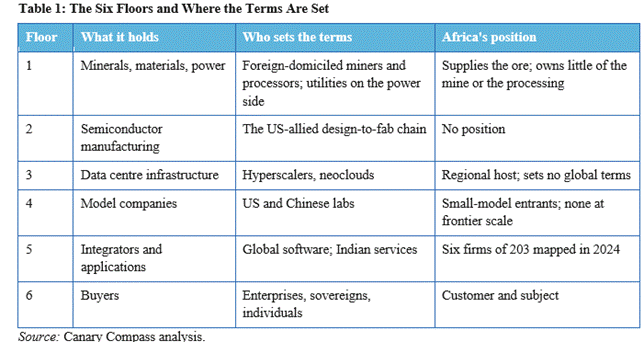
Read down the last column and the truncation is the one The Cathode Economy documented in copper and cobalt, carried from molecules to weights. The mineral chain and the intelligence chain are one chain, and Africa exits it early both times.
There is a second raw material on this chain. The first floor is minerals. The sixth produces data. African text, transaction records and behaviour train the models, calibrate the advertising systems and feed the surveillance products, paid for in services priced by the buyer of the data, not the seller. Data is not ore; it is non-rival, and taking it depletes nothing. The parallel is in the payment at origin, not the depletion. Cobalt goes into the chips. Data goes into the weights. Africa sells the first cheap, surrenders the second unpriced, and buys both back expensive. The gain on the way out is real; a copper boom is a terms-of-trade win, collected once per construction cycle. Rent, in this essay, is the surplus captured by whoever controls the scarce layer, and the scarce layers here are fabrication, compute and reach, tolled on every improvement cycle. Africa pays at both ends.
The Financing Loop
The buildout is more fragile than its revenue suggests, and the reason is how the money moves.
The hyperscalers report enormous backlogs of contracted future cloud revenue, more than USD 2 trillion across the providers that disclose it. A large share is contracted from a small number of model companies that are themselves burning cash. Analysts reading the disclosed backlogs put roughly half of the total with two customers, OpenAI and Anthropic. That figure is an allocation of disclosed backlog, not a disclosed allocation, and cannot be independently decomposed from the filings. The direction beneath it is not in dispute; the magnitude is the estimate. The model companies raise capital from investors, spend it on compute, and that spending is booked as revenue by the infrastructure layer. A railroad’s freight receipts come from farmers who are not funded by the railroad’s bondholders. Here, a material share of the forward demand validating the buildout is capitalised by the same cycle that finances the buildout. The four largest builders fund their programmes from operating cash flow and investment-grade debt; the circularity concentrates beneath them, in the neoclouds, the vendor guarantees and the vehicles. The Bank for International Settlements named this in its Annual Economic Report in June. It listed circular deals, the same asset pledged more than once, poorly disclosed terms, and the risk that weak returns turn the boom into a bust. Its October bulletin on AI financing sharpened the warning, tracing the leverage into private credit where disclosure is thinnest.
The strongest counter is that the labs’ revenue is real and growing fast, and that enterprise demand is no accounting artefact. The BIS itself credits the rationale: these relationships can secure supply and share risk. But revenue growing is not the same as a loop closing. The demand concentrates among the same few counterparties that finance it, and that is the fact the bull case has to climb over rather than around.
CoreWeave is the cleanest exhibit. Microsoft was about 62 per cent of its revenue in 2024 and about 67 per cent in 2025. The diversification since has been into OpenAI, Meta and Anthropic, every one of them already inside the loop. Nvidia is simultaneously CoreWeave’s investor and its supplier. CoreWeave did not diversify out of the loop. It diversified deeper into it.
Part of the loop runs outside sponsor balance sheets, through disclosed special-purpose vehicles. Bloomberg Tax documented in July the return of off-balance-sheet structures holding data centre debt away from the sponsors’ accounts. Meta’s Louisiana campus sits in such a venture, carrying its debt off Meta’s books against a disclosed maximum exposure of about USD 46 billion. Meta bases its non-consolidation on a judgement that it lacks power over the venture’s most consequential activities. That judgement can be contested; it cannot simply be reversed. What is not in dispute is where the debt lands. It migrates toward private credit, where prudential oversight is lightest, which is where the BIS traced leverage moving.
Oracle shows the strain in a rating. S&P cut it to BBB- in July, one notch above speculative grade, with roughly USD 260 billion in data centre lease commitments outside its reported debt. Negative free cash flow sits behind them.
The largest exhibit is Nvidia’s. In late July it entered talks to guarantee the financing behind OpenAI’s planned Ohio campus. On 17 August it filed the commitment with the SEC: residual value guaranties with SB Energy as lessor, capped cumulatively at USD 105 billion, covering about 4.25 gigawatts of load. They pay out only if OpenAI becomes insolvent or fails to pay, and the headline had shrunk from a reported USD 250 billion through negotiation. The vendor’s balance sheet now stands behind the customer’s lease because the customer lacks an investment-grade rating. The filing carries one more clause that closes the circle: OpenAI has agreed to reimburse Nvidia for anything paid under the guaranties. The backstop of the tenant’s lease is itself a claim on the tenant, worth least at the moment it would be needed.
This reaches the person paying USD 20 or USD 200 a month by a short path. A consumer subscription can run a positive margin on the cost of serving it while the provider still loses money funding research and expansion. In effect, outside capital absorbs the gap between what subscriptions cover and what the build costs. Whether today’s prices hold depends on falling costs, rising use, cross-subsidy, higher prices or more financing. In most of those paths power moves toward the provider, though sharper competition can move some of it back. The marginal buyer feels it first either way, and on the sixth floor the marginal buyer is African more often than not. The arithmetic is short: a USD 20 subscription stands against a monthly income per head of roughly USD 105 in Zambia.
A material share of the buildout’s demand comes from customers financed by someone else’s capital. Whether that someone stays a venture capitalist or becomes a treasury is this essay’s central prediction, argued in Part 4. The other outcomes, retained earnings, acquisitions, write-downs, a smaller buildout, are real; the forecast here is that the state arrives, and the case is built on Thursday.
2. The Price of a Barrel of Intelligence
The pricing story my friends and I lived through is now documented from the household to the Fortune 500. Walmart capped its staff’s use of an internal AI coding tool after demand outran the budget. Uber burned its annual budget for AI tools in four months and imposed caps. A cap is as consistent with runaway demand as with distress; either way the budget binds. Bain’s 2026 survey of enterprise buyers found budgets growing while returns are not. Microsoft’s AI chief, Mustafa Suleyman, said on Bloomberg in June that a leading rival was extremely expensive and that many buyers were urgently seeking alternatives.
The market’s answer looks, at first, like relief. An independent benchmarking platform, Artificial Analysis, puts the cost of a standard task at USD 0.02 on the cheapest Chinese model and USD 2.75 on the costliest American configuration, a spread of about 138 times. The investor Chamath Palihapitiya drew the same gap more loosely in July, a ladder of per-million-token prices from the top American lab down to the Chinese tier. Those are his tier picks, not like-for-like flagship prices, which is why the figure defended here is the task-cost index rather than the token ladder.
The two ends of that spread move in opposite directions, and the motion is the finding. The bottom raced toward zero. The top held. When Anthropic launched its flagship in June at double the price of its previous flagship, it priced upward into a deflating market, because the frontier could. Late September tested the hold. On 22 September, in their first releases since calling publicly for a slowdown, Anthropic and OpenAI both shipped cheaper models beneath their flagships. OpenAI’s new tier came in at half the prevailing price of the models it replaced. Anthropic’s arrived a fifth below its predecessor on list, and about 40 per cent cheaper on typical work by its own estimate. The flagships kept their list prices. The list held; the effective price of frontier-grade work fell. On this essay’s reading that is the sharper competition the loop section allowed for, arriving on schedule: the frontier defended its label by selling near-frontier capability at a discount beneath it. Google’s new flagship arrived on 30 September at introductory rates of USD 2 and USD 10 per million tokens, access still restricted at the cut-off, a third seller pricing under the incumbents’ lists. What commoditises is last year’s frontier; this year’s holds the label and gives ground under it.
One entrant complicates the picture. Moonshot’s Kimi K3, released on 16 July with weights made public on 27 July, reached the frontier cluster on several benchmarks at a large discount to American frontier list prices. Alibaba’s flagship followed within days. The cheap quadrant is no longer empty; it is being entered from the east. Whether that entry is independent is the question the next passage turns on, and the answer decides what the discount is worth.
The Tether
The cheap tier’s price is not an independent production cost. The common account of Chinese model economics, argued by investors and conceded in part by the labs, is distillation: training on the outputs of the expensive American models to transfer capability cheaply. The claim should not be swallowed whole, because the Chinese labs did real architectural work, and the framing flatters the American valuations that depend on a moat. The mechanism is nonetheless real, and it carries an implication that outlasts the attribution fight.
Historical dependence in development and substitutability in use are different questions. A model can train partly on a teacher and still be a working substitute for the user today. The dependence that matters is forward. If the cheap tier relies on continued access to the expensive one to keep improving, then cutting that access slows its future, and the cut does not need a courtroom. It runs through the vendor’s own tools, in rough order of speed. Detection is already demonstrated: Anthropic has attributed routed exchanges to specific labs. Output hardening and account enforcement are unilateral acts the labs can take tomorrow. Export blacklisting is an executive act. Litigation is the slowest path and the most openly contested one. On 22 July the US Treasury Secretary called open source “not open season on American IP” and put sanctions and Entity List designations on the table. In September Anthropic published a threat report naming distillation campaigns by Alibaba, Moonshot and DeepSeek, with nearly 190 million exchanges across the three largest campaigns. The line between learning from a model and stealing from one is still undrawn, but the state has now priced the tether.
Priced is not proved. A cut would slow the next generation, not the weights already shipped, and the harder constraint on the Chinese tier may be export-controlled compute rather than access to the teacher. Whether the cheap tier improves from here without that access is unproven, contested by interested parties on both sides, and the central empirical question for African AI strategy. For a continent whose AI use leans disproportionately on the cheap tier, the discount is downstream of the concentration it appears to escape. Dependency at a discount is still dependency.
The frontier models are themselves trained on the human corpus, largely without licence. That recursion belongs on the record as context: the first extraction is still before the courts while the machinery is built for the second. The nearest doctrinal analogies, the clean-room reimplementations that built compilers and drivers, were repeatedly adjudicated toward interoperability; distillation at scale is not clean-room, and contract terms bind regardless. The doctrinal ground is contested rather than settled, which is why the cut will run through terms and infrastructure rather than through a verdict. African text and data sit inside that first extraction, unpriced, which is what Part 3’s data-revenue line exists to change.
The chronology runs backwards from the accusations. The State Department’s own language, that distilled models look comparable on selected benchmarks but do not replicate full performance, comes from a cable dated April, naming DeepSeek, Moonshot and MiniMax. It predates both the June flagship and K3. The April cable is the state’s general theory of the tether. The July statements are its application to K3, and the government’s own people note the timeline strain. When K3 shipped, the American flagship had been broadly available for under three weeks: four days in June, then the run from its 1 July redeployment. Both facts hold. The tether was priced before the model it was later used against existed.
What the Buyers Are Getting
Price only matters against value captured, and the value is landing unevenly. An investor with every reason for optimism told a podcast in June he had seen little success outside legal, compliance and back office, and called the enterprise story very early. MIT’s NANDA initiative, in a preliminary August 2025 survey, put the share of enterprise AI pilots with no measurable profit impact at 95 per cent. PwC’s 2026 analysis found that the firms most exposed to AI, measured against a 2018 baseline, posted far higher labour-productivity growth than the rest.
Those two findings do not contradict each other, and they do not combine into one. They measure different populations over different periods, so they cannot be read as a single distribution, and neither establishes what sorts the winners from the losers. Adoption is uneven and the gains concentrate. The capacity to absorb cost before the return arrives, the USD 500 before the USD 10,000, is one plausible part of what separates the firms that capture value from the firms that do not. It is a hypothesis this essay carries, not a finding these studies prove. What the studies do show is a market that is sorting rather than one that is simply failing. On the developing world that Annual Economic Report spares one sentence, and it calls the position likely to benefit less.
3. The Reach
The public argument treats capability as a property of the model. Benchmarks rank models, headlines announce which leads, and the pricing fight is about cost per token. This misses where the capability actually sits.
A frontier model does not work from its training alone. It retrieves. The highest-value deployments fetch documents, filings, research and data before they answer, so the weights provide the reasoning and the retrieval provides the material the reasoning works on. The intelligence is not the model. It is the model plus the reach.
That changes the shape of the divide, and the variable is institutional access, not geography. Access, though, is distributed along the lines of capital, and the capital distribution is the geography. Take two institutions paying the same token price for the same model. One retrieves proprietary terminals, internal archives, paid datasets and, where authorised, restricted government data. The other retrieves public releases, whatever it has digitised, and whatever its subscriptions carry. Same engine, different fuel, and the output differs because the input differs. I write this from the second seat. A Nairobi institution may hold local records a Washington desk cannot get, but on the depth of paid and privileged material the reach is not equal. Those local records are also the one layer on this map the continent owns outright; what they are worth is where this week is headed. The model reasons only across what it can reach.
Stitching several cheap models together does cut the model bill, and a fused panel with broad retrieval can outscore a single frontier model on a benchmark, because benchmarks hand every system the same input. It does not close the reach gap. Orchestration cannot retrieve material the institution cannot reach, and no amount of model-stitching turns public data into privileged data. Whether a panel of cheap models can replace a particular frontier model on a particular task is a separate and empirical question; what it cannot do is manufacture access. The cost of a trustworthy answer is the token price plus the human judgement needed to check what comes back, and that judgement is scarcer and dearer where the reach is thinnest.
One operating rule follows, and it holds for an institution as much as a person. Do not hand the machine the question of what to think. A model asked to supply a position tends to return a balanced average of what it has read. Used to attack a position you already hold, it returns a stress test, which is worth more. That holds only while the position stays provisional and you ask the model what would falsify it, not what would confirm it. An institution that outsources its judgement has rented a consensus assembled somewhere else, not bought capability.
The open-weight wave looks like the exit from all of this: download the weights, run the model, pay no one. It moves the barrier rather than removing it. Running a frontier-scale model yourself needs the compute, power and engineering the six floors show Africa holding at none of the relevant levels. The regional capacity that exists, Cassava’s included, serves hosting and fine-tuning, not frontier training. For a firm that can rent capacity from a third-party host, open weights are real relief, because they let it change model suppliers freely. What they do not change is the dependence on the compute and hosting beneath, which becomes the layer that holds the leverage. The paywall moves from the subscription to the data centre, and the data centre is the floor where the dependence lands hardest.
The machine is mapped and the price is understood, and neither is where the control sits. Africa supplies the first floor and rents the sixth. The cheap tier it runs on is a discount on a dependence, not an escape from it. And the reach that decides what any model is actually worth runs along the existing lines of capital and infrastructure, which is what makes the rent stick. The model is the brain. What it can reach is the eyes. The rest of this week asks who owns the eyes, and what it would take for Africa to own them. Tomorrow opens with the choice already being forced: whose stack they plug into.
Sources
Data cut-off: 3 October 2026. Part 1 of a four-part series; consolidated sources appear with Part 4.
Anthropic, threat intelligence report (September 2026).
Artificial Analysis, Intelligence Index and cost-per-task data (September 2026 snapshot).
Bain & Company, Your AI Budget Is Growing. Your Returns Aren’t (2026).
Bank for International Settlements, Annual Economic Report 2026.
Bank for International Settlements, Bulletin No 137, Circular Relationships Among AI Firms (October 2026).
Bloomberg, Mustafa Suleyman interview (June 2026).
Bloomberg Tax, off-balance-sheet data centre financing (July 2026).
Cassava Technologies and Africa Data Centres, disclosures (2026).
CNBC and Fortune, frontier model price cuts (22 September 2026).
Company disclosures and analyst compilations of contracted cloud backlogs (2026).
CoreWeave, annual filings (2024 and 2025).
Financial Times and company guidance, hyperscaler capital expenditure (2026).
Georgetown University Africa-China Initiative, Chinese surveillance systems in Africa.
Google, Gemini 4 Argon announcement (30 September 2026).
Lelapa AI, InkubaLM model disclosures (2024).
Meta Platforms, Form 10-Q (June 2026).
Moonshot AI, Kimi K3 release and weights (16 and 27 July 2026).
Morgan Stanley Research, AI value-chain map (July 2026).
Nvidia, Form 8-K (17 August 2026).
Onyambu, Dean, The Cathode Economy and The Forced Choice, Canary Compass (2026).
Onyambu, Dean, 203-company AI mapping (2024).
Oracle Corporation, S&P Global rating action (July 2026).
PJM Interconnection, 2028/2029 Base Residual Auction and Independent Market Monitor estimates (July 2026).
PwC, AI Jobs Barometer (2026).
Uber and Walmart, internal AI usage caps, as reported by Outlook Business and People Matters (June 2026).
US Treasury and State Department statements (July 2026) and State Department cable (April 2026), as reported by Reuters.
Disclaimer
This article does not constitute legal, financial, or investment advice. The author shares views for perspective and discussion only. Do not rely on them as a substitute for professional advice tailored to your specific circumstances. Always consult a qualified legal, financial, investment, or other professional adviser before making decisions based on this content. The analysis reflects proprietary research undertaken by Canary Compass and the author.
Canary Compass and the author accept no liability for actions taken or not taken based on the information in this article.
The views expressed in this article represent the author’s independent professional analysis and do not constitute an endorsement of any individual, institution, or position. Canary Compass and the author accept no responsibility for how this content is interpreted, excerpted, or recontextualised by third parties not involved in its production and publication. Reproducing any portion of this work in isolation, or in combination with other material, in a manner that misrepresents the author’s original meaning constitutes a distortion of the published record.
The author may hold positions in financial instruments, currencies, or assets discussed or referenced in this publication. Such positions do not constitute a recommendation to buy or sell.
All views, projections, and forecasts reflect the author’s assessment at the time of writing. Data sourced from third parties is believed to be reliable but has not been independently verified. Past performance does not indicate future results.
All content published by Canary Compass is the intellectual property of the author. Reproduction, adaptation, or redistribution, in whole or in part, requires written permission.
About the Author
Dean N. Onyambu is the Founder and Chief Strategist of Canary Compass, a financial research publication focused on African monetary architecture and financial sovereignty. He brings 18 years of experience across trading, fund leadership, and economic policy, with senior roles at Standard Bank, First Capital Bank, and Opportunik Global Fund.
Read and subscribe at www.canarycompass.com.
The Canary Compass Channel is available on @CanaryCompassWhatsApp for economic and financial market updates on the go.
For more insights from Dean, you can follow him on LinkedIn @DeanNOnyambu or X @InfinitelyDean.