

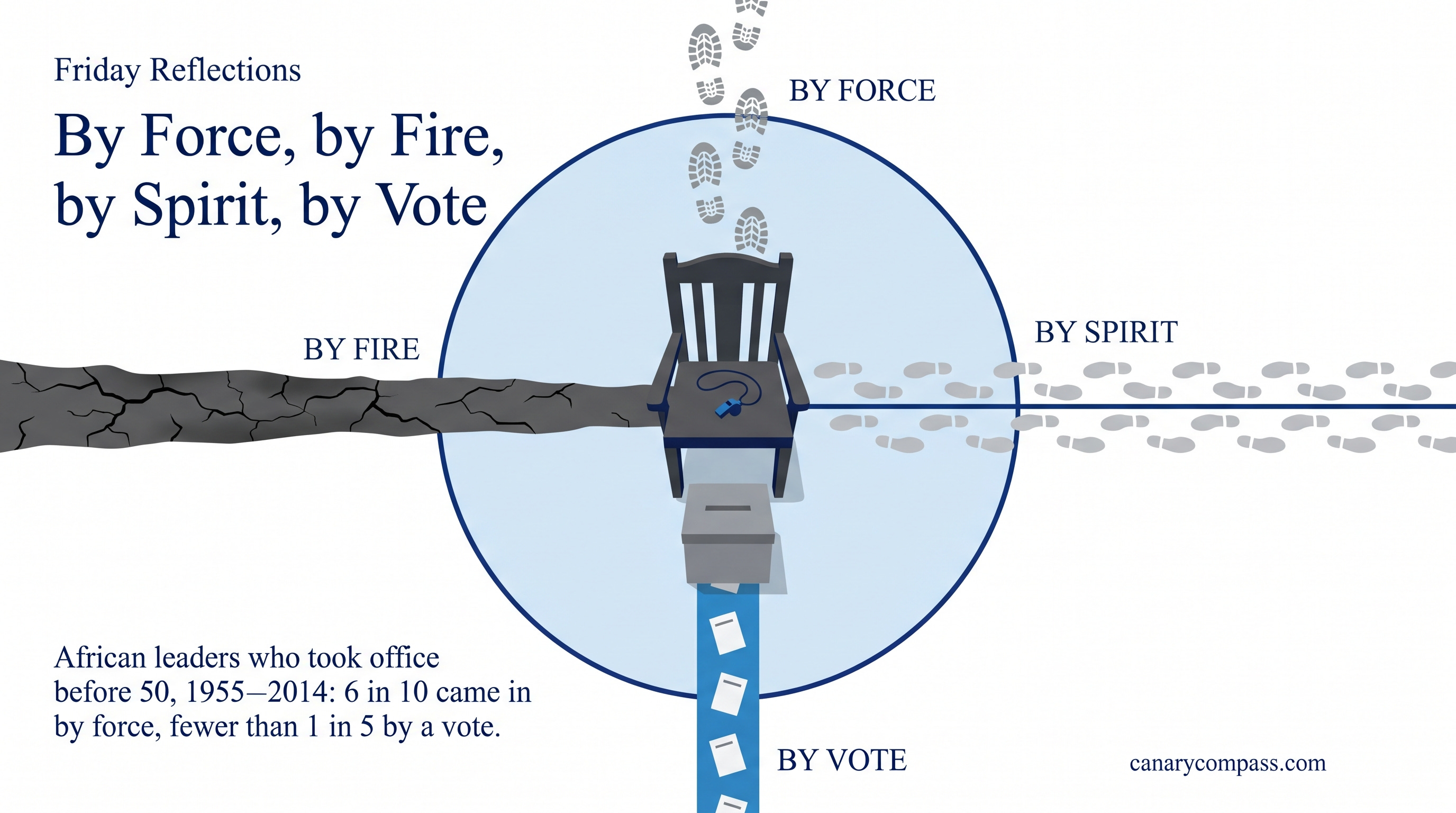
AI-illustration: Four roads lead to the same chair. Africa's young leaders mostly came in by force, and rarely by a vote
Canary Compass will move to paid subscriptions soon. Founding members put two questions a month to Dean and join a quarterly call. Founding membership is limited to 10 people. Pledge now; you pay nothing until paid publishing begins. Friday Reflections will stay free. See every plan and what it includes. Institutional licences: dean@canarycompass.com
On Tuesday evening I was catching up on X. The Court of Arbitration for Sport had just given Senegal its Africa Cup of Nations title back. The forfeit rule, it said, applies only when the referee ends the match, and the referee had let play go on.
Senegal took me back to a January video of Cristiano Ronaldo welcoming Sadio Mané back to Al Nassr as the champion. Then I went down a rabbit hole, as I usually do when I let my mind wander. I got thinking about why Cristiano ended up in Saudi Arabia after United, and whether the age gap had a part in what failed there.
It’s also election season. Zambia voted in August, Uganda and Tanzania before it, and Kenya is next. Then it hit me: all these countries are young, and their leaders are old. The gap itself is no secret: Africa’s median age is about 19, and the median age of its leaders is about 63. I half expected countries to do better when the two are closer.
So I tested it. Putting today’s Africa beside today’s Europe tests nothing, because Europe got old as it got rich. The fair test catches countries when they were as young as we are: the year each country’s median age reached 20, followed for 20 years. Of the 53 countries that passed that point between 1955 and 2000, most were in Asia and Latin America, and just 3 in sub-Saharan Africa. Africa got younger after 1955, its median age falling from 17.9 to 16.3 by the 1980s, and the UN expects it to reach 20 only in 2029.
I measured how households fared by spending per head, since GDP per head also counts what the state and investors spend. If my hunch was right, the narrowest gaps should have pulled ahead. They didn’t. Among them, spending boomed in Singapore and Mongolia and shrank in Qatar and Lebanon. China went the other way: Deng, more than 50 years older than the median Chinese, ran it for most of those years, and household spending grew among the fastest. Within countries over time, spending growth didn’t track the gap either. But spending per head is an average. So I checked the poorest 40 per cent’s share of income, the share below the World Bank’s USD3.00-a-day poverty line, and deaths of children under 5. Neither the share nor poverty moved consistently with the gap. Child deaths fell more slowly where gaps were widest, but faster when a country’s own gap widened. The gap didn’t decide who got better off, so I let the hunch go.
The gap does cost something, though: voice. Researchers found that in democracies where politicians are much older than the public, people have less confidence that their representatives speak for them, and support for democracy is lower.
Back home, our gap widens from both ends. High fertility keeps our people young, and our leaders stay. Between 1960 and 2021, sub-Saharan leaders took office at a median age of 52, no older than Europe’s, but stayed 2.5 times as long on average. More than a third served 10 years or more, against 7.3 per cent in Europe. That’s a problem for those who want term limits removed and point to Europe, where most prime ministers face none. Even without limits, Europe’s parliamentary democracies changed leader 3.3 times as often as we did, and only 5.6 per cent of their prime ministers lasted 10 years. Voters and parliaments make them leave. Ours were 6.0 times as likely to stay that long. Mo Ibrahim said it years ago: the trouble is less the age at which our leaders take power than their reluctance to give it up.
Ours stay by capturing the referees: parliaments, courts and constitutions. In 2017 Uganda’s parliament scrapped the presidential age limit of 75, which let the sitting president run again. It had paid each member for “consultations” that opponents called a bribe, and the courts upheld the change. In Côte d’Ivoire, the Constitutional Council ruled that a new constitution restarted the president’s term count, and last year he won a fourth. In 2024 Togo moved to a system whose real head of government faces no term limit, and last year its president took that job. In the Africa Center‘s 2024 count, leaders who kept to term limits had served an average of 5 years, and those who evaded them a median of 16. Referees can hold, too. In 2006 Nigeria’s Senate threw out an amendment that would have let the president run for a third term.
When leaders won’t leave, change comes by force, by fire, by spirit or by vote. I sorted 1,453 changes of leader worldwide between 1955 and 2014 by how each came about. Coups tend to come in bad times, so I allowed for how fast each country had been growing, how rich it was, and where and when.
By force, soldiers ousted leaders 214 times, and spending over the next 5 years grew about 1.1 percentage points a year slower than after a vote. By fire, rebels won 30 times, and spending afterwards did worst. By spirit, crowds brought down 29 leaders, and spending after them grew about as slowly as after a coup. Fire and spirit rest on too few cases to be sure. By vote came the best growth of the four. Orderly handovers without a real vote did about as well, the poor included: child deaths fell at much the same pace, and the poorest 40 per cent’s share moved no differently. But only those already in power can call a handover.
One thing bothered me as I went. American and European institutions built most of these records, and some judge which countries count as democracies. Rather than absorb someone else’s ranking whole, I ran the test twice, their way and on my own rule, which asks only whether an election had just taken place. It held both ways. Africa’s coups and rebellions point the same way on fewer cases, and its 7 crowd-led exits are too few to judge.
Those same records held something I didn’t expect. Africa has had plenty of young leaders, and when our leaders have got younger, it has mostly been through force or fire. Of the African leaders who took office before 50 between 1955 and 2014, 6 in 10 came in by force and fewer than 1 in 5 by a vote. Leaders installed by force here had a median age of 43, against 56 for leaders who came in the regular way. In 2021 soldiers in Mali replaced a transitional president of 70 with a colonel of 37, and in Chad, when the president died, the army installed his 37-year-old son. The young got a younger ruler, not a voice. And many of those young leaders grew old in office: more than 4 in 10 ruled for 10 years or more, and 12 for 20 or more. Even force isn’t the norm: about a third of sub-Saharan countries, South Africa, Kenya, Zambia and Senegal among them, have never seen soldiers remove a leader, while Nigeria has had 6.
Then there’s the Sahel, where the noise online about its new rulers runs both ways. Their coups are too recent for a few years of figures to settle it. The long record is the fairer test, and it says force costs.
That reminds me of Zechariah: “Not by might, nor by power, but by my spirit.” Might and power are force and fire, and the record says they don’t deliver. The crowd’s spirit on its own didn’t deliver either. What made the difference was carrying it to the ballot.
Senegal has done that more than once. In 2012 its voters turned out a president seeking a third term. In 2024, when his successor tried to push back the election, crowds came out, the Constitutional Council held, and a 44-year-old outsider won. Senegal isn’t rich for it: the new government ordered an audit, and the Court of Auditors confirmed debt the old one hadn’t reported, as did the IMF. The test goes on: this year the new president fell out with the man who backed him, and the local elections announced for January look set to slip.
That brings me back to the gap. Our leaders’ age is the symptom of their staying, and capturing the referees is how they stay. If the young want change, they have to prove it at the ballot, the route that has worked and the one that has rarely put the young in office. Then keep the referees strong enough to make any leader leave, young ones included. On Tuesday a result stood because a referee let the game go on and a court refused to rewrite it. A young country needs the same from its own institutions.
Go figure. Down a rabbit hole, and nothing new to see after all. It always comes back to the vote, as long as you’ve got it.
I expect that a 19-year old selecting a leader will default to what is familiar, parent and parent-peer generation (50-60+ year old), their most natural symbol of leadership and stability. Much harder, I expect, for them to select much else.