

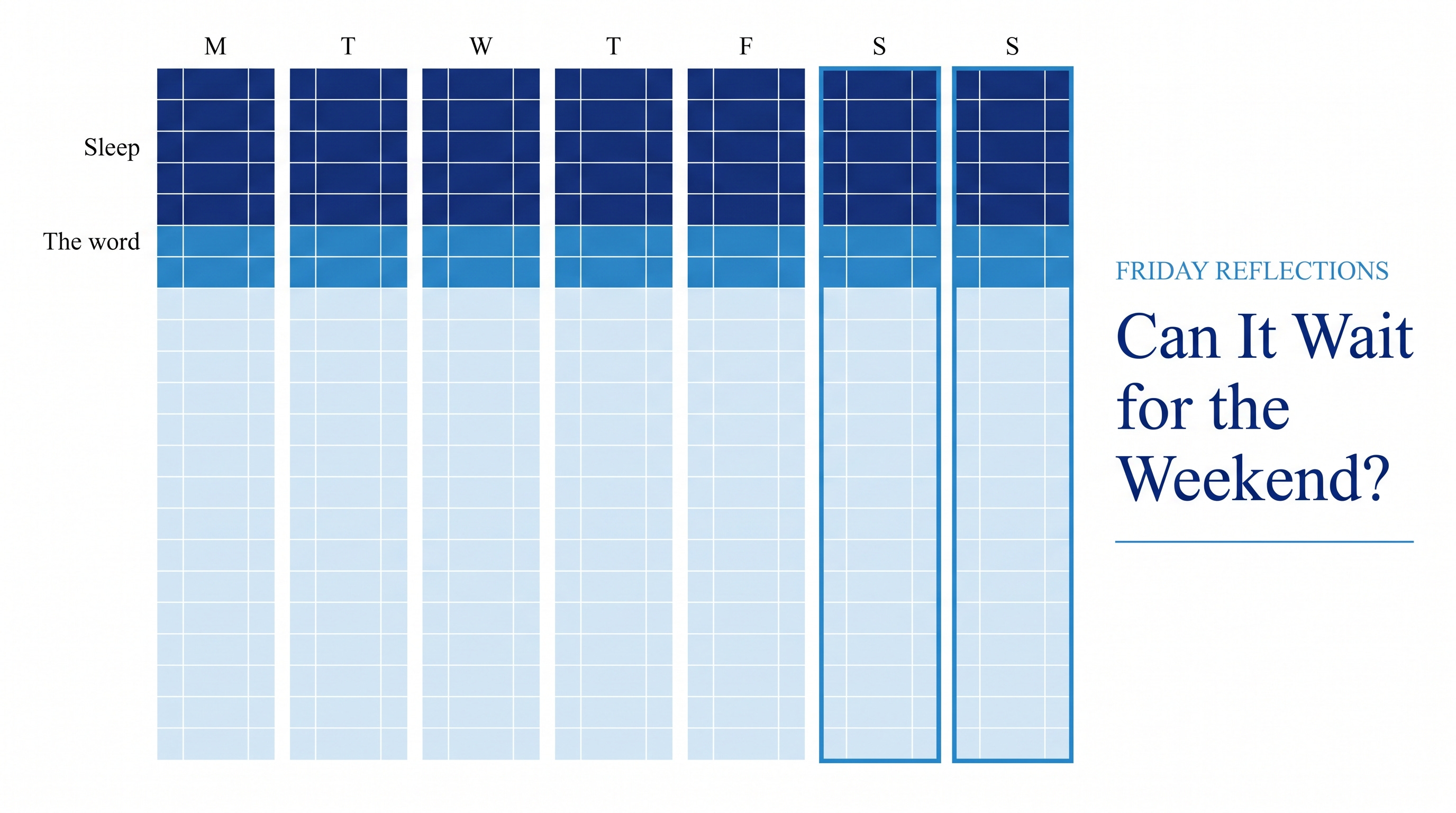
AI-illustration: Sleep and the Word, Set First Every Day of the Week.
Canary Compass will move to paid subscriptions soon. Founding members put a question to Dean every month and join a quarterly call. Founding membership is limited to 50 people and closes at launch. Pledge now; you pay nothing until paid publishing begins. Friday Reflections will stay free. See every plan and what it includes. Institutional licences: dean@canarycompass.com
In case you missed it, on Thursday we published AFRICA POLICY NOTE: Who the Pension Money Serves.
This week a lot of my conversations have been about sleep. How many hours do you sleep? How many hours do you work? They took me back to the perfect 24-hour plan I have been trying to build since 2017.
I write from a Christian foundation, because that is who I am. That foundation is not universal. Malachi 3:10 is cardinal for me. The tenth goes to God, a tenth of gross and not net. Charity does not count towards it. I strive to make it a full 10 per cent and do not always manage. For most of a working life, tax, mortgages and school fees eat into it, and life gets in the way. The plan applied the same rule to time: a tenth of the gross day is 2.4 hours. There are other claims on my day too: I want to be the best in my field, and I want time with my family.
The common advice is 8 hours of sleep. Medical guidance for adults is at least 7. For a working professional even 7 is hard, so you settle for 6.5, or less. My plan set 5 hours of core sleep and a 1.5-hour siesta, at the same times every day, Monday to Sunday. God got 1.5 hours, short of the 2.4 I started from.
I still keep the plan’s daily list and mark myself against it. The set times slip, and I regularly miss the siesta. When I worked someone else’s hours and commuted, I kept the sleep times perfectly: 9:00 PM to 2:00 AM Central Africa Time. The early start went to God first, then to the overnight markets and the previous day in Zambia, before trading began. Now I work from home on my own hours, and the times drift. I switch off the alarm and wake when my body says, usually after 5 or 5.5 hours.
The hours have to come from somewhere, because being the best in a field seems to need more of them. In one study, surgeons in training slept 5.3 hours a day. America’s latest time-use survey shows people aged 35 to 54 spend the most time at work and the least on personal care, sleep included. An earlier study of the same survey linked work most strongly to shorter sleep, followed by travel. In Nairobi, commuting 10 kilometres each way at rush hour costs 65 minutes a day.
Those years are also when founders start the firms that grow fastest. Among American start-ups, the founders of the fastest-growing 0.1 per cent were 45 on average, and prior experience in the same industry predicted far greater success. By then, Arthur Brooks writes in From Strength to Strength, raw mental sharpness has started to go. He points to a second curve: wisdom that grows with experience. He borrows the Hindu stage of vanaprastha, a turning from career towards spirituality, at around 50. The founder starts building about 5 years before that. This is where the book loses me. It assumes a life that runs in one order: build while sharp, then teach while wise. Lives with ups and downs do not keep that order, founders least of all. The experience Brooks would turn into teaching is what the founder builds with.
At the top, sleep holds up better: 27 chief executives of large companies worked 62.5-hour weeks and still slept 6.9 hours a night.
I cannot trust my body’s alarm. In one laboratory study, volunteers who spent 6 hours a night in bed for 2 weeks built up deficits in attention and memory equal to a full night without sleep, and barely noticed. Among 60,977 adults, sleep regularity predicted the risk of dying better than sleep length did. The research counts both against me: my nights are short, and since I began setting my own hours, they are no longer regular.
Brooks writes that strivers, who tie their worth to how they perform, answer decline by working harder. He sums up his answer in seven words: ‘Use things. Love people. Worship the divine.’ Sleep is not in them.
Put two questions to every claim on your day. Can something else stand in for it? Can it wait for the weekend? Work passes the first, because you can delegate it, unless you are a founder still building in your own image. Then it can only wait for the weekend. Family passes the second. What your family misses on a weekday, you can make up at the weekend, as long as the weekend comes.
Two claims fail both. Sleep is one. Nobody can sleep for you, and one study found that sleeping in at the weekend did not prevent metabolic problems once short sleep resumed. Time with God in his word is the other. The same time-use survey puts time for religious, civic and volunteer activity at its lowest between 25 and 44, at 8 to 10 minutes a day. St Josemaría Escrivá, who founded Opus Dei, taught that any honourable work can be prayer, and Rick Warren teaches much the same. I do not feel it replaces reading the Bible. On days I do not read, I listen to a sermon, which I find better than an audio Bible, though it is someone else’s reading. You still have to read the Bible and engage it daily, and nobody can do that for you.
My plan came up short in the same two places. We usually talk about balance as work against family, but work and family can bend. The squeeze falls on the two that cannot, and hardest on a founder.
As with the tithe, what is due comes first, off the gross. I let my work eat into sleep and the word, and I have not fixed it. So both have to come off the top of the day, at set hours, and work and family share the rest. This weekend, run your own week through the two questions and see what came up short.