

AI-illustration: One pension fund, ring-fenced by where its money goes: home, Africa and the rest of the world.
Canary Compass will move to paid subscriptions soon. Founding members put a question to Dean every month and join a quarterly call. Founding membership is limited to 50 people and closes at launch. Pledge now; you pay nothing until paid publishing begins. Friday Reflections will stay free. See every plan and what it includes. Institutional licences: dean@canarycompass.com
“Your Pension Financed a Losing Trade. Nobody Asked You.“ (Canary Compass, 23 October 2026) and “The Lesson From Paraguay for Anyone With an African Pension“ (Canary Compass, 6 November 2026) asked whom African pension money serves in practice. The second promised the full design, which answers one question. How does a pension protect the retirement its members save for, give each member some control and finance its own continent, and still serve the member first? The answer is a portfolio of ring-fences, each with a purpose and a limit, in which the state enters as a borrower that pays. Hard limits set the numbers they can; judgement sets the rest, and the text marks it. The parts have precedents; the combination and the settings are ours. The design is for funds that run their own portfolio and does not replace the actuarial work a promise scheme needs.
PAYWALL LINE. From the paid launch, free readers stop here. The summary box, our numbers and the verdict below are for subscribers. Until then, this Note is free in full.

1. What Debtors Owe the Funds, and the Source Rule
The first ring-fence is around the contribution. Table 1 sorts what debtors owe five systems (Ghana, Kenya, Nigeria, South Africa and Zambia) into five kinds, each with its own remedy. The amounts are in Ghanaian cedi (GHS), Kenyan shilling (KES), Nigerian naira (NGN), South African rand (ZAR) and Zambian kwacha (ZMW).
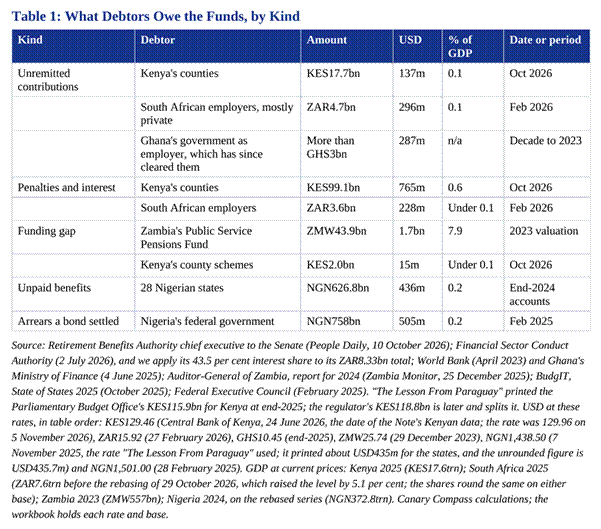
Zambia’s gap is a promise the state has not yet funded. Kenya’s three parts sum to KES118.8bn (USD918m), 83.4 per cent of it penalties.
The source rule “The Lesson From Paraguay” proposed is that the deduction and the employer’s contribution leave in the salary’s own payment instruction. Australia made it law on 1 July 2026: contributions must generally reach the fund within seven business days of payday. Kenya’s county payrolls have remitted pension deductions with salaries since the same date, on the Controller of Budget’s evidence to the Senate (People Daily, 10 October 2026). The county pensions taskforce proposed making contributions a first charge on the County Revenue Fund (Budget Watch 2026, paragraph 73). The regulator is weighing a wider version: routing statutory deductions from the National Treasury straight to schemes (Kenya Broadcasting Corporation, 9 November 2026). The Reflection’s route for the counties, the schemes’ share off the national transfer, needs an amendment to Article 219 of the Constitution.
Of what the counties already owe, the KES17.7bn of contributions is the members’ own money, so they pay it first. Only ten counties had confirmed their liabilities by 18 June 2026, the Treasury told the Senate (The Standard, 1 September 2026). The penalties need a price. The taskforce proposed restating them at the 91-day Treasury bill rate; the rate each fund credited its members in those years would leave the member where he would have stood. The funding gap follows an actuary’s schedule. Unpaid benefits are a budget arrear, which a state pays in cash or, as Nigeria’s federal government chose, from a bond. Settlement paper must name its issuer. National government paper counts inside the government limit, though a fund receives it and does not buy it; county paper is not eligible, because no reading exists for a county.
2. The Member’s Slice
The slice gives the member control over a part of his saving and no more. A fifth of each new contribution goes to it, four-fifths stay locked, and both earn the fund’s return. The member may draw from the slice in one window a year, so that the fund knows the date, or borrow against it and repay through payroll. A loan cannot exceed the slice balance, and a loan outstanding comes off what he may draw. Zambia’s Public Service Pensions Fund has lent to serving members since 2012.
A fifth is a judgement. Five of the six rich-country systems that Beshears and others studied (American Economic Review, 2015) keep savings largely locked before 55; the United States is the exception. A fifth sits between the precedents “The Lesson From Paraguay” described: Malaysia’s tenth at will, or a quarter once housing, education and health count, and South Africa’s third of new contributions. A member who draws the whole slice every year retires with a fifth less from those contributions, and the fund should tell him so.
The split fits a young defined-contribution scheme of Kenya’s kind, where the member’s pot is his pension. A promise scheme, which owes a set pension, takes the slice off that pension instead. Zambia’s National Pension Scheme Act of 2026 lowers the minimum pension of a member who takes the early lump sum to 80 per cent of the standard minimum (section 36).
3. The Portfolio
Table 2 sorts the fund by where the money goes, home, Africa and the rest of the world, and then by instrument, with each ring-fence’s purpose before its limit. Kenya’s schedule sorts by instrument and counts East Africa as home, so the two columns beside it do not match row for row.
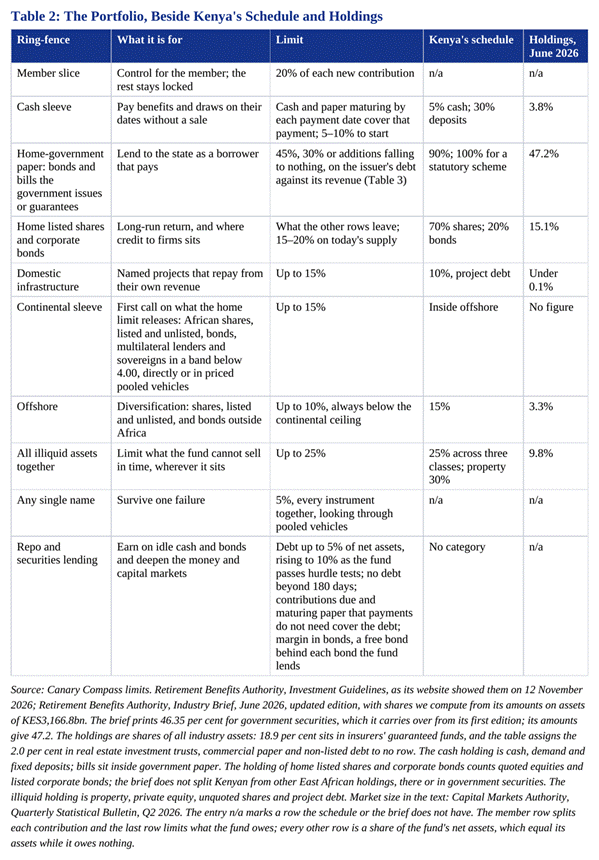
We derive the limits in order, on Kenya’s schemes at June 2026.
Cash comes first because the fund’s own payments set it. A scheme with net inflow starts at 5 to 10 per cent (Section 6); one that pays out more than it takes in holds a year of pensions plus the slice balance. A Treasury bill is not cash until it matures. Kenya’s bills trade only over the counter, dealer to dealer. The Central Bank rediscounts them, buying them back before maturity, only as a last resort, at the prevailing rate plus 3 percentage points. At October’s one-year rate of 9.04 per cent, that costs 0.2 per cent of face on a bill with 30 days left and 2.5 per cent on a one-year bill a fund has just bought.
Government paper comes second: Kenya’s band allows 30 per cent (Section 4), leaving 60 to 65 per cent to place.
The home market comes third, and its limit is supply. Kenya’s schemes hold 15.1 per cent in listed shares and corporate bonds, and already own 11.7 per cent of the Nairobi Securities Exchange by value. Every corporate bond outstanding, KES95.8bn (USD740m) in March 2026, equals 3.0 per cent of pension assets, and 1.5 per cent without the state’s Linzi notes. Even holding every corporate bond, the schemes would need 14.3 per cent of the exchange to take the row to 20 per cent. The schedule’s 70 and 20 per cent are not what holds credit back. We judge that the home market can take 15 to 20 per cent on today’s supply; that reads supply and sets no ceiling. Funds therefore need an outlet beyond it, and funds that hire credit managers and lend on terms have to build the market for credit to firms. A note the fund can sell in time for its payment dates sits in this row; one it cannot counts under the illiquid ceiling, listed or not. Long-term domestic savings build a local-currency market for lending to firms, and a pension pool is such savings.
Illiquid assets come fourth. A quarter of the fund is a judgement: the most we would lock in assets that have no market price and that the fund cannot sell to pay a member. A scheme that pays out more than it takes in should hold less. One ceiling counts them together, and an unlisted holding in Africa or offshore counts under its sleeve and under this ceiling. Kenya’s schemes hold 9.8 per cent in such assets, which leaves 15.2 points for infrastructure, unpriced loans and unlisted holdings together, and caps infrastructure at 15. That row is for named projects that carry a price, security and revenue the project sets aside for repayment, the test “Your Pension Financed a Losing Trade” set.
That leaves the room outside the home market, 15 to 25 per cent. The two ceilings fill the top of that range, and their split is the last judgement. At the low ends the rows sum to the fund, in per cent: cash 5, government 30, home listed 15, illiquid 25, Africa 15 and offshore 10. Kenya’s schedule puts Africa beyond East Africa and the rest of the world under one offshore limit of 15 per cent. The portfolio splits them, the reclassification “The 2026 Inflection, Part II: Pricing, Measurement, Capital“ (Canary Compass, 21 April 2026) proposed. Africa takes the larger share, 15, so that the continent pools its savings into African shares, credit and projects. The money the home limit releases went to an African borrower, and African borrowers that qualify have first call on it. First call is an order of looking, not a claim: an African asset still has to pass the hurdle (Section 5) and fit its ring-fence. Local-currency bonds that African multilateral lenders issue at home count in this sleeve and use no foreign exchange. Offshore takes the other 10. Filling both ceilings would need a change to Kenya’s rule; schemes leave KES370.0bn (USD2.9bn) of the schedule’s offshore room unused today.
The single-name limit counts deposits and cash the fund lends against bonds too, and treats connected issuers as one. Five per cent is a judgement: half of Paraguay’s legal 10, so that one failure at half recovery costs 2.5 per cent of the fund and the loss of a whole name costs 5. The limit excepts only paper the government itself issues, because Table 3 governs it.
Repo, a sale of bonds with an agreement to buy them back, and securities lending get a category Kenya’s schedule lacks. A fund lends cash against government bonds (a reverse repo). It also lends its bonds against cash and invests that cash, which is borrowing, and the return on it is what brings a fund to the market daily. Cash is fungible: one shilling replaces another, so a rule on what borrowed cash buys would bind nothing. The ring-fences bind instead: every ceiling applies to net assets, the members’ money, and counts everything the fund owns, including bonds out on loan.
Four rules bound what the fund may owe. The limit starts at 5 per cent of net assets and rises to 10 after two more consecutive passed hurdle tests, mirroring the two failures that bar a manager; a failed test stops new borrowing. Both are judgements, and both follow the single-name limit. If what the borrowed cash bought lost half its value, the cost would be 2.5 per cent at the start and 5 at the ceiling, the two losses that limit already accepts. No debt runs beyond 180 days, a judgement: cover should not rest on contributions further ahead than that, given the arrears in Section 1. A lender calls margin, extra security, when prices move. The fund meets it in bonds, under a contract that says so, and keeps at least one free bond behind each one it lends. Contributions due by any date, and paper maturing by then that payments do not need, must cover what the fund owes by that date, so that it repays a departing lender without a sale. Contributions count at the rate the fund actually received over the last year.
Most regimes let a pension fund borrow only briefly, for liquidity: the European Union’s directive says so, and Australia allows 10 per cent of assets for 90 days. South Africa has Africa’s most developed repo market, and its pension rules leave funds very modest users of it (International Capital Market Association, February 2026). Canada’s eight largest funds finance about 8 per cent of their assets through repo (Bank of Canada, February 2025, citing a 2021 study). Pension funds hold the bonds a repo market needs, the case “Zambia Monetary Policy. Structure Before Sentiment. Part 3: Foundations for Transmission“ (Canary Compass, 9 December 2025) made for Zambia.
Apart from the two coverage rules, every limit is a ceiling, never a floor, and binds new money only: a fund sells nothing to meet one. A fund above a ceiling adds nothing to that row until growth or maturities bring it back. Where the government limit is 45 per cent, the rows add to more than the fund, so the board chooses among them.
4. The Government Limit
Each January the fund reads the debt of the government that issued its paper against that government’s revenue, including grants, on the latest published figures. That government repays the paper, so the reading covers its debt and revenue alone. The fund never rewrites a reading. In the open band, below 3.00 times revenue, home-government paper may take up to 45 per cent of the fund. In the middle band, from 3.00 to under 4.00, the limit is 30. In the closed band, at 4.00 or more, a fund’s additions fall to nothing in equal yearly steps over five years, from what it added in the year before. After that it replaces what matures and adds nothing except bills of 91 days or less inside the cash sleeve. Ghana’s 2022 exchange exempted Treasury bills. A fund above its limit, or above 30 per cent in the closed band, also comes down to that level in equal yearly steps over five years, which it measures each January. Five years is the horizon the fourth limit below uses. The fund may buy only up to that path, and in the closed band only up to the lower of the two. The fund sells nothing: one that growth and maturities leave above its path buys no home-government paper and publishes how far behind it is. The steps give the Treasury time to find other buyers and the fund time to find other assets. The first reading sets the starting band, and Table 3 takes January 2026 as the first. After that a band becomes stricter after two consecutive readings above a line, and looser after two below, so that one revision or a miss of 0.01 does not move it. An event overrides the bands and the path. A default, an announced exchange, arrears on any market debt of the issuer, domestic or external, or an unpaid call on a guarantee stops every purchase, including bills. Purchases resume once the exchange has settled and debt service is current, at the band the next January reading sets.
A limit on home-government paper is not new. Latin American regimes cap it (World Bank, Pension Reform Primer), Peru at 30 per cent for paper its government issues or guarantees (Organisation for Economic Co-operation and Development, 2019). No regime we found moves the limit with the issuer’s debt against revenue. The path has precedents too. Botswana is moving its funds’ domestic share to 50 per cent in yearly steps over five years to December 2027 (Non-Bank Financial Institutions Regulatory Authority, Circular 2 of 2023). Namibia allowed seven months for a ten-point move in 2018, and funds met it two years late. For banks’ holdings of their own governments’ debt, Véron (2017) proposed a long phase-in and an exemption for existing debt. The Financial Stability Board told regulators in 2010 to stop writing credit ratings into rules. The reading uses debt against revenue instead, because revenue is what repays and a fund can find both figures for every issuer. “The 2026 Inflection, Part II” sorts countries by interest against revenue for capital that goes into firms. A fund holding its own government’s paper reads debt, because captive funds hold that interest bill down. The settings follow five limits, in order.
First, the lines come from the record. Across 90 external defaults between 1827 and 2008, Reinhart and Rogoff put total public debt at 4.21 times revenue on average in the year of default; the upper line sits just below, at 4.00. The median B-rated sovereign ran from 2.59 to 3.25 times between 2019 and 2021 on Fitch’s count, and the lower line, 3.00, sits inside that range. The record is of external defaults. The rule applies it to domestic paper because the same revenue services both, and Ghana, at 5.89 in 2022, began its default with its domestic bonds. Zambia stood at 6.91 when it defaulted in 2020. Second and third, the limit falls as the reading rises and stops at the upper line. Fourth, a limit must be reachable by growth alone, because funds that hold near half their assets in one issuer’s paper cannot all sell without moving the price against themselves. At half of last year’s asset growth, Kenya’s schemes would stand at 26.1 per cent after five years and Nigeria’s at 32.6. Five years and half growth are judgements, and on them the middle limit cannot sit much below 30. Fifth, no limit reaches half the fund. Reinhart and Sbrancia list pension funds among the captive lenders of indebted states; a fund mostly in one borrower’s paper is that borrower’s financing arm. The open band’s limit is 45. The five points below half are a judgement: room for prices to move. A fund that starts above half, as Nigeria’s do, comes down on the path like any other.
The ratio is a blunt screen. Six of the 13 defaults Reinhart and Rogoff tabulate came below 3.00, which is why every band has a limit and an event overrides the bands. The ratio ignores interest cost and maturity, and counts dollar and local debt alike.
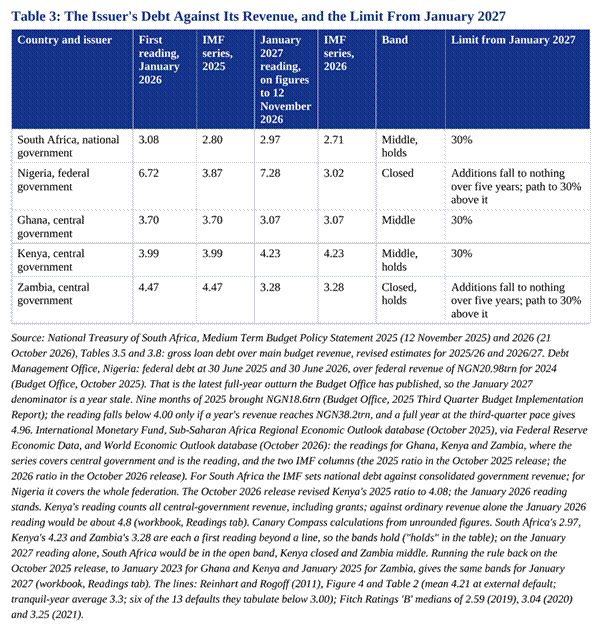
The January 2027 column shows the reading on figures to 12 November 2026; the fund takes the reading itself in January. Table 3 sets the IMF’s series beside each reading. For South Africa and Nigeria that series is wider than the issuer, so the table shows it and the rule does not use it.
On the IMF’s 2027 projection of 4.28, Kenya would post a second reading above 4.00 in January 2028. Its band would then close.
Zambia paid its local bondholders in full through its 2020 default on dollar bonds, at yields the limit would have refused. Ghana’s 2023 exchange left pension funds face value and average maturity, and about 85 per cent of the old cash interest for two years, by the memorandum’s terms. A fund cannot know beforehand which of the two it will get, so the limit gives up the first return. The state pays too. Kenya’s schemes added KES166.0bn (USD1.3bn), 0.9 per cent of GDP, to their government securities in the year to June 2026, including valuation. Over the path the Treasury must find other buyers for a growing part of that. The limit tightens as the state’s position worsens; two readings, the path and no sales slow that withdrawal without reversing it.
The same bands sort the continental sleeve. A Kenyan fund could buy South African or Ghanaian government paper within the single-name limit, and no Nigerian or Zambian paper. State securitisations, bonds that a pledged revenue repays, and guaranteed paper count twice, inside the government limit and as a single name. A guarantee is conditional for the government and whole for the fund relying on it. Kenya’s Linzi 003 notes, which “Converting Vices into a Virtuous Sporting Cycle“ (Canary Compass, 17 September 2026) counted as public borrowing, are the case.
5. The Hurdle
Each fund publishes a hurdle before its year begins and reports against it monthly. The floor is the one-year Treasury bill at the last auction before the year, or inflation over the year where that proves higher; a fund may commit to more. The bill is what a member’s money earns with no manager, and a return below inflation leaves the member poorer. The hurdle is an objective the fund answers for, not a guarantee anyone must fund. Each year-end, the fund tests the return over the last 36 months, net of fees, against the hurdles of those months. Nigeria’s National Pension Commission has required administrators to publish that window monthly since 1 July 2025. A manager that fails two consecutive year-end tests takes no new money until it passes one; a single failure can be one bad window. Where most managers fail, the year is at fault as well, and the bar applies only to those below the median. Inside the ring-fences the manager chooses the assets, and the hurdle makes a poor choice expensive. The fund judges a manager on conduct, not ownership: the manager faces the hurdle, lends to no affiliate and leaves its files with the fund.
A hurdle alone pushes funds toward whoever pays most, and a high rate from one name often prices the concentration behind it. The single-name limit is the first guard, and the board independence “The Lesson From Paraguay” set out is the second.
6. The Portfolio on the Record
The cases below are arithmetic on published documents, which the workbook sets out; they do not prove the settings optimal. Kenya and Nigeria carry most of them because their regulators publish holdings and fund returns.
Liquidity. Kenya’s National Social Security Fund (NSSF) took in KES92.3bn (USD713m) in the year to June 2026 against assets of KES742.4bn (USD5.7bn). A first year’s slices are a fifth of that, KES18.5bn (USD143m), and benefits were KES8.7bn (USD68m) in the last audited year. A 5 per cent sleeve covers both 1.4 times, before operating costs. At the far bound, where members draw a slice worth a fifth of the fund in one year, a 10 per cent sleeve and contributions less benefits meet the draw. A 5 per cent sleeve falls 3.7 per cent of assets short. South Africa is the one system of the five where members have drawn a slice. It approved withdrawals of ZAR43.4bn (USD2.3bn) in that slice’s first five months, 0.7 per cent of end-2023 assets, from a pot that started with 10 per cent of each balance, up to ZAR30k.
Borrowing. On the same figures the coverage rule lets the NSSF owe KES25.6bn (USD198m), 3.5 per cent of net assets, for one month. For three months it allows 5.3 per cent, so the starting limit binds, at KES37.1bn (USD287m). At 180 days it allows 8.1 per cent, KES60.4bn (USD467m), so coverage binds before the 10 per cent ceiling. A 90-day limit would have left the second step empty. The test counts only the cash sleeve as maturing paper. For Kenya’s schemes together the start is KES158.3bn (USD1.2bn) of bonds on loan, and half a year of contributions is 5.1 per cent of assets.
Concentration. Paraguay’s social security institute told prosecutors on 10 November 2026 that it had USD516.4m at Ueno, the failed bank: USD358.7m of retirement-fund placements and USD157.7m in three operating accounts. “The Lesson From Paraguay” printed about USD345m for the placements. The placements sat inside Paraguay’s legal limit, which counts a fund’s total resources per bank. At half recovery, an illustration, the loss is USD258.2m. Under a 5 per cent limit counting every balance it would have been USD100m, taking the placements as 9 per cent of the portfolio, the institute’s own count. Kenya’s Public Service Superannuation Fund (PSSF) bought KES16.3bn (USD126m) of the Linzi notes in mid-2025, 6.7 per cent of its fund; the limit allows KES12.1bn (USD94m).
Hurdle. The one-year bill paid 12.157 per cent at the last auction before the fiscal year 2023/24 (FY2023/24), and the NSSF’s 11.0 per cent and the PSSF’s 11.9 per cent fell short of it. Both cleared the 16.79 per cent floor in FY2024/25, the NSSF by 0.2 points. These are the rates each fund declared for members in two single years; the 36-month test needs a third. In Nigeria, December 2024 inflation of 34.8 per cent set the floor. Every administrator’s Fund II, the default for workers under 50, fell short: 31.6 per cent at best and 17.2 on average. A floor no administrator reached is the case the median clause is for.
Transition. Kenya’s schemes held 47.2 per cent of their KES3,166.8bn (USD24.5bn) of assets in government securities at end-June 2026, down from 52.5 per cent a year earlier. Assets grew 25.1 per cent in that year, or 17.6 per cent after inflation of 6.4 per cent. The two shares are of all industry assets. On the assets schemes invest directly, leaving out the 18.9 per cent in insurers’ guaranteed funds, the share is 58.2 per cent, so a scheme’s own path is steeper, 5.6 points a year. The industry’s path asks for 3.4 points a year; the share fell 5.3 last year while the schemes still added to their holdings. At that growth the first step does not bind, and at half of it the schemes may still add two-fifths of what they added last year. Take no investment return, flat contributions and members drawing the slice in full each year. Then the schemes leave KES158.4bn (USD1.2bn) of maturing paper, 10.6 per cent of the holding, unreplaced over the five years, before benefits and costs. Each further KES10bn a year of net outflow adds KES15bn. The distance is KES545.2bn (USD4.2bn) at June’s assets, and the path assumes that money finds assets: the work of the infrastructure and continental ceilings and of credit managers. Nigeria’s schemes held 56.0 per cent in federal securities in August 2026, 6.0 points above half the fund and down from 61.1 a year earlier. Their path asks for 5.2 points a year, against 5.1 last year. Nigeria sits in the closed band, so additions also fall by a fifth of last year’s amount each year. At last year’s growth that rule binds: four-fifths of last year’s addition in the first year and nothing in the fifth. At half that growth the share path binds: a tenth of last year’s addition in the first year, and from the second the funds leave some maturing paper unreplaced.
7. Build Order, What the Design Needs Next and What to Watch
Pay-at-source comes first. The government limit and its five-year path start at the first January reading, and every ceiling binds new money from that date. The draw window opens once the cash sleeve covers it and member records are right. The published hurdle follows within a year, and funds hire credit managers against it. A fund lends cash against bonds from the start and borrows against them once its managers have passed a first test. Loans against the slice come last, once repayment through payroll works, because the slice is the loan’s only security.
What the design needs next:
1. The legal instrument for each change in each system, statute, regulation or board resolution, including the right to borrow against bonds and each system’s rule on foreign assets.
2. A first test in two steps. Run the bands back reading by reading against a fixed limit. Then run the whole design on two schemes for a year, one taking in more than it pays and one paying out more.
3. Each scheme’s own holdings, maturities and cash flows, on which its path runs. The tests here are industry arithmetic.
4. A test of the Africa and offshore ceilings against the supply of assets that qualify and the foreign exchange they would use.
5. The collateral and margin operations a fund needs before it borrows, and the return series for the hurdle: time-weighted, so that cash flows do not move it, on independently valued assets, by fund type.
6. Choice of risk and the right to move, the second of the four questions “The Lesson From Paraguay” asked. This design gives access, not choice.
What to watch:
1. Zambia’s first year of lump sums, against its scheme’s next actuarial check.
2. County-by-county remittance from Kenya’s July payroll system, and the rate at which counties restate the KES99.1bn of penalties.
3. The January 2028 readings: second readings beyond a line for Kenya, South Africa and Zambia.
4. Scheme-level returns from any regulator outside Nigeria in 2027.
Sources
ABC Color and EFE, Instituto de Previsión Social files a criminal complaint over USD516.4m at Ueno (Asunción, 10 November 2026); Auditor-General of Zambia, Report on the Accounts for the Financial Year 2024, via Zambia Monitor (Lusaka, 25 December 2025); Australia, Superannuation Industry (Supervision) Act 1993, section 67 (Canberra, 1993); Bank of Canada, Staff Analytical Note 2025-6: The new repo tri-party Canadian Collateral Management Service (Ottawa, 25 February 2025); Beshears, Choi, Hurwitz, Laibson and Madrian, Liquidity in Retirement Savings Systems: An International Comparison, American Economic Review 105(5) (2015); Budget Office of the Federation, Fourth Quarter and Consolidated 2024 Budget Implementation Report, via BusinessDay (Abuja, October 2025); Budget Office of the Federation, 2025 Third Quarter Budget Implementation Report (Abuja, 2026); BudgIT, State of States 2025 (Lagos, October 2025); Business Daily, NSSF and pension scheme buy more than half of Talanta Bond (Nairobi, 31 August 2026); Canary Compass, Kenya Policy Note: Converting Vices into a Virtuous Sporting Cycle (Nairobi, 17 September 2026); Canary Compass, Friday Reflections: Your Pension Financed a Losing Trade. Nobody Asked You. (Nairobi, 23 October 2026); Canary Compass, Friday Reflections: The Lesson From Paraguay for Anyone With an African Pension (Nairobi, 6 November 2026); Canary Compass, The 2026 Inflection, Part II of V: Pricing, Measurement, Capital (Nairobi, 21 April 2026); Canary Compass, Zambia Monetary Policy. Structure Before Sentiment. Part 3: Foundations for Transmission (Nairobi, 9 December 2025); Capital Markets Authority, Quarterly Statistical Bulletin, Q2 2026, Issue 67/2026 (Nairobi, 2026); Central Bank of Kenya, frequently asked questions on government securities and Operational Guidelines for over-the-counter trading of government securities (Nairobi, 2014); Central Bank of Kenya, Treasury bill auction results of 29 June 2023, 27 June 2024 and 15 October 2026 (Nairobi, 2023 to 2026); Debt Management Office, Nigeria’s public debt stock at 30 June 2025 and 30 June 2026, via TheCable (Abuja, 2025 to 2026); Employees Provident Fund, account restructuring, which it announced on 25 April 2024, effective 11 May 2024 (Kuala Lumpur, 2024); EFE, the institute’s investment director on its placements at Ueno, via Emol (Asunción, 4 November 2026); European Union, Directive (EU) 2016/2341 on institutions for occupational retirement provision, Article 19(3) (Brussels, 14 December 2016); Fair Work Ombudsman, Payday Super: new rules starting 1 July 2026 (Canberra, 10 December 2025, updated 3 February 2026); Financial Sector Conduct Authority, release on unpaid retirement fund contributions (Pretoria, 2 July 2026) and retirement fund statistics to 31 December 2023 (Pretoria, 2024); Financial Stability Board, Principles for Reducing Reliance on CRA Ratings (Basel, 27 October 2010); Fitch Ratings, Fitch Affirms Zambia at ‘CCC’ (December 2019), Fitch Revises Ghana’s Outlook to Negative; Affirms at ‘B’ (22 June 2021) and Fitch Downgrades Ghana to ‘B-’; Outlook Negative (14 January 2022); International Capital Market Association, Guide to Repo Markets: South Africa (Zurich, February 2026); International Monetary Fund, Sub-Saharan Africa Regional Economic Outlook database, via Federal Reserve Economic Data (Washington DC, October 2025); International Monetary Fund, World Economic Outlook database (Washington DC, 13 October 2026); Kenya Broadcasting Corporation, Retirement Authority moves to recover Ksh65B unremitted pension funds (Nairobi, 9 November 2026); Kenya National Bureau of Statistics, Economic Survey 2026 and Consumer Price Indices and Inflation Rates for June 2024, June 2025 and June 2026 (Nairobi, 2024 to 2026); Law No. 7235/2023 regulating the State’s supervisory role over pension entities, art. 42 (Asunción, 2023); Ministry of Finance, Ghana, statement exempting Treasury bills from the domestic debt exchange (Accra, 5 December 2022), Exchange Memorandum: Offer to Pension Funds (Accra, 31 July 2023) and Government Has Cleared All Arrears to SSNIT (Accra, 4 June 2025); Nairametrics, Best performing pension funds in Nigeria in 2024 (Lagos, 21 January 2025); Nation, Sh100bn payroll crisis: Budget boss bets on new system to stop counties withholding deductions (Nairobi, October 2026); Namibian Sun, Driving the fiscal borrowing agenda (Windhoek, 4 June 2019); National Pension Commission, Circular PenCom/INSP/Surv/2025/795 on the calculation and reporting of rates of return (Abuja, 9 May 2025); National Pension Commission, unaudited monthly industry reports for August 2025 and August 2026 (Abuja, 2025 to 2026); National Pension Commission, disbursement of the NGN758bn pension bond (Abuja, December 2025 to July 2026); National Pension Scheme Act, 2026 (Act 72 of 2026), sections 30 and 34 to 36 (Lusaka, 2026); National Pension Scheme Authority, implementation of the National Pension Scheme Act 2026 under Statutory Instrument No. 62 of 2026 (Lusaka, August 2026); National Social Security Fund Act, No. 45 of 2013 (Nairobi, 2013); National Social Security Fund, Kenya, audited financial statements for the year to June 2025, via Business Daily (Nairobi, 2026); National Treasury of Kenya, Financial Statement for the fiscal year 2025/26 (Nairobi, June 2025); National Treasury of South Africa, Medium Term Budget Policy Statement 2025 (Pretoria, 12 November 2025) and 2026 (Pretoria, 21 October 2026); National Treasury of South Africa, two-pot retirement system: frequently asked questions (Pretoria, August 2024); Non-Bank Financial Institutions Regulatory Authority, Circular No. 2 of 2023: Changes to Pension Funds On/Offshore Investments (Gaborone, 24 March 2023); Organisation for Economic Co-operation and Development, OECD Reviews of Pension Systems: Peru (Paris, 2019); Parliamentary Budget Office, Budget Watch 2026, Table 9 and paragraphs 72 to 74 (Nairobi, 2026); People Daily, Ksh118.8B pension crisis: Senators push counties to pay retirees as new system targets arrears (Nairobi, 10 October 2026); Public Service Pensions Fund, Zambia, notice on loans to serving members (Lusaka, March 2012); Public Service Superannuation Fund, results for 2024/25 and 2025/26 (Nairobi, 2025 to 2026); Reinhart and Rogoff, The Forgotten History of Domestic Debt, Economic Journal 121 (2011); Reinhart and Sbrancia, The Liquidation of Government Debt, Economic Policy 30 (2015); Retirement Benefits Authority, Industry Brief: Pension Industry Half-Year Report, June 2026, updated edition (Nairobi, 2026); Retirement Benefits Authority, Investment Guidelines, on rba.go.ke (Nairobi, 12 November 2026); SAnews, Revised GDP figures improve key fiscal ratios (Pretoria, 5 November 2026); South African Revenue Service, two-pot withdrawal statistics (Pretoria, 31 January 2025); The Standard, Mbadi tells Senate Counties owe Pension Schemes Sh 115.7 billion (Nairobi, 1 September 2026); Véron, Sovereign Concentration Charges: A New Regime for Banks’ Sovereign Exposures, Bruegel and European Parliament (Brussels, 17 November 2017); Windhoek Express, Chart of the Week (Windhoek, 30 May 2025); World Bank, Pension Reform Primer: Portfolio limits, report 33383 (Washington DC, 2000); World Bank, Social Protection and Jobs Discussion Paper 2303 on Ghana (Washington DC, April 2023).
Disclaimer
Canary Compass research is published by Canary Imara Ltd, a private company incorporated in Kenya (PVT-3B15OQP7). Canary Imara Ltd also trades proprietary capital in markets covered by this research and may hold positions in instruments discussed. Canary Imara Ltd and anyone who works on a Canary Compass piece do not trade an instrument it names between its final draft and its publication.
This publication is for information only. It is not investment advice or a recommendation to buy or sell any instrument; readers should seek independent advice before acting on it.
Canary Compass and the author accept no liability for actions taken or not taken based on the information in this article.
The views expressed in this article represent the author’s independent professional analysis and do not constitute an endorsement of any individual, institution, or position. Canary Compass and the author accept no responsibility for how this content is interpreted, excerpted, or recontextualised by third parties not involved in its production and publication.
All views, projections, and forecasts reflect the author’s assessment at the time of writing. Data sourced from third parties is believed to be reliable but has not been independently verified. Past performance does not indicate future results.
All content published by Canary Compass is the intellectual property of the author. Reproduction, adaptation, or redistribution, in whole or in part, requires written permission.
About the Author
Dean N. Onyambu is the Founder and Chief Strategist of Canary Compass, a financial research publication focused on African monetary architecture and financial sovereignty. He brings 18 years of experience across trading, fund leadership, and economic policy, with senior roles at Standard Bank, First Capital Bank, and Opportunik Global Fund.
Read and subscribe at www.canarycompass.com.
The Canary Compass Channel is available on @CanaryCompassWhatsApp for economic and financial market updates on the go.
For more insights from Dean, you can follow him on LinkedIn @DeanNOnyambu or X @InfinitelyDean.