

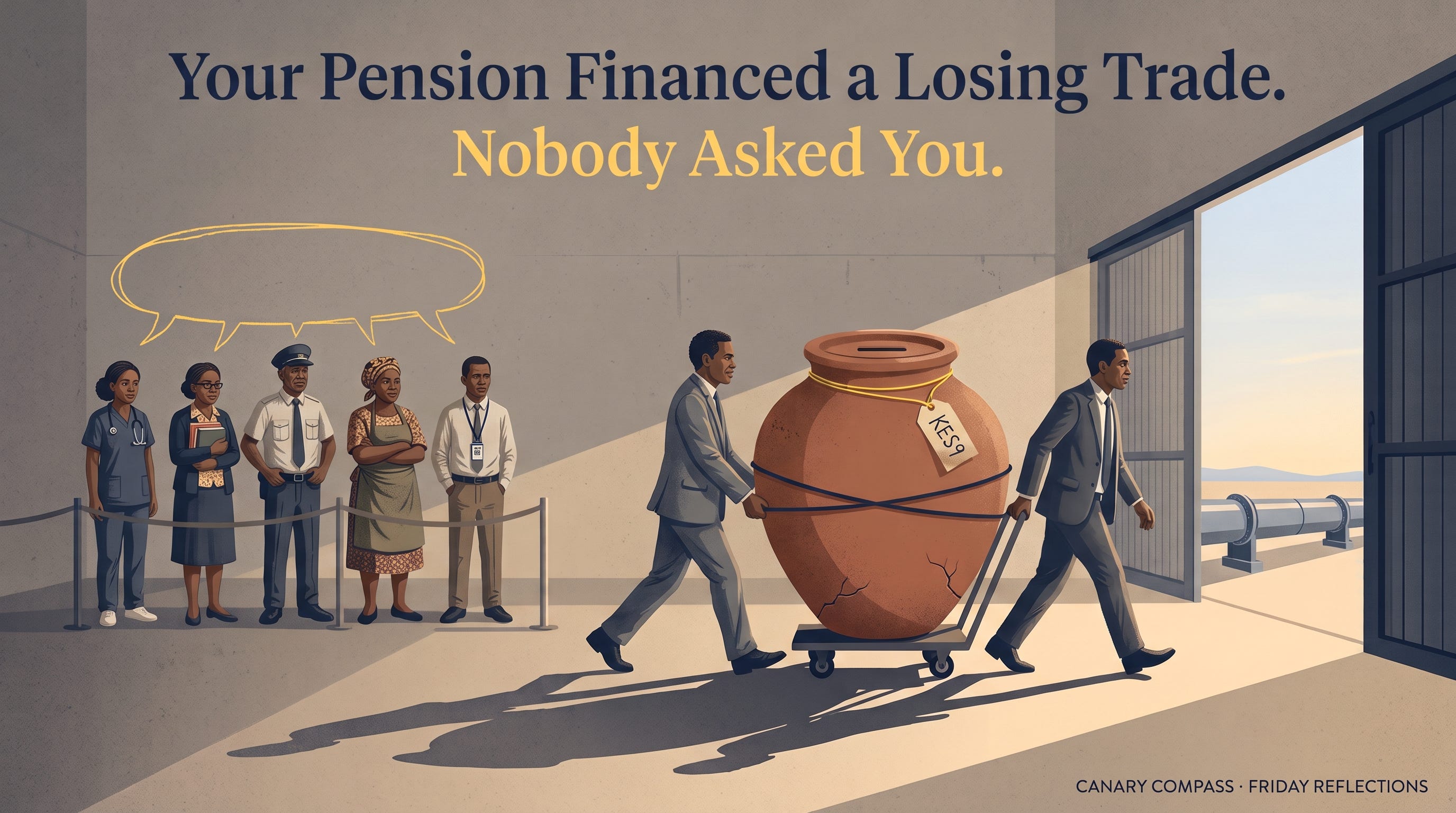
AI-illustration: Pension money in motion, February to October 2026.
Kenya spent this week arguing about pension money. The argument followed a sale. In February, state-linked pension schemes and funds were reportedly pushed into buying Kenya Pipeline Company. In October they sold a block of it. The conversation took me back. Three years ago this month I published an article called A Collaborative Reflection on Bridging Zambia’s Prosperity Divide: Wealth Creation, Alpha, Literacy and Fund Management. I read it again while the argument ran, and I counted six questions in it, all about the money workers put aside for old age. Kenya has now answered them, without meaning to.
First, the public facts. In January and February the government sold 65 per cent of Kenya Pipeline Company at 9 Kenyan shillings (KES) a share. Rich private investors stayed away. Foreign investors from outside East Africa ended up with about 0.02 per cent of the whole company. Retail buyers ended up with about 2.5 shares in every 100 of it. The sale was heading for failure. Business Daily later reported that the State pressured cash-rich parastatals and state-backed funds to save it, and that funds were selling bonds that February to raise the cash. NSSF, the national social security fund, alone invested about KES36bn, a stake valued at about KES38bn in later filings with the regulator. In all, thirteen state-linked schemes and agencies, plus Uganda’s national oil company, were reported to have supplied KES95.8bn of the KES106bn needed.
Why did so few Kenyans buy? Nobody can poll the buyers who never came, so I will not claim their reason. What can be shown is what they had been told, and what they did next. Research houses published their sums in January and February. The sceptics’ fair values ran from about KES3 to about KES6 a share, against an asking price of KES9. One bank called it a premium price for a mature, regulated company. Others noted that the dividend on offer could not compete with tax-free government infrastructure bonds. The research was public, and the private money stayed home. The allocation results show it. The offer was open to private buyers, local and foreign. Together they took under 5 shares in every 100 on offer. The largest Kenyan buyers who did go in were the ones reported to have been pushed.
There was a second barrier, older than the price. Being allowed to buy is not the same as being able to buy. I wrote about this in November 2023, when Kenya was lining up sales of state companies, and I listed what a sale built for citizens would need. Set aside part of the offer for low-income buyers, and price that part lower so they can reach it. Help them pay, through government and partner programmes. Sell through the groups people already trust, such as cooperatives and village banks. Ask the new owners to hold for ten years. Keep majority ownership of key companies at home, by law, for the life of the company. Then report in public, at regular intervals, who ended up owning what. The pipeline sale had a retail window, but none of the rest. It offered no lower price for the poor and no financing built for them, and it promised no special report on final owners. So Kenyans stayed out, whether by judgement or by exclusion. Then they were brought in anyway, through their pension money, without being asked.
Nearly eight months later, on 19 October, about a quarter of the company changed hands in a single deal, going to the Dangote group, the Nigerian industrial giant. The sellers were reported to be several of the Kenyan state-backed holders. The block was roughly 4.5 billion shares, which had cost KES40.5bn at the February price. The reported prices lay between KES9.02 and KES9.44, and the reports differ on where in that range the block went. Five days before the sale, the company’s board had proposed its first dividend as a listed company, KES0.32 a share, which shareholders still have to approve. They sold before the date that decides who gets paid, so the entitlement went with the shares to the buyer.
Then came the opinions, in three camps. The first camp celebrated: the funds bought at KES9 and sold above it, so the trade made money, and a win is a win. The second camp said nothing was lost. State funds bought a state company, and the state banked the proceeds. Money just moved from one government pocket to another. The third camp, led by a legislator’s thread, said this was all a plan for a takeover through a future rights issue, a sale of new shares to existing owners. That is speculation, and I will not adopt it. There was also a fourth, quieter strand. Some voices did ask what the trade meant for pensioners and for the independence of their funds. They were not the ones setting the week’s terms.
The three camps disagree on almost everything, yet they share one blind spot. None of them looks at the deal from the seat of the people who own the money. The second camp treats pension funds as a state pocket. The third treats them as pieces in someone else’s game; even its charge that the funds were made to sell cheap is about who moved the pieces, not what the owners were owed. The first camp cheers a headline profit for the funds without asking what the owners gave up to get it. Put the owners back in the room, and none of the three answers the question that matters. Did the members get value?
A pension scheme holds money in trust for its members. Calling a fund a state scheme tells you who wrote the law that set it up, or, in the civil service schemes, who employs the members. In NSSF’s case, most members work in the private sector. Either way, it does not tell you who owns the money. Contributions are wages, paid later instead of now. Money paid in has changed hands; the employer has no more claim on it than on last month’s salary. The government can regulate the fund and appoint the people who guard it. It can even lean on it. None of that makes it the owner. The owners are the clerks, teachers, drivers and nurses whose payslips built these funds. Very little of the week’s noise was addressed to them.
The second camp fails first. One pocket to another only works if both pockets are on the same coat, and these are not. The buying pocket belonged to workers. The receiving pocket belonged to the state. Some will say the same citizen stands behind both, as worker and as taxpayer. Even then, the two pockets follow different rules. One is held in trust for him, with his name on it. The other is spent for everyone. And the trade between them was not a wash. The workers’ pocket gave up cash and got shares most other buyers had refused at that price. When the state banked KES106bn, much of it was money that had left several million private owners, at a price of KES9, with no owner asked. Saying the government came out fine answers nothing. The question is whether the members came out fine.
The first camp fails on arithmetic. A return means nothing on its own. You must compare it with what the same money could have earned over the same months, in a choice the holder really had. Usually you have to guess at that choice. Not here. Some funds had just sold bonds to put cash into this offer. The honest benchmark is the lower-risk government paper they gave up. Nobody has published exactly which paper was sold. The dealer spoke of bonds, and that February the tax-free infrastructure bonds were paying into double digits, above the one-year bill. So the one-year bill is a gentle benchmark, used the simple way: buy it in February, count eight months of interest. Rates fell through the year, so a bill sold at month eight would have fetched a little more than that straight count. And the bill sits below the paper the funds reportedly sold. Kenya also sells three-month and six-month bills, but neither reaches across the eight months on its own, and rolling them would mean guessing the rates ahead. Only the one-year bill covered the whole window at a rate known on the day the choice was made.
So compare, on that KES40.5bn block. One-year government paper yielded about 9 per cent a year in February. Held from the offer’s close in late February to the sale on 19 October, it would have earned about 6 per cent of that KES40.5bn, around KES2.4bn. The sale’s reported numbers tell three competing stories, and all three fall short. Business Daily reported most of the block at KES9.02; on that story the gain was nearer KES90m. The week’s loudest defenders put the sellers’ profit at KES1.6bn, which works out to a KES9.36 price. And Dangote was quoted at about 327 million US dollars, which at around 130 to the dollar is the KES42.5bn put on the block, about KES9.44 a share, a gain of about KES2bn before costs. The stories cannot all be literally true, because a block averaging KES9.44 cannot also have printed mostly at KES9.02. One reading nearly reconciles them. Suppose the buyer’s total includes dealing costs of between about half and one and a half per cent, the top being the legislator’s own estimate. The implied share price then works back to between about KES9.30 and KES9.40, close to the defenders’ KES9.36, and the gain to between about KES1.4bn and KES1.8bn. That reading challenges the KES9.02 report, and nothing published settles how the fees were treated. The verdict survives every version: the biggest story, KES2bn before costs, trails the bill’s KES2.4bn, and the reconciled readings trail it by over half a billion. The proposed dividend changes none of this. A buyer paid one price for the share and the KES0.32 entitlement together, so the sellers were paid for both, and the comparison with the paper already counts everything they received. The sellers themselves are known only from newspaper reports; the regulator has said nothing. No scheme has stated in public what it sold, what it kept, what price it got, or what the sale cost.
Whatever anyone intended, and nobody has shown a plan, the record shows the job the money did. For eight months the pot carried the stake from a state that wanted out to a buyer who came later, and it bore the risk of the wait. A warehouse charges for that. This one was never paid a fee.
Were the February sceptics wrong, then? Money could do three things with February’s offer: stay out, go in and hold, or go in and sell. Eight months have sorted all three, at this week’s prices. The saver who stayed out and kept government paper earned the bill’s roughly 6 per cent. The holder who bought in February and never sold has done best so far. Three days after the block, the share touched KES9.78, lifted by Dangote’s arrival, and he sits on an uncashed gain of almost 9 per cent. The schemes did worst, and theirs was the only money whose owners were never asked: in at KES9, out before the rise their own sale set off, and below the bill at every reported price. And one actor had no February seat at all: the buyer, who paid the sellers’ price in October and watched the market mark his block up within days. So the market has moved against the sceptics’ prices; the block went through above the offer, not at KES3 or KES6. But hold the dates apart. The holder’s gain exists because Dangote came, and nobody deciding in February could have known he was coming without inside information. A decision is judged on what could be known when it was made, and the research February could read pointed away from the offer. The lift came from a strategic buyer paying for influence over what the company becomes, something no small saver was ever offered, and a block that size rarely fetches the screen price. On the test that mattered, the sceptics’ method was right, and even the money that refused out-earned the forced trade. The asset can come good, and the trade can still have left the members worse off than the paper their schemes sold. The saver’s refusal was not fear of the unknown. It was arithmetic.
One buyer at this table behaved like an owner. Uganda’s national oil company took 20.15 per cent of the whole company, paying about USD255m. Before its money moved, it negotiated two board seats and a veto over hiring and firing the chief executive. Kenya’s schemes put in more money and took no such terms. NSSF’s chief executive was given a seat on the board months after listing; Uganda’s terms were signed before its cash left home. The offer was the same and the price was the same. One investor charged for its money. The rest handed theirs over.
The week argued about the money and the price. Control came up only as a plot, never as a question. A pipeline is the artery that moves a country’s fuel. In February, Kenya sold 65 per cent of it. By October, a quarter had moved to a foreign group. And Uganda, through the veto it negotiated in February, has more say over who runs Kenya’s fuel line than the Kenyan workers whose savings paid for the rescue.
The pipeline was not even this year’s biggest sale. In June the same government sold 15 per cent of Safaricom, the country’s most valuable company, to Vodacom for about KES204bn, raising the Vodafone family’s stake to 55 per cent and handing it control. In September the High Court ruled that sale unconstitutional, partly for want of real public participation, and ordered the shares returned. Appeals are running and the shares are in dispute while they are heard. But sit with the court’s first reason. The public was never properly asked. Each sale carried the same two failures: foreign hands came out stronger, and the owners were not asked. Safaricom passed into foreign control outright. The fuel line kept its Kenyan majority, but its strongest levers, the largest private stake in Nigerian hands and a veto in Kampala, sit abroad. Twice in one year the state sold, and the explaining was left to courts and newspapers. There are good reasons for a government to sell shares; citizens can own them instead, and that is the point of listing. Selling what is strategic, while the rest of the world guards its own, is a different act, and nobody has offered a reason for it. The pipeline sale was even financed by the savings of the country’s own workers. Nobody asked them either.
Zambia shows both halves of this lesson. In 2021 it brought the Mopani copper mines back into domestic hands, taking them over from Glencore. The idea was right, because the prize was real. Copper is the metal of electrification. Demand for it was already set to run when Zambia moved, and the supply troubles since have only added to the upside. A country that owns its copper owns a claim on that future. But the vehicle was wrong. The buyer, the state mining company ZCCM-IH, was far smaller than the deal it signed. The deal left Mopani owing USD1.5bn, more than 30 billion Zambian kwacha (ZMW) at 2021 exchange rates, with ZCCM-IH guaranteeing it. Going into the deal, at the end of 2020, the buyer’s entire equity stood near ZMW16bn, so it guaranteed roughly twice its own worth. Zambia’s pension fund, NAPSA, held about ZMW55bn at the end of 2021, more than three times that equity. Even for NAPSA, Mopani was too big for one bite.
Three years later the present administration brought in a group from Abu Dhabi, which took 51 per cent, mostly by putting new money into the mine. Control drifted foreign again. To be fair, the mine needed money and mining skill, and the deal brought both, and this time the money went into the asset itself. But the fights over metals and supply chains were already running in 2021, so the case for holding on was visible even then. In hindsight, two better routes may have been open. NAPSA could have built its stake in steps. Or the foreign money could have come in with a sunset written into the deal, so that ownership folds back home over time. If the Abu Dhabi deal carries such a clause, I have not seen it published. Bringing strategic assets home takes vehicles made to carry them. A sovereign fund built for the purpose does that job: it buys and holds what matters, with money put aside for it. Patient pension money can sit alongside such a fund, on one condition. At a price and on the trustees’ own terms, in slices their balance sheets can safely carry. That is investment. A forced march in at KES9 is conscription. And letting strategic assets go because the treasury is having a bad year trades fifty years of control for one year of cash. Zambia’s dilution at least fed the mine. Kenya’s sale money sits in new state funds, with the spending still a promise.
Underneath this week sits an old argument, and it is not a Kenyan one. Every country with a pension pool faces the same temptation, because development is always urgent and the pool is always there. May the state sacrifice the returns of tomorrow’s retirees for the nation it wants to build today? The defence is the same everywhere: the project matters, and retirement money is the deepest pool of long-term savings in the country. Both things are true, and neither one answers the question. I am not arguing that pension money must never build the nation. It can. But the nation must pay for it like any other borrower. The returns must fit the risk, and over time they must beat what the money was already earning and keep ahead of rising prices. That is all a benchmark is: the check that the pot was kept safe.
And watch what the pension money actually funded here. Not the pipeline. The company pays for its own works out of earnings and borrowing, and the buyer now talks of expansion money of his own. The members’ money funded none of that. It bought the state out of its shares, and the proceeds went to the state’s new funds, where the building is still a plan. Whatever builds the pipeline will be money that charged for coming. The only money in this story that set no price for coming was the pensioners’.
Priced development money is not a fantasy. Zambia showed one version of it in 2024. NAPSA, Zambia’s national pension scheme, committed USD300m towards the new Lusaka to Ndola road. By its own account, it lent in dollars, at 9.5 per cent a year, for 13 years, standing first in line for repayment. Toll money sits in a locked account to pay the loan back. NAPSA also says nobody directed it; the deal was brought to it, and it said yes on its own tests. None of this makes the road a good project, and a coupon does not prove the price was right for the risk. Those answers will take years. And the difference between Lusaka and Nairobi runs deeper than debt against shares. Uganda bought shares in the same pipeline and still charged for it. The real difference is whether the money set any terms at all. NAPSA set terms. Kenya’s schemes were handed a price.
So what should this pool be doing instead? Not sitting in government paper, waiting for the next summons. Some of that paper even carries an infrastructure label, tax-free, and the schemes buy plenty of it. But a label is not a project. The money goes into the state’s hands and mixes with everything else, and whether every shilling reaches infrastructure is a question the label does not answer. Real project lending looks like NAPSA’s road: a named project, a price, security, and tolls set aside for repayment. A pool this deep could do more of that, on terms.
The week also showed this pot living under two standards. When the state wanted the pool, the pot was treated as open: no price and no consent, only pressure. When a member wants his own balance, the pot becomes sacred. Protection rules apply, with one narrow door for housing. Today the law lets members of any registered scheme pledge part of their benefits to guarantee a housing loan, where their scheme has set that route up. A second route, drawing savings out to buy a home, was opened in 2020; the High Court quashed it in 2022. Beyond the house, nothing. Your savings can be marched into a state company, but they cannot stand behind your shop or your working loan. Many countries lock members out to protect the pot, and that alone is no scandal. The scandal is locking the member out while letting the state in. Both rules cannot be right at once. If protection is the principle, it must bind the state first, because the state is the biggest hand reaching into the pot. And if the pot can take risk after all, the member’s own future has first claim on it. Let him borrow against a slice of his balance, at a fair price, with a floor no loan can touch, so a failed shop cannot eat a whole retirement. Banks already refuse to count much of your record when you ask for credit. I wrote about that last month, in Cronyism Without a Crony, the lock with no villain to fire. This is the same citizen at the next door: his record cannot speak for him, and now his savings cannot either. Today, outside your own house, your pension is not allowed to say a word.
When other states have reached into the pot, they have at least done it in daylight. When Argentina took over private pension funds in 2008, even that seizure was done through a law passed in congress, which citizens could read and fight. When South Africa argues about directing pension money, it argues in parliament, in the open. Kenya passed no law. The pressure was quiet, and we learned of it from a newspaper. Kenya’s pension law already demands independent judgement from trustees. Quiet pressure is how that judgement gets displaced without anyone changing a word of the law. And however the pressure arrives, by statute or by phone call, the thing being spent is the same. A pensioner’s retirement is not the state’s to spend.
A document is missing from this whole year. The Kenyan funds and agencies alone put more than KES60bn into this sale, and money like that does not move without paper. Somewhere there are trustee resolutions, committee memos, due diligence reports, and minutes that record who voted for this and why. In eight months of national argument, not one page has surfaced. No trustee of any selling fund has explained the entry or the exit. No regulator has demanded an explanation in public. Members should be shown the amounts, the dates, the costs, the alternatives weighed, and who approved it. Kenya spent a week arguing about an investment case that nobody who made it will show us.
This is not a one-off. In September I published a note on Kenya’s sports bond, the borrowing behind the new Talanta stadium, called Converting Vices into a Virtuous Sporting Cycle. It found two state schemes holding 54 per cent of a single bond issue. I asked why then. Nobody has answered.
Savers in this region have already said what they want. In 2023 I was part of a survey of middle-class savers in five African countries, published as Unlocking African Prosperity. At the time I set out its findings in A Financial Paradigm Shift for Africa. Overall, 73 per cent said they put protecting their savings ahead of chasing high returns. The Kenyan share was the same. That may sound like an argument against benchmarks. It is the opposite. The same survey asked about rising prices. In Kenya, 57 per cent wanted growth that clearly beats inflation, and only 14 per cent would accept growth below it. Zimbabweans, who have lived through money dying, wanted growth above inflation most of all, 7 in 10 of them. Protecting the pot means protecting what the money can buy. A pot that grows slower than prices is losing value quietly. The benchmark is how you check. Other systems hand the member a dial for exactly this. In Britain, a member whose workplace pension builds a pot in his own name can choose how that pot is invested, cautious or bold. In Kenya’s NSSF and Zambia’s NAPSA, and in most statutory schemes like them, no such dial exists. One portfolio is picked for everyone, and the member’s appetite for risk is never asked. On every story that can be checked, the pipeline trade, as the sellers ran it, took more risk than the government paper some schemes sold, and earned less. The owners had told anyone who surveyed them that they wanted the opposite. The system never gave them a way to say it where it counts.
The 2023 article was about Zambia, not Kenya. The subject first found me there. Zambia sets a hard test for any pension pot. In the ten years to 2023, inflation there averaged about 12 per cent a year, and the kwacha kept falling against the dollar. A pot had to grow at that pace, on average, just to stand still. Zambians know this. In the same survey, about half of them asked only for growth that keeps pace with rising prices. Of the five countries surveyed, they asked for the least.
I have made the mistake I am describing, though I had help. That article opened on my own statutory pension, with the same NAPSA that priced the road. A pre-retirement withdrawal forced me to run numbers I had never run. My own sums at the time put the return over my contribution years below inflation. Its buying power had not been protected; it had shrunk. A scheme can set terms on one road and still fail the member’s test over the years. For years I contributed without once asking for the comparison I am now demanding from Kenya’s trustees. Yet asking had a wall in front of it. My contribution statement showed what I had paid in, and nothing else: no interest or indexation, and no sign of what the money had become. A member cannot question numbers he is never shown. The scheme followed its rules. Nobody had asked whether the rules were enough. Retirement is the wrong day to find that out, and for many members it is the first time anyone checks.
So back to the six questions from 2023. I asked them of Zambia. Kenya answered them this week. They belong to any country where workers set money aside. The first said pension returns must be measured against outside markers, inflation and the currency above all, and beat them over time. This week a trade was cheered with no marker in sight. The second asked whether trustees, stopped today, could account for every position and what it earns. No selling trustee has yet accounted for this one. The third called for compulsory training and certification for everyone guarding collective money. Kenya requires trustee training today; the question the week leaves open is what that training is producing. The fourth said fund managers must be judged on the return they add, with consequences when they subtract. This year brought praise and accusation, but no consequence. The fifth put financial literacy at the top of the national list. The cheering for the smaller number tells you where that stands.
The sixth question was not for trustees or regulators. It asked for members who engage and who question. That question is for you, because you own the money. The law does not ask members to vote on investments; it asks trustees to use their own judgement for you, as if you were watching. Nobody asked you whether your deferred wages should rescue a listing, and nobody had to. That is exactly why the watching matters. Remember what your savings are allowed to do for the state, and what they are not allowed to do for you. A trustee who has never been questioned by a member will, in time, guard the money like nobody is coming back for it. Ask your scheme what it bought in February and sold in October. Ask what the money was earning before it moved. Members are not mute. They grumble to each other about statements that show them nothing, and some long ago stopped asking because nothing ever answered. But a grumble lands on nobody in particular; a question put to the scheme sits on someone’s desk. And a question like this has to be taught before it can be asked, so those of us who know it owe the teaching.
I am interested in this idea of the independence of funds as regarding Pensions. Is that a true expectation? On one hand, if it is truly independent (as would be a private fund), there is less of a sense of safety and recourse if anything goes arye. On the other hand, if the govt. has a hand, it feels safe, but also exposes it to the whims of the current admin's policies and/or practices. As an "owner", perhaps the question I need to answer is what risk I am willing to assume, or even if I am educated enough (as many pension members are) to care? Excellent piece, very provoking.