

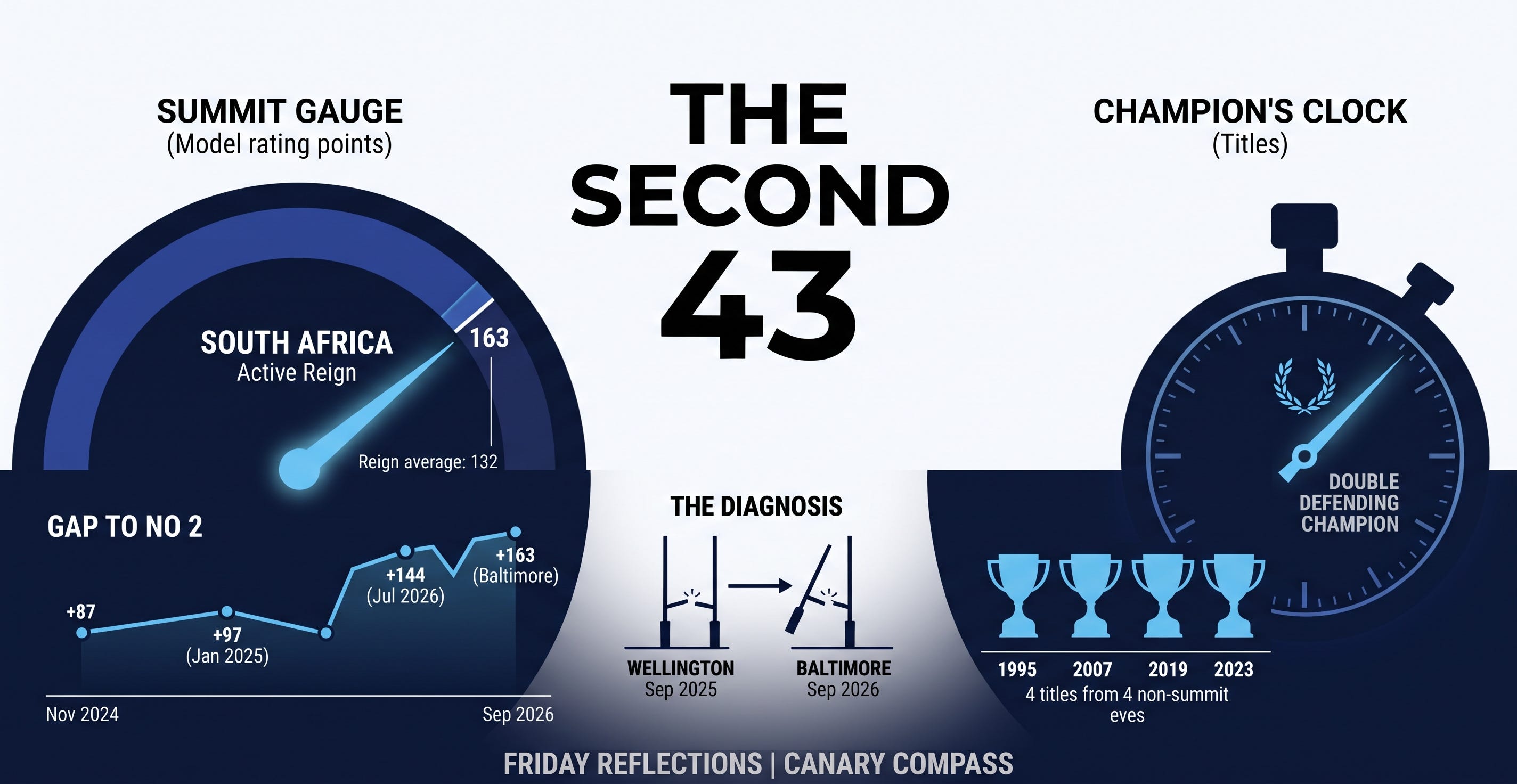
AI-illustration: The Second 43.
Exactly a year ago today, I wrote to you with one eye closed. It was a Saturday morning in Nairobi, Wellington was under lights, and the scoreboard read 43-10. The heaviest defeat in All Blacks history, and it came at home, after a second half that finished 36-0. I called it a diagnosis and asked New Zealand Rugby for a Tuesday. A scrum that resolves instead of resets. A school built from the hardest nights. Work beginning in February, so the jersey could meet them in July.
The second 43 arrived overnight. Past midnight in Nairobi, in a borrowed NFL stadium in Baltimore, South Africa closed out the All Blacks’ first full tour of South Africa in thirty years. It finished 43-28, the series won 3-1 after losing the opener. Two Septembers, two 43s, one direction. On the scoreboard, the losing margin narrowed by 18 points year on year. Watching it live said otherwise. The match stayed alive into its final ten minutes, and every time New Zealand fought back within reach, South Africa found another acceleration. Beauden Barrett’s last-minute try narrowed a margin that had touched 22. A year of Tuesdays has passed, and the report card came back in green and gold.
Ardie Savea spent this series as a captain Springbok supporters openly adore. He was injured in Soweto after scoring twice and was gone by Baltimore, and the affection did not pause for his absence. They cheer him. They call him their favourite non-Bok. Richie McCaw spent a career being called a cheat in the Republic, where the chorus held that referees let him get away with murder at the breakdown. Dan Carter was respected the way you respect a storm. Some of the warmth for Savea is simply the man. The way he plays and carries himself is legible to South African rugby culture in a way few All Blacks have ever been. The Cape has always held its pockets of genuine All Blacks support besides. But I do not think the character changed. I think the tax on admiring it did. Springbok supporters could never afford to see McCaw whole, because he was the edge of their defeat every Saturday. They can see Savea whole because his brilliance no longer threatens their hold on the rivalry: South Africa have won 8 of the last 10 tests between these teams. The affection is not the proof; the results are. I read it as a tell. Fear distorts perception, and dominance is what removed the distortion.
Baltimore had its contestable moments, as every test in this rivalry does. A loose ball spilled from an All Black who many in black swear was tripped, waved on, and scooped by Kurt-Lee Arendse inside his own half for a fifty-metre score. Cam Roigard was taken out after kicking through, a certain penalty until the television official went back a phase and found him offside first. A stoppage of more than eight minutes in which the match officials’ communications failed. Reasonable people can argue each call. What interested me was who was doing the arguing. Through the long decades of All Blacks supremacy, relitigating the referee was a Springbok supporter’s pastime, and we in black found it faintly amusing. Overnight the roles ran the other way, on my own timeline: All Blacks fans working frame by frame, Bok fans laughing. Sentiment trails results as an after-image, and the affection and the grievance now point in the same direction as the scoreboard.
The coaching box holds another tell. Scott Robertson won 20 of his 27 tests as All Blacks coach, 74 per cent, and went 1-3 against South Africa. He departed in January after an internal review, with friction between senior players and team staff reported through the preceding month. Dave Rennie replaced him in March carrying a career record of beating South Africans, including a 3-1 record against these very Springboks as Wallabies coach. His first series in black finished 1-3. The same man, against the same opponent, four years apart: 3-1 in gold, 1-3 in black. This is no controlled experiment; squads, staff and settings all differ. But it is the sharpest hint yet against the magic-wand theory of coaching, because if the coach were the binding variable, the advantage should have travelled with the man, and it inverted. It is the pattern I wrote about a year ago. My All Blacks have become my Manchester United, I said then. Post-Ferguson United is precisely the case of a club that kept changing managers while the deeper problems of authority and direction survived every rotation. Two consecutive All Blacks coaches now stand 1-3 against South Africa, and one has already lost the job. My reading, and I mark it as a reading, is that player dissatisfaction materially shaped the review and its outcome. Reporting at the time framed it as player power; the union’s public line was otherwise. If that reading is right, the next man should study his predecessor’s authority even more closely than his game plans.
The year kept asking me one question: what is dominance actually made of? Answering it meant no longer trusting my memory of eras, and counting instead. I rated every test played among the ten nations of the Six Nations and the Rugby Championship, from 1987 to Baltimore, on a continuous rating of my own. Every ranking number in this piece comes from that model, not from World Rugby’s table, and the two run on different scales. At every checkpoint where they can be compared, the six tournament eves since official rankings began, the November 2024 handover, and the two summit interruptions since, they agree at all but one. That one, 2019, is marked in Table 2. What the counting found is that dominance is one architecture read on two gauges, and that winning World Cups is a different architecture altogether. The first gauge is the summit: how far above the entire field a team sits, and for how long. The second I will call the form line: how well a team plays against top opposition on its own terms, regardless of who else is great at the time. Conversion, the machine that wins the three weeks of a tournament, is not a third gauge. It is the other architecture, and it keeps a clock of its own.
On the summit gauge, one rule was set before counting: reigns begin and end on match days, wherever the results put them, and never by the tournament calendar. Sometimes the breaking result is itself a World Cup match, and the match still governs; the 1987 final opens the second reign on this table and the 1991 semi-final closes it. What the rule forbids is cutting eras at tournaments by convention, because dominance does not respect the four-year calendar. The model keeps 21 reigns at the summit since 1987, counting the Wallaby reign already under way when the record opens, and many of them are caretaker spells lasting weeks. All 21, ranked by depth, which is average gap multiplied by duration in years, computed on unrounded figures. The gap is always the rating distance to the second-placed side. The win rate is each side’s top-tier record across the reign’s own tests. The ranking runs on the summit gauge alone. The second-last column sits outside it and marks what conversion did inside each reign. It distinguishes titles that opened a reign from tournaments entered while holding the summit:
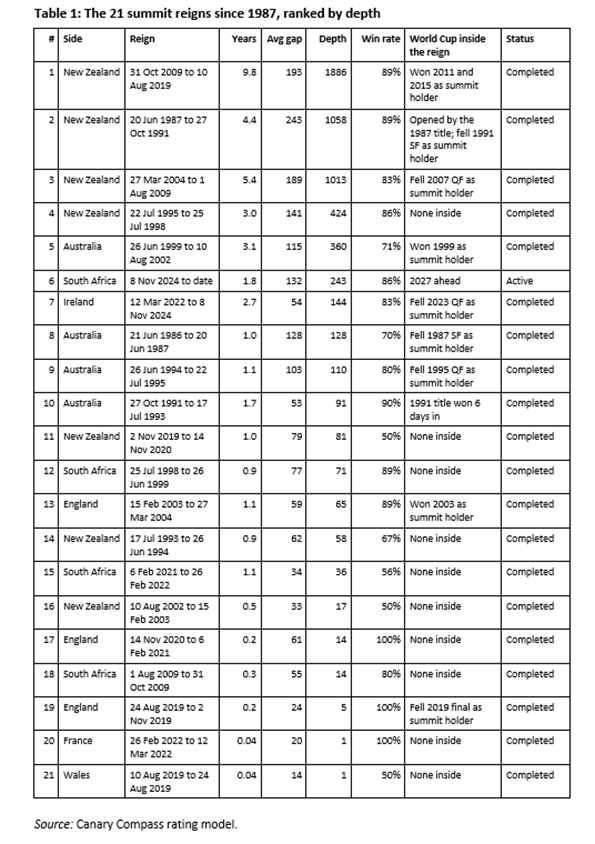
The deepest reign starts and ends on match days, the day the All Blacks overtook the World Cup-holding Springboks and the day of a 47-26 defeat in Perth, neither endpoint set by a tournament result. The form line says something starker still: from mid-2002 to late 2020, eighteen and a half unbroken years, New Zealand’s rolling win rate against top-tier opposition never once dropped below 7 in 10. Third on the table sits the first Henry reign. My model dates it from March 2004 to August 2009, ending in the season John Smit’s Springboks beat them three times. Henry was still in the chair when the next reign began two months later. Within his first reign I isolate one window, 2005 to the 2007 quarter-final, cut at the tournament because the tournament is the question being asked of it; the reign’s boundaries stay match-driven around it.
A British and Irish Lions series swept 3-0. Three consecutive Tri-Nations. The first All Blacks Grand Slam of the professional era. Across the window they won 87 per cent of their top-tier tests at an average margin of 18 points, a core hotter even than the reign around it. On the tournament’s eve, the model had them 306 points clear of the entire field, the most daylight any side has carried into a World Cup in the forty-year record. A month later they were out, beaten by France in a quarter-final, the earliest exit in their history. Of the three deepest reigns ever measured, theirs is the only one that never lifted the trophy: the deepest holds the 2011 and 2015 titles, and the second was launched by the final of 1987.
The form line exists because the summit gauge is blind in one direction: a great side that coexists with a greater one is invisible to it. Clive Woodward’s England ran at 78 per cent across five years, average margin 16. They were blocked from the summit for most of that run because the All Blacks and Wallabies stood on it. The model crowns them only in the spring of 2003. Read on that line instead, and the full canon comes back. The Wallabies of the early nineties and of the turn of the century, Woodward’s England whole, the Springboks of Mallett and of Smit, France and Ireland in this decade. Nick Mallett’s side is the one time South Africa tried the conventional order, building a dominance era first, 17 straight wins, and it remains their one great era without a title. Every South African title came the other way around.
On the summit gauge, the current Springbok reign’s average distance above the field, 132 points, is larger than any non-New Zealand reign in the record. On the form line, their cumulative record since late August 2022 runs at 80 per cent, three points shy of the Henry-era All Blacks across a full reign and ahead of peak Woodward. The line crossed the model’s 75 per cent threshold on 22 June 2024 and has not dipped below it since. Two clocks: the form arrived in the middle of 2024, and the summit followed that November. If the reign reads short against everything it measures, Table 1 says why. Until that November weekend the summit was Ireland’s, row seven, held for two and a half years while the world champions chased it on the rating. The crown never moved in those years; the summit still had to be taken. The gap after Baltimore stands at 163 points, wider than any reign outside New Zealand has ever averaged. Four reigns carry a higher average than this one, all of them New Zealand’s; the Wallaby reign that sits above it on the table ranks there on duration, not altitude. The deepest of the four needed a decade to accumulate what this side has banked in under two years. The reign is still open; its averages can still rise or fall. On both gauges, the most dominant team in the world today is South Africa, by a distance.
But dominance, on either gauge, is not conversion. South Africa has won four World Cups, more than anyone, and has never once entered one as the top-rated side:
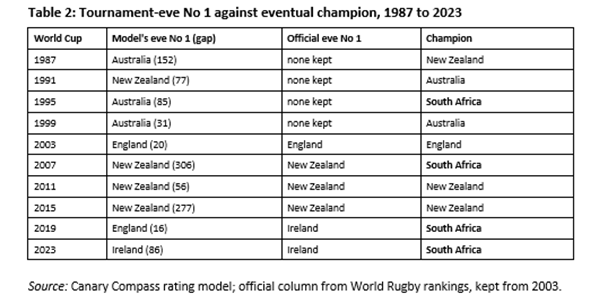
Official rankings begin in 2003; before that, only the model speaks. Where both exist they name the same leader at every eve except 2019, where the model’s 16-point England edge is noise and the official table says Ireland; on either reading, not South Africa. Four titles, and on all 4 eves somebody else was the dominant team on the planet, and every one of those 4 leaders fell. Across all 10 tournaments the eve leader converted 4 times, 1999, 2003, 2011 and 2015, and of the 3 sides that arrived commanding, more than 150 points clear, 1987, 2007 and 2015, exactly 1 converted. A champion must win three knockout matches; grant a genuinely great side an 85 per cent chance in each, against top-tier knockout opposition, and it clears all three about 6 times in 10. The model is illustrative and the matches are not coin flips, but it makes a team the favourite without making its failure surprising. Dominance is advantage, not insurance.
The familiar ambition, the one every side on the reigns table pursued, is to build the machine that wins the years and pray it converts when the three weeks arrive. Under the Erasmus programme the outcomes arrived in the opposite order. Across 2019 and 2023 they played 6 World Cup knockout matches and won all 6, 4 of them by 3 points or fewer. The last 3 came by a single point each, against the hosts, the English and the old enemy. They did it while losing pool games at both tournaments. Between those titles, the pandemic took twenty months of tests from them, and the results they did play were uneven in a telling way. A British and Irish Lions series won in the middle of the valley, the weeks machine firing while the years machine idled. Then back-to-back defeats to Australia a month later, 5 more losses in 2022, and Ireland holding the summit at 78 per cent of their own. Whether the order was designed or discovered, only Erasmus knows; the record only certifies the sequence. Conversion first. The years machine, second.
Any Springbok supporter worth their replica jersey dates this era from Yokohama, November 2019. Seven years and two titles, never surrendered. On their instrument, they are right. Call it the champion’s clock: it ticks only at World Cups, because the crown can only change hands there. On that clock South Africa’s tenure has run unbroken since then and will arrive in Australia at eight years. That matches the longest championship tenure any side has ever carried into a tournament, the All Blacks’ own 2011 to 2019. It is silent between tournaments by design, roughly 47 of every 48 months, and it measures the one possession those months cannot move. The clock could not see 2021 or 2022, just as it could not see the 2005 to 2007 All Blacks. The clock is not in dispute; the other two instruments cover the years it ignores. November 2024 is when the argument about the era ended. That is when the last of the three clocks, the summit, came into phase with the champion’s clock, the form line having joined that June. South Africa have aligned all three only once before, under Mallett across 1998 and 1999, and that alignment dissolved before the tournament arrived, where Australia took the crown as well. This one is their first with back-to-back titles already banked, and the first still intact on the road to a World Cup rather than spent ahead of one. Their four titles were all won while the other clocks read someone else’s name; since late 2024, all three read the same one. The summit wobbled twice, at Ellis Park both times. The line has held since June 2024. The champion’s clock has not moved since 2019. In a programme built conversion-first, that is the one you would expect to be the stillest.
And the second machine is now unmistakably built, complete with the signature the first one always had. They win when it counts. They still tune out between, in miniature. A 16-point home defeat to Australia at Ellis Park in August 2025, met seven days later in Cape Town. A 67-30 demolition of Argentina, nearly squandered in a two-point title-decider escape seven days later, the flicker inside a single fortnight. A 16-33 first test at Ellis Park three weeks ago, followed by three straight. The summit line itself shows the same heartbeat. South Africa took No 1 over the weekend of 8 to 10 November 2024, on the Friday, without playing, when Ireland fell in Dublin. They confirmed it on Scotland two days later. They have surrendered it exactly twice since. Four weeks after the 2025 defeat at Ellis Park, taken back by the first 43 in Wellington. One week after the 2026 defeat at the same ground, taken back in Cape Town. On the field, each defeat was avenged at the very next test, seven days on; the summit simply took longer to follow the first time, and the official table flickered at the same two moments. The gap has widened through all of it. 97 over Ireland in January 2025. 144 after a July in which England, Scotland and Wales came to the Republic and conceded 130 points for 49, Wales departing 43-0. And 163 over New Zealand after Baltimore. They still concede episodes. They no longer concede seasons. And all of it is one Erasmus-built system: coaching, selection, depth and institutional authority running as one programme. One regime, through his own head coaching, the Nienaber years with Erasmus as director of rugby, and his return. Erasmus-led continuity since 2018 is no longer a coaching variable but institutional capacity, which is exactly what New Zealand rotated instead of built.
Three sides have entered a World Cup as both the reigning champion and the top-rated team in the world. The All Blacks of 1991, who fell in a semi-final. The Wallabies of 1995, who fell in a quarter-final. The All Blacks of 2015, who converted. 1 from 3, the same rate the commanding favourites post. South Africa in 2027 would be the fourth, and the first of them to arrive as double defending champion.
A year ago I posed questions and issued prescriptions. Table 3 answers each in turn:
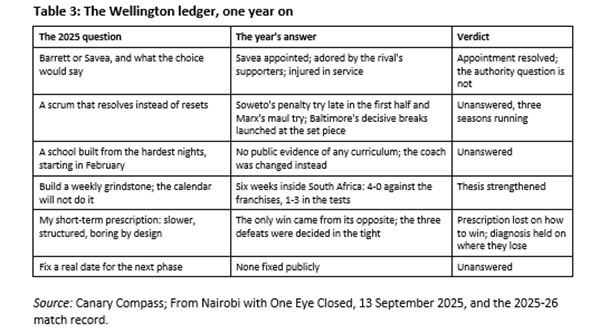
The leadership drawer I parked last September is open. The appointment was made, and what it revealed sits in the affection above. What it has not yet revealed is where authority actually lives between players, coach and union, and this year made that question larger, not smaller. The scrum: in Soweto the penalty try came late in the first half and the maul added another through Marx, in a five-point thriller. In Baltimore the decisive early second-half break was launched from a scrum penalty and the maul that followed, with another scrum the platform for the next score. New Zealand’s set piece did not lose every contest this series. It lost the contests that decided the matches, and that has been true three seasons running: the maul that powered the Ellis Park comeback in 2024, the Wellington night that named the sickness in 2025, and now Soweto and Baltimore. The school: I can find no public evidence that anything resembling the curriculum was built, and what happened instead was cheaper. Changing a coach requires one decision; a curriculum requires staff, habits and years, and there is no public sign anyone priced the difference. Add Baltimore to the wall. Eight postcards now, Townsville, Mbombela, Twickenham, Paris, Johannesburg, Cape Town, Wellington, Baltimore, and still no timetable on the door.
The grindstone thesis received the strongest stress test it has yet been given, and New Zealand’s year was not empty. They swept their July, 3 from 3, Ireland put away at Eden Park. So did South Africa, by more, and the tour was the tiebreak. The tour gave the All Blacks six weeks inside South Africa’s world, 4 franchise matches and 3 tests in the Republic before the Baltimore finale, the old immersion no calendar had offered in thirty years. They won all 4 franchise games, one of them an escape from 35-17 down against the Lions, and lost the test series. Sharper still, they won the test played earliest in the immersion and lost the 3 that followed; more exposure did not mean better results. A sceptic will answer that South Africa habitually start slow after a break, Ellis Park 2025 says as much, and the clause is fair. But the narrow finding stands: six weeks of immersion could not substitute for the operating year. My reading of the deficit is unchanged, the weekly diet and the Februaries that were never used, and one August cannot buy them back.
The morning after Wellington my short-term prescription was a slower, structured game, boring by design. The series’ only All Blacks win came from the opposite. Rennie’s expansive opening night at Ellis Park, by his own numbers, converted at 3.7 points per entry into the Springbok 22 while holding the world champions under one point per entry. It was the best attacking answer New Zealand have produced in this fixture in years, and it was not my answer. Read the whole night, though, and it was not pure expansion either. South Africa’s power game controlled much of the first hour, and the win was built on absorption plus a lethal strike rate, five tries to one from limited entries. And then read the three defeats, each decided precisely where my prescription pointed, Kolbe’s boot and the lineout steals in Cape Town, the scrum in Soweto, the set-piece launches in Baltimore. So the tactical prescription lost the argument about how to win, and the structural diagnosis won the argument about where New Zealand remain vulnerable. In this series, expansion took the opener and did not survive South Africa’s adjustments. That settles nothing about 2027; it does move the burden of proof.
The coda to those essays argued that structure and rhythm outlast slogans and star names, and that unglamorous Tuesdays decide September outcomes. New Zealand Rugby’s year inverted it: the star names outlasted the structure, no operating calendar was ever made public, and September arrived on schedule anyway.
A double world champion sits sixth on Table 1 because that table reads the summit clock alone, twenty-two months old for them, while their greatness kept the champion’s clock. If the current reign holds, they arrive in 2027 holding what only three sides in the record have ever carried in: the summit and the proven conversion machine at once. Their gap after Baltimore, 163, stands beside 2007 and 2015 among the largest ever taken toward a World Cup. Those two precedents should be studied in that order, the side that fell in a quarter-final first. The eve leader’s record is 4 from 10; the commanding favourites’ record is 1 from 3. The draw will still hand South Africa three knockout matches against the best sides alive. Their two machines alter those odds. They do not repeal them. One warning is the fate of the last such alignment before theirs: the All Blacks carried all three clocks from 2015 until Perth, six weeks before the 2019 eve, and fell in a semi-final. Thirteen months of tests stand between Baltimore and the eve. The other is written in their own signature. Their defeats stay episodes because an answer always comes within a week, and a knockout tournament is the single arena that cancels the answer week. Three of the 6 who fell died in the quarter-final. The thing this team concedes is precisely the thing the format refuses to forgive. If they lift the trophy, they will have converted from the front after a history of converting from everywhere else. If they fall, the reign joins the clearest demonstrations in forty years that three knockout weeks guarantee nobody anything, and nothing about the fall would erase what the programme already owns.
As for my team. New Zealand enter the cycle’s final year without the summit or the form line. They carry a set piece still unanswered in the moments that decide tests, an authority structure I no longer recognise, and a coach who has just watched what happened to the last one. I chose this team in 1995 for a standard, and I am not leaving. But I wrote a year ago that the prescription was work that needs no permission, and I have stopped asking for Tuesday. The men who run New Zealand rugby know the timetable. February comes around every year. The next one is the last one before Australia.
One eye is still closed. The other one is on the counting.
Data and method note: every rating, gap, reign and win rate above comes from the author’s own Elo-family model, built on all 2,886 tests played among the ten Six Nations and Rugby Championship nations from 1871 to 12 September 2026, with the analysis window opening in 1987. The scale is the model’s own and is not comparable to World Rugby’s ranking points. Win rates are top-tier rates: fixtures against nations outside the ten, and British and Irish Lions series, are excluded in every era equally. Reign boundaries are match-driven. A reign absorbs a single interrupting spell shorter than 90 days only when the same side stands on both ends of it, a tolerance applied to every reign equally: the current South African reign absorbs the two spells named in the text, the 2009 South African spell of 91 days stays unmerged by one day, and the multi-sided 2019 interregnum between the two New Zealand reigns is never merged because no single spell in it is flanked by the same side. The form line is a trailing 20-test win rate, and South Africa’s crossed the 75 per cent threshold on 22 June 2024. Both detections run identically for all ten nations, and the full summit record holds 21 reigns. South African eras register at the summit in 1998 to 1999, for three months in 2009, and for a thin pandemic-era year from February 2021 held at a 34-point average gap without the form line ever joining it; on the form line they register across 1996 to 2000, 2007 to 2009, 2011 to 2014 and 2022 to date. At the six World Cup eves since official rankings began, the model and the official table agree on the No 1 side at 5 of 6; the sole divergence, 2019, is shown in the table. The headline findings, including South Africa’s absence from every tournament-eve summit and both 2025 and 2026 summit interruptions, are stable across the tested parameter ranges; precise figures such as 306 and 163 are baseline values. Scoring-system changes across eras, including the 1992 try revaluation, affect raw margins and are noted accordingly. The reign ranking is metric-robust at the top: gap alone and gap multiplied by duration select the same four reigns, all New Zealand’s, though in a different internal order, gap alone placing 1987 to 1991 first; the only ordering that decides anything in the text is fifth against sixth, where average gap favours South Africa and depth favours the longer Wallaby run, and both readings are given.