

AI-illustration: five channels cut toward the stack; one runs with copper.
AI Week, Part 3 of 4. Part 2, published this morning, mapped the blocs and the restriction trajectory. This part leaves the politics for the ledger: the mineral join, the five revenue lines, the five scenarios and the rescue. Part 4 completes the series tomorrow, and Friday's Reflection closes the week. A 20 to 25 minute read. Data cut-off: 6 October 2026.
In brief
• Africa’s mineral leverage in AI is construction leverage: copper bought at the world price and substitutable at the margin, while the recurring toll sits in the performance layer the continent does not hold. Two clocks run against the position, substitution against cobalt and demand against copper, while no negotiating table exists.
• The ledger opens on documented losses, the offshored knowledge rung gone first. Five revenue lines could reverse it: mineral taxation, data taxation, application-layer revenue, sovereign equity in deployed infrastructure and transit fees. The mineral charge operates in the producing states, the transit toll in one jurisdiction, and a 16 July State Department cable instructs American diplomats worldwide against most of the rest.
• Across five futures, and under the recursive-improvement overlay that would collapse every window into one, control of the indispensable layers arrives in none of them without deliberate sovereign action. The rescue is the base case this part argues for how a correction resolves. State capital is already deployed at record scale, USD 66 billion into AI and digitalisation in 2025, and the rescue itself is the forecast.
5. The Mineral-AI Nexus
Part 2’s verdict ended on an instruction: build a position, to own, tax or exit, before the window closes. This part prices the position, starting where the continent’s leverage is said to live. The Cathode Economy traced the physical chain to its terminal. Zambian ore becomes cathode, cathode becomes rod and foil, foil becomes busbar and board, and the board enters the rack that trains the model. The chain ends as a subscription sold back to the country that mined the ore, on the arithmetic Part 1 ran. The Cathode Economy’s sentence stands as this essay’s inheritance: “Africa provides the copper for the board that trains the model that prices out the user who mined the ore.” The physical chain hands over at the GPU substrate. The digital chain begins there, and the join between the two carries a distinction that decides what Africa’s mineral position is worth in the AI economy.
One structural fact explains why the dual-track posture of The Forced Choice does not transfer from minerals to intelligence. The mineral market has two buyers bidding for African supply, and a seller facing two buyers can run two tracks; that is what leverage is. The AI market inverts the geometry: two suppliers of the stack, and Africa buys. Where both blocs buy, a seller plays them against each other. Where only two sell, the buyer can still bid one against the other on price; Part 1 priced that competition. What forces the pick is that these two sellers price alignment and punish the straddle, through the bundle Part 2 mapped. No third supplier of comparable scale exists, and open weights do not create one, because a downloaded model still needs the compute floor beneath it, which is Part 1’s point about self-hosting. Europe regulates more than it builds; Mistral, the honest caveat, is sub-frontier on the benchmarks (Artificial Analysis, 2026) and runs on American silicon. The Forced Choice drew the line between absorber economies, which consume what others field, and surplus economies, which field the competing industry. Part 2 carried the term to the stack: Europe is an absorber, running on a stack it does not produce. Africa’s seat is what changed sides of the table.
Africa’s minerals feed data centre construction: copper for cabling, busbars and power distribution; cobalt staying secondary, through backup storage; platinum group metals close to marginal, in electronics. Construction leverage is real and commodity. The copper is bought at the world price from whoever sells it, bought again when the racks densify and the switchgear upgrades, and substitutable at the margin by aluminium in the feeders. What it never collects is rent as Part 1 defined it, the surplus of the scarce layer. Power, the first floor’s other half, is the recurring business construction leaves behind, and it is African wherever the grid is. What Africa’s endowment does not touch is the performance layer: high-bandwidth memory, advanced packaging, lithography, the sub-components where each successive model generation’s improvement actually lives. Performance leverage is that rent, because an oligopoly controls the scarce layer and every generation repurchases it. The countries holding the second floor, the semiconductor chain, collect a toll on every improvement cycle. The countries holding the first collect the world price on tonnage, and the power bill where they can serve it.
Two clocks run against the mineral position, and they run against different minerals. The substitution clock runs against cobalt: The Forced Choice gave mineral leverage five to seven years overall, and The Cathode Economy reads cobalt’s window as shorter, with LFP past half the battery market. The demand clock runs against copper, the metal that carries the stack. The BIS named the risk in its 2026 Annual Economic Report: weak returns turn the boom into a bust, and construction demand falls with it. A processing-for-infrastructure negotiation, minerals conditioned on data centre capacity, semiconductor participation or model access, has no disclosed example anywhere on the continent. The instrument itself is proven in its parts. Indonesia’s raw nickel ore export ban, imposed in 2014 and made permanent from 2020, set onshore processing as the price of access to its reserves, and the smelters came, whatever its WTO troubles. The DRC now sets cobalt’s volume terms, quotas in place of its 2025 ban, managing price rather than compelling processing. What no state has done is point either half of the instrument up the stack, at compute. The most ambitious attempt to site the buildout on African power shows what stands in the way. Microsoft and G42 announced a USD 1 billion digital package anchored on a geothermal campus at Olkaria in May 2024, a 100 MW first phase designed to reach 1 gigawatt. Two years on it is stalled twice over. The commercial half: the companies asked the government to commit to leasing set computing capacity annually, and Kenya declined the guarantee (Bloomberg, May 2026). The physical half is the President’s, in Doha in November 2025: “we were told one data centre requires 1,000 MW and yet we have 2,300 MW. For us to do the data centre, we have to shut down half the country” (Citizen Digital, May 2026). The regulator’s statistics to June 2026 put peak demand at 2,514 MW (EPRA, September 2026); Part 1 sized the grid at roughly 3 gigawatts. The half is his rounding, and the arithmetic is his. Part 1 said the grids now being courted are African. Olkaria is what the courtship looks like on arrival: the suitor asks the Treasury to underwrite the tenancy before the grid can even carry it. Hosting either bloc’s buildout runs on firm power, and the continent’s transition-finance architecture starves the power class the compute era pays a premium for (Misaligned Transition).
6. Five Revenue Lines
If the stack cannot be owned within the window, the sovereign question becomes what Africa can charge the stack. Before the lines are counted, the ledger’s existing entry must be read: documented losses already sit on it, in the digitally delivered service exports the models reached first. Africa’s established export of knowledge services, the offshored rung, was the earliest export the models reached, because offshoring selected for exactly the tasks language models perform: codifiable, remote, delivered as text. The documented exhibit is Kenyan. The academic writing trade, grey but dollar-earning, ran to an estimated 40,000 writers in Nairobi alone at its peak (New York Times, September 2026). The trade sat inside a digitally enabled workforce a 2021 KEPSA survey sized at 1.2 million. Its collapse began within months of ChatGPT’s release, and by 2025 incomes that had outpaid formal entry-level employment were drying up (Rest of World, 2023; People Daily, 2025). Call centres, transcription, annotation and junior code sit exposed on the same rung, and the annotation work that trained these models was itself part of it. The displacement is invisible twice over. It is offshore, so it never appears in Western unemployment data, and it is informal, as are roughly five Kenyan workers in six (KNBS, 2025), so the loss is poorly captured in timely administrative data. A stable American labour market is consistent with this ladder being eaten. The first jobs the machine takes are the ones the West already sent away.
The rejoinder that AI has not displaced labour leans on the Yale and Brookings null result (October 2025), a study of American employment that says so itself. Carried beyond that scope, the rejoinder concedes the frame: if those jobs never appeared in Western statistics, the finding narrows to one labour market. A globally deployed technology defended with nationally scoped data is a measurement choice presented as a result. That income was visible in the aggregates, in foreign exchange inflows and household spending, just not to the agencies whose data the debate cites.
Five revenue lines exist in principle. Revenue is the loose word: two of the five build balance-sheet positions rather than fiscal flows, and one accrues to private firms before any treasury sees it. The mapping at the end of this section sorts them. Their institutional readiness runs from operational to contested-on-paper, and Table 3 sets them out.
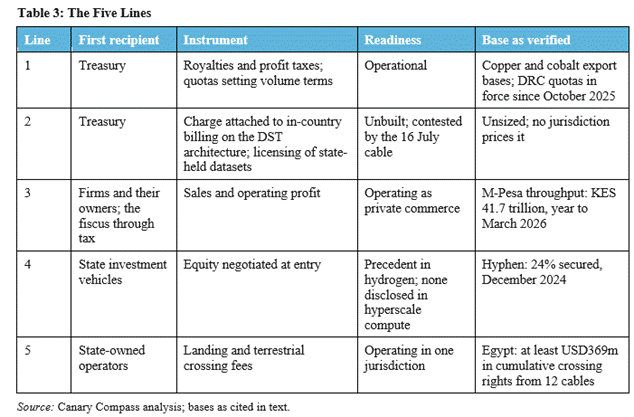
One: mineral taxation. The operational line. Zambia’s royalty framework captures extraction revenue, and the DRC’s quota regime routes its cobalt take through the royalties and taxes the permitted volumes carry. Both clocks from Section 5 run against this line, which is why The Cathode Economy’s conservation argument, conditioning new extraction on domestic capacity, is the version of this line with a future.
Two: data taxation. The principle is not that data behaves like carbon; data is non-rival, reproducible and jointly generated, which is why no severance tax maps onto it. African data trains models, calibrates advertising systems and feeds surveillance products, and no African jurisdiction yet prices that use directly. The workable nexus is the one Part 2’s trajectory already stands on. The model companies and the platforms built on them sell subscriptions, advertising and cloud inside African jurisdictions, and that billing relationship is the border of Part 2’s stage three. The digital services taxes running on the continent, Kenya’s since 2021, now a significant economic presence charge, and Nigeria’s on non-resident platforms, are the collection architecture a data charge attaches to. Part 2 named the same instrument as stage four’s nearest precedent; the charge proposed here borrows the machinery, not the stage. The border is a collection point, not yet a base. What counts as taxable use of local data, training against retrieval against advertising, is the definition the line still needs. The narrow case that works first is licensing: a statistics office or registry licensing a defined dataset for training use, at a price, to a named counterparty. That is revenue without a new tax, and a different instrument from taxing subscriptions. Two constraints apply. Absent market power, the levy’s incidence lands on the domestic bill. And Washington answered the first digital services taxes with Section 301 tariff threats, announced and then suspended; the cable below is that answer arriving before the tax. The line is institutionally undeveloped, and development takes the technical state capacity the coalition’s capacity-building programmes could build and are not directed at.
Three: application-layer revenue. The M-Pesa path: own the layer where the technology meets the African customer, even while the layers beneath are imported. M-Pesa is the continent’s proof that the layer can be held at scale, moving KES 41.7 trillion in the year to March 2026. The figure is throughput; the revenue is the operator’s toll on it. The ownership caveat The Cathode Economy priced sits on the operator’s shareholder register. Its moat was a payments licence and a cash network, the honest caveat for applications built on rented models. The moat has to live in distribution, data or regulation, because it cannot live in the model. The layer is Part 1’s fifth floor, integrators and applications, one of the three where Part 1 found African firms at regional scale, and the one floor Part 2’s margin argument favours. When the model is given away, margin migrates down into silicon and cloud and up into applications, and only the second destination is held by African firms at scale. The line holds up best if the demand clock’s bust arrives, because its revenue derives from local economic activity rather than the global capex cycle. The revenue is private first; it reaches the fiscus as tax, and the exit as ownership.
Four: sovereign equity in deployed infrastructure. The Hyphen precedent: Namibia’s designated vehicle secured 24 per cent of the foreign-developed hydrogen project on its soil in December 2024, through SDG Namibia One, a blended facility raised with Dutch state capital. The stake is a financial claim; its control rights live in the contract. The author found no disclosed case of an African state holding equity in a hyperscale data centre on its territory by this essay’s cut-off. The adjacent exhibits exist: Africa50 holds equity in PAIX’s data centres, Cassava’s African-owned capacity is on Part 1’s map, and a state-built national facility such as Konza is the state owning the floor it built. The missing case is state equity in the hyperscale capacity foreign capital deploys. Rwanda’s Anthropic MOU, a three-year deployment and capacity agreement signed in February 2026, is access; Kenya’s Microsoft campus, stalled as Section 5 found it, was to be hosting. Equity is negotiated at entry, and capital that has not landed can go elsewhere; what disciplines the ask is the siting advantage, firm power, cables, latency. The precedent exists in green hydrogen and has not been carried across the corridor to compute.
Five: transit and crossing fees on data flows. The levy architecture exists, in one African jurisdiction, and it is the literal digital Suez. State-owned Telecom Egypt charges the subsea cables that cross its territory between the Mediterranean and the Red Sea. 12 cables paid at least USD 369 million in crossing rights between 2000 and 2019, with operating charges on top. Revenue from international networks, the crossing charges inside it, ran as high as 17 per cent of the operator’s total in some years (DataCenterDynamics, 2022). The law leaves the room: UNCLOS keeps the seabed free, and the landing and the terrestrial crossing are sovereign, which is where the charge sits. Volume-based fees produced the diversion the instrument always threatens: Google’s Blue-Raman was routed through Israel and Jordan to bypass the corridor. Incidence is the second limit, because a badly designed charge lands on domestic connectivity. Egypt proves the revenue and the diversion in one exhibit; no other African jurisdiction runs a disclosed equivalent, and the line is a candidate until more do.
The line closest to the old extractive economy is operational, and Egypt’s toll shows the newest one working where a state owns the chokepoint. The lines native to the new economy are otherwise unbuilt as sovereign instruments. Africa can currently charge the stack for what leaves the ground and, Egypt’s corridor aside, cannot yet charge it for what moves through its cables. The mapping to Part 2’s instruction is direct: lines three and four build what Africa can own, lines one, two and five price what it surrenders, and together they fund the exit. Unbuilt, they leave the ledger where this section opened it, the negative entry compounding while the lines stay on paper. They are also the most visible answer to the balance sheet Part 2 found unsized. Nobody has yet offered Africa the G42 bargain Part 2 priced, alignment purchased as a package, so the seat gets bought, if it gets bought, out of the stack’s own receipts. And what the receipts buy must pass the test Part 2 set for any stack: continuity of access, auditability of the systems bought, and a credible exit between suppliers. Revenue that purchases a dependency on better terms has failed it.
These lines are contested before they exist. A February cable had ordered diplomats to fight data-sovereignty initiatives, data localisation first among them (Reuters, 25 February 2026). A State Department cable sent on 16 July and reported by Reuters on 22 July, the same cable Part 2 caught playing down kill-switch talk, went further. It instructed American diplomats worldwide to push back on so-called digital sovereignty (Reuters, 22 July 2026). The cable defined the term to include localisation requirements, network usage fees, content-moderation rules and rules restricting American technology firms’ access to foreign markets. Diplomats were also told to counter AI sovereignty arguments by describing efforts to build rival systems from the ground up as a waste of time and resources. On the narrow point the cable is largely right. Building a sovereign stack from scratch is beyond the reach of almost every country, and the attempt would consume capital with better uses. The target list runs well past autarky. Network usage fees are the fifth line’s instrument. Localisation would help the second line without being necessary to it, and the cable opposes it anyway. Market access rules sit behind the fourth. The argument on offer is anti-autarky. The instruction runs against taxation, conditioning and equity, the three things a country that will never own the stack can still do. The cable’s own pitch was plain: “They build it. It’s yours.” (Reuters, 22 July 2026). Building something on your soil and owning it are different relations, and the cable’s pitch sells the first as the second.
The continental counterweight is adopted and not yet in force. The African Union endorsed a Continental AI Strategy in July 2024. The AfCFTA’s Digital Trade Protocol, adopted in February 2024 with its eight annexes following in February 2025, is the frame for bargaining as one on the cable’s own subjects: data flows, localisation and market access. The frame is potential rather than automatic, and it cuts both ways: the protocol’s own Article 22 limits forced localisation between African parties even as the cable fights it from outside. Ratifications, 22 needed and requested by the end of 2026, stand between the text and force. The 54 AfCFTA signatories negotiate today as fragmented regimes, at the price of the weakest; one continental regime would price at the scale the buyers already aggregate. The cable’s target list and the protocol’s subject matter are the same list. On this essay’s reading, the overlap is the measure of what the protocol would be worth in force.
7. Five Scenarios
Stress-test the structure against five futures, four adverse and one benign.
Scenario one: growth continues. The buildout pays off, the bifurcation widens through pricing, both blocs keep competing for African minerals and markets. Africa retains marginal negotiating room and is progressively priced out of frontier capability. Slow deterioration.
Scenario two: correction with rescue. The author’s base case for how a correction resolves, argued in the next section. The financing loop breaks, the state steps in, concentration entrenches, access terms tighten. Slow strangulation.
Scenario three: correction without rescue, orderly. The American side of the stack contracts and consolidates without state absorption. China fills the vacuum at commodity prices, state-directed capacity that is not marked to market. Africa defaults onto the Chinese stack. If the contraction also pulls American mineral offtake, the two-bidder leverage of Section 5 goes with it, and the forced choice resolves in China’s favour by default rather than by decision.
Scenario four: the balance sheet breaks. This is the tail rather than a coequal branch. The trigger sits in the absorption rather than the capex. A rescue priced in prospect means trillions of new issuance onto gross US federal debt above USD 40 trillion, more than 120 per cent of GDP, and confidence snaps on the supply the rescue implies. Yields spike, the rescue becomes unfundable in the pricing of it, and the dollar faces its sharpest test as the reserve asset since the end of gold convertibility in 1971, with no convertible successor ready. The system destabilises rather than excludes. For Africa this is the catastrophic variant, because reserves, debt service and trade reprice at once, and stranded physical infrastructure does not care who wins.
Scenario five: diffusion wins. Model costs collapse, inference moves onto cheaper hardware, connectivity improves, and open-weight capability stays genuinely competitive. African firms build profitable applications on rented substrate, the way industries have been built on imported operating systems, clouds and chips, and productivity rises materially. The consumer surplus is real and lands on the sixth floor, where Part 1’s buyers live. This is the best available future; African incomes and African ownership can both improve inside it. What survives it is the question on the masthead. The applications run on floors owned elsewhere, some rent still clears upward through whichever imported floor remains indispensable, silicon, compute, cloud, connectivity or model access, and the terms of access remain set outside the continent. Ownership becomes less existential and more valuable at once, because a thriving application layer is what makes the five lines worth building. Diffusion winning does not close the question. It raises the price of never answering it.
Five scenarios, one constant: in none of them does control over the indispensable layers arrive without deliberate sovereign action taken during the window. The scenarios differ on what happens to the stack’s owners. They agree that Africa remains the tenant.
One overlay sits across all five, and it needs its own vocabulary first, the three terms Part 1 left waiting, because the public conversation blurs three distinct claims into one word. AGI, artificial general intelligence, is a machine matching human versatility: able to handle more or less any cognitive task a person can, rather than only the tasks it was built for. Superintelligence is the claim beyond it: a system exceeding the best human performance at essentially everything that matters. The singularity is the claimed discontinuity: a machine improving its own design faster than humans can follow, each generation building a better successor, progress going vertical. The contest over them is not academic. OpenAI’s charter defines AGI economically, as outperforming humans at most economically valuable work. Its contract with Microsoft turns in part on when that definition is declared met, and under the October 2025 terms an independent expert panel verifies the declaration. When a definition carries a contract price, even the verification is part of the negotiation.
The singularity claim is unfalsifiable as forecast, and this essay makes none. Its structural implication prices all the same, because it is the limit case of the argument already made. Four of the five scenarios assume the frontier eventually commoditises: today’s premium capability becomes tomorrow’s cheap tier, as computing always has. Recursive improvement is the state in which that assumption dies: the frontier stops waiting to be caught. In that state, whoever holds the stack at takeoff compounds away from whoever does not. Every window on the board then collapses into that moment, The Forced Choice’s five to seven years of mineral leverage included. The essay does not predict that state. It notes only that the actors spending at the scale Part 1 priced can rationally spend on conventional returns alone. OpenAI’s chief executive still opened 2025 by declaring the company’s aim now turns to superintelligence (Altman, January 2025). The rational response to a nonzero probability of a permanent allocation is to hold a position in the stack before it locks. Africa holds no position that moves the terms.
One counterweight sits against the acceleration case. Growth may be constrained not by what improves fastest but by what is essential and hard to improve, the weak links in Aghion, Jones and Jones. If some essential tasks resist automation, the labour share can stay elevated even under rapid and widespread automation. Across more than 500,000 GitHub developers, three tool generations, autocomplete to interactive to autonomous agents, raised commits by cumulative effects of 30, 180 and 240 per cent (Demirer, Musolff and Yang, revised 2026). The 240 fell to 80 per cent at the level of projects and to 30 per cent at actual releases. In coding, the one domain measured, generation ran eight times ahead of shipping, which is what a weak link looks like. The African question inside that framework is the open one: which weak links does the continent’s endowment actually hold, and what would it take to own them? A continent with the world’s youngest workforce has a stake in that answer that ageing economies do not share.
8. The Rescue
Scenario two deferred its argument here. The question that matters is not whether the buildout is a bubble but who designs the rescue if it pops.
The financing loop Part 1 traced carries the signature of 2007, concentrated where Part 1 put it: beneath the investment-grade majors, in the neoclouds, the vendor guarantees and the vehicles. An asset class has grown interconnected enough that who could be allowed to fail has entered the official literature, its risk documentation lagging the exposure. Part of its debt sits in off-balance-sheet vehicles, disclosed this time, migrating toward the least regulated lenders. The BIS, the institution that spotted the last one, has flagged circular AI financing as a named risk to the global financial system (BIS Bulletin 137, October 2026). Its June Annual Economic Report adds that an equity correction today could bring more pronounced wealth effects than earlier ones. If the correction arrives, the 2008 playbook is on the shelf: emergency liquidity, direct capital injection and asset absorption, TARP’s USD 700 billion authorisation translated to whatever the compute economy requires.
The ingredients of a rescue are assembling. The Genesis Mission launched in November 2025, with language comparing itself in urgency and ambition to the Manhattan Project. It declared AI acceleration a dedicated national effort and put the federal scientific estate behind it, the class of commitment that precedes rescue. None of this creates a formal rescue commitment, and strategic industries have been allowed to fail before, telecoms in 2001 and shale repeatedly. What distinguishes this one is the race narrative plus the export-control designation, the state’s own stated stake. The political alignment is tighter than 2008’s: the administration’s advisers include the industry’s principal investors and executives, the White House AI adviser Part 2 quoted among them. The Paulson precedent upgrades from one Goldman alumnus to an advisory bench. The balance-sheet capability exists because reserve-currency privilege makes the deficit financeable, and the political case writes itself because the race narrative makes the rescue patriotic. A state that classified frontier models as controlled exports within three days in June, as Part 2 recorded, has told you the stack is strategic; Genesis and the bench say who would hold the pen.
Beneath the market sit two sovereign floors, and only one is on the record. The capital floor is deployed money. State-owned investors put USD 66 billion across AI and digitalisation in 2025, with sovereign wealth funds alone holding a record USD 15 trillion; Mubadala’s USD 12.9 billion sat inside that flow (Global SWF, January 2026). Around the deployed money sit the pledges and the projections. France convened EUR 109 billion of largely private pledges in February 2025, and the UK opened a GBP 500 million sovereign AI fund in April 2026. PIMCO sizes the coming half-decade at up to USD 14 trillion of scaffolding across AI infrastructure, defence and energy security (PIMCO, June 2026). Against the four builders’ USD 720 to 745 billion year, the state money is a signal rather than a substitute. Capital holds valuations up while it keeps arriving; it does not put revenue through the machines. The revenue floor is the forecast: the state arriving as the compute buyer of last resort, which is Part 1’s treasury prediction and Part 4’s case to make. Disclosed sovereign procurement remains far smaller than hyperscaler capital expenditure, which is why Scenario two is a forecast and not a description.
For Africa, a rescue binds three ways. First, the design: the rescue’s terms get written close to the rescued, and access pricing for outsiders tightens because the rescuer’s mandate is national advantage, not global diffusion. Second, the financing channel: a rescue is fiscal expansion on the reserve-currency balance sheet, and its cost reaches Africa through rates rather than through any African share of the creditor base. Dollar yields held higher for longer reprice external debt service and the reserves that defend currencies. African official holdings of Treasuries, price-takers the US Treasury’s own tables publish country by country, sit on the creditor side of the balance sheet being rescued. The continent priced out of the product pays for the product’s rescue through the rate channel. Third, the aftermath: post-2008, the surviving banks emerged larger, and the regulation written to constrain them cemented their dominance. A post-rescue AI oligopoly, wrapped in national-security designation, is not a market Africa negotiates with. It is a utility Africa petitions.
The terminal version of this logic circulated in the conversations among friends that started this essay, and it is the strongest form of the claim. If AI is the terminal phase of the financial economy as we know it, capital stops needing labour, and therefore stops needing the consumer. In turn it stops needing the equity market as the mechanism for allocating and recycling claims. The claim carries a missing link its own logic must answer: capital that needs no labour still needs a buyer, and the proposition never names one. If the state becomes that buyer, then on the claim’s own logic valuation is obsolete rather than mispriced: the state swallows the market whole, and the state is swallowed by tech whole. The transformative scenario Trammell and Korinek price, labour share trending toward zero, is that end-state rendered in a growth model’s chart. Against the standard consolation that redistribution will bridge the gap, the objection from the same conversations holds: a check will not build wealth as fast as ownership does. Universal basic income inside a stack someone else owns is a tenancy agreement. The form of that world has a name: state-led capitalism. Africa would enter it holding neither the state that leads nor the capital that is led.
What this part has not asked is who absorbs the fall when the floor is tested, because that question belongs to the money that summons the floor. Part 4, tomorrow, runs the market test, follows the state’s spending to the use case the structure serves most completely, and closes the series on the answer.
Sources
Data cut-off: 6 October 2026. Part 3 of a four-part series; consolidated sources appear with Part 4.
Africa50, equity investment in PAIX Data Centres (2022).
African Union, Continental Artificial Intelligence Strategy (July 2024).
African Union, Protocol to the AfCFTA Agreement on Digital Trade (February 2024), and its eight annexes (February 2025).
Aghion, Philippe, Benjamin Jones and Charles Jones, Artificial Intelligence and Economic Growth (2019).
Altman, Sam, Reflections (January 2025).
Anthropic and the Government of Rwanda, memorandum of understanding on AI in health, education and the public sector (17 February 2026).
Artificial Analysis, model benchmark data (2026).
Bank for International Settlements, Annual Economic Report 2026, and Bulletin No 137, Circular Relationships Among AI Firms (October 2026).
Bloomberg and DataCenterDynamics, reporting on the Microsoft and G42 capacity-lease impasse (May 2026).
Citizen Digital, President Ruto’s November 2025 remarks on data centre power (May 2026).
DataCenterDynamics, analysis of Egypt’s subsea cable crossing fees (2022).
Demirer, Mert, Leon Musolff and Liyuan Yang, Writing Code vs. Shipping Code (NBER Working Paper 35275, revised September 2026).
Energy and Petroleum Regulatory Authority, Kenya energy statistics to June 2026 (September 2026).
France, AI Action Summit investment pledges (February 2025).
Global SWF, annual report on state-owned investors (January 2026).
Kenya National Bureau of Statistics, Economic Survey (2025).
Kenya Private Sector Alliance, digital and online work survey (2021).
Kenya Revenue Authority and Nigeria Federal Inland Revenue Service, digital services taxation (2021 and 2020).
Microsoft and G42, Kenya digital ecosystem initiative announcement (May 2024).
Mining Weekly and Reuters, DRC cobalt export quota regime (October 2025).
New York Times, reporting on the collapse of Kenya’s ghostwriting trade (September 2026).
Onyambu, Dean, The Cathode Economy, The Forced Choice and Misaligned Transition, Canary Compass (2026).
OpenAI, charter (2018), and OpenAI and Microsoft partnership terms (October 2025).
People Daily, Kenya’s academic writers scramble as AI takes jobs (2025).
PIMCO, Secular Outlook (June 2026).
Rest of World, reporting on Kenya’s online work economy (2023).
Reuters, State Department cables on data sovereignty (February 2026) and on so-called digital sovereignty and kill-switch talk (cable dated 16 July, reported 22 July 2026).
Safaricom, FY2026 results and M-Pesa transaction values, as reported (2026).
The Brief and The Namibian, completion of Namibia’s 24 per cent state acquisition in Hyphen Hydrogen Energy (December 2024).
Trammell, Philip and Anton Korinek, Economic Growth under Transformative AI (NBER Working Paper 31815, 2023).
UK government, sovereign AI unit and fund (April 2026).
US International Trade Commission and East Asia Forum, Indonesia’s nickel export ban and downstreaming (2023).
US Trade Representative, Section 301 investigations of digital services taxes (2019 to 2021).
US Treasury, gross federal debt data, as reported (August 2026).
White House, Executive Order 14363, Launching the Genesis Mission (24 November 2025).
Yale Budget Lab and Brookings, findings of no detectable AI labour-market disruption (October 2025).
Disclaimer
This article does not constitute legal, financial, or investment advice. The author shares views for perspective and discussion only. Do not rely on them as a substitute for professional advice tailored to your specific circumstances. Always consult a qualified legal, financial, investment, or other professional adviser before making decisions based on this content. The analysis reflects proprietary research undertaken by Canary Compass and the author.
Canary Compass and the author accept no liability for actions taken or not taken based on the information in this article.
The views expressed in this article represent the author’s independent professional analysis and do not constitute an endorsement of any individual, institution, or position. Canary Compass and the author accept no responsibility for how this content is interpreted, excerpted, or recontextualised by third parties not involved in its production and publication. Reproducing any portion of this work in isolation, or in combination with other material, in a manner that misrepresents the author’s original meaning constitutes a distortion of the published record.
The author may hold positions in financial instruments, currencies, or assets discussed or referenced in this publication. Such positions do not constitute a recommendation to buy or sell.
All views, projections, and forecasts reflect the author’s assessment at the time of writing. Data sourced from third parties is believed to be reliable but has not been independently verified. Past performance does not indicate future results.
All content published by Canary Compass is the intellectual property of the author. Reproduction, adaptation, or redistribution, in whole or in part, requires written permission.
About the Author
Dean N. Onyambu is the Founder and Chief Strategist of Canary Compass, a financial research publication focused on African monetary architecture and financial sovereignty. He brings 18 years of experience across trading, fund leadership, and economic policy, with senior roles at Standard Bank, First Capital Bank, and Opportunik Global Fund.
Read and subscribe at www.canarycompass.com.
The Canary Compass Channel is available on @CanaryCompassWhatsApp for economic and financial market updates on the go.
For more insights from Dean, you can follow him on LinkedIn @DeanNOnyambu or X @InfinitelyDean.