

AI-illustration: The four-year machine behind football’s most misunderstood billions.
On Friday I published Europe Is Trying to Kill a Conversation That Must Be Had. This paper does not relitigate it. Late that same night FIFA withdrew the Forward Enterprise proposal (FFE). Its president’s statement said the divisions created, “regardless of the level of support, are no longer in the interest of the objective set out in the first place”. On Saturday UEFA declared the FIFA leadership had lost its confidence and CONCACAF demanded “a full review of this leadership”. Confederations announced positions all week; the week still closed without one of the 211 votes being cast where votes decide, in Congress.
By publication this morning, the succession fight had moved. Wales, Serbia and Sweden had withdrawn their endorsements, with England expected to follow. DR Congo’s FECOFA had publicly reaffirmed support, while CAF, AFC and CONMEBOL endorsements remained on record. FIFA said on 18 July that more than 200 associations had pledged support, and challengers must be nominated by 18 November. Time therefore favours the incumbent: opponents must turn withdrawals and declarations into a candidate capable of winning votes before then. Europe’s formal tournament boycott was triggered by FFE and fell away when the proposal was withdrawn. Fresh reporting now describes a governance boycott and rival international competitions if Infantino remains, though UEFA has not formally adopted that escalation. The claim that Donald Trump had committed to save Infantino is also unverified. Reuters reported instead that Infantino had sought Trump’s support and had not reached him; the White House had not confirmed any backing.
The proposal is dead. The numbers that armed the kill outlive it. Several were right numbers attached to the wrong object. This paper puts each back in its place.
1. The Machine That Makes the Confusion
Begin with why intelligent people, up to and including a confederation’s press office, keep getting these numbers wrong, because nobody in this story needed to lie. FIFA sells its rights in four-year packages priced on the World Cup, so tournament and cycle blur at the contract level. Accounting then pours most of the cycle into year four. Revenue is recognised over the rights period, with measures of progress that concentrate it around delivery, so cash collected across four years appears as income in one. Headlines compress what remains. And FIFA’s own vocabulary opened the door years ago. In March 2022 AFP rendered FIFA’s accounts as “cash and asset reserves” of USD5.5bn, against audited reserves of USD1.6bn at the balance date it described.
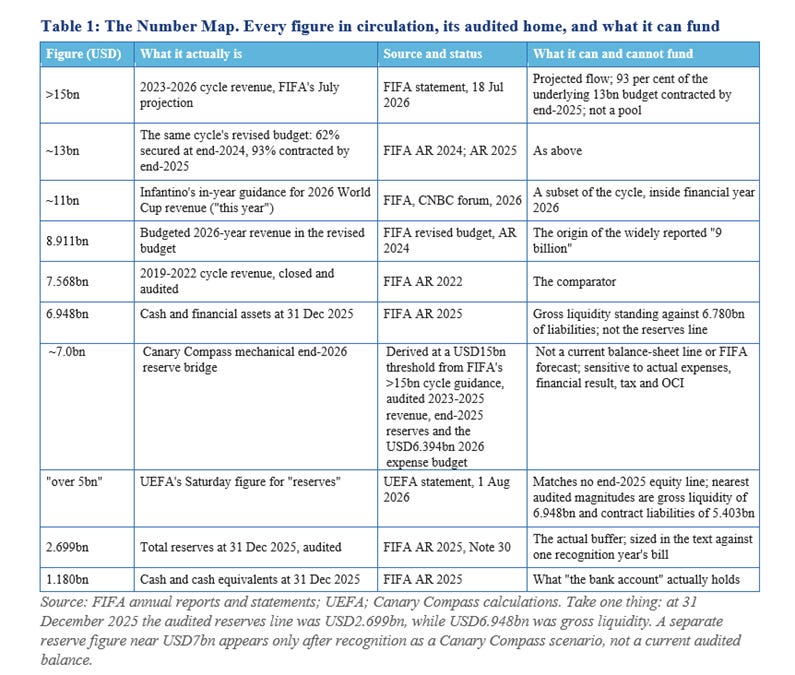
From there the ladder runs on its own: cycle revenue becomes World Cup revenue, becomes money FIFA has, becomes reserves, becomes billions sitting idle. Within two days of Infantino’s July statement that the cycle could “top the USD 15 billion mark”, outlets were reporting the figure as World Cup takings. A FIFA spokesperson had to confirm publicly that it meant the cycle. I have slipped on this ladder myself: a June essay in this catalogue attributed a cycle figure to the tournament, and the correction now sits on that piece. The final rung is UEFA’s official statement of Saturday morning, four steps from the audited balance sheet.
And note the direction of the errors, because it is the tell. Every documented misstatement in this record runs the same way: the wire’s 5.5 billion, the July compressions, Concacaf’s vast-reserves echo, UEFA’s five billion. Each makes FIFA’s free money larger than it is. Random error scatters; a pattern that always points one way is not random. The ladder’s first rung was FIFA’s own vocabulary, built years ago to flatter Zurich’s strength; this week the same ladder served Nyon. The dates on the record need no commentary: the leak of the FFE plan landed Tuesday. The loudest internal voices arrived Friday.
A club that sells four seasons of tickets in advance holds a fat bank account in year one and owes every seat of it. Nobody calls that money idle, and nobody prices the club off that account alone. FIFA is that club at planetary scale. Table 1 gives every number in circulation its home. Table 2 shows what FIFA actually holds, and Table 3 assembles the number the headlines compress.
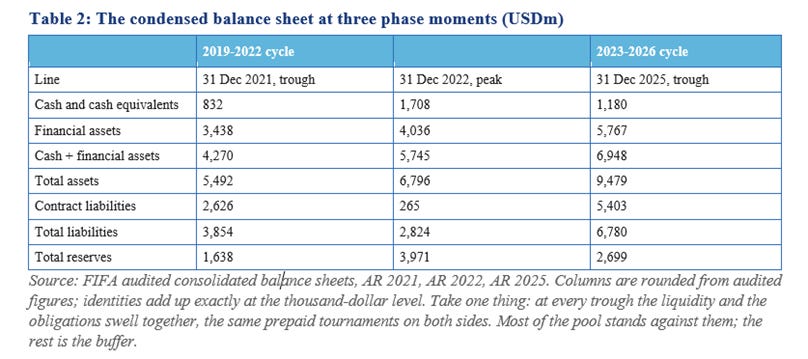
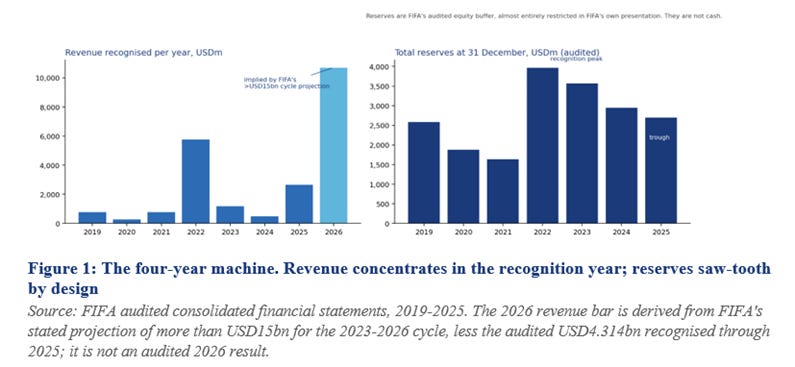
Read Table 2 as a lung. At each trough, liabilities inflate with tournaments sold and not yet delivered; at end-2021, contract liabilities were 68 per cent of everything FIFA owed. At recognition the contract-liability balance drops 90 per cent in one year as it converts to revenue, 76 per cent of the cycle’s total landing there, and reserves swell. The audited cash flows complete the picture. In 2021 FIFA booked a 312m deficit while operating cash flowed in at 780m, because customers were prepaying Qatar. In 2022 it booked a 2.37bn surplus while generating only 1.46bn of cash, because the recognition year’s revenue was mostly old money. And in 2023, with the tournament to pay for, operating cash ran out at 1.21bn as the bills settled. The cash and the revenue are the same dollars counted in different years, never two piles. That is what “sat idle in FIFA’s bank account” was describing: customers’ prepayments, held and invested against product not yet delivered. And the obligation is discharged by delivery itself, which is a real bill: delivering the 2026 cycle’s final year is budgeted at USD6.394bn of expenses, USD3.756bn of them the World Cup itself.
The reserves themselves are not a discretionary pot either. Every annual result, surplus or deficit, allocates to restricted reserves under FIFA’s own presentation. The 2025 balance sheet labels the line itself: “restricted reserves for FIFA’s statutory objectives”. Beside it sits a second pot of USD287m, “restricted reserves for club football”, the Club World Cup solidarity fund parked in equity awaiting distribution. The label does not make them unspendable; the arithmetic below makes them unrepeatable.
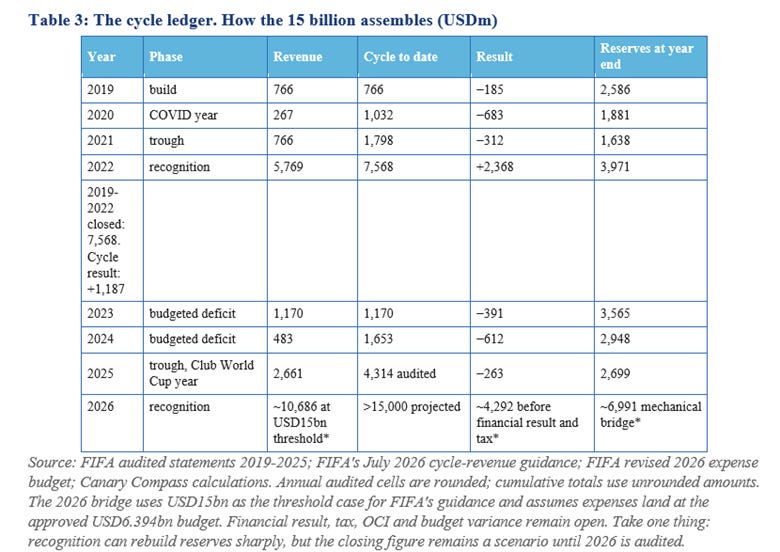
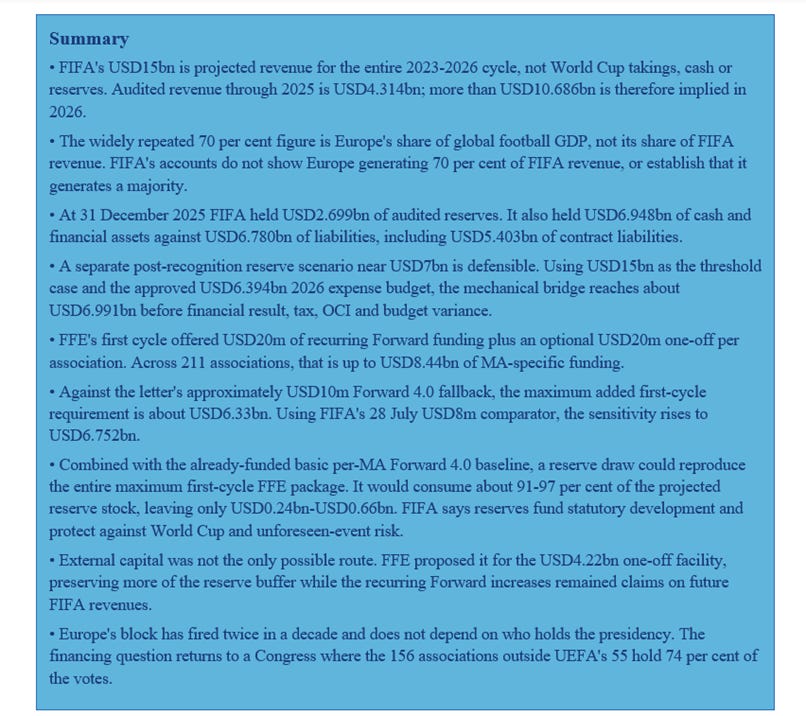
Three years into the current cycle, the audited total is 4.3bn. The remaining ten billion and more is recognised only when the tournament is delivered. That is why the same institution can be described as earning fifteen billion and running three consecutive deficits, and both descriptions are true. Even 2025, a 2.66bn revenue year on the expanded Club World Cup, was a deficit year. That tournament handed back essentially what it earned: USD1.78bn of direct costs, a billion of it prize money. A further USD287m solidarity fund was committed in equity and still awaiting distribution. Reserves fell anyway. Figure 1 shows the cycle visually.
There is therefore a defensible post-recognition reserve scenario near USD7bn. FIFA has not published an end-2026 reserves forecast. The estimate here is mechanical and uses FIFA’s own current guidance and approved budget.
The IFRS bridge is straightforward: closing reserves equal opening reserves plus the net result and OCI. At a USD15bn cycle-revenue threshold, implied 2026 revenue less approved expenses produces about USD4.292bn before financial result and tax. Added to opening reserves, that gives a mechanical bridge of about USD6.991bn before financial result, tax, OCI and actual-versus-budget variance. The USD6.394bn expense base already includes the USD660m Football Development Fund, so that commitment is already deducted. FIFA’s guidance is above USD15bn, but the expense number remains a budget; this is scenario arithmetic rather than a management forecast.
2. Who Funds FIFA?
There is another number that needs an address. FIFA itself says global football GDP is roughly USD300bn a year and that 70 per cent is generated in Europe. That is the wider football economy. It is not FIFA’s income statement.
Three objects keep being collapsed into one. Europe’s clubs, leagues and competitions dominate the wider professional football economy. FIFA earns its own revenue from broadcasting, marketing, licensing, hospitality, tickets and other rights attached principally to FIFA competitions. FIFA then redistributes part of those revenues through Forward and other programmes. A number belonging to the first object cannot simply be carried across to the second.
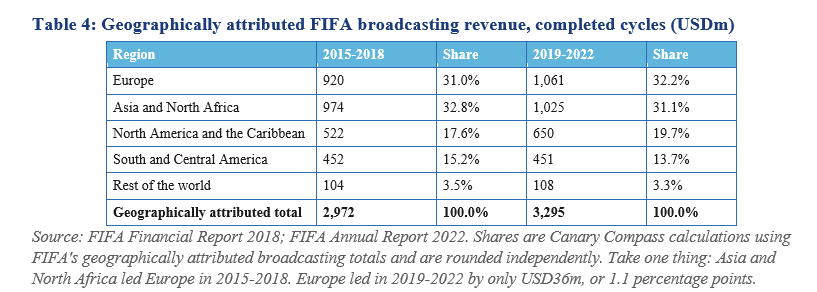
In the last completed cycle FIFA generated USD7.568bn. Broadcasting was the largest revenue category at USD3.426bn, or 45 per cent. FIFA does give that category a full-cycle geographic split, and the result is nowhere close to the claim that Europe generates FIFA’s revenues by far. Table 4 adds the previous completed cycle because the comparison matters.
That is strong evidence against the claim that Europe generates FIFA’s revenues “by far”. That table cannot establish a particular non-European share of total FIFA revenue either. FIFA does not publish regional attribution across enough of marketing, licensing, hospitality and the rest of the income statement to calculate that number honestly. The published record establishes the narrower and more important point: Europe’s 70 per cent belongs to the global football economy, not FIFA’s accounts.
The current cycle makes the same point from another angle. FIFA itself says annual broadcasting comparisons are not meaningful because revenue is recognised when the relevant event is broadcast; the full four-year cycle is the proper unit. In 2025 the problem becomes extreme: FIFA recognised USD1.044bn of broadcasting revenue, but USD1.001bn was classified as global broadcasting revenue rather than assigned to a territory. Table 5 shows the annual recognition pattern.
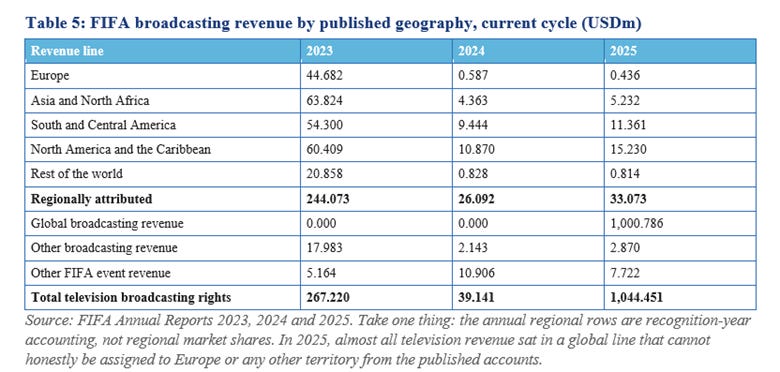
Europe is central to world football. That does not mean Europe funds FIFA. The first proposition is obvious from the club economy; the second requires evidence from FIFA’s own accounts, and those accounts do not establish it.
Redistribution also sits inside the economics rather than outside it. FIFA sells a global competition asset. Productive investment in competitions, coaching, infrastructure, youth and women’s football, national teams and institutional capacity can broaden the player, audience and commercial base that feeds that asset. The return depends on deployment, which is why contractual discipline and audit matter, alongside governance. Properly deployed development finance can strengthen the same global market from which FIFA earns.
3. The Financing Problem, and Every Alternative Tested
Now hold the argument those numbers served. UEFA’s Saturday statement pairs its five billion with a counter-proposal: it “will begin work immediately... to propose a new way of distributing resources through the existing FIFA Forward programme”, using money “sat idle”. That is a balance-sheet financing route, not merely a distribution rule. Its strength depends on what reserves become after recognition, how much the membership spends, and what insurance remains. UEFA’s own club competitions gross more across four years than FIFA’s entire cycle and redistribute it largely within Europe. For most of the 211, the World Cup engine remains the only redistribution at comparable global scale.
One source of confusion is the word development itself. Forward 3.0 does not hand each association USD8m to build a stadium. It separates operating support from project capital, then adds targeted assistance for lower-revenue associations. FFE added a separate one-off capital facility. Table 6 keeps the baseline and the new money apart.
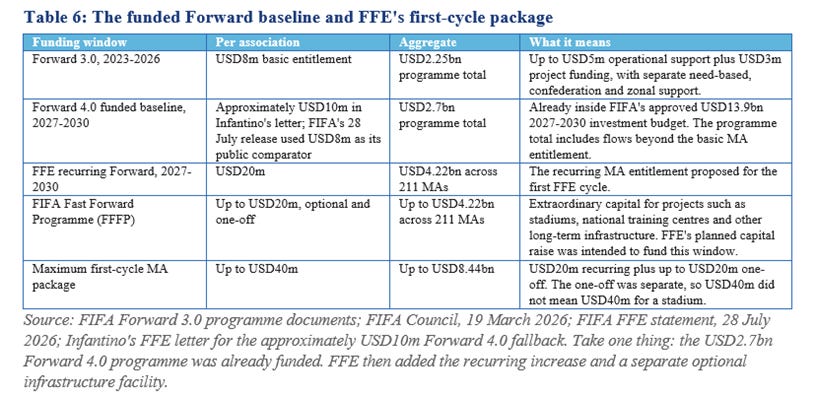
The first-cycle arithmetic starts with the whole package. FFE offered each of FIFA’s 211 member associations USD20m of recurring Forward funding for 2027-2030 plus an optional USD20m one-off FFFP facility for extraordinary infrastructure, including stadiums and national training centres. At maximum take-up, that is USD8.44bn: USD4.22bn recurring and USD4.22bn one-off. But FIFA was not starting from zero. Forward 4.0 was already approved at USD2.7bn for 2027-2030 and sits inside the operating plan. Infantino’s letter described the basic fallback as approximately USD10m per association, while FIFA’s 28 July public release used a “currently budgeted” USD8m comparator. The programme total is broader than either basic per-MA entitlement, so it is not added to the FFE package again.
On the letter’s approximately USD10m fallback, the existing basic MA allocation is about USD2.11bn, leaving a maximum additional first-cycle requirement of about USD6.33bn. On FIFA’s public USD8m comparator, the baseline is USD1.688bn and the additional requirement rises to USD6.752bn. Both calculations are shown because FIFA used both baselines. The distinction matters: the projected reserve stock is being tested against the additional FFE requirement, not against the full USD8.44bn package, because the existing Forward baseline remains funded through the ordinary budget.
The audited USD2.699bn reserve trough cannot meet either additional requirement, and neither could the last post-recognition peak of USD3.971bn. The mechanical end-2026 scenario near USD6.991bn changes the answer. If the already-budgeted Forward baseline continues through the operating plan, drawing reserves for FFE’s additional first-cycle requirement would leave roughly USD661m under the letter’s fallback or USD239m under FIFA’s public comparator. In other words, reserves could reproduce the maximum first-cycle FFE package only in combination with the Forward funding already budgeted, not by financing the USD8.44bn gross package on their own.
That is the strongest case for internal financing, and its price is visible on the same balance sheet. The draw would consume roughly 91-97 per cent of the projected reserve stock. FIFA’s own reserves note says those reserves support statutory purposes, including development, while also protecting the organisation against risks and unforeseen events, particularly World Cup risk. They are therefore available for development, but they are not idle. Funding the first cycle this way would exchange most of the insurance buffer for immediate development expenditure. FFE chose a different trade: raise up to USD4.2bn of outside equity to finance the FFFP, whose maximum one-off MA allocation is USD4.22bn, preserving more of that buffer without adding fixed debt service.
Nor does a first-cycle reserve draw settle the programme beyond 2030. FFE scheduled recurring allocations of USD22m per association in 2031-2034 and USD24m in 2035-2038, equivalent to USD4.642bn and USD5.064bn respectively. Across all three cycles, gross recurring MA Forward funding totals USD13.926bn; including the full one-off facility takes the maximum MA-specific package to USD18.146bn. Those are gross commitments, not incremental financing needs. FIFA did not publish the no-FFE per-MA counterfactual for the later cycles, so this paper does not manufacture one. If most of the reserve stock were used in the first cycle, subsequent commitments would depend on future operating surpluses rebuilding the balance sheet, new capital, or some combination of the two.
The trough itself is not distress. FIFA wrote in its 2021 report, before this dispute, that equity “is naturally expected to be at its highest at the end of the 2019-2022 cycle”. The current trough is 65 per cent above the last one, which absorbed USD321m of COVID relief. FIFA enters this recognition year more than USD1bn stronger than it entered Qatar’s. The accounts therefore reject both extremes: FIFA is not broke, and its gross liquidity is not an idle reserve pot.
Cuts have no candidate. None of the week’s counter-proposals names the line to cut, and the audited record makes the omission expensive. Across the full 2019-2022 cycle, Development and Education was FIFA’s largest expense category on its own classification. At 2.58bn, it ran narrowly larger than staging its competitions and two and a half times administration and commercial costs combined. And against its own budgets, FIFA has overspent development and underspent administration. In the closed cycle, Development and Education ran USD213m over budget while administrative costs came in USD224m under; current-cycle expenses ran under budget in 2023 and 2025 and marginally over in 2024. The deficits are the calendar FIFA chose, and inside it the record shows discipline. They are also partly self-insured: FIFA’s investment portfolio, swollen by advance receipts, earned a net financial result of USD673m across 2023-2025, offsetting more than half of the three deficits.
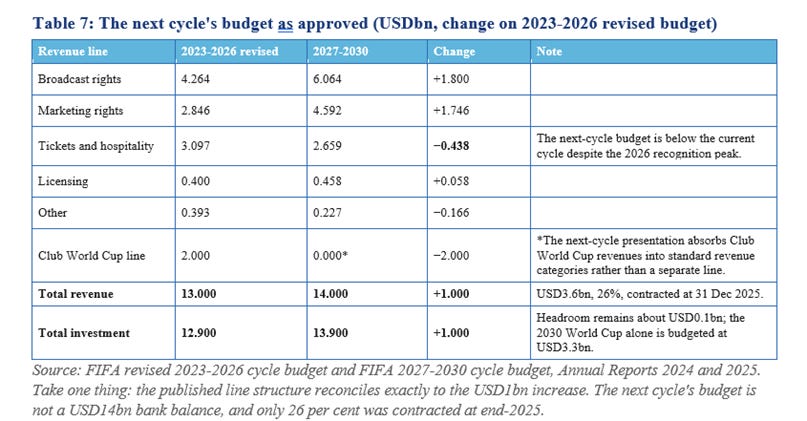
Future surplus is a real funding route, but the approved budget does not pre-fund the FFE increase. The 2027-2030 plan carries about USD100m of headroom before the financial result, while the current cycle may finish far above budget. Outperformance is real, twice demonstrated, and uncommitted. April showed what uncommitted money can fund: a USD144m prize top-up on demand. The question is what binds future outperformance to a recurring development floor.
The thin budget margin is also deliberate. FIFA has approved roughly USD100m of headroom in four consecutive budgets: 6,440 against 6,340, then 11,000 against 10,900, 13,000 against 12,900, and now 14,000 against 13,900. Even the anticipated 2026 excess already carries a USD660m Football Development Fund inside the approved investment plan. Record-breaking therefore beats the old USD13bn budget, not the emerging USD15bn-plus outcome. The next cycle is budgeted at USD14bn, and only 26 per cent was contracted at end-2025. A budget is neither cash on hand nor a guarantee of future outperformance.
Endowment income is another internal route. FIFA earned USD673m of net financial result across 2023-2025, materially offsetting the planned deficits. That income can support a blended solution, but the demonstrated three-year amount does not fund a USD6.33bn-USD6.75bn maximum first-cycle increase on its own.
The remaining routes differ in where risk sits and what future revenue they encumber. A statutory formula or ring-fenced revenue share binds but does not fund; it still needs cuts, growth or capital behind it, and none was offered. A public float raises money from a crowd that signs nothing it negotiated; conditions can be printed into a security, but nobody across the table bargains for the 211. Ordinary debt creates fixed principal and interest claims against the same envelope. Securitisation can lower that cost by pledging defined future revenues into a payment waterfall, but those revenues are then encumbered until debt service is met. Long-term commercial-rights prepayments bring future income forward at the price of future flexibility. A wholly FIFA-owned commercial subsidiary changes the legal container, not the source of capital. Fund it internally and no new external money appears; let it borrow and the structure returns to debt.
The arithmetic leaves a genuine capital-structure choice rather than a single inevitable instrument. FIFA can spend more of the reserve buffer, use future surplus, borrow against future revenues, raise outside equity or combine them. Each route moves a different risk.
FFE’s minority-equity route had one clear balance-sheet advantage: immediate capital without mandatory principal or fixed interest, while preserving more of the insurance stock. Its weaknesses were the terms and the process. Seniority and control, disclosure and deployment still decide whether that trade serves the 211. A blended structure could reduce dilution while limiting reserve drawdown, but the development floor must remain contractually protected whichever capital stack is chosen.
Money without a binding rule remains discretionary at the next budget. The Friday essay’s condition therefore survives the arithmetic intact: investor distributions, reserve drawdowns or future surplus should sit behind a protected member-association development commitment, ring-fenced from administrative absorption. The machinery already exists in Forward, where each recipient is audited centrally and by its statutory auditors. Carlos Cordeiro, senior adviser to the president, resigned on Friday, saying he could not stand by “while FIFA considers selling a stake in the World Cup”. His objection goes to the instrument; this paper’s concern is what each alternative actually buys.
4. What Next
The kill branch of the game tree the Friday essay priced in advance has now executed. The instrument died before any member voted, the periphery’s consent went unpriced, the funding reverted toward the grant path, and the block was ratified without one of the 211 votes being cast where votes decide. Nobody at UEFA’s headquarters in Nyon or FIFA’s Zurich has answered the question this weekend leaves. Europe’s block has fired twice in a decade. In 2018 it stopped the USD25bn SoftBank-backed vehicle, with objections running from transparency to the threat to its own competitions. This week it stopped FFE through a declared boycott: “UEFA and its national associations will not participate in FIFA competitions”. Both times it fired before any member voted. It is a demonstrated capability, and it does not live in the presidency. Unseat Infantino or keep him, the block persists in the boycott lever and the market power behind it. Changing the arguer changes nothing about the argument.
And ask why it fired at all, against a president Europe itself put forward and bankrolled. In 2016 UEFA’s executive backed Infantino’s candidacy with a declared EUR500,000 (USD542,000 at the time) campaign budget and an endorsement that called him “the right man to take FIFA Forward now”. A decade later the same confederation declares his leadership has lost its confidence. The record between those dates needs no theory of anyone’s heart. Development entitlements rose from about USD2m per association before Forward to USD8m under it, with USD20m offered. FIFA puts its development investment across the decade at USD5.1bn; the World Cup grew to 48 teams and Africa’s places rose from five to nine direct, ten with the play-off won by DR Congo.
The increases were most material to smaller, lower-revenue associations. Europe’s accumulating objections, the Club World Cup, the calendar, now FFE, tracked Europe’s interests each time, as the periphery’s support tracked its own; interests are the map on both sides. None of this defends the governance record. This catalogue has prosecuted it, the locked cabinets, the unexplained discretion; the reported succession compensation is denied and not relitigated here. Both indictments hold at once, which is the standard Friday’s essay applied to FIFA and this one applies to its president. And the reform this publication champions runs through stronger guardrails on allocated money and published reasoning, never through pretending the redistribution did not happen.
What the block cannot do is keep the conversation killed, because both parties to the kill committed within a day to reopening it. UEFA promises new Forward distribution, “not the end of the story”. FIFA’s withdrawal promises development-funding discussions in the coming days and weeks. The financing question therefore returns to a table where the 156 hold 74 per cent of the votes and every alternative carries an audited price. And for the first time, a public record exists of what their consent was worth. A one-off USD20m per association was offered in the letter as consideration for support by 19 September, recharacterised as unconditional in FIFA’s clarification a day later, and withdrawn with the proposal. That number does not expire with the proposal or the president. It travels with the office, into the leadership review, the November nominations, and the March Congress in Rabat. And one thing bears watching if that review proceeds, whoever holds the presidency at its end. Congress runs on the principle that each member association has one vote, and the only permanent victory at that table is to change what a vote weighs. Watch for stakeholder seats for clubs and leagues, merit-tested funding criteria, and competencies migrating to appointed bodies. Each would dilute the practical weight of one member, one vote without formally amending it, and each can travel under the name of governance reform.
The audited numbers are now on the table. At 31 December 2025 FIFA had USD2.699bn of reserves and USD6.948bn of gross liquidity against USD6.780bn of liabilities. If current revenue guidance and the approved expense budget hold, recognition can mechanically rebuild reserves toward USD7bn. That is real internal firepower, not a current bank balance.
The first cycle can be recreated from the funded basic per-MA baseline plus a reserve draw, but only at a steep price. The maximum incremental MA requirement is about USD6.33bn-USD6.75bn, including the one-off infrastructure window. Funding it from the projected reserve stock would leave roughly USD0.24bn-USD0.66bn of insurance. The argument is therefore no longer whether FIFA has money. It is how much insurance the membership should spend, what future revenue should be bound, and which capital structure prices that choice best.
If the game’s development is worth funding at scale, name the money, name its rank, and put it to the 211 in a recorded vote, the one thing this entire week refused to risk.
The statutes already hold the key. One fifth of the member associations, 43 on today’s membership, can requisition an extraordinary Congress in writing, with an agenda the requisitioners set and a three-month clock, and the duty to convene is mandatory. Nobody needs Zurich or Nyon to call the question. The standard this catalogue set for sovereign debt applies unchanged: the 156 should not arrive with grievances and guessing. They should arrive owning the arithmetic of their own consent, valuation, term sheet and audit trail, built inside the federations rather than borrowed from whoever leaks first. Africa’s 54 are the largest bloc in that room, and nobody does the smartening up on their behalf. The homework is the sovereignty. That is the conversation Europe could not kill and FIFA could not sell. It begins where the numbers end.
Sources
Sources: FIFA (2019) Financial Report 2018. FIFA (2022) Annual Report 2021. FIFA (2023) Annual Report 2022, including the 2019-2022 consolidated financial statements, full-cycle revenue analysis and the 2023-2026 cycle budget. FIFA (2024) Annual Report 2023. FIFA (2025) Annual Report 2024, including the revised 2023-2026 cycle budget. FIFA (2026) Annual Report 2025, including the 2025 consolidated financial statements and the 2027-2030 cycle budget approved by the 76th FIFA Congress. FIFA (2026), “FIFA President Calls for Global Investment in Football at the Milken Institute Global Conference”, 6 May. FIFA Forward 3.0 programme overview, core principles and programme regulations. FIFA (2026) statement of 18 July on 2023-2026 cycle revenues; FIFA (2026), 28 July FFE statement setting the USD20m one-off and USD20m/USD22m/USD24m Forward schedule; the FIFA Forward Enterprise letter, clarification and withdrawal statements of 28 July to 1 August. UEFA (2026) media releases of 30 July and 1 August. Concacaf (2026) statements of 30 July and 1 August. FIFA Statutes, provisions on the Extraordinary Congress. Associated Press (2016) on the declared campaign funding. CAF (2026), 29 April statement supporting Infantino's 2027 candidacy; AFC and CONMEBOL public endorsements from April 2026; FECOFA public letter reaffirming support, 3 August 2026. Reuters and Associated Press reporting of 3-4 August 2026 on endorsement withdrawals, the November nomination deadline and the reported approach to the White House. The Times, 4 August 2026, on the reported governance boycott and possible rival international competitions. Contemporary reporting by The Times, Financial Times, Sky News, Associated Press, Reuters, CNBC, The Guardian, CBS Sports, Sports Business Journal, Inside World Football and The Sports Examiner, July to August 2026, used for live chronology and attributed statements where primary documents were unavailable. Prior Canary Compass coverage as linked in the text. Canary Compass calculations and analysis, including the mechanical end-2026 reserve bridge and first-cycle FFE sensitivity using both FIFA-stated baselines.
Disclaimer
This article does not constitute legal, financial, or investment advice. The author shares views for perspective and discussion only. Do not rely on them as a substitute for professional advice tailored to your specific circumstances. Always consult a qualified legal, financial, investment, or other professional adviser before making decisions based on this content. The analysis reflects proprietary research undertaken by Canary Compass and the author.
Canary Compass and the author accept no liability for actions taken or not taken based on the information in this article.
The views expressed in this article represent the author’s independent professional analysis and do not constitute an endorsement of any individual, institution, or position. Canary Compass and the author accept no responsibility for how this content is interpreted, excerpted, or recontextualised by third parties not involved in its production and publication. Reproducing any portion of this work in isolation, or in combination with other material, in a manner that misrepresents the author’s original meaning constitutes a distortion of the published record.
The author may hold positions in financial instruments, currencies, or assets discussed or referenced in this publication. Such positions do not constitute a recommendation to buy or sell.
All views, projections, and forecasts reflect the author’s assessment at the time of writing. Data sourced from third parties is believed to be reliable but has not been independently verified. Past performance does not indicate future results.
All content published by Canary Compass is the intellectual property of the author. Reproduction, adaptation, or redistribution, in whole or in part, requires written permission.
About the Author
Dean N. Onyambu is the Founder and Chief Strategist of Canary Compass, a financial research publication focused on African monetary architecture and financial sovereignty. He brings 18 years of experience across trading, fund leadership, and economic policy, with senior roles at Standard Bank, First Capital Bank, and Opportunik Global Fund.
Read and subscribe at www.canarycompass.com.
The Canary Compass Channel is available on @CanaryCompassWhatsApp for economic and financial market updates on the go.
For more insights from Dean, you can follow him on LinkedIn @DeanNOnyambu or X @InfinitelyDean.