

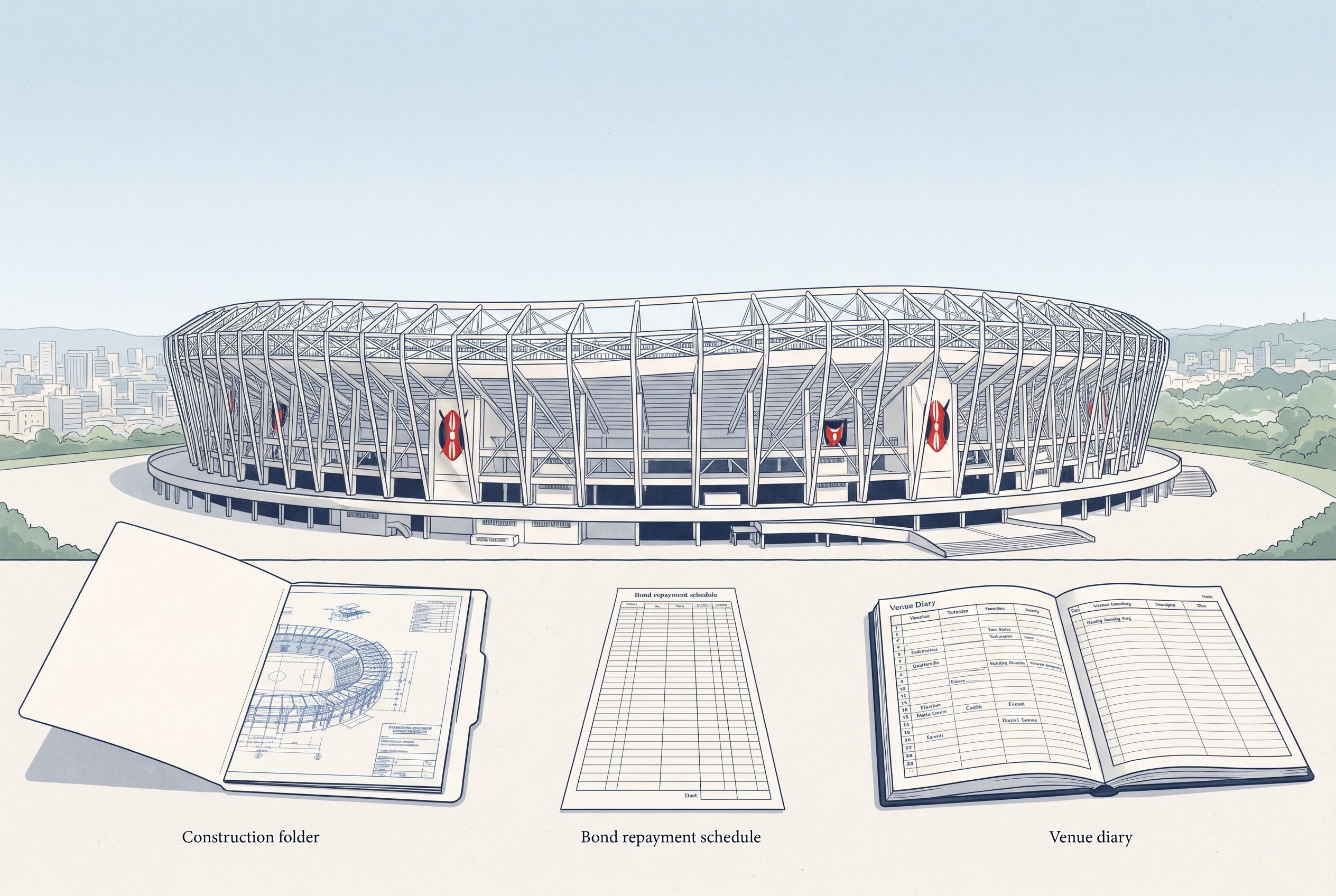
AI-illustration: Talanta Stadium with separate records for construction, bond financing and venue operations.
Canary Compass will move to paid subscriptions soon. Founding members put a question to Dean every month and join a quarterly call. Founding membership is limited to 50 people and closes at launch. Pledge now; you pay nothing until paid publishing begins. Friday Reflections will stay free. See every plan and what it includes. Institutional licences: dean@canarycompass.com
Chart data: founding members, institutional seats and Desk licence readers receive the values behind this Note’s charts on request.
Talanta Stadium has several prices in public discussion because the records count different bills. The construction contract gives the price Kenya agreed with the builder. The bond raised part of the money for that work. Its repayment bill includes the cash investors lent and the interest they earn. We reconcile the figures in Kenyan shillings (KES) because the documents use different exchange rates.
Once the stadium opens, the operator has another bill to pay. Staff and pitch care cost money every year. Roofs, screens and floodlights eventually need replacing. A full stadium tells us how many people came. The hire agreement tells us how much the operator keeps after the organiser takes its share and the event pays its costs. The Sports, Arts and Social Development Fund (Sports Fund) assigns receipts to the trust that pays investors.
The opening events can bring customers to hotels, shops and airlines. Those businesses earn income in their own right. Nairobi can also move a booking from one public ground to another. The new venue gains a date, and the old one gives up what it would have earned. The value of the extra ground depends in part on what business Nairobi can add. We use the crowds Nairobi has already drawn to test what Talanta could earn in an ordinary year. That gives the reader a way to judge the upkeep bill after the opening crowds go home.
From the paid launch, free readers stop here. The summary box, our numbers and the verdict below are for subscribers. Until then, this Note is free in full.

1. The Construction Contract
The Office of the Auditor-General (OAG) gives the design, construction and equipment price in the Ministry of Defence audit for the financial year ending June 2025 (FY2024/25). The Ministry signed on 26 May 2024 for USD344,514,966 (KES45,848,051,675). The audit’s pairing implies 133.08 KES per USD.
The National Treasury had approved KES35.0bn (USD263m) under a six-year funding plan. The signed amount exceeded that approval by KES10.8bn (USD82m), or 31.0 per cent. The sports ministry told the Senate that its initial estimate omitted taxes, levies and costs on imported materials. The OAG found that the records did not support the variation. An itemised comparison of the two scopes would identify what raised the price.
The final payment certificates and any changes to the work determine how much the completed build ultimately costs.
Figure 1 puts Talanta’s contract at 100. Table 1 shows what each peer cost includes and the capacity that goes with it. We compare nominal prices per seat at the exchange rate for each cost period. The two pale bars assign the full price of shared access works to Talanta. They use the June average from the Central Bank of Kenya (CBK).
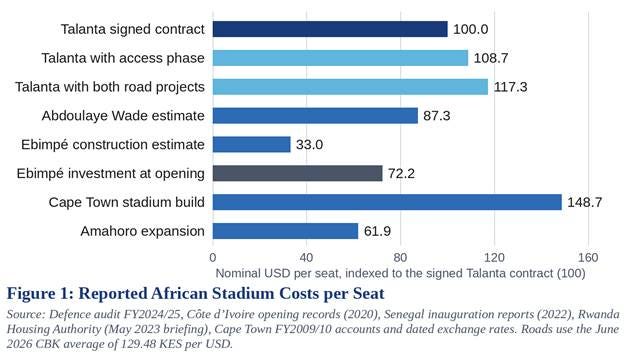
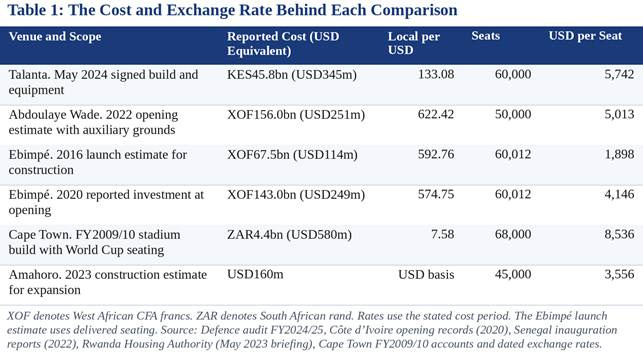
Cape Town’s temporary World Cup seats lower the measured cost per seat compared with the permanent layout. Amahoro gives Nairobi a reference for upgrading an existing ground.
The September note used an investment figure for Ebimpé. The Ivorian government also gives a construction estimate from the launch of works. These figures cover different scopes and periods. Table 1 shows both so that readers can trace the comparison to the correct record.
Table 2 traces costs outside the signed build. The sports audit records the 2023 Telkom award for the stadium site and says the appeal remained pending at the time of the audit. The judgment also awarded interest. Settlement and payment records would show the cash cost.
The budget provision addresses land compensation. The record traces it through the first supplementary estimates, the budget committee’s proposed reduction on 1 April 2026 and the FY2026/27 budget summary. An appropriation authorises spending. The payment record establishes the outturn.

The access phase serves Talanta and the Bomas convention centre. The flyover serves the wider Ngong Road corridor. A project account could allocate the shared costs. A value-for-money comparison would also price an upgrade to an existing Nairobi ground with the same event, access and equipment requirements.
2. What the Bond Financed
“Converting Vices into a Virtuous Sporting Cycle” (Canary Compass, September 2026) traced the betting taxes that back the bond. Linzi FinCo 003 Trust raised KES44.8bn (USD347m). We keep the September principal, the amount the trust borrowed, for the investor repayment models. It captures all the money investors put in.
Table 3 follows the planned uses in the Linzi offering memorandum. The contractor allocation and the earlier payment together reproduce the Sports Fund audit’s base to the shilling. The audit gives no breakdown of that base. If the two lines cover separate payments under the signed contract, the records leave KES1.3bn (USD10m) to reconcile.
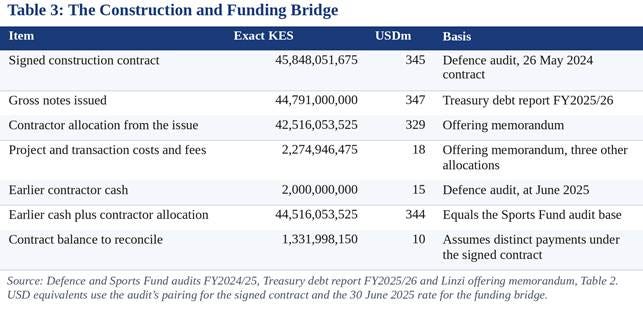
Compare the contract and the issue in shillings. The dollar equivalents use the audit’s exchange rate for the contract and the bond-close rate for the financing.
2.1 What the Bond Terms Tell Us
A bond’s issue price tells us how much the borrower gets at the start. The face value tells us how much principal the borrower promises to repay. The repayment schedule tells us when that cash falls due. Table 4 gives the common terms for these choices.
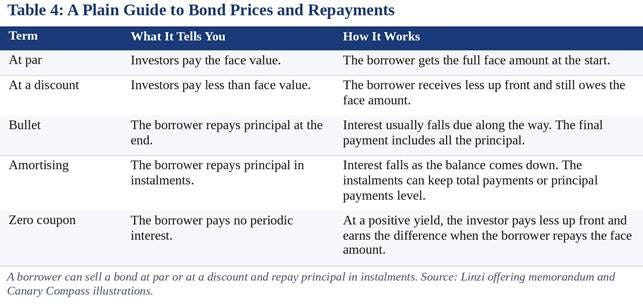
Market reporting puts the Talanta notes at par. The offering memorandum describes gradual repayment with interest. Its conditions 4.3 and 4.4 leave the actual instalments to the final pricing supplement, which sets the terms for the issue.
Money today can earn a return before a later payment arrives. Investors value each payment on the same date to compare financing costs. A cash budget adds the payments and records when each falls due.
2.2 Why the Repayment Totals Differ
The Sports Fund audit for FY2024/25 describes a guarantee that the Fund offered through the State Department for Sports on behalf of the government, with Treasury approval. This finding revises September’s guarantee account. The auditor lacked full transaction documents. The instrument would establish the scope of the undertaking and who owes what if the trust falls short.
The same audit records a contingent liability, a possible obligation, for the receipts the Fund assigned to the trust. The guarantee finding describes monthly transfers. The contingent-liability finding puts the balance at maturity. These disclosures track the Fund’s commitments. The payment schedule tracks what investors receive.
Table 5 reconstructs the public repayment totals. The first path applies the audit’s interest rate to the same starting balance each year. The second repeats the reported half-year amount over the term. Both round to the same total. The third adds the interest that Business Daily reported to the amount investors put in.

The reported-interest total exceeds the audit reconstruction by KES4.9bn (USD38m). The larger principal explains KES275m (USD2m) of that difference. The interest amounts explain the rest. The audit charges interest on its own balance. The issue quotes what investors earn on their cash flows.
The cash budget starts with repayment of principal and interest. It also counts construction cash from other sources, separately funded works and the cost of running the venue. Adding the whole construction contract to all the repayments would count the bond-funded work twice.
2.3 What Changes the Payments
September’s reported basis doubles the half-year amount to give KES6.5bn (USD50m) in annual Fund transfers. That half-year amount matches the rounded interest charge on the full issue if the quoted rate compounds over the year. Trust investment earnings could add to the cash investors receive.
If investors received only the reported amount in every half-year instalment, the cash flows would imply an annual return of 12.0 per cent under the usual half-year quotation. The issue quotes 15.04 per cent. The final pricing supplement and payment accounts would show which cash flows bridge that difference.
September’s level-payment basis gives the borrower equal instalments each half-year. The nominal convention splits the quoted annual rate in half. The effective convention compounds the half-year rate to reach the annual quote. The effective calculation uses a slightly lower half-year rate.
Under equal principal, the trust repays the same amount of principal each period. That brings the balance down faster than equal total payments. The borrower therefore pays less interest over the term at the same rate.
2.4 What the Auction Comparison Measures
The present value (PV) measures what a stream of future payments is worth today. A yield measures what an investor earns from the price they pay and the cash they receive. Table 6 uses accepted yields on two tax-exempt infrastructure bonds to value the modelled payments at Talanta’s issue date.
The CBK quotes the yields at reopenings on either side of the issue. The February reopening dates to 17 February 2025 and the bond matures on 20 February 2040. The August reopening dates to 18 August 2025 and the bond matures on 28 January 2041.

Across the schedules and benchmarks, the model puts the payments KES0.5bn–KES2.4bn (USD4m–USD18m) above the proceeds raised. The result gives the scale of the financing difference at those yields. A direct pricing comparison needs the contractual payment dates, liquidity, the cost of credit facilities and the protection investors receive.
Table 7 shows why the total cash can change even when investors earn the same yield. The example holds maturity and yield constant. It varies the timing of principal payments or the interest the bond promises, known as the coupon.

To compare two ways to finance the same bill, start with the rows that raise the same cash. An instalment loan returns part of the principal sooner and reduces later interest. A smaller coupon reduces proceeds if the borrower keeps the face amount fixed. To close that funding gap at the same yield, the borrower has to promise a larger final payment.
3. The Events Talanta Can Earn From
The Ministry of Defence describes Talanta as a 60,000-seat football and rugby ground. The main arena has no athletics track. World Athletics names Kasarani as the centrepiece of Nairobi’s 2029 World Athletics Championships. Talanta’s regular market is the football, rugby and other events that fit its arena.
3.1 The Opening Year
The Confederation of African Football (CAF) lists Bayern Munich against Ajax for the opening on 5 January 2027. The organiser reported that supporters bought all 15,000 tickets in the first release in November 2026. The entry price sets a test of demand for a marquee match.
World Rugby scheduled the Nairobi round of its second-tier sevens series, HSBC SVNS 2, at Talanta on 23–24 January 2027. Nyayo hosted the 2026 round and sold its ticket allocation. This is a transferred booking. It adds a date at Talanta and leaves the number of tournaments in Nairobi and Kenya unchanged.
Kenya co-hosts the Africa Cup of Nations (AFCON) from 19 June to 17 July 2027. CAF controls tournament broadcast and sponsorship rights. Its general rules allocate ticketing receipts to the host association. The tournament and hire agreements determine what Talanta keeps from the matches it hosts. The September note estimates visitor spending across Kenya. That belongs in the economic appraisal, apart from the stadium’s accounts.
3.2 An Ordinary Calendar
Senior internationals give Talanta a recurring use. The 2026 World Cup qualifying format gave Kenya five home matches across the group campaign. Kenya played two of those matches in Malawi in June 2024. AFCON qualifying and friendlies can add dates. The number of home internationals available to Talanta varies by year and venue allocation.
The Football Kenya Federation (FKF) listed 17,406 seats in its ticket categories for the March 2025 Kenya–Gabon qualifier at Nyayo. That count includes some invited guests. CAF reported 27,000 spectators at the Kenya–Zambia match at Kasarani during the 2025 African Nations Championship. Both figures put demand for a good international in the tens of thousands. They use different ways of counting the crowd.
Major derbies and selected cup games give Talanta a domestic market. The model leaves regular league matches at clubs’ usual grounds. At Kasarani in October 2023, AFC Leopards reported selling 12,172 tickets for the Mashemeji Derby. It sold 9,885 at the flash-sale price. The entry tier carried most of the crowd.
Nyayo’s December 2025 derby brought in KES7m (USD54k) before any venue allocation. In April 2026 AFC Leopards reported 20,336 tickets for another derby at Nyayo. This supports the reference attendance for a major Talanta derby. The strong case gives Talanta a larger crowd and a higher ticket price.
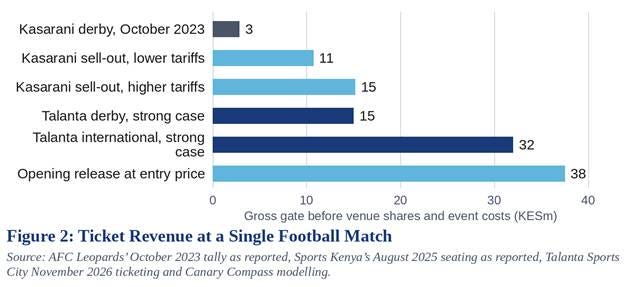
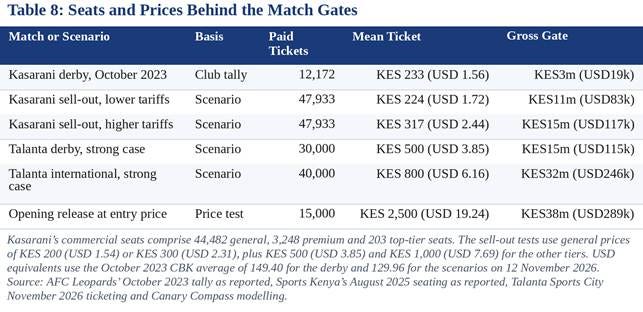
Figure 2 compares the observed Kasarani gate with the sell-out and Talanta scenarios. Table 8 gives the number of tickets and average price behind each result. The opening release calculation prices every ticket at the advertised entry price. The actual gate depends on the mix of tickets and any further sales.
International sevens offers a possible repeat booking. Any Talanta round beyond 2027 depends on a fresh award. Rugby Africa reported more than 15,000 tickets for Nyayo’s 2026 round. The model counts each paid day admission and spreads the price of a weekend pass over the days it covers.
Domestic rugby gives the venue occasional finals or festivals. Regular tickets at the May 2026 Kenya Cup final in Kakamega cost KES 200 (USD 1.55). Impala Floodlit already has a host and an audience. A move to Talanta makes commercial sense for a tournament when the extra ticket and hospitality business covers any extra costs of using the ground.
3.3 Where New Events Could Come From
Bayern and Ajax use a winter break to come to Nairobi. July pre-season offers a route to English clubs. The Premier League’s festive games make its January calendar tighter. Kasarani already hosted Everton against Kariobangi Sharks in 2019. A similar booking can add business in Kenya if the tour would otherwise go abroad.
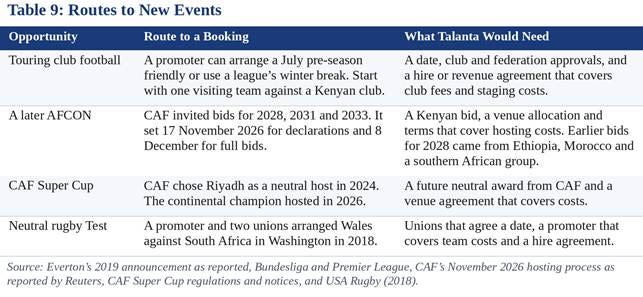
CAF restored the two-year AFCON cycle in October 2026. This updates the schedule in the September note. Table 9 shows how Nairobi could win standalone matches or a later tournament. Treat each as an opportunity until an organiser commits and Talanta’s agreement identifies what the operator keeps.
A league match for points faces a tougher test. In August 2025 the Premier League said it had no plans to play league fixtures abroad. The Union of European Football Associations (UEFA) made exceptions for La Liga’s Miami match and Serie A’s Perth match that year. Both fell through.
A promoter can pay fixed hire and carry the risk of weak ticket sales. An operator that shares ticket and hospitality income may also take on club fees and event costs. An award adds to the upkeep budget only through the income Talanta keeps after those costs.
4. What It Takes to Cover Upkeep
An ordinary budget has to fund routine work such as staffing and pitch care. It also has to set aside money to replace floodlights, screens and other equipment. Staging a match adds costs such as stewarding, ticketing and cleaning. The calculations charge those costs to the event before the venue puts its share towards upkeep.
Talanta’s operating budget, replacement plan and hire contracts would establish its annual costs and the share of the gate it keeps. We test upkeep at 1.0–3.0 per cent of the signed contract. We also test an illustrative retained share of 30.0 per cent of the gate after event costs and organiser shares. We translate the operating scenarios at the CBK’s 12 November 2026 rate.
Table 10 gives three ordinary-year calendars. The strong case assumes 40,000 paid entries at each senior international and 30,000 at each major domestic match. Those crowds exceed the comparison matches above. The reference and strong cases assume a further award of the existing Nairobi sevens round.
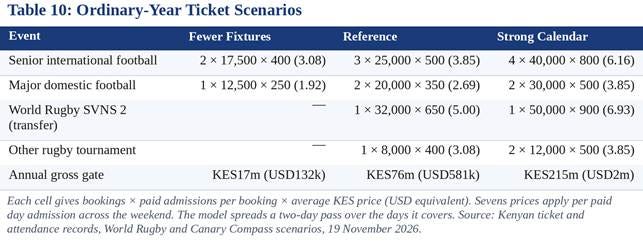
The lower upkeep allowance is KES458m (USD4m). The higher allowance reaches KES1.4bn (USD11m). The strong calendar generates KES215m (USD2m) before any organiser share or event cost. Without the sevens award, its gross gate falls to KES170m (USD1m). Even if Talanta could keep the whole strong-case gate, the gap would be KES243m (USD2m).
The strong case gives sevens KES 900 (USD 6.93) per paid day admission. A two-day pass at that rate costs KES 1,800 (USD 13.85). Selling a pass for every seat and filling every football match raises KES372m (USD3m), with the other rugby gates unchanged. Even with the whole gate, Talanta still needs KES86m (USD665k) at the lower allowance.
The strong calendar takes in KES 731 (USD 5.63) on average across 294,000 paid admissions. To cover the lower upkeep allowance from that crowd, Talanta would need to keep KES 1,559 (USD 12.00) per admission after costs and splits. Higher prices close the gap only if enough fans pay them.
At the illustrative retention rate the strong calendar leaves KES394m (USD3m) to fund at the lower allowance and KES1.3bn (USD10m) at the higher one. If the operator relied on suites alone, it would need KES8m (USD58k) per suite annually after service costs in the lower case. That assumes it leases all 52 suites that the Senate’s October 2026 inspection identifies. Naming rights, concerts and hospitality can add income if contracts yield enough after costs.
Cape Town’s operator recorded 45 main-arena events and 739,929 admissions in FY2024/25. A regular rugby tenant supplies repeat dates there. The operator recorded ZAR71m (USD4m) from rentals and other commercial activity. It also recorded a municipal grant of ZAR19m (USD1m) against expenditure of ZAR100m (USD5m). The city’s April 2026 reporting gives an audited repairs and maintenance outturn of ZAR30m (USD2m). The city carries capital expenditure separately.
If Talanta drew that many paying admissions, it would need to keep KES 620–1,859 (USD 4.77–14.30) per admission to meet the modelled upkeep allowances from tickets alone.
5. The Three-Stadium Test
Talanta, Kasarani and Nyayo compete for some of the same events. When a fixture moves, Talanta gains its net booking income. The former ground loses the net contribution it would have earned after allowing for costs it avoids. It still carries upkeep. A budget that counts a gain at Talanta alone overstates what the stadium portfolio gains.
Start with what Talanta keeps. Deduct what the previous host would have kept. Add the net contribution from any replacement event the move makes possible. An event that the former ground could have hosted anyway adds nothing to this calculation. The resulting change in event income must also justify whatever it costs to run the extra capacity.
Sevens makes the point because Nairobi could stage a round at either ground. Extra attendance can lift stadium income. The national gain comes from genuinely additional business, such as visitors who would otherwise spend abroad or an event that would otherwise leave Kenya. Local spending that follows a moved fixture changes who gets paid.
The December 2025 derby moved from Kasarani to Nyayo when Kasarani had a continental club booking. An extra suitable arena gives Nairobi another way to resolve such a clash. The value comes from the event the city can now stage or retain and the costs it avoids. An economic appraisal can also value wider access to international sport. Those public benefits may support an upkeep allocation. The venue still needs cash to meet its bills.
6. What Could Change the Public Cost
Figure 3 connects the borrowing terms and the receipts that back the bond with upkeep and other project costs.
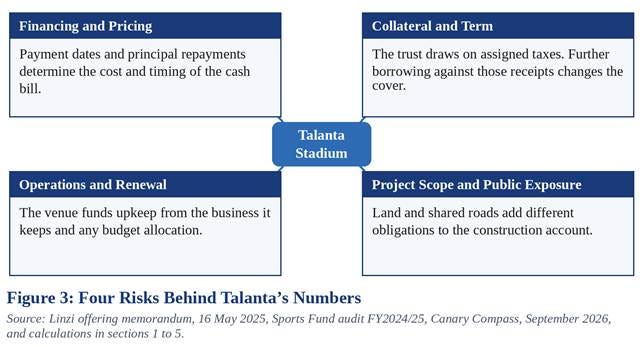
September traced the Fund’s term to 2028 and the notes’ maturity in 2040. The offering memorandum treats failure to extend the Fund as an event of default. Investors have recourse to trust assets. The stadium sits outside that pool.
The proposed KES38.7bn (USD300m) county-stadium issue would draw on the same revenues. We test a second 15-year issue that needs the same annual cash per shilling as Talanta. September’s two payment bases then give combined annual payments of KES12.1bn (USD94m)–KES14.2bn (USD110m).
That equals 78.1–91.3 per cent of the KES15.5bn (USD120m) the Fund reported from betting, lotteries, income tax and excise in FY2024/25, before its other statutory spending. The auditor could not confirm the tax line’s completeness. The proposed issue’s terms would establish payment priority.
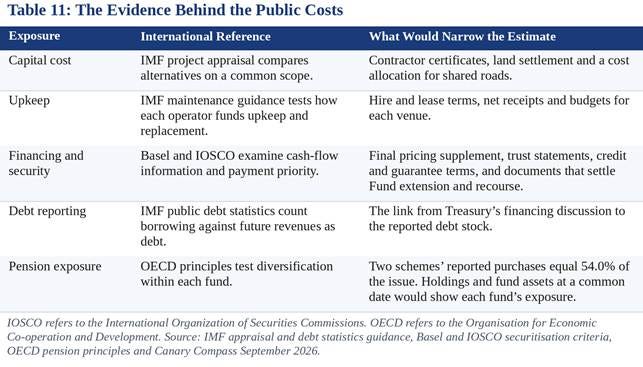
Table 11 uses international references to show what each comparison needs. Treasury describes Talanta in the financing arrangements section of its FY2025/26 debt report. A reconciliation to the headline debt stock would show where it counts the borrowing.
7. Conclusion
The signed contract gives the builder’s price. The bond proceeds show what the trust raised. The published repayment totals use different principal amounts or payment assumptions. The final pricing supplement sets the instalments the trust owes investors and their timing. Talanta’s cost per seat falls within the peer range. We still lack the cost of a comparable Nairobi upgrade.
Even the sell-out test leaves Talanta short of the lower upkeep allowance. Nairobi’s past crowds make that calendar an unrealistic budget. We expect Talanta to need public funding for upkeep in FY2028/29, the first full financial year after AFCON. The amount depends on what the operator keeps from hire, leases and hospitality.
Across Nairobi’s three grounds, the gain depends on the business Talanta adds, what the other grounds give up and what the extra capacity costs to run. The FY2027/28 sports budget gives the first funding test. The FY2028/29 accounts and venue calendars will show what Nairobi added and what the budget paid for.
Sources
Kenya’s Office of the Auditor-General, Ministry of Defence, Sports Kenya, State Department for Sports and Sports, Arts and Social Development Fund reports for FY2024/25 (Fund tax proceeds, Note 7). Linzi FinCo 003 Offering Memorandum (16 May 2025, Table 2 and conditions 4.3–4.11). National Treasury, Annual Debt Management Report FY2025/26 (section 7.9). Central Bank of Kenya, auction results for IFB1/2023/017 and IFB1/2022/019 (February and August 2025). Business Daily, Talanta bond payments (20 May 2026) and the proposed second issue (1 September 2026). Cytonn, H1 2025 Markets Review, Linzi offer results. Kenyan Parliament, Senate cost briefing (May 2026) and Talanta site inspection (1 October 2026). Parliamentary Budget Office, Unpacking Supplementary I FY2025/26 (May 2026). National Assembly, Supplementary Order Paper (1 April 2026). National Treasury, Budget Summary for FY2026/27 (Talanta land compensation). Environment and Land Court, Telcom Kenya Limited & Another v Ministry of Sports, Culture and Heritage & Others (17 July 2023). Kenya Urban Roads Authority, Phase I tender addendum (January 2026). National roads briefing (29 June 2026) and State Department for Roads flyover statement (30 June 2026). Central Bank of Kenya, Weekly Bulletins (4 July 2025 and 13 November 2026) and Statistical Bulletins (historical monthly averages). Central Bank of West African States, Annual Report 2016 (Table 1). OECD, Revenue Statistics in Africa 2024 (exchange rates). Gold Fields, Form 20-F filed in 2012 (FY2010 rand average). Implats FY2025 results (rand average). Ministry of Defence, Talanta design briefing. City of Cape Town, Annual Report FY2009/10, 2010 World Cup Green Goal Legacy Report, Cape Town Stadium Annual Report FY2024/25 and April 2026 Monthly Financial Report, Annexure A (Table SF8c). Côte d’Ivoire government and District of Abidjan, Ebimpé opening records (2020). FIFA and Société Nationale de Radiodiffusion et de Télévision, Abdoulaye Wade inauguration reports (2022). Rwanda Housing Authority, Amahoro site briefing (May 2023). Confederation of African Football, 2026 World Cup qualifying format and June 2024 fixtures, 2025 African Nations Championship Kenya–Zambia report, Africa Cup of Nations regulations (article 98.7 and commercial provisions), 2027 schedule, Talanta opening, November 2026 commercial-rights amendment and Super Cup regulations and venue notices (2024 and 2026). Reuters, CAF hosting process (13 November 2026). World Athletics, Nairobi host award (15 September 2026). World Rugby, Nairobi sevens (2026) and 2027 schedule (13 October 2026). Rugby Africa, Nyayo ticket count (16 February 2026). Talanta Sports City and Pulse Sports, opening tickets and sales (November 2026). Everton, Kenya pre-season fixture (The Standard, 2 May 2019). Bundesliga, Bayern–Ajax winter friendly (28 October 2026). Premier League, US Summer Series (2025) and festive schedule (19 October 2026). Sky Sports, Premier League chief executive on overseas fixtures (15 August 2025). UEFA, exceptional approvals (6 October 2025). La Liga, Miami withdrawal (21 October 2025). Western Australian Government, Perth withdrawal (23 December 2025). USA Rugby, Washington neutral Test announcement (26 February 2018). AFC Leopards’ October 2023 and April 2026 ticket tallies and FKF’s March 2025 Kenya–Gabon ticket categories, as reported by People Daily and Pulse Sports. Sports Kenya August 2025 seating, as reported by Switch News and TNX. The Star and Capital FM, Nyayo derby gates (2025). SportPesa, December 2025 venue switch. Mozzart Sport, Kenya Cup final (2026). Citizen Digital, Impala Floodlit (2026). IMF, Public Investment Management Assessment Handbook (2022, institutions 4 and 9) and Kenya Debt Statistics Data Quality Assessment (April 2026, paragraph 37). Basel Committee and IOSCO, securitisation criteria (2015) and Basel Framework CRE40. OECD, Core Principles of Private Pension Regulation (2016). Canary Compass calculations.
Disclaimer
Canary Compass research is published by Canary Imara Ltd, a private company incorporated in Kenya (PVT-3B15OQP7). Canary Imara Ltd also trades proprietary capital in markets covered by this research and may hold positions in instruments discussed. Canary Imara Ltd and anyone who works on a Canary Compass piece do not trade an instrument it names between its final draft and its publication.
This publication is for information only. It is not investment advice or a recommendation to buy or sell any instrument; readers should seek independent advice before acting on it.
Canary Compass and the author accept no liability for actions taken or not taken based on the information in this article.
The views expressed in this article represent the author’s independent professional analysis and do not constitute an endorsement of any individual, institution, or position. Canary Compass and the author accept no responsibility for how this content is interpreted, excerpted, or recontextualised by third parties not involved in its production and publication.
All views, projections, and forecasts reflect the author’s assessment at the time of writing. Data sourced from third parties is believed to be reliable but has not been independently verified. Past performance does not indicate future results.
All content published by Canary Compass is the intellectual property of the author. Reproduction, adaptation, or redistribution, in whole or in part, requires written permission.
About the Author
Dean N. Onyambu is the Founder and Chief Strategist of Canary Compass, a financial research publication focused on African monetary architecture and financial sovereignty. He brings 18 years of experience across trading, fund leadership, and economic policy, with senior roles at Standard Bank, First Capital Bank, and Opportunik Global Fund.
Read and subscribe at www.canarycompass.com.
The Canary Compass Channel is available on @CanaryCompassWhatsApp for economic and financial market updates on the go.
For more insights from Dean, you can follow him on LinkedIn @DeanNOnyambu or X @InfinitelyDean.