

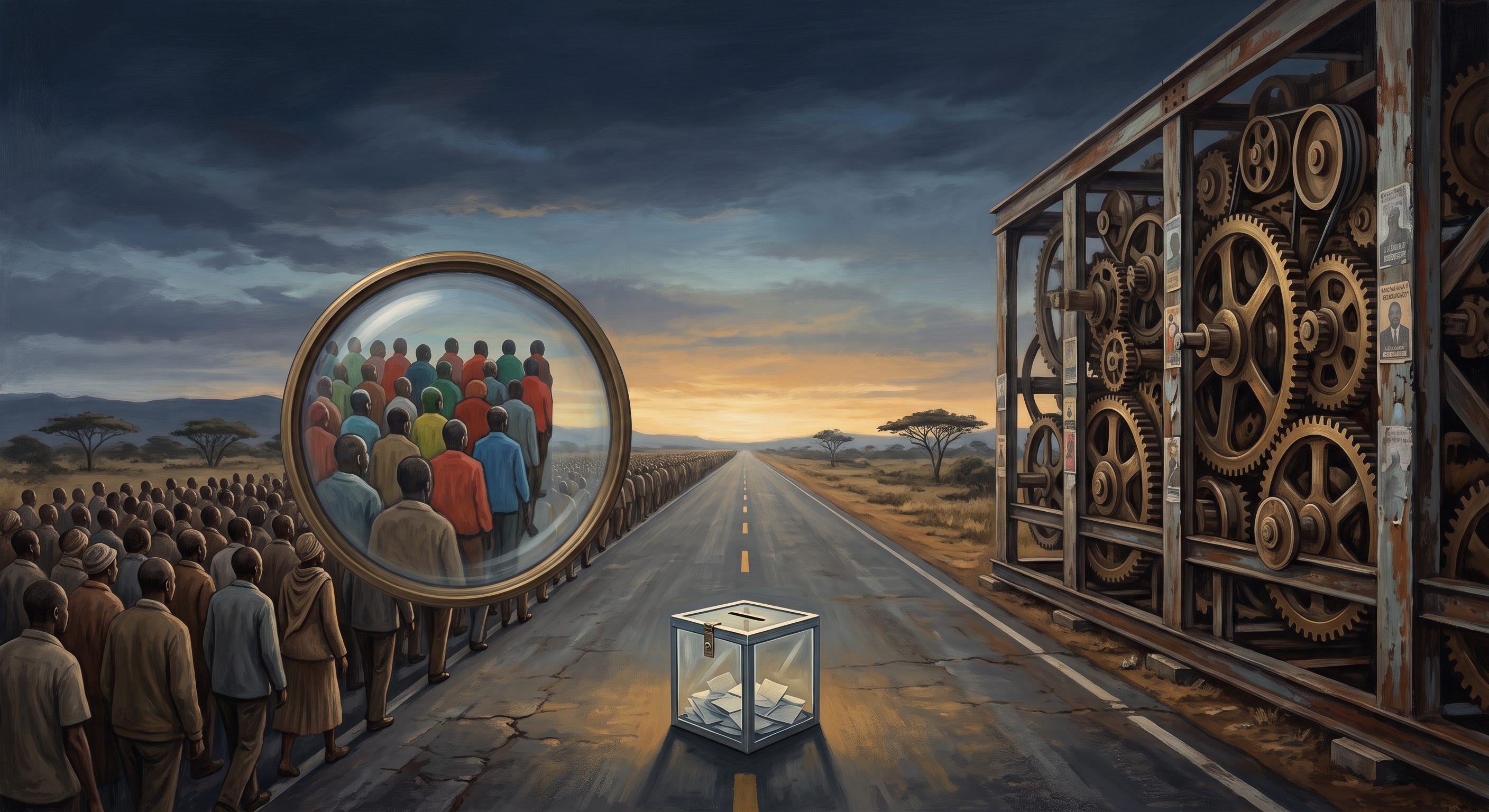
AI-illustration: Kenya's 2027 election, one year out
A very interesting conversation is happening in Kenya right now, and a version of it has played out, three times or so, between me and a man on X whom I respect. He has been around Kenyan politics a long time, and he reads it deep: governance, history, the economy, the lineages of the tribes. He is from the President’s own Kalenjin community, itself a house of several sub-tribes. Nearness can tilt a reading; it can also inform one. We agree far more than we differ, on Kenya’s economic performance and on how much has changed; most of our differences are small. Edwin Sifuna is the big one. He calls him a fad. That is where Kenya’s conversation has reached.
He has plenty of company. Since 1992 no popular wave in Kenya has won without a machine underneath it, and the old heads have watched them all. The people best qualified to read Kenyan elections are precisely the ones most likely to misread this one, because everything they know is true. That is what makes Sifuna the biggest dark horse in the 2027 field, and almost beside the point. The old lens looks at him and sees a man without a machine: no bloc to inherit, no barons to pay his way. It has not noticed that the machine may no longer be the thing being voted on.
The wave does not start with him. In June 2024 a generation walked out of its group chats and into the streets against a finance bill, and on the 25th of that month it breached Parliament. No baron paid for the buses. They were the most educated cohort Kenya has ever produced, the first whose entire adult life has run under the 2010 constitution. They turned out to know its articles better than the men elected under it. Their parents watched them go and then, slowly, started listening. We educated a generation; it learned its rights and has come calling. Uncanny as the season feels, this is what every nation says it desires: that the educated come home with a conscience, a moral reckoning. The hope, always, is that jobs are waiting when they arrive.
Sifuna cannot be separated from that month, and the reason is on film. On 25 June 2024 the Senator for Nairobi was at Parliament when the shooting began, and the footage shows him rushing at police to stop them firing on protesters. The oversight authority would later record sixty deaths from those weeks. What that footage gave a generation was an answer to a question it had stopped bothering to ask: whether any of the men it elected would put his own life on the line for them. One did, on camera. The movement he now leads is named after the thing he did that afternoon. Linda Mwananchi. Protect the citizen. The name is the manifesto.
And, so far, it is tribeless. It is the fact the incumbent’s side finds hardest to metabolise and the old analysts file away as noise. The June 2024 crowds answered to no bloc. Online, Sifuna wins the straw polls by landslides, even those run by the loudest promoters of other candidates, and the hands picking him look voluntary, not paid. Some results show him winning a field the opposition has not united. I doubt that, on the cadence of Kenyan elections alone; division is how the machine has always won. But the doubt and the thesis meet in one place. If an idea has truly found its moment, it does not care who else is on the ballot. 1992’s majority was divided from above, by its carriers; this one can only be divided from below, if its voters let it be. That is the test a divided field would run.
The caution on the polls still stands: an online poll is a self-selected electorate, young and connected, and it is not the roll. One Kenyan polling house has just proved the point by producing both findings itself. Its July web poll, with over a hundred and twenty thousand participants, gave Sifuna a head-to-head majority over the President. Its survey released this week, with the full field of candidates on offer, gave the President forty-five per cent and Sifuna second at under twenty. The same house, with two instruments and two different questions, found two winners. The two results do not measure the same contest. But the caution cuts both ways. In 2022 the professional houses’ final polls had Raila ahead by seven to nine points in a race Ruto won by under two. The profession’s own post-mortems kept returning to the cause: they had not modelled turnout. The decisive variable, then as now, is who turns up.
The crowds are harder to dismiss. They are Linda Mwananchi’s crowds, not his alone; the movement tours with its principals, and he is plainly its darling. The tour has run from Busia and Kakamega through Kisumu and Kisii to Meru, Machakos, Nakuru, Mombasa and Taita Taveta, with stops between. It has not yet reached the far north or the north east, and the deep Rift remains the President’s own ground. The crowds have looked the same at every stop, and the stops do not share a tribe.
In the conversations I keep having with people my age and younger, they keep saying the same thing: it is almost as if we are back in the Gen Z protests. Something else has entered those conversations, and I cannot remember the last time I heard it said of a Kenyan politician: I hope nothing happens to him. There are mothers praying that he lives to stand on a nomination platform and face the president. The prayers have their reasons; his rallies have been violently disrupted more than once. That is not the vocabulary of a fad. Each morning brings a fresh rumour of a campaign collapsing or a movement at war with itself, from blogs without bylines and papers with leanings, some toward the state, some toward rival opposition camps. Much of it cannot be verified; the pattern can. The man said little in public for months after Raila’s death and still led the coverage. He is the story of this season, and the attacks run his publicity free. Voices aligned to the administration keep reaching back to tribal politics against this wave, though it was their own camp that bent that model in 2022. The veterans of every count since 1992 reach back to it because it is the only model their data has ever confirmed.
Sifuna himself tells Kenyans it is not about him. The job, as he frames it, stays the same whoever carries it: make William Ruto a one-term president. Wantam, the crowds call it. Then his supporters answer him, in numbers, that if it is not him they will not wake up to vote at all. Some answer differently, that if he does not run the movement will simply find another young carrier. But the louder answer has been the stay-home one, and the movement’s whole risk lives inside it. Abstention is arithmetic for the incumbent. A wave that says it is about the idea, and then behaves as if it is about the man, is volunteering to prove the sceptics right. Sifuna is not the idea. He is the first vessel this idea has trusted. And the idea, for a season at least, is a hope with two strands. One is that tribe can be set aside for this one election, and that one election becomes a stepping stone to setting it aside for good. The other is that impunity can be ended once and for all. That strand runs straight back to June 2024. One of the defining features of the anger then was the opulence on display, a political class flaunting its wealth at the very people it was asking to pay more. Pride in ethnicity is nothing to apologise for. But ethnicity has been a scourge in this country at moments too, and that has always been its fine line: where does pride stop and become something else.
So look at the vessel. He was born in western Kenya in 1982, a Bukusu, the son of a teacher and a civil servant, and he is of my generation. He read law at Nairobi, was admitted in 2008, built his own practice, and stayed close to the Law Society. In 2017 he tried for Parliament at home in Kanduyi and lost before the general election even arrived. The home route, the one the old heads say a western politician must take, rejected him on its own doorstep. The party then threw him into the Nairobi Senate race that August, and he took more than six hundred and seventy thousand votes in the capital and still lost. Five years later he came back and won the seat, in the most tribally mixed county in the republic, with more than seven hundred thousand votes. His base turned out to be the cross-tribal city, and now a cross-tribal generation. Nairobi in both years was also Raila Odinga’s coalition in a city Raila carried decisively, so the live question was always whether that mandate was Sifuna’s or borrowed. The crowds the movement has drawn this year, with him at their centre and no party machine behind him, lean the answer his way. They do not settle it. Raila is gone, and some of what gathers may be his orphaned following looking for a home.
It is an old pattern: a man is often seen properly abroad before he is seen at home. Sifuna’s version has completed its circuit. In 2017 home and the capital both said no. The capital came round first, in 2022. This year home caught up: the declarations came out of the west one after another, and in the west, the sermons now find their way to him. The old lens will read those declarations as a bloc assembling. It should look at the crowds instead. Home has recognised him; that question is closed, and it is not what 2027 will decide.
What made him the vessel was a stripping. Raila Odinga died on 15 October 2025, in India, at eighty, still inside the broad-based arrangement he had signed with the man he lost to. The party he built stayed inside it. Sifuna would not. His refusal was categorical, and it is much of what endears him: he has said he will not support Ruto’s re-election under any circumstances, because the country cannot afford another five years of it. He threatened to leave the party rather than see it back the President in 2027. That stance is what the party punished. In February this year ODM’s national executive removed him as Secretary General, the post he had held since his mid-thirties; his own summary was that his only crime was opposing the plan to support Ruto. In July the Registrar of Political Parties approved the removal. The Senate deputy whip’s post went with it. He contested the process through the institutions, as a constitutionalist would, and he lost through the institutions, as men who challenge power usually do. The positions taken from him became his credential. His own answer carries the arc: some of those positions came from Raila, he said, but most of them came from the public. He is the truest heir of the Raila school and the loudest rebel against what Raila’s party became. While Raila lived, it was Raila’s hand that kept him inside it. Sad as the loss was and remains, this moment did not exist while he lived. That irony is difficult to reconcile, because I suspect Raila would have been proud.
On 26 September the Linda Mwananchi movement named him its leader and its presidential candidate. The vehicle is expected to be unveiled in these first days of October. Even the name had to be fought for. The Registrar refused to reserve Linda Mwananchi, allies accused the state of blocking the registration and took the refusal to the disputes tribunal in their own names. This week the tribunal ruled the refusal unlawful, and the Registrar’s reservation letter followed within a day. This time the institutions cut his way, and the manner of it matters: the movement answered the blow by filing, and it won at law. And the win came against a clock. The commission’s published election calendar requires parties to lodge the names of their authorised officials by 15 October, with polling day already fixed for Tuesday, 10 August 2027. The tribunal freed the name fifteen days before the first gate.
The veterans’ scepticism stands on a record. Until 1991 the question did not arise. Kenya was a one-party state by law from 1982. In 1988 the ruling party’s nominations, which decided the seats, ran by mlolongo: citizens queueing in public behind their candidate’s agent while officials counted heads. Loyalty was visible, and so was its price. The multiparty ballot returned in 1992 carrying a genuine wave, and the wave died by its own hand. The anti-Moi vote was a clear majority of the country. Then FORD broke into two parties along the very lines the movement claimed to have transcended. The majority split three ways, between Kenneth Matiba, Mwai Kibaki and Jaramogi Oginga Odinga, and Daniel arap Moi won with roughly a third of the vote. In 1997 the opposition arrived divided again, four ways this time, and Moi won again without a majority. The analysts drew the exact lesson the record taught: coalitions win Kenyan elections, and coalitions are assembled from ethnic blocs.
2002 is the exception they will cite, and it proves their rule as much as it breaks it. The NARC wave was real. Kenyans of every region voted against four decades of KANU, and Kibaki took roughly six votes in ten. But the wave rode a machine. Raila’s “Kibaki tosha” carried a memorandum of understanding among regional barons, and KANU had already imploded after Moi anointed Uhuru Kenyatta and his lieutenants walked out. The idea won in 2002 because the barons agreed to carry it.
2007 is the wound, and it is also the tell. Kibaki had presided over the strongest growth in a generation, corruption stories and all, and the economy still could not settle the ballot. The count collapsed into dispute, the swearing-in came at dusk, and the inquiry that followed ruled the true result unknowable. Many Kenyans ruled otherwise, and still do. The country burned along the same lines the parties had mobilised: more than a thousand dead, hundreds of thousands displaced, and in the end power shared under international mediation. The dispute’s arithmetic lived in a simple comparison, presidential votes cast against parliamentary votes cast in the same constituencies, numbers that should move together and did not. The same comparison, run on Zambia’s 2026 count in Polished Teeth, Blank Portal, found 186,247 more presidential than parliamentary ballots across twenty-one constituencies, every one won by the declared winner. The instrument traces back to Kenya’s 2007.
2013 followed as the census election: Uhuru Kenyatta and William Ruto, then facing ICC cases that later collapsed, fused their blocs and cleared the constitutional bar by a fraction of a point against Raila’s coalition. 2017 gave constitutionalism its high-water mark and its stress test in the same year. The Supreme Court annulled a presidential election, the first court in Africa to do so, and the re-run collapsed into a boycott. Through all of it, the blocs held.
Then 2022, the crack. Ruto won against the combined weight of a sitting president and the opposition’s eternal candidate, and he did it by running a class story against a coalition story. Hustlers against dynasties cut across enough of the old blocs to win, including deep inside territory his opponents assumed was theirs. The model bent in 2022; it did not break. And the man who bent it is the incumbent this wave now seeks to retire.
Kenya has run an idea before. In 1992 the idea was the ballot itself, the end of one-party rule. It commanded a majority, it arrived carried by rival barons, the carriers split it three ways, and the machinery won without one. In 2002 the idea was the end of KANU, and it won when the machinery defected to it: the barons unified behind one man and the ruling party imploded. An idea has never yet won in Kenya except by borrowing the machine. Even 2022’s class story ran on a machine of its own. What is different about 2027, on the evidence so far, is the carrier. This idea came up from a generation rather than down from barons, and the declarations have followed the crowds rather than summoned them. What is unchanged is the trap. The machinery has won whenever an idea’s carriers split, and it has won that way without ever beating the idea. The opposition today is still several camps in search of one ticket, and I am not convinced the leaders of the other factions have read the mood or understood the moment. The money question runs beside it. They keep telling him he cannot fund a national campaign, and on the arithmetic of agents and logistics the point is real; machines pay for elections. The reply forming is one Kenya has not seen at this scale: a ten-shilling paybill, and citizens, many of them poor, handing the movement their own money at its rallies. The sums are still small against a machine. And the standard is already biting its owner: a donor of fifty-five shillings has gone to court to compel an accounting. A movement running on the rule of law will be audited by it. The sceptics pricing a 1992 replay are not being cynical; they are reading the record, and they could be right. That is why the next twelve months fascinate: the record and the carrier have never been this evenly matched.
The constitution splits its verdict. A winning candidate needs more than half of all votes cast, and at least a quarter of the vote in more than half of the forty-seven counties. The first test sides with the record; majorities here have always been assembled from blocs. The second demands breadth, and breadth does not care how it is assembled. For thirty years coalitions of blocs were the only way to assemble it, so the test has been read as tribe. A genuinely tribeless candidacy is simply the second way through the same gate, and the easier one, if its crowds reach where the tour has not. And 1992 cannot replay exactly, because this constitution added a second round. If no one clears both tests, the top two meet again within thirty days. Kenya has never yet needed that round; the 2017 re-run was a court’s order, not the arithmetic’s. A fractured field in 2027 could force it for the first time, and a runoff is a different fight from the one Moi won with a third of the vote.
Then there is the roll, and it is the number that will settle the argument. The median Kenyan is about twenty years old; the country’s centre of gravity has never stood further from its ruling generation. The generation that breached Parliament registered poorly in 2022, and it began this cycle no better. By March the electoral commission was raising the alarm that two of every three new registrations were coming from voters over thirty-five. Then the mass drive in April closed with the commission declaring its two and a half million target met, the earlier slow months counted in. The late surge came from the young, and Nairobi led all counties. Registration has since returned to the commission’s offices, ticking along quietly. Which is why the weeks ahead are the first honest measure of this wave. A movement has named its candidate, and its vehicle is days from unveiling. If the wave is real, it will now walk to a registration desk, and that number cannot be spun. A wave that does not convert to the register is weather. Ruto is formidable, and the delivery is real. But if this generation registers first and then votes, the arithmetic that has organised every Kenyan election since 1992 stops organising this one. The crowds say which way it would break. The register will say whether it breaks at all.
And there is the man they must retire. He has spent three decades inside Kenyan politics, and he is the incumbent. I do not know that I have seen a Kenyan president work this hard or move this much. The development tours run three and four days at a stretch, sometimes longer: the South Rift, Luo Nyanza, Ukambani, the Coast. Dangote’s two trillion shilling refinery broke ground at Lamu the week he landed back from New York. Critics read the tours as early campaigning, and the expenditure, State House’s included, is a fair argument. That he does not work is not one. The economy he was handed in 2022 was close to the rocks; the one he governs today has been pulled well off them. The shilling that was sliding has held, exports have grown, and the external position has been repaired to a degree the 2022 numbers gave Kenya no right to expect. Imports have grown too, and the public debt has crossed thirteen trillion shillings, and on the law’s own present-value measure it stands in the mid-sixties per cent of GDP against an anchor of fifty-five. The external account has been well managed; it has not been cheap, and part of the repair ran under a Fund programme that lapsed last year with its final review unfinished. The economic team around David Ndii has been, to my eye, among the best on this continent, and it draws criticism even for the things it has plainly delivered. The delivery runs past the ledgers too: fertiliser at a third of its 2022 price, more than a hundred thousand housing units under construction, tens of thousands of teachers hired. Some of what Ruto opens was conceived before his time; completion still counts. Some of it speaks directly to the generation in the streets: a continental football championship in 2027, the world’s athletics in 2029, Kasarani mid-rebuild for the first and now needed for the second. A new national stadium is to carry Raila Odinga’s name. How some of this is financed is a separate argument, made in Converting Vices into a Virtuous Sporting Cycle. The building is real, and the credit is due.
All of it is true, and it may still not be enough, because the wave has two arguments and the aggregates answer neither. The first is diffusion. The headline has healed faster than the household, and the young are the ones formal work has not yet absorbed. The country’s own survey counted more than eight hundred thousand new jobs last year; nine in ten were informal. Quick Comment on Kenya’s Economic Balancing Act set Kenya’s external stability against its internal strain in January 2025 and named the 2027 election as the flashpoint if the gap went unclosed. Growth Without Diffusion found the same divergence in Zambia fourteen months later: growth returns to the ledgers before it returns to the street. Nor is it an African story. Diffusion failure is the argument of this age everywhere. It is why nationalism is rising through the old industrial democracies and why socialism is back on ballots that had buried it. Electorates now vote on the distance between the ledger and their lives, and Kenya in 2027 will be one more instance. The second argument is the constitution, and no delivery answers it. Ruto can win the argument about aggregates and still lose on diffusion and on obedience in the same afternoon. The ballot question has moved from who delivers to who obeys, and who feels it.
The same man who calls the wave a fad gave me one of the most interesting readings of Ruto I have heard. Above everything, he said, the man is a doer. He starts from whether a thing can be done and how to do it, and only then asks about the rules. Coming from inside the President’s own community, and as an explanation of the delivery record, it works. It also explains the collisions with the judiciary, and the moments when constitutional process has been treated as an obstacle standing between a decision and its execution. A constitution is built to hold a government back; it must be followed anyway. But when small things are skirted, the question becomes what happens with the larger ones. The wave’s case sits inside that reading, and it came from the same sceptic who calls Sifuna a fad.
Listen to the commentary long enough and you will hear that Sifuna has no agenda. It is the strangest charge of the cycle, because the agenda is the largest one on offer. A return to the rule of law and a state bound by its own constitution, where speech does not cost the speaker his liberty or his life. Kenya has voted on development, on unity, and once, in 2022, on class. It has voted on writing constitutions too: the referendums of 2005 and 2010, and the reform promises that rode the 2002 and 2007 campaigns. What has never led a presidential ballot is the narrower, harder question of whether the constitution already written will be obeyed. That is the entire offer here.
Some say June 2024 is too far back to decide anything in 2027, and they would be right if June 2024 had ended. It has not ended. The record since has kept teaching the same lesson, and the generation that recited the constitution’s articles in the streets knows exactly why the offer matters now. Albert Ojwang, a teacher who posted about a senior policeman, was driven three hundred and fifty kilometres to a Nairobi cell and did not leave it alive. The police said he had hurt himself, and the autopsy said otherwise. The June 2025 anniversary marches left nineteen dead by the human rights commission’s count; Saba Saba, twelve days later, at least thirty-eight more. The disappearances of critics since 2024 sit documented in the same commission’s files.
Then there is the quieter thing that may cut deepest, because it touches the one economy this generation built for itself. Locked out of formal work, the young moved their labour online: content, code and commerce run from a phone. It is thin ground. The Loud Ten Per Cent found six in ten African creators earning under a hundred dollars a month, because the platforms price an African audience at a fraction of a Western one. The state’s most visible arrival in that economy has been a deduction. Under a tax written in 2023, the platforms now hold back five per cent of whatever they pay a Kenyan creator and pass it to the state. Meta began the deductions; Google followed, and its deadline for creators to hand over their tax PINs fell the day before this essay publishes. The deduction moved faster than the support: the bill meant to grow this same economy trailed years behind the tax that draws from it. The young built a room the state never furnished, and the first knock on the door was the revenue authority’s. The taxes are lawful and the order is necessary. That account is still the one a generation carries to the register.
Zambia taught me one more cold thing this year. The world will not referee 2027. The Forced Choice set the rule out in February: the referee era is over, and the countries in between choose deliberately or are chosen for by default. Nairobi and Washington are warm again, and great powers go quiet where their interests sit comfortably; the hardening of the continent’s political space, which After the Count traced from Lusaka, grants Kenya no exemption. If the count is disputed and the response turns hard, nobody is coming. Zambia’s count carried a narrower lesson inside that one: when the powers that be sit with the incumbent, a close win is not a win. An opposition in that position must take the race beyond dispute. What Kenyans hold that Zambians did not is their own architecture. A stronger constitution, a court that has already annulled a presidential election, and a public that has protested for what is right and died for it. And history built one deterrent of its own. The last count disputed to the point of fire ended at The Hague, and nobody on any side wants the sequel.
The old lens hears all this and asks where the machine is, and the question has a precedent it should sit with. In 2008 the United States elected a forty-seven-year-old with four years in the Senate and a thin file by the standards of the men he beat, because he carried an idea into its moment. The idea built him a machine of its own, small money and volunteers, inside an established party. Sifuna is building his outside every established party, from a ten-shilling paybill up. In an ordinary year, the machine wins. An idea is not undefeatable; 1992 buried one on its own doorstep. But an idea that arrives with its moment is the hardest thing a ballot has ever had to stop. By the old lens, 2027 will be an ordinary year. This time, I am not sure the old lens is right.
One more photograph, then. In late 2014, as Zambia’s ruling party fought over a dead president’s succession, a single frame captured the country: one contender sat on the grass under a tree while his rivals sat on chairs. Zambians named him the humble man, and two months later Edgar Lungu was president. Kenya carries an even more powerful image, and it comes from 25 June 2024, one of the most extraordinary days in living memory. I suspect that day will end up a public holiday, depending on who takes the presidency. A senator running at armed police to stop them shooting at the young. Expect it to be played and replayed from now until the ballot. And it will not replay alone. On that day Kenyans watched, live on television and on their phones, young people shot dead at the gates of their own Parliament; in the seasons since, the dead have included children. A broadcaster later reconstructed the Parliament shootings frame by frame and identified one shooter as a serving soldier; the authorities’ answer was to block the film’s screening. The frames survived. They are archived on millions of devices, and they will replay too. The President’s side has pictures of its own, and they are real: the roads, the stadiums, the cranes on the skyline. That is the choice, told in images: what a government builds, against what a government obeys. Building and the constitution have led Kenyan ballots before. The rule of law never has. If 2027 has a defining frame, it is already filmed.